SmartNIC (Network Interface Card) Processor Market Insights
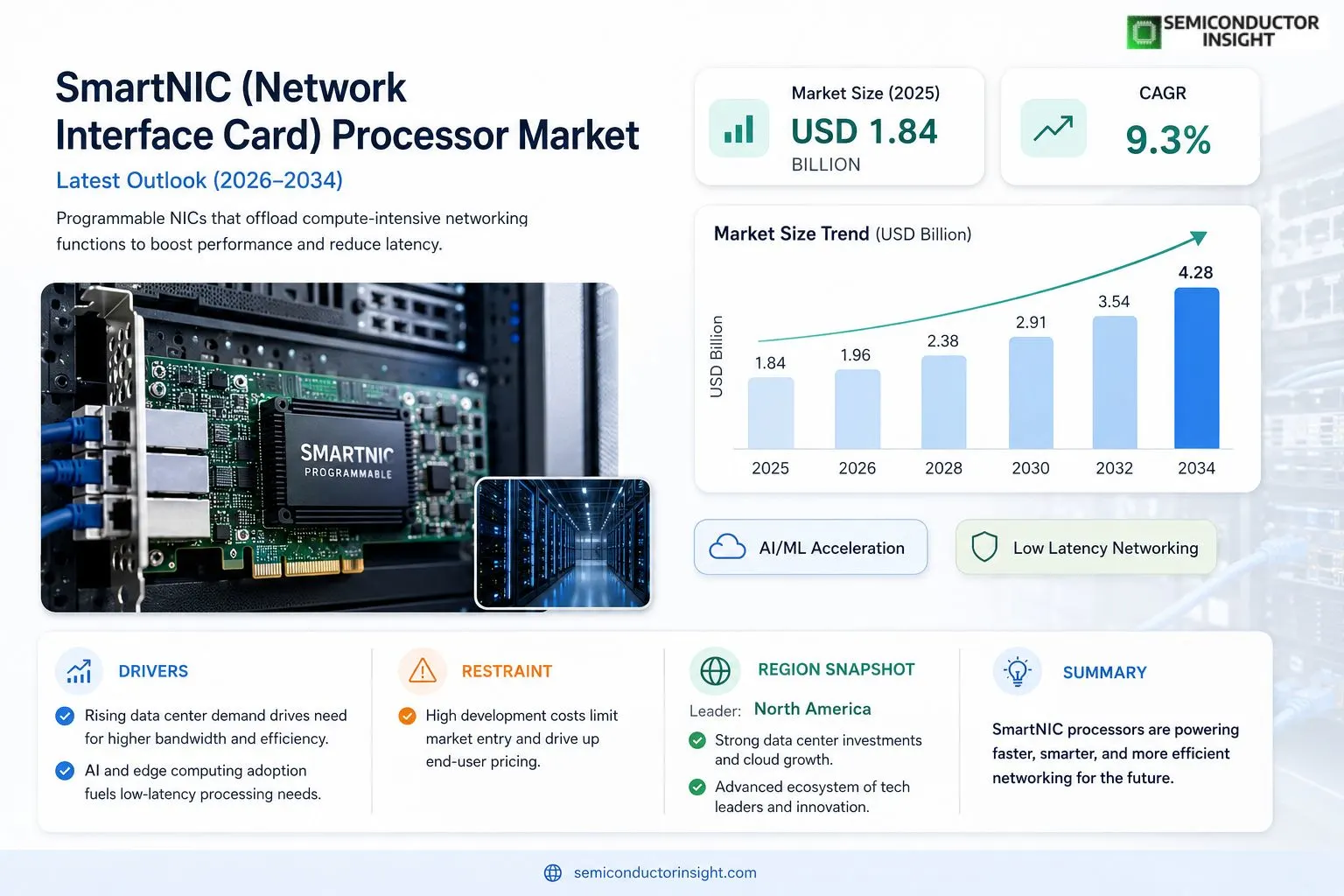
Global SmartNIC (Network Interface Card) processor market size was valued at USD 1.84 billion in 2025. The market is projected to grow from USD 1.96 billion in 2026 to USD 4.28 billion by 2034, exhibiting a CAGR of 9.3% during the forecast period.
SmartNIC processors are programmable network interface cards that offload compute‑intensive networking functions,such as packet filtering, encryption, and telemetry,from host CPUs. By integrating dedicated ASICs or FPGA cores with high‑speed Ethernet interfaces, they enable low‑latency processing for cloud, hyperscale data centers, and edge deployments.The market is accelerating because hyperscale cloud operators are scaling bandwidth to support AI/ML workloads, while enterprises seek reduced latency for financial trading and IoT edge analytics. Furthermore, the rise of composable infrastructure drives adoption of programmable NICs that can be updated via software-defined networking stacks. Leading vendors,including NVIDIA Mellanox, Intel Ethernet Business Group, Broadcom and Marvell,are expanding their portfolios through strategic acquisitions and collaborations, reinforcing the growth momentum.
MARKET DRIVERS
Rising Data Center Demand
The exponential growth of cloud services and hyperscale data centers is creating unprecedented bandwidth requirements. SmartNIC (Network Interface Card) Processor Market providers are benefitting from the need to offload latency‑sensitive workloads such as storage virtualization, firewalling, and telemetry directly onto the network interface. This offloading improves CPU utilization and reduces total cost of ownership for operators seeking higher throughput at lower power envelopes.
Adoption of AI and Edge Computing
Artificial intelligence inference and edge analytics generate massive data streams that must be processed near the source. SmartNICs equipped with programmable datapaths enable on‑card AI acceleration, decreasing data movement latency and freeing host processors for model training. Enterprises are therefore investing in adaptive NIC architectures to sustain real‑time decision making across distributed edge locations.
➤ Industry analysts project a compound annual growth rate exceeding 30% for SmartNIC solutions through 2030, driven by the convergence of AI, 5G, and cloud-native workloads.
Beyond performance gains, the shift toward disaggregated infrastructure,where compute, storage, and networking are decoupled,creates a fertile market for programmable NICs. Vendors that deliver open‑source SDKs and seamless integration with orchestration platforms position themselves to capture a larger share of future data center upgrades.
MARKET CHALLENGES
Integration Complexity
Deploying advanced SmartNICs often requires deep changes to existing network stacks, drivers, and security policies. Organizations face steep learning curves when adapting to heterogeneous hardware, leading to longer deployment cycles and potential configuration errors. Without comprehensive vendor support, the perceived risk can slow adoption despite clear performance benefits.
Other Challenges
Cost Sensitivity
The premium price of programmable NICs compared with conventional adapters remains a barrier for small‑to‑mid‑size enterprises. Budget constraints force IT leaders to justify investments through clear ROI models, and uncertainties around future firmware updates can further deter spending.In addition, compliance requirements for data sovereignty and encryption add layers of verification that many SmartNIC solutions must satisfy. Ensuring that hardware‑based security features align with regulatory standards can prolong procurement timelines.
MARKET RESTRAINTS
High Development Costs
Designing ASIC‑based SmartNICs demands substantial R&D expenditures, often exceeding hundreds of millions of dollars. This financial commitment limits market entry to a handful of well‑capitalized players, reducing competitive pressure and potentially leading to higher pricing for end users.Furthermore, the rapid evolution of networking standards (e.g., PCIe 5.0, CXL) forces continuous redesign cycles. Companies that cannot keep pace with these technological shifts risk obsolescence, reinforcing the restraint imposed by high development overhead.
MARKET OPPORTUNITIES
Emerging 5G & Cloud‑Native Workloads
The rollout of 5G networks is accelerating demand for low‑latency, high‑throughput processing at the edge. SmartNICs that can execute network functions virtualization (NFV) and service‑mesh tasks on the data plane are uniquely positioned to enable telecom operators to meet SLAs while minimizing infrastructure costs.Additionally, the rise of cloud‑native architectures,such as Kubernetes‑based microservices,requires programmable network interfaces that can enforce policies and accelerate traffic directly within the container fabric. Vendors delivering open, API‑driven NIC solutions stand to capture significant market share as enterprises modernize their application stacks.
SmartNIC (Network Interface Card) Processor Market Trends
Rising Adoption of Programmable NICs for AI/ML Workloads
SmartNIC (Network Interface Card) Processor Market is experiencing a pronounced shift as hyperscale cloud providers and enterprise data centers seek to offload compute‑intensive networking functions. By embedding dedicated ASIC or FPGA cores alongside high‑speed Ethernet interfaces, programmable NICs deliver low‑latency packet processing, encryption, and telemetry. This capability aligns tightly with the growing demand for AI and machine‑learning inference, where bandwidth and latency constraints directly affect model performance. Vendors are expanding programmable stacks, enabling software‑defined acceleration that can be updated without hardware changes, thereby reinforcing market momentum.
Other Trends
Impact of Hyperscale Cloud Operators
Hyperscale operators are scaling bandwidth to accommodate AI/ML workloads and real‑time analytics, prompting widespread deployment of SmartNIC solutions that reduce CPU load and improve overall throughput. Financial trading firms also benefit from deterministic latency reductions, while edge analytics deployments leverage the same offload mechanisms to process IoT streams locally. The confluence of these use cases accelerates investment in high‑performance network interfaces, driving a virtuous cycle of software innovation and hardware optimization across the ecosystem.
Shift Toward Composable Infrastructure and Software‑Defined Networking
Composable infrastructure models, which treat compute, storage, and networking as interchangeable resources, are prompting data center architects to adopt programmable NICs that can be re‑configured through SDN controllers. This flexibility supports rapid provisioning of network services, reduces operational complexity, and aligns with the broader industry trend toward modular, software‑centric architectures. As leading vendors enhance their portfolios through strategic collaborations, SmartNIC (Network Interface Card) Processor Market is positioned for sustained growth, underpinned by continuous advancements in programmable hardware and a widening base of use cases.
COMPETITIVE LANDSCAPEKey Industry Players
SmartNIC Processor Market Competitive Landscape
The SmartNIC processor market is dominated by a handful of large semiconductor and networking firms that have leveraged deep expertise in ASIC design, high‑speed Ethernet, and data‑center scale software stacks. NVIDIA’s acquisition of Mellanox has created a robust portfolio that couples cutting‑edge Ethernet ASICs with GPU‑accelerated intelligence, positioning it as a market leader for hyperscale cloud operators. Intel’s Ethernet Business Group continues to push programmable data‑plane solutions that integrate seamlessly with its Xeon platform, while Broadcom supplies carrier‑grade SmartNIC silicon to both enterprise and telco customers. Marvell’s recent focus on FPGA‑based SmartNICs adds flexibility for AI/ML workloads, and its strategic partnerships reinforce a consolidated front where a few multibillion‑dollar players set the performance baseline and capture the majority of revenue.Beyond the tier‑one vendors, a vibrant ecosystem of niche innovators fuels specialization and rapid feature adoption. Netronome delivers high‑throughput, programmable NICs tailored for financial trading and security inspection. Pensando (now part of Cisco) offers a software‑defined data‑plane that abstracts hardware complexity for edge deployments. Xilinx (AMD) supplies FPGA‑centric SmartNICs that enable on‑the‑fly reconfiguration for AI inference. Amazon’s Nitro system provides purpose‑built NICs that offload virtualization overhead for AWS workloads. Google Cloud’s custom SmartNICs support its massive AI training clusters, while Alibaba Cloud has introduced region‑specific NIC accelerators for the Asian market. Additional contributors such as Cavium (Marvell), Solarflare (Xilinx), and Barefoot Networks (Intel) bring specialized packet processing pipelines that address emerging use‑cases in 5G, composable infrastructure, and zero‑trust networking.
List of Key SmartNIC Companies Profiled
- NVIDIA (Mellanox)
- Intel Ethernet Business Group
- Broadcom
- Marvell Technology Group
- Netronome Systems
- Pensando Systems
- Xilinx (AMD)
- Amazon Nitro
- Google Cloud SmartNIC
- Alibaba Cloud SmartNIC
- Cavium (Marvell)
- Solarflare (Xilinx)
- Barefoot Networks
Segment Analysis:
| Segment Category | Sub-Segments | Key Insights |
| By Type |
|
Programmable ASIC is emerging as the dominant type because it blends high performance with the flexibility needed for rapid feature updates.
|
| By Application |
|
Cloud Data Center drives the strongest demand as operators look to off‑load intensive networking functions.
|
| By End User |
|
Hyperscale Cloud Providers are the leading end‑user segment because they continuously seek to improve latency and throughput for large‑scale services.
|
| By Deployment Model |
|
Composable Infrastructure stands out as the most compelling deployment model for SmartNICs.
|
| By Performance Tier |
|
Latency‑Critical segment drives the most strategic interest because many emerging applications cannot tolerate delay.
|
Regional Analysis: North America
United States
The expansion and modernization of data centers across the United States are major drivers for SmartNIC adoption. These facilities require high-speed, low-latency networking to support demanding workloads like artificial intelligence, machine learning, and big data analytics. SmartNICs provide the necessary infrastructure for efficient data transfer and processing within these environments.
The rapid growth of cloud computing in the US is creating a significant demand for SmartNICs. Cloud providers are increasingly integrating SmartNICs into their infrastructure to enhance the performance and efficiency of their services. This trend is particularly evident in the increasing use of serverless computing and containerization technologies.
The HPC sector in the United States is a significant consumer of advanced networking solutions. SmartNICs are playing a crucial role in accelerating HPC workloads by offloading networking tasks and providing high-bandwidth connectivity between compute nodes. This is vital for scientific research, engineering simulations, and other computationally intensive applications.
With the increasing sophistication of cyber threats, network security is a paramount concern for organizations in the United States. SmartNICs offer enhanced security features, such as offload capabilities for encryption and decryption, which help to protect network traffic and data from unauthorized access.
Europe
Europe represents a significant and steadily growing market for SmartNIC processor technology. Driven by the expanding cloud infrastructure across countries like Germany, the United Kingdom, and France, along with advancements in industrial automation and telecommunications, the demand for efficient and high-performance networking is on the rise. The European focus on data privacy and security is also influencing the adoption of SmartNICs with enhanced security features. The market here is characterized by a strong emphasis on energy efficiency and sustainable computing practices.
Asia-Pacific
The Asia-Pacific region, particularly China, Japan, and India, is emerging as a high-growth market for SmartNICs. The rapid expansion of data centers to support the burgeoning digital economy, coupled with increasing investments in 5G infrastructure and edge computing, is fueling demand. Government initiatives promoting technological advancement and digitalization further contribute to this growth. The region is witnessing a strong adoption of SmartNICs in telecommunications networks and large-scale enterprise deployments.
South America
South America presents a moderately growing market for SmartNICs. The increasing adoption of cloud services and the expansion of data centers in countries like Brazil and Argentina are driving demand. The region’s focus on improving digital infrastructure and enabling e-commerce is creating opportunities for SmartNIC technology. While the market is still in its early stages compared to North America and Asia-Pacific, the long-term outlook is positive.
Middle East & Africa
The Middle East and Africa represent a relatively nascent market for SmartNIC processors, but with considerable potential for growth. Investments in digital transformation initiatives, particularly in sectors like oil and gas, finance, and government, are driving demand for advanced networking solutions. The expansion of data centers in key countries like the UAE and Saudi Arabia is also contributing to market growth. The focus on smart cities and industrial automation presents further opportunities for SmartNIC adoption in the region.
Report Scope
This market research report provides a comprehensive analysis of the SmartNIC (Network Interface Card) Processor Market , covering the forecast period 2026–2034. It offers detailed insights into market dynamics, technological advancements, competitive landscape, and key trends shaping the industry.
Key focus areas of the report include:
- Market Overview: The report begins with an overview outlining its current market scenario, key growth indicators, and industry transformation drivers. It discusses macroeconomic factors, demand–supply balance, regulatory landscape, and the strategic role of semiconductors in powering advancements across industries such as automotive, telecommunications, consumer electronics, and industrial automation.
- Market Size & Forecast: Historical data and future projections for revenue, unit shipments, and market value across major regions and segments.
- Segmentation Analysis: Detailed breakdown by product type, technology, application, and end-user industry to identify high-growth segments and investment opportunities.
- Regional Insights: Insights into market performance across North America, Europe, Asia-Pacific, Latin America, and the Middle East & Africa, including country-level analysis where relevant.
- Competitive Landscape: Profiles of leading market participants, including their product offerings, R&D focus, manufacturing capacity, pricing strategies, and recent developments such as mergers, acquisitions, and partnerships.
- Technology Trends & Innovation: Assessment of emerging technologies, integration of AI/IoT, semiconductor design trends, fabrication techniques, and evolving industry standards.
- Market Drivers & Restraints: Evaluation of factors driving market growth along with challenges, supply chain constraints, regulatory issues, and market-entry barriers.
- Stakeholder Insights: Insights for component suppliers, OEMs, system integrators, investors, and policymakers regarding the evolving ecosystem and strategic opportunities.
Primary and secondary research methods are employed, including interviews with industry experts, data from verified sources, and real-time market intelligence to ensure the accuracy and reliability of the insights presented.
FREQUENTLY ASKED QUESTIONS:
What is the current market size of SmartNIC (Network Interface Card) Processor Market?
-> SmartNIC (Network Interface Card) Processor Market was valued at USD 1.84 billion in 2025 and is expected to reach USD 4.28 billion by 2034.
Which key companies operate in SmartNIC (Network Interface Card) Processor Market?
-> Key players include NVIDIA Mellanox, Intel Ethernet Business Group, Broadcom, and Marvell, among others.
What are the key growth drivers?
-> Key growth drivers include hyperscale cloud operators scaling bandwidth for AI/ML workloads, enterprises seeking reduced latency for financial trading and IoT edge analytics, and the rise of composable infrastructure enabling programmable NIC updates via software‑defined networking.
Which region dominates the market?
-> The reference does not provide specific regional dominance information.
What are the emerging trends?
-> Emerging trends include increased adoption of programmable SmartNICs, integration with composable infrastructure, and software‑defined networking enhancements that allow post‑deployment upgrades.

Get Sample Report PDF for Exclusive Insights
Report Sample Includes
- Table of Contents
- List of Tables & Figures
- Charts, Research Methodology, and more...
 Download Sample Report PDF