Insulated Metal Substrates Market Insights
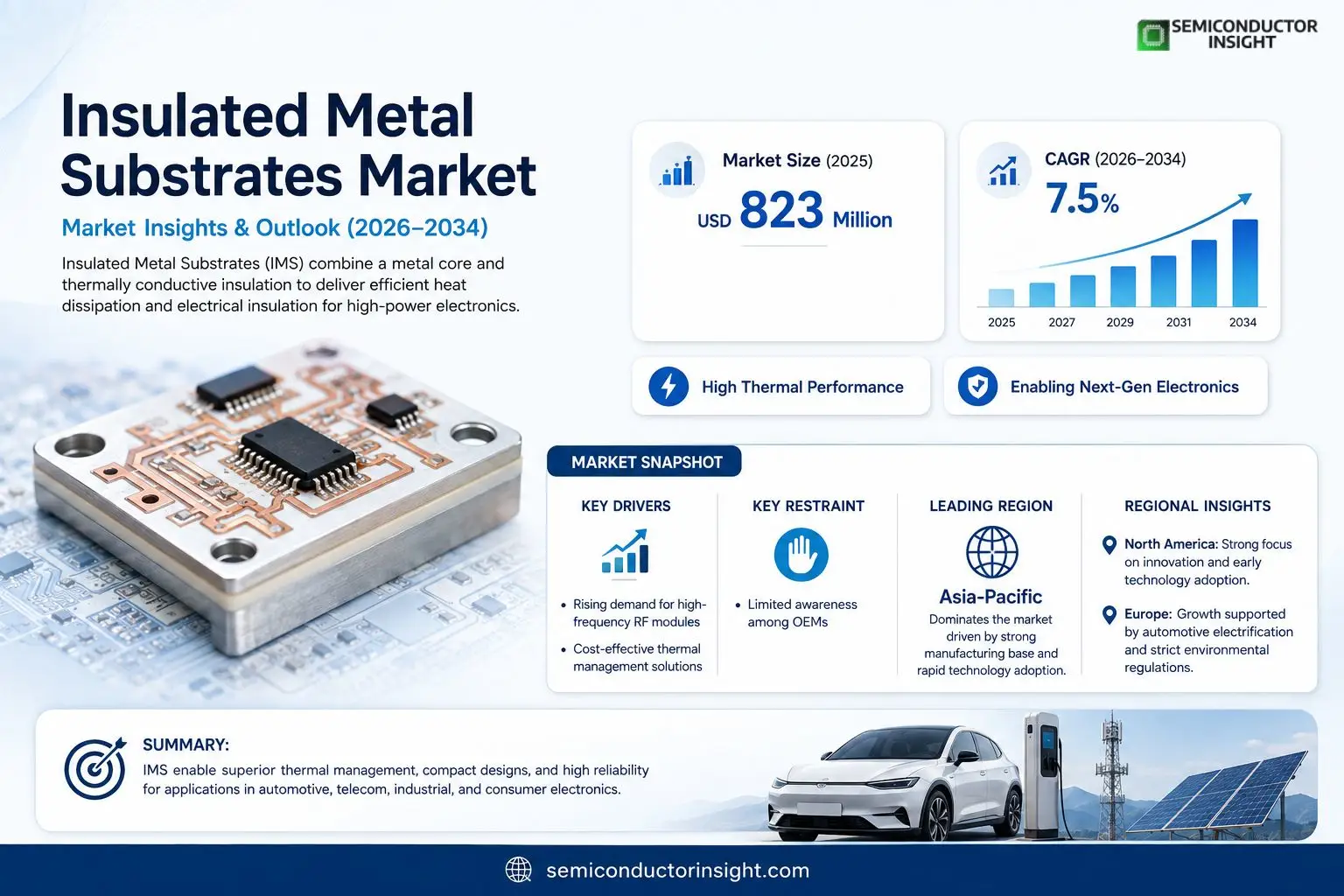
Insulated Metal Substrates market size was valued at USD 823 million in 2025 and is expected to reach USD 1,369 million by 2034, reflecting a compound annual growth rate of roughly 7.5% during the forecast period.
Insulated Metal Substrates (IMS), also referred to as Metal Core Printed Circuit Boards (MCPCB), consist of a metal basetypically aluminum, copper or stainless steellaminated beneath a thermally conductive insulating layer such as ceramic‑filled epoxy resin or polyimide, topped with a copper foil circuit layer. This construction delivers electrical insulation while providing efficient heat removal for high‑power components like LEDs, power semiconductors and automotive electronic control units, thereby supplanting conventional FR‑4 substrates.The upward trajectory is underpinned by expanding electric‑vehicle powertrain architectures, increasing adoption of SiC/GaN wide‑band
MARKET DRIVERS
Rising demand for high‑frequency RF modules
Insulated Metal Substrates Market benefits from telecom operators expanding 5G networks, which require RF components that operate efficiently at millimeter‑wave frequencies. Insulated metal substrates deliver the low‑loss and stable dielectric properties needed for such bands, prompting system designers to replace traditional FR‑4 boards with these higher‑performance alternatives.
Cost‑effective thermal management solutions
Thermal overload remains a primary bottleneck in compact electronic assemblies. By integrating a metal core that spreads heat laterally, insulated metal substrates reduce the need for external heat sinks, allowing manufacturers to lower bill‑of‑materials while maintaining reliability. This economic advantage accelerates adoption across consumer electronics and automotive radar modules.
➤ Efficient heat dissipation is increasingly becoming the design criterion rather than an afterthought.
Consequently, design houses are reshaping their product roadmaps to incorporate insulated metal substrates early in the development cycle, a shift that translates into longer product lifecycles and repeat purchases for substrate suppliers.
MARKET CHALLENGES
Manufacturing complexity
Producing insulated metal substrates demands precise control over copper plating, dielectric lamination, and metal‑core bonding. Small deviations can impair signal integrity, forcing many OEMs to partner with a limited pool of qualified vendors, which in turn constrains volume scalability.
Other Challenges
Material consistency
Ensuring uniform dielectric thickness across large panels is critical for high‑frequency performance. Variability drives higher inspection costs and can delay time‑to‑market for new designs.
MARKET RESTRAINTS
Limited awareness among OEMs
Many original equipment manufacturers still rely on legacy substrate technologies out of habit rather than technical necessity. This inertia slows the diffusion of insulated metal substrates, particularly in regions where engineering training on advanced materials is scarce.
Regulatory and environmental constraints
Stringent RoHS and REACH compliance mandates increase the scrutiny of metal‑core alloys and adhesives used in substrate production. Meeting these standards adds certification overhead, which can deter small‑scale players from entering the market.
MARKET OPPORTUNITIES
Adoption in 5G infrastructure
Base‑station manufacturers are seeking substrates that support dense antenna arrays while maintaining minimal insertion loss. Insulated metal substrates meet these criteria, opening a sizeable growth corridor for suppliers that can certify large‑scale production capacity.
Automotive radar and ADAS
Advanced driver‑assistance systems rely on radar modules operating at 77 GHz and above. The thermal resilience of insulated metal substrates aligns with the rugged automotive environment, presenting a clear avenue for market entry as vehicle electrification accelerates.
Emerging IoT edge devices
Edge computing nodes for smart factories and remote monitoring require compact, high‑performance boards. By leveraging the superior thermal conductivity of insulated metal substrates, designers can increase processing density without compromising reliability, a benefit that is likely to drive niche adoption in the near term.
Insulated Metal Substrates Market Trends
Thermal Conductivity Advances
The ongoing shift from conventional epoxy insulation to ceramic‑filled composites is reshaping Insulated Metal Substrates Market. By integrating materials such as Al₂O₃, AlN or Si₃N₄, manufacturers are lifting thermal conductivity into the 5‑10 W/m·K range, which directly addresses the heat‑dissipation demands of SiC and GaN power devices. This improvement reduces hotspot formation, prolongs component life, and enables tighter packaging in high‑power LED and automotive modules. For equipment designers the higher conductivity translates into smaller heat sinks, lower system cost, and faster time‑to‑market for next‑generation power electronics.
Other Trends
Material and Process Innovations
Beyond the insulating layer, the substrate core is seeing a pronounced move toward copper‑based constructions. Copper offers a superior thermal path compared with aluminum, especially in high‑current environments. Simultaneously, eco‑friendly, halogen‑free binders are being adopted to satisfy stricter environmental regulations. Process wise, laser direct imaging and refined lamination techniques are delivering finer line widths and stronger interlayer bonds, which support ultra‑thin (sub‑0.8 mm) and multi‑layer designs. The combination of material upgrades and precision manufacturing is empowering OEMs to embed passive components directly within the substrate, thereby increasing functional density without sacrificing thermal performance.
Application Expansion in EVs and Power Electronics
Electric‑vehicle powertrains, on‑board chargers and fast‑charging infrastructure are emerging as the most compelling demand drivers for insulated metal substrates. The power density required in DC‑DC converters and inverter modules exceeds the capability of traditional FR‑4, prompting system architects to migrate to IMS for its dual role of insulation and heat spreading. Parallel growth is observed in data‑center power supplies and industrial inverters, where the need for reliable, high‑temperature operation aligns with the thermal advantages of the technology. This application shift is prompting suppliers to tailor product portfoliosoffering thicker copper layers, localized reinforcement, and customized stack‑up configurationsto meet the nuanced specifications of each vertical.
COMPETITIVE LANDSCAPEKey Industry Players
Insulated Metal Substrates – Competitive Overview
AT&S commands the largest share of the insulated metal substrate arena, leveraging a vertically integrated production line that spans raw‑metal procurement, advanced ceramic‑filled epoxy formulation, and high‑precision copper‑foil patterning. The Austrian firm’s ability to deliver sub‑millimetre thicknesses with tight thermal‑expansion tolerances has secured long‑term contracts with leading LED manufacturers and automotive power‑module makers. Its strategic positioning in Europe, complemented by a high‑capacity plant in China, creates a supply‑chain flexibility that many rivals struggle to duplicate. Recent investment in laser direct imaging (LDI) equipment has sharpened AT&S’s lead in multi‑layer IMS, enabling customers to push power density while preserving thermal performance. The company’s financial reporting shows a steady double‑digit revenue uplift, reflecting both organic demand from electric‑vehicle power‑electronics and incremental market share captured from traditional FR‑4 rivals.Beyond the market leader, a constellation of specialized firms sustains the competitive fabric of the sector. KinWong in China and Shengyi in Taiwan have carved out niches by focusing on copper‑based IMS for high‑temperature applications, offering customized board thicknesses that meet the stringent requirements of GaN power devices. European players such as STARTEAM and Technoboards KRONACH emphasize halogen‑free, eco‑friendly insulation systems, catering to OEMs with stringent environmental compliance mandates. Meanwhile, North‑American entities like TCLAD Inc and Segue Electronics differentiate through rapid‑prototype services and close collaboration with defense contractors, where low‑profile, high‑reliability substrates are critical. Smaller innovators, including AI Technology (US) and PragoBoard s.r.o. (Czech Republic), are experimenting with embedded passive components to boost system integration. Collectively, these actors push the technology envelope, creating a dynamic environment where material upgrades, ultra‑thin designs, and localized copper thickening are continuously explored to meet the power‑density challenges of next‑generation electronics.
List of Key Insulated Metal Substrates Companies Profiled
- AT&S
- KinWong
- Aismalibar
- NHK
- Shengyi
- Ventec
- TCLAD Inc
- Denka
- STARTEAM
- Daleba
- Segue Electronics
- Technoboards KRONACH GmbH
- AI Technology
- Electronics Components Marketing Group
- PragoBoard s.r.o.
Segment Analysis:
| Segment Category | Sub-Segments | Key Insights |
| By Type |
|
Aluminum‑Based IMS offers a balanced cost‑performance profile that makes it the preferred choice for high‑volume LED lighting and consumer power modules. Key qualitative drivers include:
|
| By Application |
|
Automotive Power Modules drive the most compelling demand for IMS because of stringent thermal management requirements in electric‑vehicle architectures. Qualitative insights:
|
| By End User |
|
OEMs lead adoption because they embed IMS directly into product designs to achieve superior power density and thermal efficiency. Key qualitative observations:
|
| By Material Innovation |
|
Ceramic‑Filled Epoxy has emerged as the leading material due to its superior thermal conductivity and compatibility with high‑power devices. Qualitative factors:
|
| By Circuit Complexity |
|
Multi‑Layer IMS is gaining traction as designers demand higher integration density and localized power delivery. Qualitative insights:
|
Regional Analysis: Insulated Metal Substrates Market
Asia‑Pacific
High‑resolution display requirements, especially for 8K and beyond, compel manufacturers to adopt insulated metal substrates that can endure tighter bend radii while maintaining signal integrity. The rapid shift toward vehicle‑to‑everything (V2X) communications likewise creates a niche where durable, lightweight substrates are indispensable for reliable data links across harsh automotive environments.
Emerging environmental standards in the region, such as stricter RoHS‑like directives, push suppliers toward lead‑free solder masks and recyclable core materials. Compliance pressures are compelling vendors to refine their material sourcing, which in turn raises the barrier to entry for new players lacking certified processes.
The concentration of copper foil producers and advanced dielectric manufacturers within the same geographic corridor reduces logistics costs and shortens lead times. However, recent geopolitical tensions have highlighted the need for diversified sourcing strategies to mitigate potential disruptions.
Beyond consumer electronics, insulated metal substrates are gaining traction in aerospace avionics and renewable‑energy monitoring systems, where thermal resilience and mechanical stability are paramount. Early adopters in these sectors are prompting a wave of custom‑engineered substrate solutions.
North America
North America remains a robust secondary market, anchored by a mature ecosystem of display manufacturers and a high propensity for early technology adoption. U.S. firms continue to prioritize research collaborations with university labs, driving incremental improvements in substrate thickness and dielectric performance. Although cost pressures are less acute than in Asia‑Pacific, regulatory compliance and sustainability concerns shape procurement strategies, encouraging suppliers to offer recyclable or bio‑based core options. For investors, the lesson is to watch for consolidation among niche players seeking to bundle design expertise with manufacturing capacity, thereby enhancing their appeal to large OEMs looking for end‑to‑end solutions.
Europe
European demand for insulated metal substrates is closely tied to the region’s automotive electrification agenda and a growing market for premium retail displays. German and French manufacturers prize precision engineering, which drives a preference for substrates with exceptionally low thermal expansion coefficients. The EU’s stringent waste‑management directives compel vendors to certify end‑of‑life recycling pathways, nudging the market toward circular‑economy models. Companies that can demonstrate a transparent carbon‑footprint narrative are likely to secure long‑term contracts with OEMs that are tightening their own ESG commitments.
South America
In South America, market growth is modest but steady, supported primarily by Brazil’s expanding consumer electronics sector and emerging telecom infrastructure projects. Local manufacturers often face higher material import costs, which makes value‑added servicessuch as on‑site testing and rapid prototypingcritical differentiators. Partnerships with Asian suppliers that can bundle material supply with technical support are becoming a common strategy to offset cost gaps while maintaining competitive product specifications.
Middle East & Africa
The Middle East & Africa region is transitioning from a pure consumption market to a nascent production hub, propelled by large‑scale smart‑city initiatives and defense procurement programs that require rugged, high‑frequency substrates. While overall volume remains limited, government‑driven projects in the United Arab Emirates and Saudi Arabia are introducing early‑stage supply contracts that favor suppliers with proven thermal‑management capabilities. For entrants, aligning with local system integrators and offering turnkey solutions can accelerate market penetration in an environment where technical expertise is still developing.
Report Scope
This market research report provides a comprehensive analysis of the Insulated Metal Substrates Market , covering the forecast period 2026–2034. It offers detailed insights into market dynamics, technological advancements, competitive landscape, and key trends shaping the industry.
Key focus areas of the report include:
- Market Overview: The report begins with an overview outlining its current market scenario, key growth indicators, and industry transformation drivers. It discusses macroeconomic factors, demand–supply balance, regulatory landscape, and the strategic role of semiconductors in powering advancements across industries such as automotive, telecommunications, consumer electronics, and industrial automation.
- Market Size & Forecast: Historical data and future projections for revenue, unit shipments, and market value across major regions and segments.
- Segmentation Analysis: Detailed breakdown by product type, technology, application, and end-user industry to identify high-growth segments and investment opportunities.
- Regional Insights: Insights into market performance across North America, Europe, Asia-Pacific, Latin America, and the Middle East & Africa, including country-level analysis where relevant.
- Competitive Landscape: Profiles of leading market participants, including their product offerings, R&D focus, manufacturing capacity, pricing strategies, and recent developments such as mergers, acquisitions, and partnerships.
- Technology Trends & Innovation: Assessment of emerging technologies, integration of AI/IoT, semiconductor design trends, fabrication techniques, and evolving industry standards.
- Market Drivers & Restraints: Evaluation of factors driving market growth along with challenges, supply chain constraints, regulatory issues, and market-entry barriers.
- Stakeholder Insights: Insights for component suppliers, OEMs, system integrators, investors, and policymakers regarding the evolving ecosystem and strategic opportunities.
Primary and secondary research methods are employed, including interviews with industry experts, data from verified sources, and real-time market intelligence to ensure the accuracy and reliability of the insights presented.
FREQUENTLY ASKED QUESTIONS:
What is the current market size of Insulated Metal Substrates Market?
-> Insulated Metal Substrates Market was valued at USD 823 million in 2025 and is expected to reach USD 1369 million by 2034, at a CAGR of 7.5% during the forecast period.
Which key companies operate in Insulated Metal Substrates Market?
-> Key players include AT&S, KinWong, Aismalibar, NHK, Shengyi, Ventec, TCLAD Inc, Denka, STARTEAM , Daleba, Segue Electronics, Technoboards KRONACH GmbH, AI Technology, Electronics Components Marketing Group, PragoBoard s.r.o..
What are the key growth drivers?
-> Key growth drivers include the rapid adoption of new energy vehicles (OBC, DC‑DC converters, charging stations), expansion of wide‑bandgap power modules, growing demand for high‑power LED and UV‑curing systems, and increased need for fast‑charging/server power supplies, all of which intensify thermal‑management requirements.
Which region dominates the market?
-> Asia‑Pacific dominates the market, driven by concentrated production capacity and escalating demand in China, Japan, and South Korea, while Europe remains a significant but secondary market.
What are the emerging trends?
-> Emerging trends include enhanced thermal conductivity using ceramic‑filled insulating layers, ultra‑thin and multi‑layer IMS designs, material upgrades toward copper‑based and halogen‑free systems, and advanced manufacturing processes such as Laser Direct Imaging (LDI) and fine‑line patterning.
Get Sample Report PDF for Exclusive Insights
Report Sample Includes
- Table of Contents
- List of Tables & Figures
- Charts, Research Methodology, and more...
 Download Sample Report PDF