Key Statistics
Key Takeaways
- Packaging substrates lead the type mix because they provide the electrical and mechanical interconnect platform for advanced packages, with FC-BGA requirements rising alongside AI and high-performance computing.
- Consumer electronics remain the largest application in the report scope, while AI, data-center and automotive electronics increase the performance requirements of substrates, underfills and encapsulants.
- Asia Pacific is the largest regional market because foundries, OSATs, IDMs, substrate manufacturers and electronics assembly are heavily concentrated across the region.
- Advanced packaging investment is broadening geographically: U.S. Commerce finalized $1.4 billion of NAPMP awards in January 2025, including $300 million for advanced substrates and materials research.
- Qualification complexity and raw-material volatility restrain entry because new materials must pass thermal, electrical, mechanical and reliability requirements in customer-specific package platforms.
Semiconductor Packaging Materials Market Overview
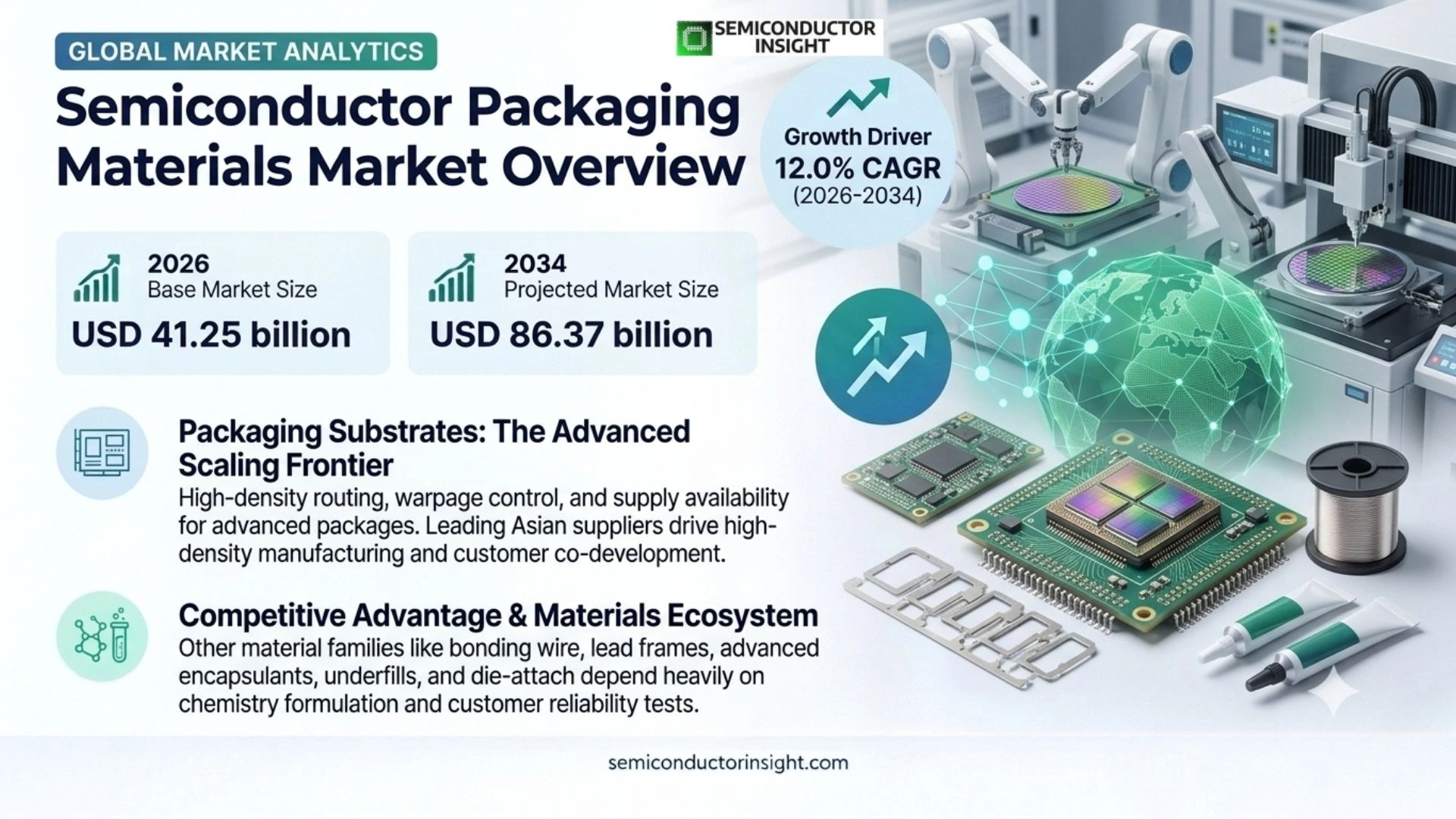
Semiconductor Packaging Materials Market is valued at USD 31.24 billion in 2025 and is projected to reach USD 86.37 billion by 2034, representing a 12.0% CAGR during 2026–2034. The 2026 estimated market size is USD 34.98 billion. Asia Pacific is the largest market because advanced packaging, OSAT, foundry, substrate and electronics-manufacturing capacity are heavily concentrated across the region.
Base year: 2025 · Estimated year: 2026 · Forecast period: 2026–2034 · Historical data: 2020–2025 · Values in USD
Semiconductor packaging materials convert a fabricated die into a protected, electrically connected and thermally manageable component. The market includes substrates, lead frames, bonding wire, encapsulating resins, ceramic materials, chip-bonding materials and related inputs. Each material must survive manufacturing and field conditions while meeting electrical, thermal, dimensional and reliability requirements.
Advanced packaging increases the value of materials engineering. Chiplets, 2.5D and 3D integration, high-bandwidth memory and high-power processors place greater pressure on substrate routing density, dielectric loss, coefficient-of-thermal-expansion matching, warpage control and thermal management. Material qualification therefore occurs jointly with package architecture and process conditions.
SEMI’s 2024 industry outlook identifies substrates as the largest packaging-material revenue category within its own methodology and highlights FC-BGA substrates, wafer-level packaging dielectrics and flip-chip underfill as important growth areas. Those directions explain technology demand without replacing the client report’s controlling market-size anchors.
Segment Analysis: By Type
By type, the report covers Packaging Substrate, Lead Frame, Bonding Wire, Encapsulating Resin, Ceramic Packaging Material, Chip Bonding Material and Others. Packaging substrates lead because advanced packages require dense interconnect, low-loss electrical paths and precise mechanical control, while the remaining materials are essential to package reliability and assembly economics.
| Type | Core function | Market position |
|---|---|---|
| Packaging Substrate | High-density electrical redistribution and mechanical platform between die/package and board. Advanced FC-BGA substrates require fine routing, controlled dielectric properties and warpage management. | Leading type. AI, high-performance computing and chiplet architectures increase routing density, layer count and signal-integrity requirements. SEMI also identifies substrates as the largest revenue material category in its industry dataset. |
| Lead Frame | Metal framework for die support and electrical connection in mature and high-volume package families, especially automotive, analog and power devices. | A large mature segment with steady demand. Plating quality, dimensional consistency and high-volume economics are key supplier differentiators. |
| Bonding Wire | Die-to-package interconnect using gold, copper, silver-alloy and related materials. Bondability and metallurgical compatibility determine process yield and reliability. | Mature but technically active, with material choices balancing cost, electrical performance and bonding reliability across consumer, automotive and industrial packages. |
| Encapsulating Resin | Protects die and interconnects from moisture, contamination and mechanical stress while controlling flow, cure behavior and package warpage. | Strategic for fine-pitch and high-density packages where filler design, thermal expansion and moisture performance become increasingly demanding. |
| Ceramic Packaging Material | Provides high-temperature stability, insulation and thermal performance for demanding power, RF, medical and industrial packages. | Smaller high-value segment with premium qualification niches where organic materials cannot meet thermal or reliability requirements. |
| Chip Bonding Material | Die-attach adhesives, solders and related materials form mechanical and thermal connections between die and substrate or lead frame. | Demand rises with package power density and reliability requirements; low voiding, thermal conductivity and process compatibility determine value. |
| Others | Specialized dielectrics, plating chemistries, solder materials and other package-process inputs vary by architecture. | Fragmented but innovation-intensive; new package structures can create rapid demand for a specific chemistry even when total category value is smaller. |
Secondary segmentation
The report also segments demand by end user, material technology and packaging platform. IDMs, foundries and OSATs have different qualification models; organic substrates, ceramic packages and advanced encapsulants address different performance envelopes; and flip-chip, wafer-level and 2.5D/3D platforms change the material stack and process sequence. A supplier is therefore qualified into a package flow rather than into a generic semiconductor market.
| Axis | Segments | Commercial implication |
|---|---|---|
| End User | Semiconductor Foundries · Integrated Device Manufacturers (IDMs) · Outsourced Semiconductor Assembly and Test (OSAT) providers | IDMs and OSATs drive direct materials qualification, while foundry-linked advanced packaging increasingly influences substrate and bonding specifications. |
| Material Technology | Organic Substrates · Ceramic Packages · Advanced Encapsulants | Organic substrates provide high-volume interconnect economics; ceramics serve demanding thermal niches; advanced encapsulants solve mechanical and moisture challenges. |
| Packaging Platform | Flip-Chip · Wafer-Level Packaging (WLP) · 3D/2.5D IC Integration | The platform determines bump pitch, redistribution, underfill, substrate, dielectric and thermal-material requirements. |
Segment Analysis: By Application
By application, the report covers Consumer Electronics, Automobiles, Communications, Medical and Others. Consumer electronics remain the leading application by broad device volume, while automotive and high-performance computing raise the reliability, thermal and electrical-performance thresholds that determine which advanced materials can be qualified.
| Application | Demand characteristics |
|---|---|
| Consumer Electronics | The largest application base includes smartphones, PCs, wearables and high-volume devices. Miniaturization and AI features increase packaging complexity while severe cost pressure rewards materials that deliver high yield in mass production. |
| Automobiles | Automotive electronics require long life, thermal cycling endurance and traceability. Electrification and ADAS increase semiconductor content, creating premium demand for materials that can maintain reliability under harsh conditions. |
| Communications | Networking and 5G infrastructure demand low-loss substrates, reliable interconnect and thermal materials that support higher data rates and power density. |
| Medical | Medical devices value reliability, traceability and long product lifecycles. Volumes are lower but qualification requirements can support premium materials and durable supplier relationships. |
| Others | Industrial, aerospace and specialized computing applications create diverse high-temperature and high-reliability material demand, often favoring documentation and customization over commodity pricing. |
Regional Analysis
Asia Pacific is the largest semiconductor packaging materials market because the region contains the densest network of foundries, OSATs, IDMs, substrate makers and electronics assembly. North America is expanding advanced-packaging capacity and research, Europe is anchored by automotive and industrial reliability requirements, and other regions remain smaller downstream markets.
How does regional demand differ across semiconductor packaging materials?
Packaging materials follow where packages are designed, qualified and assembled. Asia Pacific benefits from deeply integrated supply chains and high production volume. North America combines leading chip design with policy-supported packaging expansion. Europe creates high-value demand through automotive, power and industrial electronics. Smaller regions depend more heavily on imported packaged semiconductors.
| Region | Position | Growth outlook | Demand profile | Supplier selection |
|---|---|---|---|---|
| Asia Pacific | Largest market | High | Manufacturing & OSAT led | Qualification speed, local supply and substrate capability |
| North America | Advanced packaging expansion | High | AI/HPC & policy led | Technical performance, domestic capacity and co-development |
| Europe | High-reliability center | Moderate to high | Automotive & industrial | Reliability, traceability and compliance |
| South America | Emerging | Moderate | Import & assembly led | Landed cost, availability and support |
| Middle East & Africa | Early-stage | Moderate | Technology investment | Project pipeline and ecosystem formation |
Competitive Landscape
Competition is segmented by material family rather than dominated by one integrated supplier. The report identifies Kyocera, Shinko and Ibiden as the leading group and profiles substrate, bonding-wire, lead-frame, resin, ceramic and specialty-material companies. The durable advantage is qualification into customer package platforms with stable manufacturing consistency.
Packaging substrates are a strategic competitive arena because routing density, electrical loss, warpage and supply availability can constrain advanced-package scaling. Japanese, Taiwanese and Korean suppliers compete through high-density manufacturing, customer co-development and capital intensity.
Other material families have different economics. Bonding wire and lead frames include mature high-volume businesses, while advanced encapsulants, underfills and die-attach materials depend heavily on formulation chemistry and customer reliability tests. Ceramics serve high-temperature and high-reliability niches.
Qualification creates commercial stickiness. A material change can alter wire-bond behavior, package warpage, moisture sensitivity, thermal cycling or electrical loss, so approved suppliers can hold positions that are difficult to displace with price alone.
Competitive tier structure
| Tier | Companies | Basis of competition |
|---|---|---|
| Tier 1 | Kyocera; Shinko; Ibiden; Unimicron Technology; ZhenDing Tech; Semco | Scale, high-density manufacturing, OSAT/IDM relationships and leading-edge qualification |
| Tier 2 | LG Innotek; KINSUS; Nan Ya PCB; Simmtech; Shin-Etsu; Heraeus; Henkel; Toppan; Tanaka | Specialist leadership in substrates, bonding, encapsulation and high-reliability materials |
| Specialists | Remaining profiled suppliers | Material-specific capabilities, regional supply positions and focused qualification niches |
Key companies profiled in the report scope
- Kyocera
- Shinko
- Ibiden
- LG Innotek
- Unimicron Technology
- ZhenDing Tech
- Semco
- KINSUS INTERCONNECT TECHNOLOGY
- Nan Ya PCB
- Nippon Micrometal Corporation
- Simmtech
- Mitsui High-tec, Inc.
- HAESUNG
- Shin-Etsu
- Heraeus
- AAMI
- Henkel
- Shennan Circuits
- Kangqiang Electronics
- LG Chem
- NGK/NTK
- MK Electron
- Toppan Printing Co., Ltd.
- Tanaka
- MARUWA
- Momentive
- SCHOTT
- Element Solutions
- Hitachi Chemical
- Fastprint
- Hongchang Electronic
- Sumitomo
Semiconductor Packaging Materials Production Capacity Analysis
Packaging-material capacity is distributed across specialized industries including organic substrates, lead frames, wire drawing, resin compounding, ceramics and specialty chemicals. The constraint depends on architecture: advanced substrates can be limited by high-density yield and capital, while resins and bonding materials are more constrained by formulation qualification and customer approval.
Advanced substrate capacity has a long ramp because new lines require fine-pattern processing, high layer-count manufacturing, inspection and tight warpage control. The commercially relevant measure is qualified output at the layer count, line/space and electrical-loss level required by leading packages, not simply panel-start capacity.
Chemical and encapsulation capacity has different economics. Production may be less capital intensive than substrates, but small formulation changes can affect flow, cure, contamination, voiding and reliability. A supplier can have chemical capacity yet still need months of customer evaluation before it becomes addressable for a package family.
Market Dynamics
The market is being reshaped by advanced packaging, AI compute, automotive electronics and geographic efforts to strengthen semiconductor supply chains. Growth is strongest where materials solve density, thermal or signal-integrity problems, while cost pressure, long qualification and semiconductor cyclicality limit how quickly new capacity translates into revenue.
MARKET DRIVERS
Drivers Impact Analysis*
| Factor | Forecast impact* | Geographic relevance | Impact timeline |
|---|---|---|---|
| AI & high-performance computing packages | High | Asia Pacific, North America | Short to long term |
| Chiplet, 2.5D & 3D integration | High | Global advanced-packaging hubs | Medium term |
| Automotive semiconductor content | High | Europe, Asia Pacific, North America | Medium to long term |
| Domestic advanced-packaging investment | Medium to high | North America, Asia Pacific, Europe | Medium term |
*Directional analytical rating; not a measured contribution to the headline CAGR.
AI packages increase material intensity
AI accelerators and high-bandwidth-memory systems need dense interconnect, larger substrates, advanced underfills and thermal materials. The result is more packaging-material value per high-end package, giving suppliers exposure to compute growth even if semiconductor unit volumes grow more slowly.
Heterogeneous integration changes the material stack
Chiplets, 2.5D and 3D integration add die-to-die interconnect, redistribution and multiple bonding interfaces. Each interface creates requirements for dielectric properties, adhesion, thermal expansion and moisture performance, creating opportunities for specialized materials.
Automotive electronics reward reliability
Electric vehicles and ADAS increase semiconductor content exposed to temperature, vibration and long service-life requirements. Materials suppliers with automotive-grade documentation and stable manufacturing can defend strong positions because product-change control is demanding.
Policy-supported packaging investment broadens demand
U.S. NAPMP and CHIPS investments create new domestic qualification nodes for substrates and materials, diversifying demand beyond traditional Asian hubs and creating co-development opportunities.
MARKET RESTRAINTS
Restraints Impact Analysis*
| Factor | Forecast impact* | Geographic relevance | Impact timeline |
|---|---|---|---|
| Long qualification cycles | High | Global | Persistent |
| Raw-material & energy volatility | Medium to high | Global | Short to medium term |
| Semiconductor cyclicality | Medium | Global | Persistent |
| Advanced substrate capital intensity | High | Asia Pacific, North America | Medium term |
*Directional analytical rating; not a measured contribution to the headline CAGR.
Qualification delays monetization
A technically strong material must still pass process compatibility, warpage, moisture and reliability tests. These evaluations can span multiple iterations, so R&D spending and production capacity often precede material revenue.
Specialized upstream inputs can be volatile
High-purity metals, fillers, resins, glass, ceramics and specialty chemicals can face price or availability shocks. Suppliers cannot always substitute quickly because customer qualifications tie materials to approved sources and formulations.
Semiconductor cycles affect volumes
Memory or consumer-electronics inventory corrections reduce package starts and material consumption. High fixed-cost substrate suppliers are especially exposed to utilization swings, making end-market diversification important.
Leading-edge substrates require heavy capital
Fine-line substrates require specialized equipment, inspection and yield learning. New capacity can take time to reach customer-qualified output, and unsuccessful ramps can create depreciation without corresponding revenue.
MARKET OPPORTUNITIES
Build materials for AI and HBM packages
AI packaging combines large substrates, advanced underfill, thermal materials and high-density interconnect. Suppliers that co-design with OSATs, foundries and chip companies can gain platform-level positions rather than competing as interchangeable vendors.
Use new U.S. packaging programs
NAPMP and CHIPS-supported investments create research and manufacturing nodes where suppliers can qualify early into domestic advanced packaging flows, improving the chance of becoming production sources.
Develop lower-loss, lower-warpage substrate systems
As package size and I/O density increase, warpage and electrical loss become limiting variables. Materials that improve dimensional stability and dielectric performance can command value by improving package yield and signal integrity.
Capture sustainability-driven formulation change
Environmental rules and customer goals create opportunities for lower-impact chemistries and materials that reduce process temperature or waste, especially when sustainability improvements also improve yield or energy use.
Semiconductor Packaging Materials Supply Chain Analysis
Upstream purity sets the process window
Packaging materials may begin with commodity-origin inputs, but semiconductor-grade performance depends on purification, particle control, metallurgical consistency and formulation discipline. Variability can create bond failures, contamination, dielectric loss or warpage.
Material conversion combines scale and process know-how
Substrate layering, lead-frame plating, wire metallurgy, resin compounding and ceramic firing require specialized process control. The advantage is producing the same electrical and mechanical behavior across lots and factories.
Assembly and test companies are the qualification gate
OSATs and IDMs define process windows and reliability tests that decide whether a material reaches production. Advanced packages increasingly involve foundries and chip designers as well, making application engineering a core commercial function.
End-market performance determines material value
Consumer packages prioritize cost and throughput; AI packages prioritize loss and thermal control; automotive packages prioritize lifetime reliability. Suppliers improve margins when formulations solve the actual package failure mode.
Recent Developments in the Semiconductor Packaging Materials Market
U.S. Commerce finalizes $1.4 billion of NAPMP awards
The awards support next-generation advanced packaging, including $300 million for advanced substrates and materials research at Absolics, Applied Materials and Arizona State University.
Amkor receives up to $407 million CHIPS award
The award supports Amkor’s planned Peoria advanced packaging and test facility and creates a future domestic consumption point for qualified packaging materials.
SEMI reports packaging-material recovery and advanced-packaging growth areas
SEMI highlighted substrates, FC-BGA, WLP dielectrics and flip-chip underfill as important material areas in its 2024 industry outlook.
CHIPS for America opens advanced-packaging materials funding opportunity
U.S. Commerce announced R&D funding for advanced substrates and material systems, signaling policy support for domestic packaging capability.
REPORT SCOPE & SEGMENTATION
| Attribute | Details |
|---|---|
| Study Period | 2020–2034 |
| Base Year | 2025 |
| Estimated Year | 2026 |
| Forecast Period | 2026–2034 |
| Historical Period | 2020–2025 |
| Market Size 2025 | USD 31.24 billion |
| Market Size 2034 | USD 86.37 billion |
| Growth Rate | CAGR of 12.0% from 2026–2034 |
| Unit | Value (USD Million/Billion) and Volume (Tonnes/Units where applicable) |
| Segmentation | By Type, By Application, By End User, By Material Technology, By Packaging Platform |
| By Type | Packaging Substrate · Lead Frame · Bonding Wire · Encapsulating Resin · Ceramic Packaging Material · Chip Bonding Material · Others |
| By Application | Consumer Electronics · Automobiles · Communications · Medical · Others |
| By End User | Semiconductor Foundries · Integrated Device Manufacturers (IDMs) · Outsourced Semiconductor Assembly and Test (OSAT) providers |
| By Material Technology | Organic Substrates · Ceramic Packages · Advanced Encapsulants |
| By Packaging Platform | Flip-Chip · Wafer-Level Packaging (WLP) · 3D/2.5D IC Integration |
| By Region | Each region analysed by Type, Application and CountryNorth AmericaUnited States, Canada, MexicoEuropeGermany, France, U.K., Italy, Russia, Nordic Countries, BeneluxAsiaChina, Japan, South Korea, Southeast Asia, IndiaSouth AmericaBrazil, ArgentinaMiddle East & AfricaTurkey, Israel, Saudi Arabia, UAE |
| Key Companies Profiled | Kyocera · Shinko · Ibiden · LG Innotek · Unimicron Technology · ZhenDing Tech · Semco · KINSUS INTERCONNECT TECHNOLOGY · Nan Ya PCB · Nippon Micrometal Corporation · Simmtech · Mitsui High-tec, Inc. · HAESUNG · Shin-Etsu · Heraeus · AAMI · Henkel · Shennan Circuits · Kangqiang Electronics · LG Chem · NGK/NTK · MK Electron · Toppan Printing Co., Ltd. · Tanaka · MARUWA · Momentive · SCHOTT · Element Solutions · Hitachi Chemical · Fastprint · Hongchang Electronic · Sumitomo |
| Customization Scope | Free report customization equivalent to up to four analyst working days with purchase. Addition or alteration to country, regional and segment scope. |
Frequently Asked Questions
What is the current size of the semiconductor packaging materials market?
The market is valued at USD 31.24 billion in 2025 and is projected to reach USD 86.37 billion by 2034, implying a 12.0% CAGR during 2026–2034. The 2026 estimated market size is USD 34.98 billion, normalized from the source page’s 2024 and 2032 size anchors.
Which material type leads the market?
Packaging substrates lead because they provide the electrical and mechanical interconnect platform for modern packages. Advanced FC-BGA, chiplet and high-performance computing designs increase routing density, dielectric and warpage requirements.
Which application is most important?
Consumer electronics remain the largest application by broad device volume. Automotive, communications and high-performance computing are strategically important because they raise reliability, thermal and signal-integrity requirements.
Which region leads in 2025?
Asia Pacific is the largest market because it contains the densest concentration of foundries, OSATs, IDMs, substrate manufacturers and electronics assembly across the region.
What is the estimated market size in 2026?
The 2026 market size is estimated at USD 34.98 billion and is consistent with the 12.0% CAGR derived from the source page’s two published market-size anchors.
What are the main growth drivers?
The main drivers are AI and high-performance computing, chiplet and 2.5D/3D integration, rising automotive semiconductor content and investment in domestic advanced packaging capacity.
What are the main restraints?
The key restraints are lengthy qualification cycles, raw-material and energy-cost volatility, semiconductor industry cyclicality and the capital intensity of leading-edge substrate manufacturing.
How is competition structured?
Competition is segmented by material family. Leading companies compete in substrates, bonding wire, lead frames, resins, ceramics and specialty chemicals, with customer qualification and consistency serving as stronger moats than price alone.
What is the most important opportunity through 2034?
The strongest opportunity is to become designed into advanced package platforms for AI, HBM, chiplets and heterogeneous integration, where materials can solve package-level yield, signal-integrity or thermal constraints.
What segmentation does the report cover?
The report covers packaging material type, application, end user, material technology, packaging platform and region, together with the full profiled-company set listed in the Report Scope table.
Research Sources & Evidence Base
View primary and authoritative evidence used in this overview
- SEMI. Global Semiconductor Packaging Materials Outlook – 2024 edition – Industry-association evidence on substrate leadership and advanced packaging trends.
- SEMI. Global semiconductor packaging material market outlook shows return to growth – October 2024 evidence on AI-driven advanced packaging and materials direction.
- U.S. Department of Commerce. $1.4 billion in final awards for next-generation advanced packaging – January 2025 evidence including $300 million for substrates and materials research.
- U.S. Department of Commerce. CHIPS incentives award with Amkor Technology – December 2024 evidence on Amkor’s Arizona advanced packaging facility.
- U.S. Department of Commerce. Funding opportunity for advanced packaging substrates and materials – Official evidence on federal support for advanced packaging R&D.
Get Sample Report PDF for Exclusive Insights
Report Sample Includes
- Table of Contents
- List of Tables & Figures
- Charts, Research Methodology, and more...
 Download Sample Report PDF