Key Statistics
Key Takeaways
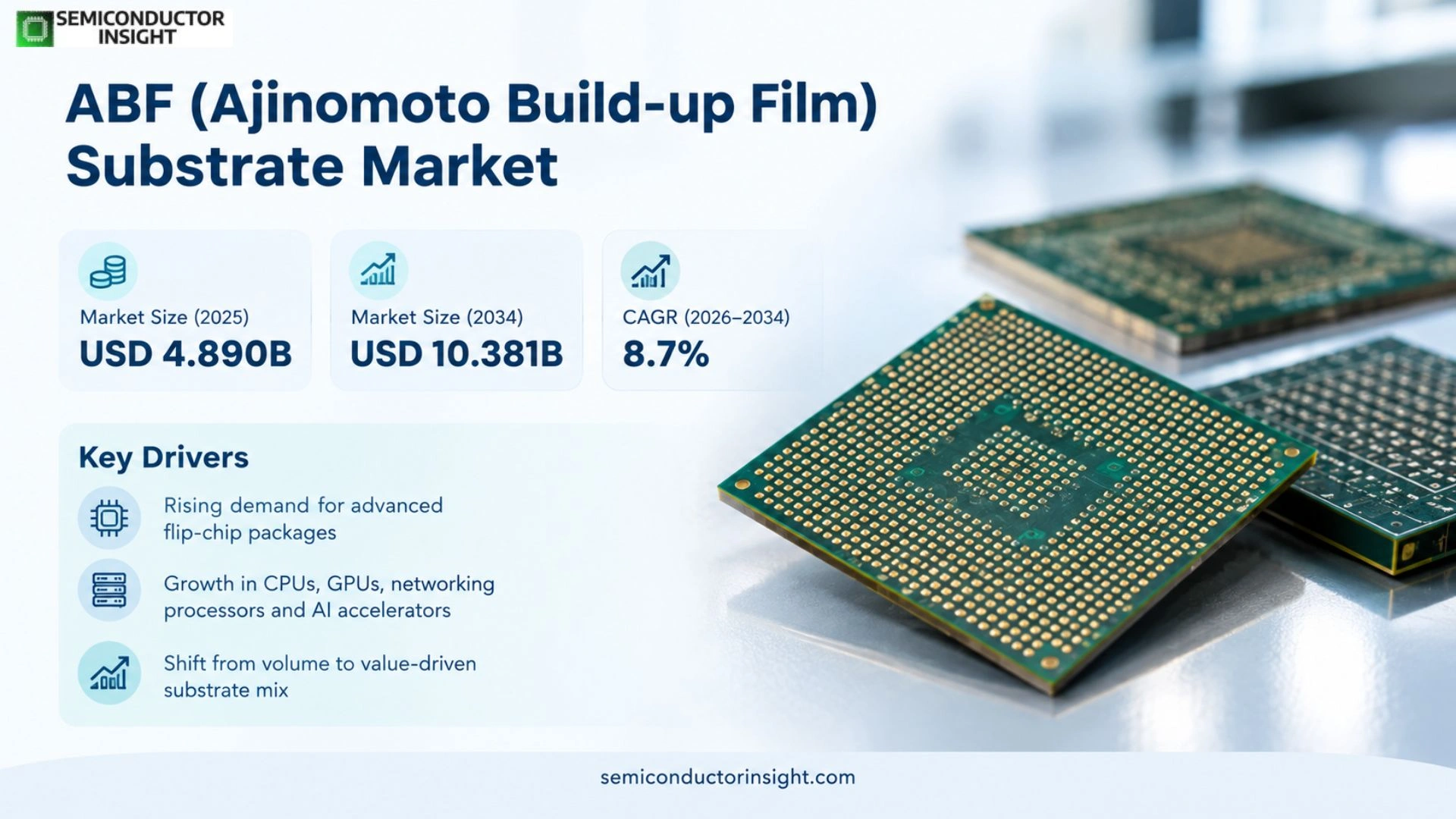
- ABF (Ajinomoto Build-up Film) Substrate Market is valued at USD 4.890 billion in 2025 and reaches approximately USD 10.381 billion by 2034. The published 2025 and 2033 market-size anchors imply an internally consistent 8.7% compound annual growth trajectory. Demand is driven by increasingly complex flip-chip ball-grid-array packages for CPUs, GPUs, networking processors and AI accelerators that require more build-up layers, finer routing, controlled impedance and robust thermal-mechanical performance.
- Four-to-eight-layer ABF substrates remain the largest product category in the controlling scope because they offer a practical balance of routing density, yield and cost for mainstream processors. Higher-layer substrates are gaining strategic importance for AI, high-performance computing and large-body packages that use chiplets or high-bandwidth memory. Ajinomoto explains that ABF enables micrometer-scale circuits through laser processing and direct copper plating, making the material central to translating nanoscale chip terminals into package-level interconnect.
- Asia Pacific is the largest market and production region because Taiwan, Japan, South Korea, China and Southeast Asia host the most concentrated IC-substrate, foundry, packaging and electronics manufacturing ecosystems. Recent capacity additions reinforce this lead: IBIDEN began sequential mass production at its new Ono plant in October 2025, AT&S started high-volume IC-substrate manufacturing in Kulim during 2025, and TOPPAN scheduled a new Niigata FC-BGA line to start operation in January 2026.
- The market is entering a capacity-intensive phase because AI processors require larger packages, more layers and tighter design rules, which consume more substrate area and process time per unit. Ajinomoto announced in May 2026 that it will create a third ABF production base in Gifu, with construction planned from 2028 and operations in 2032. This investment signals that material suppliers expect long-run demand growth but also shows that adding qualified capacity takes years rather than quarters.
ABF (Ajinomoto Build-up Film) Substrate Market Overview
ABF substrates are multilayer organic package substrates built using Ajinomoto Build-up Film as the interlayer insulating material. The film combines organic epoxy resin, hardener and inorganic fillers to provide electrical insulation, low thermal expansion and processability. Laser drilling and copper plating form fine interconnect structures layer by layer. The controlling report segments the market by 4-8 Layers ABF Substrate, 16 Layers ABF Substrate and Others, with applications spanning PCs, Server & Data Center, HPC/AI Chips, Communication and Others.
The substrate acts as the electrical and mechanical bridge between advanced semiconductor dies and the larger printed circuit board. As processor I/O counts increase, substrate line width, via density, layer count, warpage control and signal integrity become more demanding. Large AI packages add another challenge because package dimensions increase while tolerances tighten. This shifts value toward suppliers that can combine high-density build-up processing with strong yield management, large-body handling and close co-development relationships with chip designers and packaging partners.
The commercial ecosystem includes the ABF material supplier, IC-substrate manufacturers, semiconductor companies, outsourced assembly and test providers, foundries and electronics OEMs. Ajinomoto supplies the insulating film, while companies such as Unimicron, IBIDEN, AT&S, Shinko and TOPPAN manufacture high-density substrates. Because substrate designs are customized for processor packages, qualification cycles can be long and customer relationships sticky. Capacity therefore has to be added ahead of full demand visibility, creating significant capital and execution risk.
Segment Analysis: By Type
| Type | Market interpretation |
|---|---|
| 4-8 Layers ABF Substrate | Four-to-eight-layer products are the largest type because mainstream CPUs, controllers and other high-performance packages can achieve the required routing density without the cost and yield burden of very high build-up counts. The controlling report identifies this category as dominant. Commercial competition centers on fine-line capability, warpage, via quality and cost per usable substrate. As designs become more complex, suppliers can migrate customers toward improved materials and finer geometries while retaining a moderate layer structure. |
| 16 Layers ABF Substrate | Sixteen-layer ABF substrates address more complex high-end packages where large die counts, chiplets, HBM interfaces and dense power or signal routing require additional build-up layers. The segment is strategically important for AI and HPC because package complexity is increasing faster than unit volumes. Manufacturing is more difficult because every added layer introduces process steps, registration requirements and yield risk. Suppliers that can control dimensional stability and line quality across many build-up cycles can command premium pricing. |
| Others | Other ABF substrate configurations include layer counts and structures outside the two principal categories, including specialized large-body or application-specific designs. This segment captures custom packaging requirements for networking, communication, automotive and advanced compute products. The commercial opportunity is less standardized but can be high value because customers may require unusual stack-ups, thermal characteristics or electrical performance. Engineering collaboration and rapid prototyping are especially important where package architecture is still evolving. |
Segment Analysis: By Application
| Application | Demand characteristics |
|---|---|
| PCs | PCs are the largest application in the controlling scope because CPUs and GPUs have used ABF-based FC-BGA substrates for decades and continue to increase I/O density and electrical performance. Ajinomoto states that ABF is found at the heart of most personal computers and became a standard material for high-performance CPUs. AI PCs and gaming systems add larger processors and more memory bandwidth, supporting continued substrate value even when mature PC shipment growth is modest. |
| Server & Data Center | Server and data-center processors are a high-value growth application because package size, power and interconnect requirements exceed mainstream client processors. IBIDEN’s new Ono plant is scheduled to focus primarily on AI server products, while AT&S states that its Kulim plant produces high-end IC substrates for data-center processors. Larger server CPUs and accelerators consume more substrate area and often need finer routing or higher layer counts, raising revenue per package even before unit growth is considered. |
| HPC/AI Chips | HPC and AI chips are the most important strategic growth application because GPUs, custom accelerators and chiplet-based processors require extremely dense interconnect and large package bodies. Shinko’s i-THOP development highlights the industry’s move toward ultra-high-density organic substrates for logic and high-bandwidth-memory interfaces. AI packages also increase demand for dimensional stability, signal integrity and thermal performance, creating a technology premium for high-end ABF substrates and driving new manufacturing investment across Japan, Taiwan and Southeast Asia. |
| Communication | Communication processors, switches, baseband chips and networking ASICs use ABF substrates where high-speed signals and dense I/O require advanced flip-chip packages. Data-center networking and 5G infrastructure increase bandwidth requirements, while edge computing pushes more compute into distributed systems. These applications value controlled impedance and low-loss routing and can adopt high-performance ABF material grades. Demand is more diversified than CPUs because package dimensions and qualification requirements vary across telecom equipment and network platforms. |
| Others | Other applications include automotive processors, industrial computing and specialized semiconductor packages. Automotive electronics increasingly use high-performance application processors for digital cockpits, ADAS and connectivity, extending ABF into environments that require long product lifecycles and stringent reliability. Industrial and specialty compute packages also benefit from higher interconnect density. These applications are smaller than PCs or AI data centers but provide diversification and can support premium specifications where reliability and thermal performance are critical. |
Regional Analysis
Asia Pacific is the largest ABF substrate market because the region combines the dominant substrate manufacturing base with leading foundries, memory producers and semiconductor packaging operations. Taiwan hosts Unimicron, Kinsus and Zhen Ding; Japan hosts IBIDEN, Shinko, TOPPAN and Ajinomoto’s ABF material operations; South Korea hosts Samsung Electro-Mechanics, Daeduck and LG Innotek; and China is expanding domestic substrate capability. North America and Europe are major demand and design centers but remain more dependent on Asian manufacturing.
| Region | Position | Growth outlook | Commercial basis |
|---|---|---|---|
| Asia Pacific | Largest | Strong | Concentration of substrate production, foundries, OSATs and semiconductor manufacturing provides both capacity and customer proximity. |
| North America | High-value demand market | Strong | AI, cloud and processor design companies create advanced substrate requirements even though much manufacturing is sourced from Asia. |
| Europe | Technology and industrial market | Moderate to strong | Automotive, industrial and HPC demand plus AT&S capacity in Austria supports regional technology development and partial localization. |
| South America | Small downstream market | Gradual | Demand arrives mainly through imported processors, servers and electronics rather than direct substrate manufacturing. |
| Middle East & Africa | Emerging infrastructure market | From low base | AI data-center and telecom investment creates indirect demand for high-end processors packaged on ABF substrates. |
Asia Pacific
Asia Pacific dominates because the ABF material, substrate production, advanced packaging and semiconductor manufacturing value chain is unusually concentrated. Taiwan, Japan and South Korea have long-standing substrate expertise, while Malaysia and China are adding capacity. IBIDEN’s Ono facility, TOPPAN’s Niigata expansion and AT&S’s Kulim ramp show that suppliers are responding to AI and data-center requirements through geographically diversified Asian investments. This density of suppliers and customers shortens qualification loops and supports the fine-line process learning needed for high-end substrates.
| Country / subregion | Commercial logic |
|---|---|
| Taiwan | Unimicron, Kinsus, Nan Ya PCB and Zhen Ding anchor a dense substrate ecosystem tied closely to foundries, OSATs and fabless processor customers. |
| Japan | Ajinomoto supplies the ABF material and IBIDEN, Shinko and TOPPAN manufacture advanced package substrates, giving Japan both materials and process leadership. |
| South Korea & Malaysia | Korean substrate suppliers support memory and logic ecosystems, while AT&S’s Kulim site adds a major Southeast Asian high-end IC-substrate manufacturing base. |
Dated market instances
North America
North America is a major source of ABF demand because the United States hosts leading CPU, GPU, networking and cloud companies whose package designs drive substrate complexity. Manufacturing remains heavily Asian, but U.S. chip designers increasingly work with substrate suppliers on large-body FC-BGA, chiplet and AI-accelerator architectures. Domestic semiconductor policy also encourages localization of advanced packaging and related materials, although building high-yield substrate capacity requires specialized process expertise that cannot be replicated quickly. Commercial relationships therefore combine U.S. design leadership with Asian production execution.
| Country / subregion | Commercial logic |
|---|---|
| United States | AI accelerators, server CPUs, networking chips and high-performance client processors create the region’s largest direct substrate design demand. |
| Canada | AI, telecom and semiconductor design activity contributes smaller but high-value demand through global package supply chains. |
| Mexico | Electronics manufacturing and data-center investment create downstream processor demand, while direct ABF substrate production remains limited. |
Dated market instances
Europe
Europe’s ABF substrate market is shaped by automotive, industrial and high-performance computing applications and by AT&S’s technology base in Austria. European customers often require long lifecycles, traceability and reliability, while AI and HPC development raises demand for more advanced package structures. AT&S has built a European competence center in Leoben with connected series production for IC-substrate technologies, giving the region an important R&D and pilot-to-production capability even though most global high-volume ABF substrate capacity remains in Asia.
| Country / subregion | Commercial logic |
|---|---|
| Austria | AT&S operates IC-substrate technology and production capabilities in Leoben, supporting European development and qualification. |
| Germany | Automotive, industrial and semiconductor design customers create demand for reliable advanced substrates sourced through global supply chains. |
| France & Benelux | HPC, automotive and semiconductor research ecosystems create package-development demand and reinforce interest in regional advanced-packaging capability. |
Dated market instances
South America
South America has little direct ABF substrate manufacturing, so the market is primarily expressed through imported processors, servers, communications equipment and high-end electronics. Brazil is the main regional demand center through data centers, electronics manufacturing and industrial digitalization. Substrate suppliers generally serve this demand indirectly through global semiconductor customers rather than local sales of bare substrates. Growth therefore depends on regional compute infrastructure and electronics investment, while currency and import conditions influence the timing of downstream equipment purchases.
| Country / subregion | Commercial logic |
|---|---|
| Brazil | Largest regional data-center and electronics market, consuming ABF indirectly through imported CPUs, GPUs and networking processors. |
| Argentina | Smaller enterprise and research-computing demand, served through imported systems and components. |
| Rest of South America | Telecom modernization and cloud adoption gradually increase downstream demand for processors packaged on advanced organic substrates. |
Dated market instances
Middle East & Africa
Middle East & Africa remains a downstream ABF demand market, but large AI data-center projects in Gulf countries are increasing the number of high-end processors deployed in the region. These systems use server CPUs, GPUs and networking ASICs that rely heavily on advanced FC-BGA substrates. Direct substrate manufacturing is limited, so the opportunity is captured upstream by Asian and European substrate suppliers through global processor vendors. Telecom modernization and sovereign AI projects create the strongest growth path, while African demand remains more fragmented.
| Country / subregion | Commercial logic |
|---|---|
| Saudi Arabia | AI and data-center investment creates indirect demand for high-end ABF-packaged accelerators and server processors. |
| United Arab Emirates | Cloud, sovereign AI and data-center projects increase consumption of advanced compute hardware sourced from global semiconductor vendors. |
| South Africa | Enterprise computing, telecom and research demand contribute a smaller but growing downstream market for advanced processors. |
Dated market instances
Key ABF Substrate Manufacturers and Competitive Landscape
Competition is led by a relatively concentrated group of high-end IC-substrate manufacturers with deep relationships with processor companies. Unimicron, IBIDEN, Nan Ya PCB, Shinko Electric, Kinsus and AT&S are among the most established suppliers, while Samsung Electro-Mechanics, TOPPAN, Zhen Ding, Daeduck, LG Innotek and Chinese manufacturers broaden regional capacity. Qualification barriers are high because customers require electrical, thermal and mechanical performance to remain stable across complex package assembly and long product ramps.
Technology leadership is shifting toward larger substrates, finer routing and higher layer counts for AI and chiplet packages. IBIDEN’s new AI-server-focused plant, TOPPAN’s new high-end FC-BGA line and Shinko’s i-THOP ultra-high-density organic substrate demonstrate different approaches to the same requirement: more I/O and HBM connectivity inside larger organic packages. Suppliers that can control warpage, line geometry and yield across large panels or package bodies are best positioned to win premium AI programs.
| Competitive tier | Companies and positioning |
|---|---|
| Global high-end substrate leaders | Unimicron, Ibiden, Nan Ya PCB, Shinko Electric Industries and AT&S compete through large-scale FC-BGA capability, advanced build-up processing and long qualification relationships with processor customers. |
| Asian diversified substrate suppliers | Kinsus Interconnect, Semco, TOPPAN, Zhen Ding Technology, Daeduck Electronics and LG InnoTek broaden supply through regional manufacturing, specialized high-density processes and relationships across computing, mobile and semiconductor packaging. |
| Specialists and growth suppliers | Kyocera, Zhuhai Access Semiconductor, Shennan Circuit and Shenzhen Fastprint Circuit Tech provide additional technology and geographic diversification, particularly as China expands domestic high-end substrate capability. |
Companies covered in the report
- Unimicron
- Ibiden
- Nan Ya PCB
- Shinko Electric Industries
- Kinsus Interconnect
- AT&S
- Semco
- Kyocera
- TOPPAN
- Zhen Ding Technology
- Daeduck Electronics
- Zhuhai Access Semiconductor
- LG InnoTek
- Shennan Circuit
- Shenzhen Fastprint Circuit Tech
The complete controlling company set is retained for competitive profiling. Evaluation separates high-volume FC-BGA leaders, diversified Asian substrate manufacturers and growth suppliers by achievable line and space, layer count, large-body yield, warpage control, customer qualification and manufacturing footprint. The fifteen companies are not treated as interchangeable because their technology maturity, target processor classes, exposure to AI and server programs, and ability to ramp newly qualified plants differ materially.
ABF Layer Architecture, Fine-Line Yield and Package-Qualification Analysis
ABF substrate capacity is determined by more than nominal factory floor area. Production requires laminate preparation, laser drilling, desmear, copper plating, fine-line imaging, multilayer build-up, core processing, surface finishing, routing and intensive inspection. Each additional layer adds cycle time and yield exposure. AI packages further reduce effective capacity because larger substrate bodies occupy more panel area and may need tighter tolerances. Consequently, a shift toward high-layer-count AI products can tighten supply even without a dramatic increase in package units.
Recent investments indicate a broad capacity expansion cycle. IBIDEN’s Ono plant started mass production in October 2025 for AI server products, AT&S began high-volume manufacturing in Kulim in 2025, TOPPAN’s new Niigata line came online in January 2026, and Ajinomoto plans a third ABF material base from 2032. The long lead times between site acquisition, equipment installation and customer qualification show why supply can remain tight during sudden demand accelerations and why customers reserve capacity years ahead.
ABF (Ajinomoto Build-up Film) Substrate Market Dynamics: Drivers, Restraints and Opportunities
The market is moving from a volume-driven PC substrate cycle toward a value-driven mix shaped by AI servers, HPC and heterogeneous integration. PC processors still provide the largest application base, but AI packages are larger, more layered and more technically demanding, increasing substrate content per device. This changes supplier economics because high-end products may consume disproportionate process capacity while generating higher average selling prices. Capacity planning therefore depends increasingly on substrate area and complexity rather than simple unit shipments.
A second dynamic is localization. Taiwan and Japan remain central, but suppliers are expanding in Malaysia, Austria and other locations to reduce geographic concentration and serve customer resilience requirements. AT&S’s Kulim investment is the clearest example, while Europe is strengthening R&D and small-scale production capability. Localization does not eliminate dependence on Ajinomoto ABF material or Asian equipment ecosystems, but it creates alternate qualified sites and can reduce geopolitical or logistics risk for critical processor customers.
MARKET DRIVERS
| Factor | Directional CAGR impact | Most exposed market | Time horizon |
|---|---|---|---|
| AI and HPC package complexity | +1.8 to +2.6 percentage points | Server and accelerator substrates | Medium term |
| Larger body size and layer count | +1.1 to +1.8 percentage points | FC-BGA platforms | Immediate to medium term |
| Regional advanced-packaging investment | +0.7 to +1.3 percentage points | Asia and selected new hubs | Long term |
AI and high-performance computing are the strongest growth drivers because GPUs, custom accelerators and large server CPUs require greater routing density, package area and interconnect bandwidth. Shinko’s i-THOP development specifically targets chiplets and logic-to-HBM interfaces, while IBIDEN and TOPPAN are adding capacity for AI and data-center packages. Every increase in accelerator package size or layer count raises substrate value per chip, creating a market effect that can outpace the growth in processor unit shipments.
Advanced-node semiconductor scaling is another driver because finer transistors increase die I/O density and make package interconnect a more important system bottleneck. Ajinomoto explains that ABF is used to bridge nanoscale chip terminals with millimeter-scale board connections through micrometer-scale build-up wiring. As processors add chiplets, HBM and faster serial interfaces, substrate design must maintain signal integrity and power delivery across more connections. This pushes customers toward higher-performance material grades and tighter process control.
MARKET RESTRAINTS
| Factor | Directional CAGR impact | Most exposed market | Time horizon |
|---|---|---|---|
| Fine-line yield and warpage control | -1.2 to -1.9 percentage points | High-layer-count substrates | Immediate |
| Long customer qualification cycles | -0.8 to -1.4 percentage points | New plants and suppliers | Medium term |
| Capital and environmental intensity | -0.6 to -1.1 percentage points | All producing regions | Long term |
High capital intensity and long qualification cycles restrain supply response. A new substrate plant requires specialized wet processes, laser tools, imaging, plating, inspection and environmental controls, followed by extensive customer qualification before commercial volumes can ramp. IBIDEN’s Ono plant took years from site acquisition to mass production, while Ajinomoto’s third ABF material site announced in 2026 is not expected to operate until 2032. Sudden AI demand can therefore outpace the speed at which fully qualified capacity enters the market.
Yield becomes more difficult as package size, layer count and line density increase. Large substrates are more sensitive to warpage, registration errors, plating defects and dimensional variation, while extra build-up layers multiply process opportunities for failure. A nominal capacity increase may produce less usable output if a new high-end product starts with low yields. Customers and suppliers must therefore co-optimize design rules, material properties and process windows, which can slow migration to the most aggressive substrate architectures.
MARKET OPPORTUNITIES
Large-body AI substrates are the clearest premium opportunity because accelerator packages combine large logic dies, chiplets and HBM while requiring high-speed signaling and dense power delivery. Suppliers that can produce larger panels or package bodies with low warpage and high fine-line yield can capture more value per unit. TOPPAN’s new line and IBIDEN’s AI-server-focused Ono plant show that leading vendors are dedicating capital specifically to this opportunity rather than relying on existing mainstream PC substrate capacity.
Geographic diversification creates a second opportunity. AT&S’s Kulim plant establishes a major high-end IC-substrate base in Malaysia, while its Leoben competence center provides European R&D and series-production capability. Customers increasingly want alternate manufacturing locations to reduce concentration risk, creating openings for suppliers that can qualify equivalent processes across regions. This may also support government-backed advanced-packaging ecosystems in North America and Europe, even if Asia retains the largest manufacturing share through 2034.
ABF Substrate Materials, Fabrication and Qualification Ecosystem Analysis
The supply chain begins with Ajinomoto Build-up Film, copper foils, core materials, process chemicals and specialty equipment. Substrate manufacturers laminate ABF layers, laser-drill microvias, plate copper and repeatedly image fine wiring to create multilayer structures. Finished substrates are shipped to semiconductor assembly operations where processor dies, chiplets or interposers are attached, underfilled and tested before the package is mounted on a system board. Yield at each stage affects total economics because a high-value processor depends on a relatively low-cost but highly customized substrate.
Material concentration is especially important because Ajinomoto’s ABF is the reference interlayer material for high-performance CPU substrates. The company states that ABF has become the product of choice for nearly all high-performance CPUs, making stable supply strategically important. Ajinomoto’s planned third production base strengthens resilience but will take years to complete. Substrate customers therefore manage risk through inventory, long-term agreements and process qualification, while manufacturers diversify plant locations and invest in alternative material or substrate technologies where feasible.
Recent Developments in the ABF (Ajinomoto Build-up Film) Substrate Market
Developments tracked to September 2026. Entries follow official company or industry publications.
- May 2026: Ajinomoto and Ajinomoto Fine-Techno announced acquisition of a new plant site in Gifu for a third ABF production base. The acquisition amount is approximately JPY 1.2 billion, construction is scheduled to begin in 2028 and operations are planned for 2032. The project is explicitly intended to strengthen stable supply and business continuity, providing a long-term upstream capacity signal for advanced semiconductor packaging. Source.
- January 2026: TOPPAN started operation of a new FC-BGA substrate manufacturing line at its Niigata Plant after announcing the expansion in December 2025. TOPPAN said demand for FC-BGA substrates is increasing with data-center and edge-computing growth and that package size, layer count and technical specifications are becoming more advanced. The line strengthens Japanese high-end substrate capacity for AI and data-center semiconductor packages. Source.
- October 2025: IBIDEN opened the Ono Plant in Gifu Prefecture and began sequential mass production primarily for AI server products. The company describes the site as its largest domestic production area and a world-leading IC package substrate facility. The ramp is commercially significant because AI-server processors consume large, complex substrates, so dedicated new capacity can materially increase high-end ABF-substrate supply rather than merely adding mainstream package volume. Source.
- May 2025: AT&S announced that its new Kulim Hi-Tech Park campus in Malaysia was ready for high-volume manufacturing of high-end IC substrates, including substrates for AMD data-center processors. AT&S has committed more than USD 1 billion to Malaysia, making the site its largest initial investment in the country. The facility expands Southeast Asian advanced-substrate capacity and provides customers with geographic diversification outside traditional Taiwanese and Japanese production hubs. Source.
- March 2025: the International Finance Corporation and AT&S signed a USD 250 million sustainability-linked loan agreement to further develop the Kulim IC-substrate plant. IFC stated that the financing supports high-end substrates required for high-performance data processors, data centers and AI infrastructure. The agreement links global development finance directly to advanced packaging capacity and demonstrates the capital intensity required to expand qualified substrate supply at the pace demanded by AI computing. Source.
REPORT SCOPE & SEGMENTATION
| Scope dimension | Coverage |
|---|---|
| Market window | The market is USD 4.890 billion in 2025 and approximately USD 10.381 billion in 2034, consistent with the published 2025 and 2033 market-size anchors and an internally consistent 8.7% compound annual growth trajectory. |
| By Type | 4-8 Layers ABF Substrate; 16 Layers ABF Substrate; Others. |
| By Application | PCs; Server & Data Center; HPC/AI Chips; Communication; Others. |
| By End User | Semiconductor Manufacturers; Electronics OEMs; Contract Manufacturers. |
| By Technology Node | Advanced Nodes (7nm and below); Mainstream Nodes (10-28nm); Legacy Nodes (Above 28nm). |
| By Material Grade | Standard Grade; High-Performance Grade; Specialty Grade. |
| Companies | Unimicron; Ibiden; Nan Ya PCB; Shinko Electric Industries; Kinsus Interconnect; AT&S; Semco; Kyocera; TOPPAN; Zhen Ding Technology; Daeduck Electronics; Zhuhai Access Semiconductor; LG InnoTek; Shennan Circuit; Shenzhen Fastprint Circuit Tech |
Forecast reconciliation confirms USD 4.890 billion, USD 10.381 billion, 8.7% as the controlling rebased metrics for the 2025–2034 planning window. The calculation preserves the published endpoint relationship and applies compound growth consistently across elapsed annual periods. This validation note is provided so readers can reproduce the arithmetic, compare it with the source anchors and avoid relying on a headline percentage that may be rounded or internally inconsistent.
Frequently Asked Questions
What is the 2025 ABF substrate market size?
The global ABF substrate market is valued at USD 4.890 billion in 2025 in the controlling scope. The market covers organic build-up package substrates using Ajinomoto Build-up Film across PCs, servers and data centers, HPC and AI chips, communications and other applications. Revenue reflects substrate products rather than the upstream ABF film alone, so the value includes significant manufacturing content from multilayer processing, fine-line routing, plating, inspection and customer-specific qualification.
What is the projected market size by 2034?
The market reaches approximately USD 10.381 billion by 2034 based on the growth trajectory embedded in the published 2025 and 2033 size anchors. The resulting rate is about 8.7%. Growth is driven less by simple processor unit increases than by rising substrate content per device: AI accelerators and large server processors use bigger package bodies, more build-up layers and finer interconnect, increasing substrate area and manufacturing value.
Why is Asia Pacific the largest region?
Asia Pacific is largest because Taiwan, Japan, South Korea, China and Southeast Asia host the dominant substrate, foundry, memory and semiconductor-packaging ecosystems. Major suppliers in the controlling list are concentrated in the region, and recent investments by IBIDEN, TOPPAN and AT&S are adding high-end capacity in Japan and Malaysia. Ajinomoto’s own ABF production is also based in Japan, reinforcing regional upstream integration.
Which ABF substrate type is largest?
Four-to-eight-layer ABF substrates are the largest product type in the controlling scope because they provide an effective balance of routing density, cost and manufacturing yield for mainstream processors. Higher-layer substrates are strategically important for AI and HPC packages, where chiplets, HBM interfaces and larger package bodies require more routing resources. The market therefore combines a high-volume mainstream segment with a faster-growing premium complexity segment.
Which application is largest?
PCs remain the largest application because ABF became a standard insulating material for high-performance CPU package substrates and continues to be used broadly in client processors and GPUs. The fastest strategic growth, however, is coming from server, data-center and HPC or AI chips. These packages consume more substrate area and often require finer features or more layers, so their revenue contribution can grow faster than their unit shipments.
Which companies are profiled?
The report profiles Unimicron, Ibiden, Nan Ya PCB, Shinko Electric Industries, Kinsus Interconnect, AT&S, Semco, Kyocera, TOPPAN, Zhen Ding Technology, Daeduck Electronics, Zhuhai Access Semiconductor, LG InnoTek, Shennan Circuit and Shenzhen Fastprint Circuit Tech. The companies differ by scale, geographic footprint and high-end FC-BGA capability, but all are retained from the controlling competitive scope.
Why are AI chips important for ABF substrate demand?
AI accelerators combine large logic dies, chiplets and high-bandwidth memory and therefore need dense power and signal routing across a large package. This increases package substrate area, layer count and process complexity. IBIDEN’s new Ono plant focuses primarily on AI server products, TOPPAN expanded FC-BGA capacity for AI and data-center demand, and Shinko is developing ultra-high-density organic substrates for chiplet and HBM integration, providing direct evidence of this demand shift.
What limits ABF substrate capacity?
Capacity is constrained by long manufacturing cycles, high capital requirements, process yield and customer qualification. Each build-up layer requires lamination, laser drilling, plating and imaging, and large high-layer-count substrates consume more panel area and process time. New facilities can take years to build and qualify, as shown by Ajinomoto’s third ABF material site planned for operation in 2032. Effective capacity can therefore tighten quickly when AI package complexity rises.
How important is Ajinomoto Build-up Film itself?
Ajinomoto describes ABF as an essential interlayer insulating material for high-performance CPU substrates and says it has become the product of choice for nearly all high-performance CPUs. The film enables laser processing and direct copper plating for micrometer-scale build-up wiring. Because substrate manufacturers design processes around its thermal, mechanical and electrical characteristics, upstream material stability is strategically important to the entire FC-BGA supply chain.
Where are the strongest market opportunities?
The strongest opportunities are large-body AI substrates, higher-layer-count products, finer-line routing and geographic supply diversification. AI and data-center processors raise substrate value per package, while new plants in Japan and Malaysia create capacity for those premium products. Suppliers that can qualify equivalent high-yield processes across multiple regions can also address customer resilience requirements, creating a commercial advantage beyond pure line-and-space performance or price.
Get Sample Report PDF for Exclusive Insights
Report Sample Includes
- Table of Contents
- List of Tables & Figures
- Charts, Research Methodology, and more...