
Key Statistics
Key Takeaways
- 32-bit MCUs are the leading value segment because automotive, industrial and edge-AI systems require more compute, memory, security and connectivity than legacy 8-bit and 16-bit platforms can provide.
- Automotive is the leading application in the report scope as modern vehicles use MCUs across body control, chassis, battery management, powertrain, HMI and zonal architectures.
- Asia Pacific leads global MCU demand through large electronics, appliance, automotive and industrial manufacturing bases in China, Japan, South Korea, Taiwan and Southeast Asia.
- Secure connectivity is becoming a core differentiator. NXP’s 2026 MCX A5 integrates 10BASE-T1S Ethernet and post-quantum cryptography for industrial edge nodes.
- AI is moving onto MCU-class devices. Renesas RA8P1 integrates a Cortex-M85, Cortex-M33 and Ethos-U55 NPU to support voice, vision and real-time analytics on a microcontroller platform.
- Manufacturing localization matters. ST began volume production of China-manufactured STM32 MCUs in 2026, showing how major vendors are aligning production with regional demand and supply resilience.
Microcontroller Unit (MCU) Market Overview
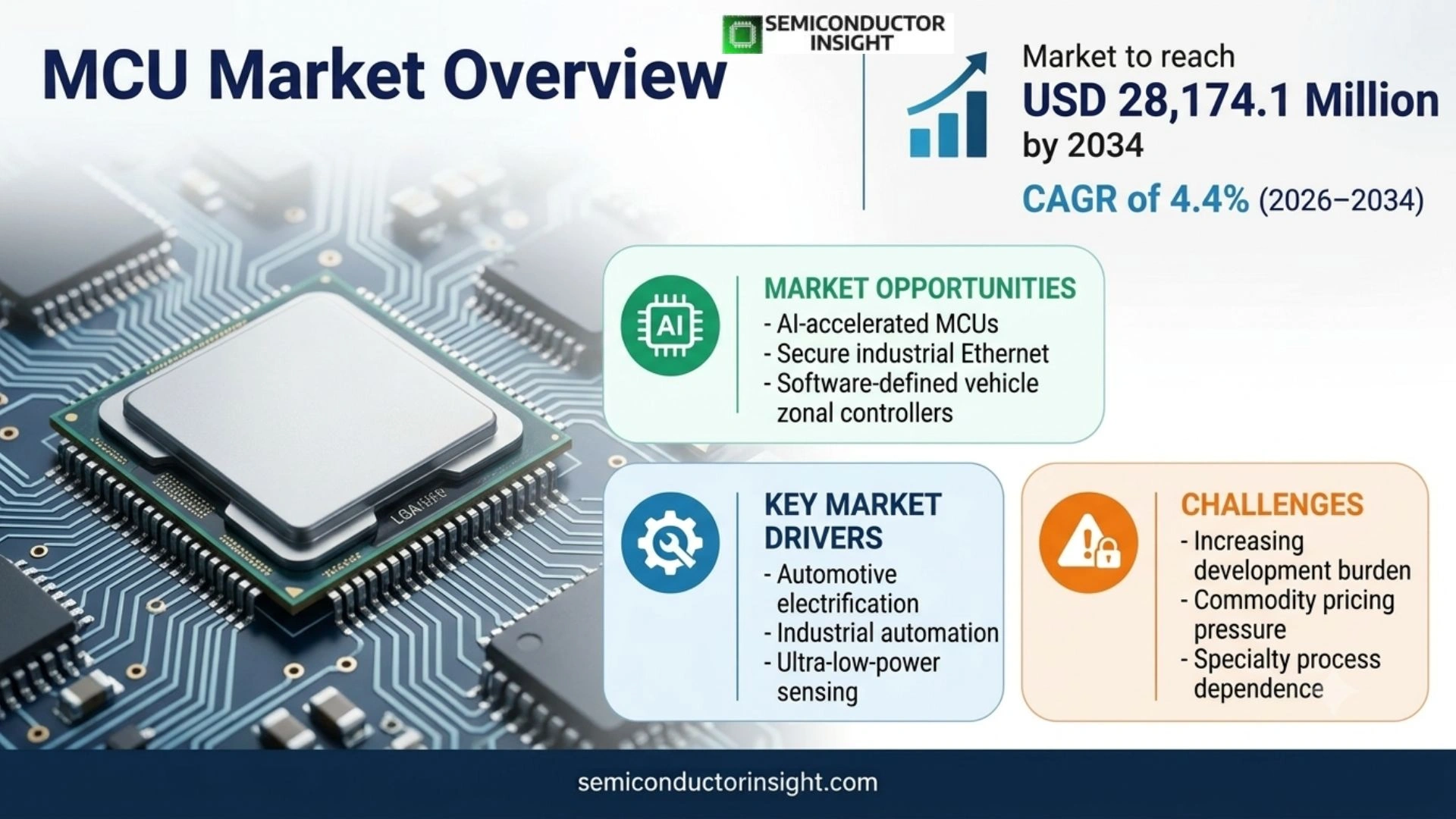
MCU Market was valued at USD 19,080.0 million in 2025, is estimated at USD 19,924.4 million in 2026, and is projected to reach USD 28,174.1 million by 2034, representing a CAGR of 4.4% during 2026–2034. Asia Pacific is the largest regional market in 2025, while the commercial growth mechanism is increasingly shaped by automotive electrification, software-defined vehicles, industrial automation, secure edge connectivity, TinyML, smart appliances, and low-power IoT.
A microcontroller unit is a compact integrated circuit that combines a processor core with nonvolatile memory, SRAM, timers, analog interfaces, communication peripherals and programmable I/O. MCUs are optimized for real-time embedded control rather than general-purpose computing and are used in vehicles, factory equipment, appliances, medical systems, sensors, power electronics and connected devices.
The market is moving toward higher performance and greater integration without abandoning low-cost segments. 8-bit and 16-bit MCUs remain important in simple controls and appliances, but 32-bit devices are capturing more value as customers add Ethernet, CAN, security, touch, graphics and AI. Vendors increasingly offer scalable families that allow software reuse across entry, mid-range and high-performance devices.
Software ecosystems are becoming a larger part of competition. Developers evaluate RTOS support, safety libraries, security frameworks, AI toolchains and long-term software maintenance alongside core frequency and peripheral count. This favors suppliers that can combine silicon with development boards, code examples, middleware and lifecycle programs across multiple generations.
Segment Analysis: By Type
By type, the market is segmented into 4 Bit MCU, 8 Bit MCU, 16 Bit MCU, and 32 Bit MCU. 32-bit MCUs lead the value mix because modern embedded systems increasingly require higher performance, connectivity, security and edge intelligence.
| Type | Technical role | Market position |
|---|---|---|
| 4 Bit MCU | Very low-cost control devices for simple timing, display and appliance functions with minimal memory and peripheral requirements. | A small legacy segment with limited new-design growth, retained mainly where ultra-low cost and proven designs dominate. |
| 8 Bit MCU | Widely used in appliances, simple sensors, motor control, power supplies and cost-sensitive embedded products. | A durable high-volume category. Pin compatibility, 5V operation and mature development ecosystems keep 8-bit relevant in long-life applications. |
| 16 Bit MCU | Provides more arithmetic performance, timers and control capability than 8-bit platforms while maintaining efficient power and cost. | Important in motor control, automotive body functions, metering and specialized industrial applications, though many new designs migrate to 32-bit. |
| 32 Bit MCU | Typically based on Arm Cortex-M, proprietary automotive cores or RISC-V architectures, with higher clock rates, larger memory, connectivity, security and AI accelerators. | The leading value segment. Automotive, industrial, IoT and edge-AI platforms increasingly standardize on 32-bit architectures. |
Why are 32-bit MCUs replacing lower-bit devices in many new designs?
Modern embedded products need more than basic control. Secure boot, encrypted communications, Ethernet, USB, graphics, motor algorithms and machine learning all require more processing and memory. 32-bit MCUs can integrate these functions while preserving low power and real-time response. Suppliers also use scalable software platforms so customers can move from a low-cost 32-bit device to a higher-performance member without rewriting the application.
Segment Analysis: By Application
By application, the market covers Automotive, Industrial, Communication and Computer, Consumer Electronics, and Others. Automotive leads the value mix, while industrial automation and connected edge systems provide strong diversified growth.
| Application | Demand characteristics | |
|---|---|---|
| Automotive | MCUs manage body electronics, chassis, BMS, lighting, motor control, HMI, gateways and many safety functions. Automotive devices require long lifecycle, security and functional-safety support. | The leading application. Software-defined vehicle and zonal architectures increase compute and connectivity per control domain even as some functions consolidate. |
| Industrial | Factory automation, motor drives, robotics, PLCs, building control and energy systems rely on deterministic real-time control and long product lifecycles. | A major growth segment where Ethernet, safety, motor control and edge AI are increasingly integrated into MCU platforms. |
| Communication and Computer | Routers, peripherals, power-management systems and interface controllers use MCUs for management, timing and low-level control. | A stable segment benefiting from more complex infrastructure and device-management requirements. |
| Consumer Electronics | Appliances, wearables, smart-home devices, gaming accessories and personal electronics use large volumes of low-cost and connected MCUs. | A high-volume segment where power, touch, connectivity and cost determine design wins. |
| Others | Medical devices, aerospace, metering, tools and specialized embedded systems broaden demand. | A diverse premium opportunity where qualification and long-term supply can outweigh unit price. |
How are software-defined vehicles changing MCU requirements?
Vehicle electronics are moving from many isolated ECUs toward domain and zonal architectures connected by CAN FD and Ethernet. MCUs now need stronger security, more network interfaces, safety capability and software scalability. Renesas’s 2026 RH850/U2C targets chassis, BMS, body control and ASIL D functions with rich connectivity and advanced security, illustrating how automotive MCUs are becoming central nodes inside larger software-defined electrical architectures.
Regional Analysis
Asia Pacific leads the MCU market because the region combines major automotive, appliance, consumer-electronics and industrial manufacturing with large semiconductor supply chains. North America is a major innovation and enterprise market, while Europe is especially strong in automotive and industrial control.
How do regional MCU markets differ?
Asia Pacific combines the largest unit consumption with Japanese and Chinese MCU suppliers and large electronics factories. Europe is weighted toward automotive and industrial control. North America has strong MCU design, industrial IoT, aerospace and medical demand. South America remains import dependent, while the Middle East and Africa are driven by industrial, energy and smart-infrastructure systems.
| Region | Position | Growth outlook | Demand profile | What decides supplier selection |
|---|---|---|---|---|
| Asia Pacific | Largest | Strong | Automotive, consumer and industrial scale | Cost, local supply, connectivity and lifecycle |
| Europe | Automotive & industrial specialist | Strong | Vehicles, factory automation and energy | Functional safety, security and long support |
| North America | High-value innovation market | Moderate to strong | Industrial IoT, medical, aerospace and smart devices | Software ecosystem, security and performance |
| South America | Developing import market | Selective | Automotive, appliances and industrial control | Cost, availability and local support |
| Middle East & Africa | Emerging embedded market | Selective | Energy, infrastructure and industrial automation | Ruggedness, security and channel availability |
Competitive Landscape
The MCU market is led by NXP Semiconductors, Microchip Technology, Renesas Electronics, STMicroelectronics and Infineon Technologies, with Texas Instruments, Silicon Labs, GigaDevice, Nuvoton and other suppliers competing across industrial, consumer and IoT segments.
NXP, Renesas, ST and Infineon have strong automotive positions through functional-safety, CAN/Ethernet and long-lifecycle portfolios. Their design wins can remain in production for many years because vehicle-platform requalification is expensive.
Microchip and Texas Instruments compete strongly in industrial, appliance and mixed-signal control by combining MCU cores with analog peripherals, motor-control functions and broad development ecosystems. Low-cost 32-bit products increasingly overlap with legacy 8-bit use cases.
GigaDevice, Nuvoton and other Asian suppliers are expanding 32-bit portfolios for cost-sensitive IoT and consumer markets. Competitive differentiation is moving from raw core performance toward security, AI acceleration, connectivity, toolchains and guaranteed product longevity.
| Competitive tier | Representative companies | Commercial basis |
|---|---|---|
| Global automotive & industrial leaders | NXP Semiconductors; Renesas Electronics; STMicroelectronics; Infineon Technologies | Safety, security, networking, large software ecosystems and long automotive qualification history. |
| Broad embedded-control suppliers | Microchip Technology; Texas Instruments; Silicon Laboratories | Analog integration, low-power control, IoT connectivity and developer tools. |
| Regional growth suppliers | GigaDevice; Nuvoton; other Asian MCU vendors | Cost-competitive 32-bit platforms, local customer access and expanding ecosystems. |
Key Market Participants
NXP Semiconductors, Microchip Technology, Renesas Electronics, STMicroelectronics, Infineon Technologies, Texas Instruments, Silicon Laboratories, GigaDevice, Nuvoton Technology.
Production Capacity Analysis
MCU production spans mature and advanced CMOS nodes. Cost-sensitive 8-bit and entry-level 32-bit devices often use mature processes, while high-performance automotive and AI MCUs use 28nm, 22nm and other advanced embedded nodes with larger Flash, SRAM, security and accelerator blocks.
MCU economics depend on integrating CPU, embedded Flash or MRAM, SRAM, analog peripherals and communication interfaces on one die. Mature nodes offer attractive cost and long availability, while high-performance devices move to smaller geometries to add more compute and memory.
Embedded nonvolatile memory is a key process capability. Automotive and industrial customers expect years of data retention and high-temperature reliability, so foundry/process qualification is more demanding than for many commodity logic devices.
Final test validates analog accuracy, timing, security fuses and memory. Automotive devices add AEC-Q100 and functional-safety documentation, while industrial customers value long-term supply commitments and controlled product changes.
| Capacity layer | Where it concentrates | Commercial constraint |
|---|---|---|
| Wafer fabrication | Japan, Europe, United States and Asian foundry hubs | Embedded NVM, analog integration, node cost and long-life process support. |
| Packaging & test | Asia Pacific, Europe and global semiconductor back-end sites | Automotive temperature, pin count, test coverage and package availability. |
| Software & security provisioning | Global vendor ecosystems | Boot keys, firmware libraries, RTOS, drivers and security lifecycle. |
| OEM qualification | Automotive, industrial, consumer and medical customers | Reliability, software compatibility and long-term availability. |
Market Dynamics
MCU growth is steady because embedded control is ubiquitous, but the value mix is shifting rapidly toward 32-bit, automotive, industrial networking and edge AI. Supplier success increasingly depends on ecosystems and lifecycle support rather than transistor technology alone.
Market Drivers
| Factor | Directional impact | Why it matters |
|---|---|---|
| Automotive electrification & SDV | High | More controlled functions, zonal networking and safety requirements increase MCU value per vehicle. |
| Industrial automation | High | Robotics, motors and connected sensors need deterministic real-time control. |
| Edge AI & TinyML | Medium-High | Local inference adds new workloads to high-performance MCU platforms. |
| Secure IoT connectivity | Medium-High | Ethernet, wireless and cybersecurity features move deeper into embedded nodes. |
Software-defined vehicles expand networking and security
MCUs now coordinate body, chassis, BMS and zonal functions over CAN FD and Ethernet. Security and safety become first-class silicon requirements, supporting higher-value 32-bit devices.
Industrial automation needs local deterministic control
Factories require low-latency motor control, sensor processing and safety even when cloud connectivity is unavailable. MCUs remain the preferred architecture for real-time edge control.
TinyML raises MCU compute requirements
Voice, anomaly detection and vision workloads increasingly run on microcontrollers. NPUs and DSP accelerators allow local inference without the power and cost of a full application processor.
Connected endpoints need stronger cybersecurity
As more sensors and actuators join IP networks, secure boot, encryption and future-proof cryptography become purchasing criteria. Integrated security can reduce the need for separate secure elements.
Market Restraints
| Factor | Directional impact | Why it matters |
|---|---|---|
| Design and software complexity | High | More security, connectivity and AI functions increase development and validation work. |
| Price competition | High | Low- and mid-range MCU markets have many interchangeable alternatives. |
| Long qualification cycles | Medium-High | Automotive and industrial customers require extensive validation. |
| Supply concentration | Medium | Some embedded Flash and specialty processes have limited qualified alternatives. |
Feature growth increases development burden
A modern MCU may include dozens of peripherals, security blocks and software packages. Developers need reliable SDKs and reference code to avoid spending months integrating basic functionality.
Commodity segments face intense pricing
8-bit and entry-level 32-bit products compete heavily on cents per unit. Vendors need scale, analog integration or software differentiation to protect margins.
Automotive qualification slows supplier changes
Once a controller is approved in a vehicle, replacing it can trigger software and safety revalidation. This creates stable design wins but raises barriers for new entrants.
Specialty process dependence creates supply risk
Embedded Flash and analog integration are not offered on every foundry node. Suppliers must maintain long-lived process lines or port products carefully when capacity changes.
Market Opportunities
AI-accelerated MCUs
Integrated NPUs can bring voice, vision and predictive analytics into battery-powered and low-cost systems.
Secure industrial Ethernet
10BASE-T1S and TSN-compatible MCUs can connect sensors and actuators directly to IP networks.
Software-defined vehicle zonal controllers
High-performance safety MCUs can consolidate body and chassis functions while managing Ethernet and CAN networks.
Ultra-low-power sensing
Advanced low-power modes and hardware signal processing enable always-on sensing in wearables, meters and smart infrastructure.
Supply Chain Analysis
IP & Architecture. Vendors balance processor performance with integrated peripherals so customers can reduce external component count. Scalable families encourage software reuse across multiple products.
Wafer Fabrication. MCUs rely on mixed-signal and embedded-memory process technologies with long product lives. Mature-node capacity remains strategically important even as premium devices move to smaller geometries.
Packaging & Test. Package options range from tiny QFN devices to large BGA automotive controllers. Final test covers analog, digital, memory and security functions over required temperature ranges.
Software & Design-In. The developer ecosystem is part of the supply chain. Long-term support, middleware and security updates determine whether customers can maintain products for a decade or more.
Recent Developments in the Microcontroller Unit (MCU) Market
Developments tracked to September 2026. Entries are dated to the official publication date where available.
- 18 August 2026 Connectivity
NXP announced MCX A5 MCUs with integrated 10BASE-T1S Ethernet digital PHY, topology discovery and post-quantum cryptography. The family targets connected industrial and IoT edge nodes. Source - 23 March 2026 Manufacturing
STMicroelectronics began volume delivery of fully made-in-China STM32 microcontrollers. Initial production includes STM32H7 and will extend to STM32H5 and STM32C5. Source - 5 March 2026 Product
ST introduced the STM32C5 entry-level 32-bit MCU series based on Cortex-M33 and a 40nm process. The family raises performance and Flash density while targeting cost-sensitive smart devices. Source - 4 March 2026 Automotive
Renesas launched the 28nm RH850/U2C 32-bit MCU for chassis, safety, BMS and body-control applications. It adds advanced connectivity and security for next-generation vehicle architectures. Source - 29 January 2026 Product
Microchip introduced PIC32CM PL10 low-power 5V Cortex-M0+ MCUs. The devices target industrial control, building automation, appliances, power tools and automotive HMI. Source
Report Scope & Segmentation
| Attribute | Coverage |
|---|---|
| Report title | MCU Market, Trends, Business Strategies 2026-2034 |
| Base / estimate / forecast | 2025 base year; 2026 estimated year; 2034 forecast end year; CAGR measured for 2026–2034. |
| By Type | 4 Bit MCU; 8 Bit MCU; 16 Bit MCU; 32 Bit MCU |
| By Application | Automotive; Industrial; Communication and Computer; Consumer Electronics; Others |
| Regions | North America, Europe, Asia-Pacific, South America, and Middle East & Africa, with country-level analysis across the principal national markets. |
| Companies | NXP Semiconductors, Microchip Technology, Renesas Electronics, STMicroelectronics, Infineon Technologies, Texas Instruments, Silicon Laboratories, GigaDevice, Nuvoton Technology |
| Customization Scope | Free report customization (equivalent to up to 4 analyst working days) with purchase. Addition or alteration to country, regional and segment scope. |
Frequently Asked Questions
What is the size of the MCU market?
The global MCU market is valued at USD 19,080.0 million in 2025, is estimated at USD 19,924.4 million in 2026, and is projected to reach USD 28,174.1 million by 2034, representing a 4.4% CAGR during 2026–2034.
Which region leads the MCU market?
Asia Pacific leads because the region combines major automotive, appliance, consumer-electronics and industrial manufacturing with large MCU supply chains.
Which MCU type leads the market?
32-bit MCUs lead the value mix because new automotive, industrial and edge-AI systems require more processing, connectivity, security and memory.
Which application is largest?
Automotive is the leading application in the report scope, with MCUs used across body, chassis, BMS, powertrain, HMI and safety systems.
Why are 8-bit MCUs still used?
8-bit MCUs remain attractive in appliances, simple control and cost-sensitive embedded systems because they offer proven software, low cost, 5V operation and long product lifecycles.
How is AI affecting the MCU market?
MCU vendors are adding NPUs, DSP accelerators and AI toolchains so voice, vision and anomaly-detection workloads can run locally at much lower power than on general-purpose processors.
What are the main restraints?
Design complexity, price competition, long automotive qualification cycles and dependence on specialty embedded-memory processes are the main restraints.
Who are the major MCU companies?
Major companies include NXP, Microchip, Renesas, STMicroelectronics, Infineon, Texas Instruments, Silicon Labs, GigaDevice and Nuvoton.
Why is secure connectivity important?
Industrial and automotive MCUs increasingly connect directly to Ethernet and other networks, making secure boot, encryption, authentication and post-quantum readiness important design criteria.
Where are the strongest MCU opportunities?
The strongest opportunities are in AI-accelerated MCUs, secure industrial Ethernet, software-defined vehicle controllers and ultra-low-power sensing.
Research Sources & Evidence Base
Get Sample Report PDF for Exclusive Insights
Report Sample Includes
- Table of Contents
- List of Tables & Figures
- Charts, Research Methodology, and more...
 Download Sample Report PDF


