Key Statistics
Key Takeaways
- 32 Bit Type is the largest type position in the source-defined scope, while 32 Bit Type carries the strongest structural growth case as product architectures move toward higher integration, efficiency and performance requirements.
- Automotive Application (35%) is the leading application position, while Automotive & Industrial Automation is the most important incremental demand engine because system complexity and electronic content are rising faster than unit volumes alone.
- Asia Pacific has the strongest market position, supported by manufacturing scale, design activity and downstream demand that create both volume purchasing and faster qualification of new product generations.
- The 2025–2034 value path rises from USD 20.32 billion to USD 48.38 billion, with a rebased CAGR of 10.1% for 2026–2034. This series uses the two published market-size anchors as the controlling values.
- Supplier differentiation increasingly depends on system-level performance, qualification, software or application support, and lifecycle reliability rather than on component price alone, which favors vendors able to solve integration problems for OEM customers.
Microcontroller Unit (MCU) Market Overview
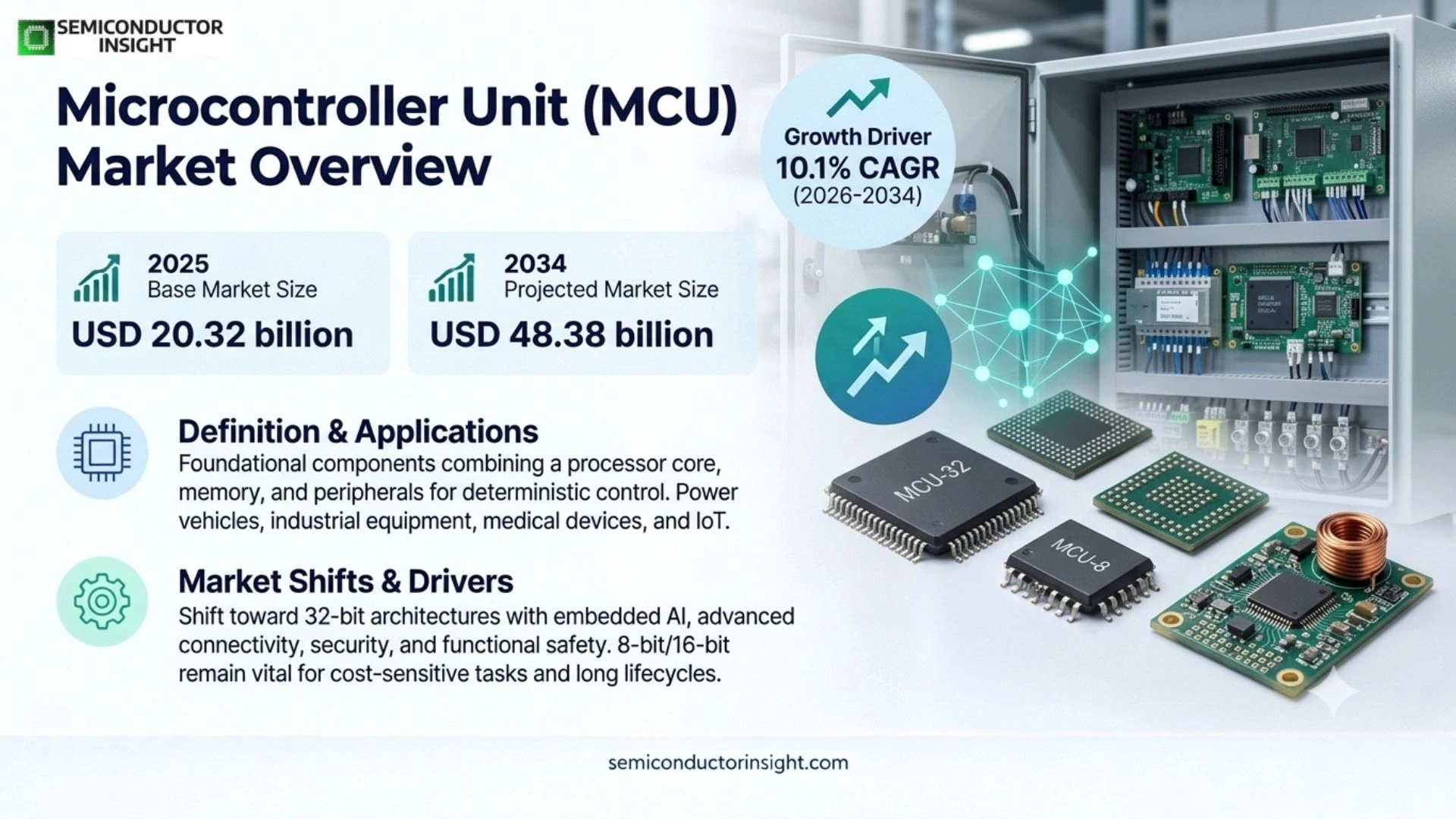
Microcontroller Unit (MCU) Market was valued at USD 20.32 billion in 2025 and is projected to reach USD 48.38 billion by 2034, representing a CAGR of 10.1% during 2026–2034. Asia Pacific holds the strongest market position in the source-defined scope.
A microcontroller unit combines a processor core, embedded program and data memory, timers, analog and digital peripherals, and programmable input/output on one integrated circuit. MCUs are optimized for deterministic control and low-power embedded operation rather than general-purpose computing, making them foundational components in vehicles, industrial equipment, appliances, medical devices, meters, connected sensors and consumer electronics.
The market is shifting toward higher-performance 32-bit architectures with hardware security, richer connectivity, embedded AI acceleration, advanced analog functions and functional-safety support. At the same time, 8-bit and 16-bit devices remain economically important in cost-sensitive control tasks where low standby power, mature software and long product lifecycles are more valuable than raw compute throughput.
Automotive is the largest application on the source page with a 35% share, and its influence is expanding as vehicles move toward zonal electrical architectures, electrification, advanced body control and software-defined functions. NXP’s 2025 S32K5 family illustrates the direction of travel: 16 nm automotive MCUs with embedded MRAM designed for zonal and electrification architectures, while Renesas and ST are pushing 1 GHz-class MCU performance into industrial, HMI and motor-control applications.
Segment Analysis: By Type
By type, the report segments the market into 4 Bit Type, 8 Bit Type, 16 Bit Type, 32 Bit Type, 64 Bit Type. 32 Bit Type holds the leading position, while 32 Bit Type offers the strongest structural growth path as buyers prioritize newer performance and integration requirements.
| Type | Demand characteristics | Market position |
|---|---|---|
| 4 Bit Type | 4 Bit Type serves a distinct portion of the microcontroller unit (mcu) market. Its purchasing logic depends on the balance between performance, integration, cost, lifecycle support and downstream design requirements. The segment’s commercial position is best understood through design-win persistence: once an OEM validates a component or product architecture, qualification cost and software or mechanical integration can keep that choice in production for multiple product generations. Application-dependent demand describes its current strategic role. | Application-dependent demand. Supplier competition centers on specifications that reduce customer design risk while preserving cost, availability and qualification continuity. |
| 8 Bit Type | 8 Bit Type serves a distinct portion of the microcontroller unit (mcu) market. Its purchasing logic depends on the balance between performance, integration, cost, lifecycle support and downstream design requirements. The segment’s commercial position is best understood through design-win persistence: once an OEM validates a component or product architecture, qualification cost and software or mechanical integration can keep that choice in production for multiple product generations. Application-dependent demand describes its current strategic role. | Application-dependent demand. Supplier competition centers on specifications that reduce customer design risk while preserving cost, availability and qualification continuity. |
| 16 Bit Type | 16 Bit Type serves a distinct portion of the microcontroller unit (mcu) market. Its purchasing logic depends on the balance between performance, integration, cost, lifecycle support and downstream design requirements. The segment’s commercial position is best understood through design-win persistence: once an OEM validates a component or product architecture, qualification cost and software or mechanical integration can keep that choice in production for multiple product generations. Application-dependent demand describes its current strategic role. | Application-dependent demand. Supplier competition centers on specifications that reduce customer design risk while preserving cost, availability and qualification continuity. |
| 32 Bit Type | 32 Bit Type serves a distinct portion of the microcontroller unit (mcu) market. Its purchasing logic depends on the balance between performance, integration, cost, lifecycle support and downstream design requirements. The segment’s commercial position is best understood through design-win persistence: once an OEM validates a component or product architecture, qualification cost and software or mechanical integration can keep that choice in production for multiple product generations. Largest / established segment describes its current strategic role. | Largest / established segment. Supplier competition centers on specifications that reduce customer design risk while preserving cost, availability and qualification continuity. |
| 64 Bit Type | 64 Bit Type serves a distinct portion of the microcontroller unit (mcu) market. Its purchasing logic depends on the balance between performance, integration, cost, lifecycle support and downstream design requirements. The segment’s commercial position is best understood through design-win persistence: once an OEM validates a component or product architecture, qualification cost and software or mechanical integration can keep that choice in production for multiple product generations. Application-dependent demand describes its current strategic role. | Application-dependent demand. Supplier competition centers on specifications that reduce customer design risk while preserving cost, availability and qualification continuity. |
Technology and performance mix
Although the source page uses a compact type axis, commercial differentiation extends across performance, connectivity, power, form factor and software support. These attributes determine average selling price and the persistence of design wins, so suppliers increasingly organize road maps around complete application platforms rather than isolated part numbers.
Segment Analysis: By Application
The application scope includes Industrial Application, Automotive Application, Other Applications. Automotive Application (35%) carries the largest current position, while Automotive & Industrial Automation is the most important incremental growth channel because it combines new unit demand with rising content or feature value per system.
| Application | Demand characteristics |
|---|---|
| Industrial Application Established application |
Industrial Application demand is created when end users need the core function of the microcontroller unit (mcu) category inside a finished system. Purchasing is triggered by product refresh cycles, performance targets, compliance requirements and the economics of integrating a validated solution. OEMs tend to favor suppliers that can document reliability, maintain availability and support engineering teams through design and qualification. This makes application expertise a commercial advantage rather than a marketing label. |
| Automotive Application Leading application |
Automotive Application demand is created when end users need the core function of the microcontroller unit (mcu) category inside a finished system. Purchasing is triggered by product refresh cycles, performance targets, compliance requirements and the economics of integrating a validated solution. OEMs tend to favor suppliers that can document reliability, maintain availability and support engineering teams through design and qualification. This makes application expertise a commercial advantage rather than a marketing label. |
| Other Applications Established application |
Other Applications demand is created when end users need the core function of the microcontroller unit (mcu) category inside a finished system. Purchasing is triggered by product refresh cycles, performance targets, compliance requirements and the economics of integrating a validated solution. OEMs tend to favor suppliers that can document reliability, maintain availability and support engineering teams through design and qualification. This makes application expertise a commercial advantage rather than a marketing label. |
Regional Analysis
Asia Pacific holds the strongest regional position, while the market’s regional structure reflects different combinations of manufacturing, downstream adoption, regulation, channel depth and design activity. These differences affect not only growth rates but also which product specifications and supplier capabilities convert into revenue.
How does regional demand differ across the Microcontroller Unit (MCU) market?
| Region | Position | Commercial logic |
|---|---|---|
| Asia Pacific | Largest | The region combines the largest electronics manufacturing base with strong automotive, appliance, industrial and IoT demand. China, Japan, South Korea and Taiwan anchor semiconductor production and embedded-system manufacturing, while India and Southeast Asia add fast-growing design and assembly capacity. |
| North America | Established / emerging | The United States market was USD 5.85 billion in 2024 on the source page. Demand is concentrated in automotive electronics, industrial control, aerospace, medical devices, smart-home platforms and a large embedded-software ecosystem. |
| Europe | Established / emerging | Automotive control, industrial automation, energy systems and safety-critical applications drive a high mix of qualified 32-bit MCUs. Functional-safety and cybersecurity requirements favor suppliers with long lifecycle support and established software ecosystems. |
| South America | Established / emerging | Brazil dominates regional demand through appliances, automotive assembly, industrial automation and utility metering. Distribution breadth and lifecycle availability are important because much of the market is supplied through imported semiconductors. |
| Middle East & Africa | Established / emerging | Smart-metering, industrial controls, energy systems, telecom equipment and consumer-electronics assembly are the main demand channels. The region remains smaller but benefits from infrastructure digitalization and local electronics initiatives. |
Competitive Landscape
The competitive landscape includes global platform suppliers, application specialists and regional value players. Key profiled companies include Renesas Electronics, Freescale Semiconductor, Microchip, ST, Atmel, NXP, Infineon Tech, TI, with competition increasingly decided by design support, product breadth, qualification history, software or ecosystem compatibility and the ability to maintain supply through long customer lifecycles.
Large suppliers benefit from portfolio breadth and cross-selling because customers can qualify several adjacent functions through one vendor relationship. Specialists can still win where they provide superior performance, domain-specific engineering or faster product innovation. The result is a market in which share is often determined during the design phase and then protected by switching costs once the customer enters production.
Pricing power is strongest where a product solves a system-level constraint, such as energy efficiency, functional safety, acoustic performance, low power, security, thermal limits or time to market. Commodity positions are more exposed to price erosion and distributor substitution, while differentiated positions can preserve margin through software, reference designs, certification packages and application engineering.
| Tier | Companies | Basis of competition |
|---|---|---|
| Tier 1 | Renesas Electronics, Freescale Semiconductor, Microchip, ST, Atmel | Global design-in reach, broad portfolio, strong channel access and sustained R&D investment. |
| Tier 2 | NXP, Infineon Tech, TI, Toshiba, Spansion, Maxim | Application specialization, regional strength and targeted technology differentiation. |
| Tier 3 / Other profiled | Nuvoton, Sinowealth, Sonix, Holtek, Elan, Sunplus, Megawin, Silan, Actions, Sigma Micro, CR Microelectronics, Novatek | Value positioning, local distribution and focused product niches. |
Key companies profiled in the report scope
- Renesas Electronics
- Freescale Semiconductor
- Microchip
- ST
- Atmel
- NXP
- Infineon Tech
- TI
- Toshiba
- Spansion
- Maxim
- Nuvoton
- Sinowealth
- Sonix
- Holtek
- Elan
- Sunplus
- Megawin
- Silan
- Actions
- Sigma Micro
- CR Microelectronics
- Novatek
Microcontroller Unit (MCU) Production Capacity Analysis
Production capacity for the microcontroller unit (mcu) market depends on semiconductor wafer fabrication, assembly, test and the availability of qualified process technologies. Large suppliers use a mix of internal fabs and foundry capacity, while back-end packaging and test remain essential for automotive, industrial and consumer-grade product differentiation.
The critical constraint is not simply wafer starts. Product qualification, process migration, packaging, test coverage, long-term reliability and customer-specific validation determine how quickly nominal capacity can become revenue-producing supply. Automotive and industrial products often remain on mature nodes for long periods because predictable analog behavior, embedded nonvolatile memory and proven reliability can matter more than transistor density.
Market Dynamics
Market growth is supported by technology upgrade cycles, broader downstream adoptionx”>Market positionEstablished / emerging
| Country | What drives demand |
|---|---|
| United States | The source page values the U.S. market at USD 5.85 billion in 2024, supported by automotive, industrial, medical and connected-device design. The commercial implication is that winning suppliers need a combination of local channel coverage, qualification support and product availability matched to the application mix rather than a uniform regional sales model. |
| Mexico | Automotive and electronics manufacturing near-shoring creates production demand for embedded controllers. The commercial implication is that winning suppliers need a combination of local channel coverage, qualification support and product availability matched to the application mix rather than a uniform regional sales model. |
| Canada | Industrial automation, energy and medical-device design support a smaller high-specification market. The commercial implication is that winning suppliers need a combination of local channel coverage, qualification support and product availability matched to the application mix rather than a uniform regional sales model. |
Market instances
- The region’s strongest demand pockets are those where downstream production, infrastructure investment or consumer adoption is expanding faster than the installed base. That creates fresh design decisions rather than replacement-only purchasing and gives suppliers an opportunity to win multi-year platform positions.
- Channel structure matters because qualification and availability often determine supplier selection before headline price. Vendors with local technical support, stocked inventory and application-specific reference designs can convert a global portfolio into regional share more effectively than remote catalog-only competitors.
- Product mix also differs by country. Mature markets pay for efficiency, reliability, software and advanced features, while faster-growing value markets require cost discipline and simpler integration. A supplier that uses one undifferentiated configuration across all countries risks losing both ends of the market.
Competitive Landscape
The competitive landscape includes global platform suppliers, application specialists and regional value players. Key profiled companies include Renesas Electronics, Freescale Semiconductor, Microchip, ST, Atmel, NXP, Infineon Tech, TI, with competition increasingly decided by design support, product breadth, qualification history, software or ecosystem compatibility and the ability to maintain supply through long customer lifecycles.
Large suppliers benefit from portfolio breadth and cross-selling because customers can qualify several adjacent functions through one vendor relationship. Specialists can still win where they provide superior performance, domain-specific engineering or faster product innovation. The result is a market in which share is often determined during the design phase and then protected by switching costs once the customer enters production.
Pricing power is strongest where a product solves a system-level constraint, such as energy efficiency, functional safety, acoustic performance, low power, security, thermal limits or time to market. Commodity positions are more exposed to price erosion and distributor substitution, while differentiated positions can preserve margin through software, reference designs, certification packages and application engineering.
| Tier | Companies | Basis of competition |
|---|---|---|
| Tier 1 | Renesas Electronics, Freescale Semiconductor, Microchip, ST, Atmel | Global design-in reach, broad portfolio, strong channel access and sustained R&D investment. |
| Tier 2 | NXP, Infineon Tech, TI, Toshiba, Spansion, Maxim | Application specialization, regional strength and targeted technology differentiation. |
| Tier 3 / Other profiled | Nuvoton, Sinowealth, Sonix, Holtek, Elan, Sunplus, Megawin, Silan, Actions, Sigma Micro, CR Microelectronics, Novatek | Value positioning, local distribution and focused product niches. |
Key companies profiled in the report scope
- Renesas Electronics
- Freescale Semiconductor
- Microchip
- ST
- Atmel
- NXP
- Infineon Tech
- TI
- Toshiba
- Spansion
- Maxim
- Nuvoton
- Sinowealth
- Sonix
- Holtek
- Elan
- Sunplus
- Megawin
- Silan
- Actions
- Sigma Micro
- CR Microelectronics
- Novatek
Microcontroller Unit (MCU) Production Capacity Analysis
Production capacity for the microcontroller unit (mcu) market depends on semiconductor wafer fabrication, assembly, test and the availability of qualified process technologies. Large suppliers use a mix of internal fabs and foundry capacity, while back-end packaging and test remain essential for automotive, industrial and consumer-grade product differentiation.
The critical constraint is not simply wafer starts. Product qualification, process migration, packaging, test coverage, long-term reliability and customer-specific validation determine how quickly nominal capacity can become revenue-producing supply. Automotive and industrial products often remain on mature nodes for long periods because predictable analog behavior, embedded nonvolatile memory and proven reliability can matter more than transistor density.
Market Dynamics
Market growth is supported by technology upgrade cycles, broader downstream adoptionand rising system-level performance requirements. The principal counterweights are qualification cost, price competition, integration complexity and supply-chain risk. The balance of these forces supports the rebased 10.1% CAGR for 2026–2034.
MARKET DRIVERS
Drivers Impact Analysis*
| Factor | Directional impact | Geographic relevance | Impact timeline |
|---|---|---|---|
| Automotive electronics expansion | High | Global with strongest relevance in Asia Pacific | 2026–2034 |
| Industrial automation and robotics | High | Global with strongest relevance in Asia Pacific | 2026–2034 |
| IoT and connected-device proliferation | Medium | Global with strongest relevance in Asia Pacific | 2026–2034 |
| Embedded AI and HMI capability | Medium | Global with strongest relevance in Asia Pacific | 2026–2034 |
Automotive electronics expansion
The source page assigns automotive applications a 35% share. Zonal architectures, electrification, battery management and body electronics increase both MCU count and performance requirements per vehicle. The commercial response is therefore visible in product road maps, qualification strategy and channel positioning, which determines whether the factor expands total addressable demand or simply redistributes share among existing suppliers.
Industrial automation and robotics
Renesas introduced the 1 GHz RA8T2 in September 2025 for high-end motor control, factory automation and robotics, showing how industrial control is moving toward higher compute density inside MCU-class devices. The commercial response is therefore visible in product road maps, qualification strategy and channel positioning, which determines whether the factor expands total addressable demand or simply redistributes share among existing suppliers.
IoT and connected-device proliferation
Low-power wireless connectivity, security and sensor integration expand MCU content in smart-home, metering, healthcare and industrial edge devices. The commercial response is therefore visible in product road maps, qualification strategy and channel positioning, which determines whether the factor expands total addressable demand or simply redistributes share among existing suppliers.
Embedded AI and HMI capability
ST’s STM32V8 and Renesas RA8D2/RA8M2 launches show MCU vendors adding more compute, graphics, DSP and machine-learning capability while retaining deterministic control and embedded peripherals. The commercial response is therefore visible in product road maps, qualification strategy and channel positioning, which determines whether the factor expands total addressable demand or simply redistributes share among existing suppliers.
MARKET RESTRAINTS
Restraints Impact Analysis*
| Factor | Directional impact | Geographic relevance | Impact timeline |
|---|---|---|---|
| Cyclical semiconductor inventory swings | High | Global with strongest relevance in Asia Pacific | 2026–2034 |
| Software migration cost | High | Global with strongest relevance in Asia Pacific | 2026–2034 |
| Security and safety qualification burden | Medium | Global with strongest relevance in Asia Pacific | 2026–2034 |
| Legacy architecture persistence | Medium | Global with strongest relevance in Asia Pacific | 2026–2034 |
Cyclical semiconductor inventory swings
MCU demand can be distorted by inventory corrections after shortage periods, causing order volatility that is sharper than underlying end-market consumption. The commercial response is therefore visible in product road maps, qualification strategy and channel positioning, which determines whether the factor expands total addressable demand or simply redistributes share among existing suppliers.
Software migration cost
Changing MCU families requires firmware porting, validation, safety recertification and toolchain changes, making design wins sticky but slowing adoption of new entrants. The commercial response is therefore visible in product road maps, qualification strategy and channel positioning, which determines whether the factor expands total addressable demand or simply redistributes share among existing suppliers.
Security and safety qualification burden
Automotive and industrial customers increasingly require secure boot, hardware roots of trust, long support periods and ISO 26262-class safety, increasing development cost. The commercial response is therefore visible in product road maps, qualification strategy and channel positioning, which determines whether the factor expands total addressable demand or simply redistributes share among existing suppliers.
Legacy architecture persistence
Large installed bases of 8-bit and 16-bit designs remain economical and difficult to displace, slowing the speed at which higher-value 32-bit devices penetrate every application. The commercial response is therefore visible in product road maps, qualification strategy and channel positioning, which determines whether the factor expands total addressable demand or simply redistributes share among existing suppliers.
MARKET OPPORTUNITIES
Software-defined vehicle zonal control
NXP’s S32K5 family targets zonal and electrification architectures with 16 nm FinFET and embedded MRAM, creating a higher-value MCU tier tied to ECU consolidation. The commercial response is therefore visible in product road maps, qualification strategy and channel positioning, which determines whether the factor expands total addressable demand or simply redistributes share among existing suppliers.
1 GHz-class industrial MCUs
Renesas RA8T2 and RA8M2/RA8D2 show that MCU vendors can capture workloads that previously required application processors or DSPs while preserving real-time control. The commercial response is therefore visible in product road maps, qualification strategy and channel positioning, which determines whether the factor expands total addressable demand or simply redistributes share among existing suppliers.
Ultra-low-power edge devices
ST’s STM32U3 targets meters, healthcare devices and industrial sensors with strong performance-per-watt, expanding opportunities where battery life is a purchasing constraint. The commercial response is therefore visible in product road maps, qualification strategy and channel positioning, which determines whether the factor expands total addressable demand or simply redistributes share among existing suppliers.
Secure connected MCUs
Wi-Fi, Bluetooth LE and Ethernet integration with hardware security can shift value from external connectivity chips into the MCU platform and deepen software ecosystem lock-in. The commercial response is therefore visible in product road maps, qualification strategy and channel positioning, which determines whether the factor expands total addressable demand or simply redistributes share among existing suppliers.
Microcontroller Unit (MCU) Supply Chain Analysis
Wafer & Materials
Silicon wafers, process materials and specialty substrates feed semiconductor fabrication.
Fabrication
IDMs and foundries create die using process nodes chosen for analog, power, embedded-memory and reliability needs.
Packaging & Test
Assembly, qualification and test convert wafer output into application-ready components with required thermal and reliability characteristics.
OEM & Distribution
OEM design-ins, authorized distribution and application support determine how semiconductor supply becomes end-market revenue.
Wafer & Materials: Silicon wafers, process materials and specialty substrates feed semiconductor fabrication. Value capture at this stage depends on the ability to solve a bottleneck that downstream customers cannot easily substitute, so qualification, yield, intellectual property, logistics and support all influence bargaining power.
Fabrication: IDMs and foundries create die using process nodes chosen for analog, power, embedded-memory and reliability needs. Value capture at this stage depends on the ability to solve a bottleneck that downstream customers cannot easily substitute, so qualification, yield, intellectual property, logistics and support all influence bargaining power.
Packaging & Test: Assembly, qualification and test convert wafer output into application-ready components with required thermal and reliability characteristics. Value capture at this stage depends on the ability to solve a bottleneck that downstream customers cannot easily substitute, so qualification, yield, intellectual property, logistics and support all influence bargaining power.
OEM & Distribution: OEM design-ins, authorized distribution and application support determine how semiconductor supply becomes end-market revenue. Value capture at this stage depends on the ability to solve a bottleneck that downstream customers cannot easily substitute, so qualification, yield, intellectual property, logistics and support all influence bargaining power.
Recent Developments in the Microcontroller Unit (MCU) Market
REPORT SCOPE & SEGMENTATION
| Attribute | Details |
|---|---|
| Study Period | 2021–2034 |
| Base Year | 2025 |
| Estimated Year | 2026 |
| Forecast Period | 2026–2034 |
| Historical Period | 2021–2025 |
| Market Size 2025 | USD 20.32 billion |
| Market Size 2034 | USD 48.38 billion |
| Growth Rate | CAGR of 10.1% from 2026–2034 |
| Unit | Value (USD Million/Billion) and Volume (Units/Thousand Units where applicable) |
| Segmentation | By Type, By Application, By Region |
| By Type | 4 Bit Type · 8 Bit Type · 16 Bit Type · 32 Bit Type · 64 Bit Type |
| By Application | Industrial Application · Automotive Application · Other Applications |
| By Region | Each region analysed by Type, Application and Country North AmericaUnited States, Canada, Mexico EuropeGermany, France, U.K., Italy, Russia, Rest of Europe Asia PacificChina, Japan, South Korea, India, Southeast Asia, Rest of Asia Pacific South AmericaBrazil, Argentina, Colombia, Rest of South America Middle East & AfricaSaudi Arabia, UAE, Egypt, Nigeria, South Africa, Rest of MEA |
| Key Companies Profiled | Renesas Electronics · Freescale Semiconductor · Microchip · ST · Atmel · NXP · Infineon Tech · TI · Toshiba · Spansion · Maxim · Nuvoton · Sinowealth · Sonix · Holtek · Elan · Sunplus · Megawin · Silan · Actions · Sigma Micro · CR Microelectronics · Novatek |
| Customization Scope | Free report customization equivalent to up to four analyst working days with purchase. Addition or alteration to country, regional and segment scope. |
Frequently Asked Questions
What is the current size of the market?
The Microcontroller Unit (MCU) market is valued at USD 20.32 billion in 2025 and is projected to reach USD 48.38 billion by 2034. The rebased series implies a 10.1% CAGR during 2026–2034. The forecast is anchored to the two published market-size values on the source report page and then normalized to the requested 2025 base and 2034 endpoint.
Which product type leads the market?
32 Bit Type holds the leading type position in the source-defined segmentation. Its advantage reflects the balance of installed-base demand, performance requirements, design familiarity and supplier availability. 32 Bit Type has the strongest structural growth case because newer systems place greater emphasis on integration, efficiency, advanced features or performance that expands value per unit.
Which application is most important?
Automotive Application (35%) is the largest current application position, while Automotive & Industrial Automation is the most important incremental growth channel. Application growth is not only about shipment volume: it also reflects rising content, more demanding technical specifications, stronger qualification requirements and a greater need for system-level support from component or product suppliers.
Which market or region leads in 2025?
Asia Pacific holds the strongest market position in 2025 within the available source evidence, while Asia Pacific has the most important regional role in the broader competitive structure. Leadership is supported by a combination of downstream demand, manufacturing capacity, design activity, channel depth and faster adoption of newer product generations.
Get Sample Report PDF for Exclusive Insights
Report Sample Includes
- Table of Contents
- List of Tables & Figures
- Charts, Research Methodology, and more...