
General-Purpose AI Processor Market Insights
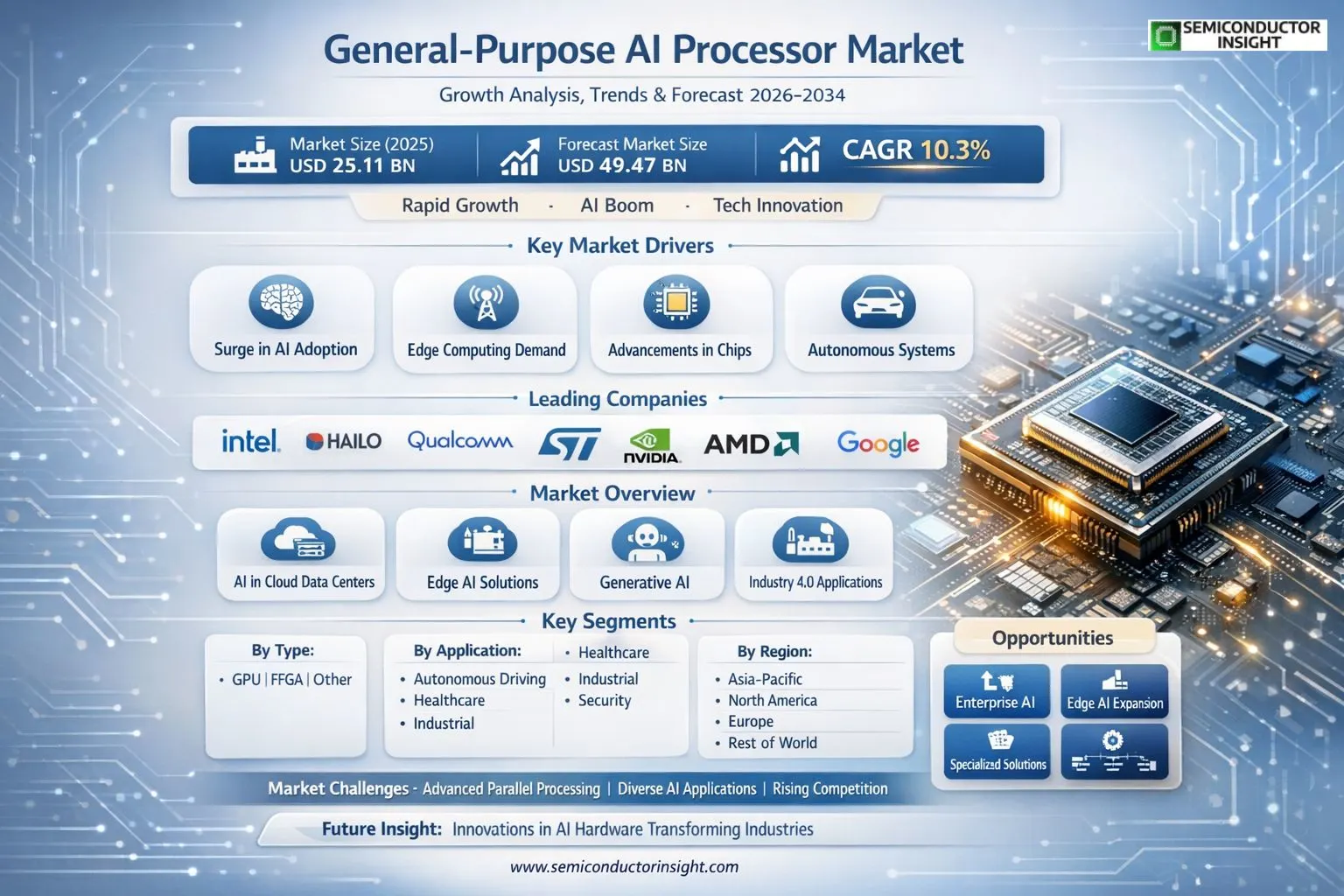
Global General-Purpose AI Processor market size was valued at USD 25.11 billion in 2025. The market is projected to grow from USD 27.7 billion in 2026 to USD 49.47 billion by 2034, exhibiting a CAGR of 10.3% during the forecast period.
General-purpose AI processors are specialized hardware devices engineered to efficiently execute a broad spectrum of artificial intelligence (AI) workloads. These chips combine the programmability of traditional central processing units (CPUs) with the massively parallel architecture of graphics processing units (GPUs), while being specifically optimized for computationally intensive algorithms like machine learning and deep learning. Their highly parallelized design enables rapid processing of vast datasets, and they typically support multiple precision data types critical for AI model training and inference.
The market is experiencing robust growth driven by several key factors, including the explosive demand for AI capabilities across cloud data centers, edge computing devices, and autonomous systems. Furthermore, advancements in large language models (LLMs) and generative AI are creating unprecedented computational demands that fuel adoption. Initiatives by leading semiconductor companies are also accelerating market expansion. For instance, in recent years, NVIDIA has continued to launch new architectures like Hopper and Blackwell for data center GPUs, while companies like AMD with its Instinct MI300 series and Intel with its Gaudi accelerators are intensifying competition in this high-growth segment.
MARKET DRIVERS
Proliferation of AI Workloads Across Industries
The exponential growth in AI adoption for data analytics, natural language processing, and computer vision is fundamentally increasing demand for the General-Purpose AI Processor Market. These chips are designed for versatile AI model training and inference, unlike application-specific accelerators. The shift from cloud-centric to hybrid and edge AI deployment models further necessitates flexible processing power, directly fueling market expansion across sectors from automotive to healthcare. Over 40% of large enterprises are now investing in dedicated AI hardware infrastructure.
Advancements in Semiconductor Fabrication
Breakthroughs in chiplet architectures, advanced packaging like 2.5D/3D integration, and next-generation process nodes (below 5nm) are enabling unprecedented performance and energy efficiency for general-purpose AI processors. This technological evolution allows single-chip solutions to handle increasingly complex and concurrent AI workloads, reducing total cost of ownership and making powerful AI acceleration more accessible. These improvements are critical for scaling large language model operations.
➤ The demand for hardware capable of running diverse and evolving AI algorithms, without being locked into a single function, is the core value proposition of the General-Purpose AI Processor Market.
Concurrently, significant investment from both established semiconductor giants and well-funded startups is accelerating R&D cycles and product diversification. This competitive intensity is rapidly bringing new architectures to market, offering customers greater choice and pushing the boundaries of computational throughput and memory bandwidth essential for modern AI tasks.
MARKET CHALLENGES
Intense Competition and Architectural Fragmentation
The General-Purpose AI Processor Market faces a fiercely competitive landscape with divergent architectural approaches (e.g., GPGPU, TPU-like designs, novel vector processors). This fragmentation creates uncertainty for OEMs and software developers, who must invest significant resources in porting and optimizing frameworks for different hardware platforms. Achieving broad software ecosystem support and developer mindshare remains a significant hurdle for new entrants attempting to challenge incumbents.
Other Challenges
Power and Thermal Constraints
As performance scales, managing the immense power density and heat dissipation of cutting-edge general-purpose AI processors becomes a critical engineering challenge, especially for deployment in dense data centers or edge devices.
Rapid Technological Obsolescence
The breakneck pace of AI model development and algorithmic innovation can render a processor architecture less optimal within a short timeframe, posing a constant risk of investment depreciation for both vendors and buyers.
MARKET RESTRAINTS
High Development Costs and Extended Design Cycles
The design and fabrication of a leading-edge general-purpose AI processor requires capital investment often exceeding several billion dollars and spanning multiple years. This creates a high barrier to entry and concentrates market power among a few well-resourced players. The economic model depends on achieving high-volume sales to recoup these immense R&D and manufacturing costs, which can be precarious in a market with shifting technical requirements.
Supply Chain and Geopolitical Vulnerabilities
The market is susceptible to disruptions in the advanced semiconductor supply chain, from access to EUV lithography tools to specialty materials. Furthermore, increasing geopolitical tensions and export controls on advanced computing technology can restrict market access and bifurcate global supply chains, limiting growth potential and complicating strategic planning for vendors in the General-Purpose AI Processor Market.
MARKET OPPORTUNITIES
Enterprise AI Democratization and Edge Expansion
The trend toward democratizing AI, where smaller organizations deploy customized models, opens a vast opportunity for general-purpose AI processors that offer a balance of performance and programmability. Furthermore, the explosive growth of AI at the edge,in smart factories, retail, and IoT devices,requires efficient, versatile processors that can run multiple AI tasks in constrained environments, representing a major new frontier for market growth beyond traditional data centers.
Specialization within General-Purpose Paradigms
There is significant opportunity for innovation in designing general-purpose AI processors with targeted enhancements for specific data types (e.g., graph neural networks, reinforcement learning) or industry verticals. This approach, often called domain-specific architecture within a flexible framework, allows vendors to capture high-value segments of the General-Purpose AI Processor Market while maintaining the software advantages of a broadly applicable platform, enhancing performance for emerging workloads.
General-Purpose AI Processor Market Trends
Architectural Evolution Towards Higher Parallelism
The dominant trend in the General-Purpose AI Processor Market revolves around architectural innovation to achieve unprecedented parallel processing capabilities. Unlike traditional CPUs, these processors are designed with highly parallelized structures that efficiently manage the matrix and vector computations inherent to deep learning. This architectural shift is driven by the need to process vast datasets for training complex neural networks, pushing the market towards designs that optimize for multiple data precision types simultaneously. Manufacturers are integrating specialized tensor cores and advanced memory hierarchies to reduce data movement bottlenecks, a critical factor for performance in data-intensive applications from autonomous systems to real-time analytics.
Other Trends
Diversification Across Application Verticals
Expansion beyond cloud data centers is a significant trend, with the General-Purpose AI Processor Market seeing rapid adoption across diverse verticals. The demand is particularly strong in automotive for autonomous driving, industrial automation for predictive maintenance, and security for intelligent video analytics. Each application imposes unique requirements for power efficiency, latency, and reliability, prompting vendors to develop specialized variants of their core architectures. This trend is compelling the competitive landscape to evolve, as companies must now provide tailored solutions alongside their flagship products to capture growth in these emerging segments. The market segment percentages reflect this broadening, with significant portions allocated to autonomous driving, medical, and industrial applications.
Intensifying Competitive Landscape and Strategic Developments
The competitive dynamics within the General-Purpose AI Processor Market are intensifying, marked by strategic mergers, acquisitions, and increased R&D investments from both established semiconductor giants and specialized silicon startups. Key players, including NVIDIA, Intel, AMD, and Qualcomm, are leveraging their expertise in GPU and system-on-chip design, while newer entrants from regions like China are focusing on niche optimizations and cost-effective solutions. This activity extends the market’s innovation horizon, fostering developments in chiplet-based designs and advanced packaging technologies to further enhance performance and scalability for next-generation AI workloads.
COMPETITIVE LANDSCAPE
Key Industry Players
A High-Growth Arena Dominated by Established Silicon Giants and Agile Specialists
Global General-Purpose AI Processor market is characterized by intense competition, with NVIDIA historically establishing a dominant leadership position through its advanced GPU architectures, which have become the de facto standard for training complex AI models. However, the market structure is rapidly evolving from a near-monopoly to an oligopolistic and fragmented landscape. Established semiconductor giants like Intel, AMD, and Qualcomm are aggressively investing in dedicated AI silicon (XPUs, NPUs) to capture data center and edge computing segments. Concurrently, hyperscalers such as Google have vertically integrated with custom silicon like the TPU, creating a significant captive market and exerting pressure on merchant chip vendors. This dynamic has consolidated a substantial portion of revenue among the top five global players, though their collective market share is being contested by innovative newcomers.
Beyond the leaders, a vibrant ecosystem of specialist and regional players is carving out significant niches. Companies like HAILO and Texas Instruments focus on ultra-efficient processors for edge AI and automotive applications. In China, a concerted push for semiconductor self-sufficiency has spurred the growth of key domestic contenders, including Beijing Haiguang Information Technology, Suzhou Denglin Technology, and Biren Technology, which are developing competitive alternatives across cloud and data center markets. Similarly, FPGA vendors like Lattice Semiconductor and Intel (via its Altera division) cater to customizable, low-latency inference workloads. This diversification indicates a healthy, competitive market where innovation in architecture, power efficiency, and software ecosystems is paramount for sustained growth.
List of Key General-Purpose AI Processor Companies Profiled
- NVIDIA Corporation
- Intel Corporation
- Advanced Micro Devices, Inc. (AMD)
- Qualcomm Incorporated
- Google LLC (Alphabet Inc.)
- Texas Instruments Incorporated
- HAILO
- STMicroelectronics N.V.
- Suzhou Denglin Technology Co., Ltd.
- Beijing Haiguang Information Technology Co., Ltd.
- Shanghai Biren Technology Co., Ltd.
- Kunlunxin (Beijing) Technology Co., Ltd.
- Lattice Semiconductor Corporation
- Moore Threads Intelligent Technology (Beijing) Co., Ltd.
- T-head (Shanghai) Semiconductor Co., Ltd.
Segment Analysis:
| Segment Category | Sub-Segments | Key Insights |
| By Type |
|
GPU (Graphics Processing Unit) remains the foundational and leading segment, widely adopted for its proven parallel processing capabilities ideal for deep learning training. The segment benefits from extensive software ecosystems and continuous architectural breakthroughs from key manufacturers. Its flexibility across diverse AI workloads, from data centers to edge computing, underpins its dominance, while competition spurs innovation in power efficiency and specialized AI tensor cores. |
| By Application |
|
Autonomous Driving represents a primary growth frontier, driving intense demand for high-performance, low-latency, and safety-certifiable processors. The complexity of real-time sensor fusion and decision-making requires processors that balance immense computational power with stringent reliability standards, making it a key innovation battleground. This application pushes the boundaries for power efficiency and edge-AI capabilities, directly influencing processor design priorities across the market. |
| By End User |
|
Data Center & Cloud Service Providers are the leading end-users, acting as the primary engine for AI training and large-scale inference services. Their demand prioritizes raw computational throughput, scalability, and total cost of ownership, shaping product roadmaps towards ever-more powerful and efficient server-grade processors. This segment’s requirements for handling massive, heterogeneous AI workloads make it the central driver for technological advancements in processor architecture and interconnects. |
| By Deployment |
|
Cloud/Data Center deployment is the dominant paradigm, centralizing the most demanding AI training workloads and inference services. However, the strategic importance of Edge Devices is growing rapidly, fueled by needs for real-time processing, data privacy, and bandwidth efficiency in applications like autonomous vehicles and smart factories. This dual-cloud-and-edge dynamic is compelling vendors to develop heterogeneous product portfolios, balancing sheer power with extreme efficiency and ruggedness for diverse deployment environments. |
| By Design Focus |
|
Training-Optimized Processors have historically led, focusing on extreme precision and massive parallelism for model development. The market trajectory shows a powerful surge in Inference-Optimized Processors designed for cost-effective, high-volume deployment. This shift underscores the industry’s maturation from a research-centric phase to large-scale commercialization, driving innovation in lower-precision arithmetic, dedicated tensor cores, and memory architectures tailored for efficient, low-latency execution of trained models in production environments. |
Regional Analysis: General-Purpose AI Processor Market
North America
The region is an epicenter for R&D, with tech-giants and agile startups in the General-Purpose AI Processor Market driving architectural breakthroughs in energy efficiency, memory bandwidth, and multi-core designs to support complex AI workloads.
Early and deep integration of General-Purpose AI Processors by hyperscalers and large enterprises for data-intensive tasks creates a high-demand foundation, accelerating deployment cycles and validating new use cases.
An active venture capital environment provides substantial funding for General-Purpose AI Processor Market innovators, enabling rapid scaling from prototype to volume production and supporting aggressive go-to-market strategies.
Strong collaborations between processor designers, foundries, software firms, and end-users create a vertically-integrated ecosystem that speeds up development and establishes comprehensive solution platforms for the General-Purpose AI Processor Market.
Asia-Pacific
The Asia-Pacific region represents the fastest-growing market for General-Purpose AI Processors, fueled by massive manufacturing capabilities, increasing AI integration in consumer electronics, and proactive government initiatives. Countries such as China, South Korea, and Taiwan are critical, not only as major consumers but also as pivotal nodes in Global semiconductor supply chain. Growth is propelled by the expansion of data center infrastructure, the proliferation of AI-powered smart devices, and significant investments in domestic chip design capabilities. The regional General-Purpose AI Processor Market is characterized by a focus on cost-competitive solutions and scalable manufacturing, catering to a broad industrial and consumer base. Localized innovation aimed at meeting specific regional demands for smart cities, industrial automation, and edge computing applications further accelerates market penetration and diversification.
Europe
Europe’s General-Purpose AI Processor Market is growing steadily, anchored by a strong emphasis on research excellence, stringent data governance, and strategic autonomy in critical technologies. Key regional strengths lie in automotive, industrial IoT, and scientific research sectors, which demand high-performance, energy-efficient, and reliable AI processors. Initiatives like the European Chips Act aim to bolster the regional semiconductor ecosystem, including design and production capabilities for advanced processors. Market growth is supported by collaborative projects between academia, research institutes, and industry, focusing on specialized applications that align with European values of sustainability, privacy, and ethical AI. This focus creates a niche for General-Purpose AI Processors optimized for edge deployment and trusted computing environments.
South America
The General-Purpose AI Processor Market in South America is in an emerging phase, with growth primarily catalyzed by digital transformation in the financial services, agriculture, and telecommunications sectors. Initial adoption is concentrated among large corporations and tech-savvy enterprises looking to leverage AI for data analytics and process automation. While the regional market currently relies on imports, there is a gradual increase in local AI talent development and pilot projects. Challenges include infrastructure limitations and economic volatility, but these are offset by the long-term potential for AI integration. The market trajectory is set for gradual acceleration as connectivity improves and regional partnerships foster knowledge transfer and localized solution development.
Middle East & Africa
The General-Purpose AI Processor Market in the Middle East & Africa region is characterized by strategic investments in smart city projects, digital government services, and energy sector optimization. Gulf nations are leading the adoption, deploying AI processors to power ambitious national visions focused on economic diversification. Key applications include surveillance, resource management, and financial technology. In Africa, growth is more nascent but promising, driven by mobile technology penetration and fintech innovation. The regional market is defined by project-based deployment and partnerships with global technology providers. Long-term development hinges on building digital infrastructure and cultivating local expertise, positioning the General-Purpose AI Processor Market for future strategic importance.
Report Scope
This market research report provides a comprehensive analysis of the General-Purpose AI Processor Market , covering the forecast period 2026–2034. It offers detailed insights into market dynamics, technological advancements, competitive landscape, and key trends shaping the industry.
Key focus areas of the report include:
- Market Overview: The report begins with an overview outlining its current market scenario, key growth indicators, and industry transformation drivers. It discusses macroeconomic factors, demand–supply balance, regulatory landscape, and the strategic role of semiconductors in powering advancements across industries such as automotive, telecommunications, consumer electronics, and industrial automation.
- Market Size & Forecast: Historical data and future projections for revenue, unit shipments, and market value across major regions and segments.
- Segmentation Analysis: Detailed breakdown by product type, technology, application, and end-user industry to identify high-growth segments and investment opportunities.
- Regional Insights: Insights into market performance across North America, Europe, Asia-Pacific, Latin America, and the Middle East & Africa, including country-level analysis where relevant.
- Competitive Landscape: Profiles of leading market participants, including their product offerings, R&D focus, manufacturing capacity, pricing strategies, and recent developments such as mergers, acquisitions, and partnerships.
- Technology Trends & Innovation: Assessment of emerging technologies, integration of AI/IoT, semiconductor design trends, fabrication techniques, and evolving industry standards.
- Market Drivers & Restraints: Evaluation of factors driving market growth along with challenges, supply chain constraints, regulatory issues, and market-entry barriers.
- Stakeholder Insights: Insights for component suppliers, OEMs, system integrators, investors, and policymakers regarding the evolving ecosystem and strategic opportunities.
Primary and secondary research methods are employed, including interviews with industry experts, data from verified sources, and real-time market intelligence to ensure the accuracy and reliability of the insights presented.
FREQUENTLY ASKED QUESTIONS:
What is the current market size of General-Purpose AI Processor Market?
-> Global General-Purpose AI Processor market was valued at USD 25110 million in 2025 and is projected to reach USD 49470 million by 2034, at a CAGR of 10.3% during the forecast period.
Which key companies operate in General-Purpose AI Processor Market?
-> Key players include Intel, HAILO, Qualcomm, STMicroelectronics, NVIDIA, AMD, Google, Texas Instruments, Suzhou Denglin Technology, Beijing Haiguang Information Technology, among others.
What are the key growth drivers?
-> Key growth drivers include the increasing demand from industries such as autonomous driving, security, medical, and industrial automation, advancements in AI algorithms requiring dedicated hardware, and the highly parallelized architecture of these processors enabling efficient computational performance.
Which region dominates the market?
-> While detailed regional valuation is included in the report, the market is analyzed across all major regions including North America, Europe, Asia, South America, and the Middle East & Africa.
What are the emerging trends?
-> Emerging trends include the development of processors optimized for diverse AI tasks and data types (machine learning and deep learning), greater hardware integration of AI capabilities, and continuous innovation in processor design for high-performance applications.

Get Sample Report PDF for Exclusive Insights
Report Sample Includes
- Table of Contents
- List of Tables & Figures
- Charts, Research Methodology, and more...
 Download Sample Report PDF



