Key Statistics
Key Takeaways
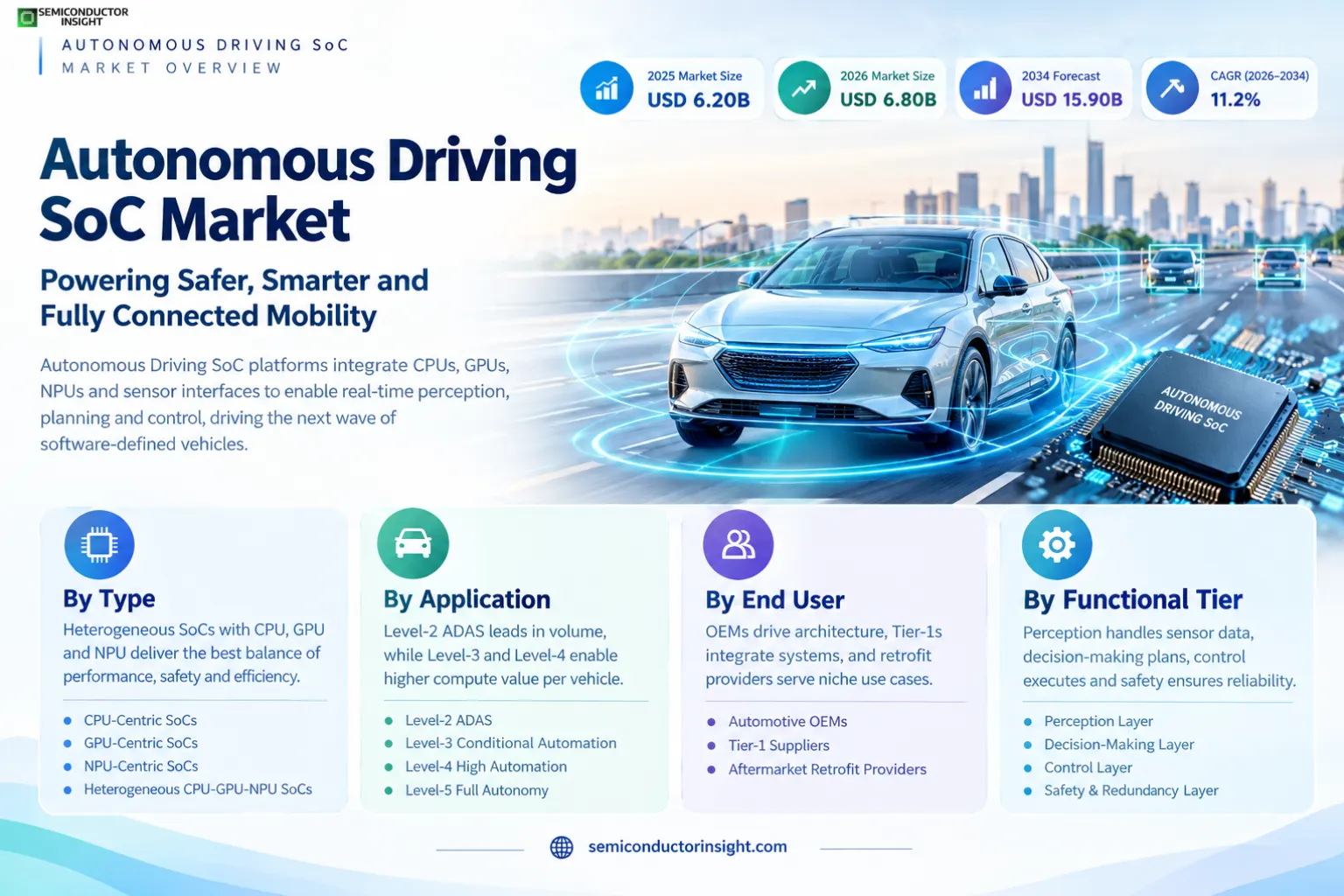
- The market is valued at USD 6.20 billion in 2025 and is projected to reach USD 15.90 billion by 2034, representing a 11.2% CAGR over 2026–2034.
- CPU-Centric SoCs is a major product segment, while adjacent variants are expanding as performance, integration and cost requirements evolve.
- Level-2 ADAS is a leading application area, supported by demand across Level-3 Conditional Automation, Level-4 High Automation.
- North America is the largest market in 2025 based on current demand, technology concentration and ecosystem maturity.
Autonomous Driving SoC Market Overview
Autonomous Driving SoC platforms integrate CPUs, GPUs, NPUs, image-processing engines, networking and functional-safety processors to run perception, sensor fusion, path planning and vehicle control in real time. They replace collections of discrete ECUs with centralized or zonal compute platforms capable of supporting software-defined vehicle architectures. Commercial adoption of Autonomous Driving SoC products therefore depends on system-level productivity, integration requirements, reliability expectations and the economics of replacing established alternatives in real operating environments.
The market is moving toward much higher AI performance and stronger hardware-software co-design. New platforms combine large neural accelerators with safety islands and high-bandwidth sensor interfaces, while software stacks increasingly support end-to-end AI and over-the-air improvement. Commercial success therefore depends on both silicon capability and long-term automotive software support. Suppliers that translate technical improvements into measurable gains in efficiency, uptime, cost, throughput or workflow simplicity are better positioned to win long-duration programs and repeat purchases.
Segment Analysis: By Type
Heterogeneous CPU-GPU-NPU SoCs are becoming the architectural center of the market because autonomous driving needs general compute, highly parallel vision processing and efficient neural inference at the same time. Safety islands and dedicated accelerators add deterministic control and fault monitoring. Within this segment, customers increasingly compare lifecycle support, qualification requirements, integration effort and total ownership cost rather than relying on a single specification or upfront price.
| Segment | Market Relevance |
|---|---|
| CPU-Centric SoCs | General control and safety-heavy designs. |
| GPU-Centric SoCs | High parallel throughput for vision workloads. |
| NPU-Centric SoCs | Efficient neural inference. |
| Heterogeneous CPU-GPU-NPU SoCs | Fastest-growing unified automotive compute. |
Segment Analysis: By Application
Level-2 ADAS provides the largest current shipment base, while Level-3 and Level-4 platforms create the highest compute value per vehicle. Level-5 remains a long-term opportunity because technical, validation and regulatory requirements are substantially higher. Within this segment, customers increasingly compare lifecycle support, qualification requirements, integration effort and total ownership cost rather than relying on a single specification or upfront price.
| Segment | Market Relevance |
|---|---|
| Level-2 ADAS | Largest production volume today. |
| Level-3 Conditional Automation | Eyes-off capability under defined conditions. |
| Level-4 High Automation | Robotaxi and advanced commercial deployments. |
| Level-5 Full Autonomy | Long-term fully driverless target. |
Segment Analysis: By End User
Automotive OEMs increasingly control compute architecture because software-defined vehicle strategies require long-term hardware and software roadmaps. Tier-1 suppliers integrate sensors and domain controllers, while retrofit providers address limited commercial or fleet use cases. Within this segment, customers increasingly compare lifecycle support, qualification requirements, integration effort and total ownership cost rather than relying on a single specification or upfront price.
| Segment | Market Relevance |
|---|---|
| Automotive OEMs | Architecture ownership and vehicle integration. |
| Tier-1 Suppliers | Sensor, ECU and system integration. |
| Aftermarket Retrofit Providers | Specialized fleet and legacy vehicle use. |
Segment Analysis: By Functional Tier
Perception consumes the largest AI throughput because multiple camera, radar and lidar streams must be processed in real time. Decision-making and control require low-latency deterministic execution, while safety and redundancy layers monitor critical functions independently of the main AI workload. Within this segment, customers increasingly compare lifecycle support, qualification requirements, integration effort and total ownership cost rather than relying on a single specification or upfront price.
| Segment | Market Relevance |
|---|---|
| Perception Layer | Camera/radar/lidar fusion and object detection. |
| Decision-Making Layer | Planning and path selection. |
| Control Layer | Vehicle actuation and real-time response. |
| Safety & Redundancy Layer | Independent monitoring and fail-operational behavior. |
Regional Analysis
North America is a leading market because NVIDIA, Qualcomm and major autonomous-driving developers are based in the United States, while Asia Pacific is expanding rapidly through China, South Korea and Japan. Europe remains a major automotive integration and functional-safety market. Regional share also reflects supplier depth, engineering support, manufacturing concentration and the speed at which new Autonomous Driving SoC designs can move from evaluation into repeat deployment.
| Region | Position | Growth | Profile |
|---|---|---|---|
| North America | Largest | Very strong | SoC design, AI software and OEM partnerships led |
| Asia Pacific | Fastest-growing | Very strong | Vehicle volume and local AI chip development led |
| Europe | Automotive integration hub | Strong | OEM engineering and safety led |
| South America | Emerging | Moderate | ADAS adoption led |
| Middle East & Africa | Developing | Strong from smaller base | Smart mobility and premium vehicles led |
Detailed Regional Blocks
Why does North America matter in this market?
North America leads in high-performance autonomous-driving compute through NVIDIA, Qualcomm, Tesla and a dense AI ecosystem. U.S. suppliers increasingly provide complete hardware-software platforms rather than standalone silicon, which strengthens design-in with global automakers. In North America, procurement decisions also depend on service coverage, qualification resources, logistics and long-term availability, so ecosystem maturity can materially influence adoption even when core technology performance is similar.
| Country / Market | Role | Context |
|---|---|---|
| United States | Global platform hub | NVIDIA, Qualcomm and Tesla drive architecture and software. |
| Canada | AI research niche | Computer-vision and autonomy research support development. |
| Mexico | Vehicle manufacturing base | ADAS platforms enter regional vehicle production. |
- NVIDIA DRIVE AGX Thor delivers more than 1,000 INT8 TOPS and supports Level 2+ through fully autonomous systems.
- Qualcomm Snapdragon Ride combines Oryon CPU, Adreno GPU, Hexagon NPU and safety processing across scalable automotive platforms.
- Qualcomm announced in July 2026 that BMW selected its compute silicon for next-generation cockpit and ADAS/AD programs through the next decade.
Why does Asia Pacific matter in this market?
Asia Pacific is expanding rapidly because China has a large EV market and active autonomous-driving ecosystem, while Japan and South Korea combine automotive manufacturing with advanced semiconductor capabilities. Local SoC suppliers are also increasing competition. In Asia Pacific, procurement decisions also depend on service coverage, qualification resources, logistics and long-term availability, so ecosystem maturity can materially influence adoption even when core technology performance is similar.
| Country / Market | Role | Context |
|---|---|---|
| China | Largest growth engine | EVs, smart vehicles and domestic silicon accelerate adoption. |
| Japan | Automotive and semiconductor hub | OEMs integrate advanced ADAS compute. |
| South Korea | Electronics and vehicle platform market | Samsung and automakers support local ecosystems. |
- Chinese OEMs are among the fastest adopters of centralized vehicle compute.
- NVIDIA and Qualcomm platforms are widely designed into global and Asian vehicle programs.
- Functional-safety and software ecosystems remain key differentiators despite local silicon growth.
Why does Europe matter in this market?
Europe is a major demand and integration region because German and other European OEMs are pushing Level-2+, Level-3 and software-defined vehicle architectures. Safety, cybersecurity and long-term lifecycle support are central procurement requirements. In Europe, procurement decisions also depend on service coverage, qualification resources, logistics and long-term availability, so ecosystem maturity can materially influence adoption even when core technology performance is similar.
| Country / Market | Role | Context |
|---|---|---|
| Germany | Automotive engineering hub | BMW and Mercedes-Benz drive advanced platform deployment. |
| France | Vehicle and Tier-1 market | ADAS integration supports SoC demand. |
| Sweden | Safety-focused automotive market | Advanced sensing and centralized compute expand. |
- Qualcomm and BMW jointly developed Snapdragon Ride Pilot software for production vehicles.
- European programs emphasize ISO 26262 alignment and validated redundancy.
- Central compute platforms can consolidate cockpit and ADAS workloads, reducing ECU count.
Why does South America matter in this market?
South America is an emerging market where advanced autonomy adoption is slower than in major automotive regions, but Level-2 ADAS content is rising in premium and locally assembled vehicles. In South America, procurement decisions also depend on service coverage, qualification resources, logistics and long-term availability, so ecosystem maturity can materially influence adoption even when core technology performance is similar.
| Country / Market | Role | Context |
|---|---|---|
| Brazil | Largest regional vehicle market | ADAS penetration is increasing across new models. |
| Argentina | Selective automotive demand | High-end imported vehicles lead adoption. |
- Most SoCs enter the region inside globally designed vehicle platforms.
- Level-2 functions will dominate near-term volume.
- Infrastructure and regulation limit higher-autonomy deployment speed.
Why does Middle East & Africa matter in this market?
Middle East and Africa demand is concentrated in Gulf smart-mobility projects and premium vehicles, with South Africa providing additional automotive volume. Higher-level autonomy remains selective but strategically visible. In Middle East & Africa, procurement decisions also depend on service coverage, qualification resources, logistics and long-term availability, so ecosystem maturity can materially influence adoption even when core technology performance is similar.
| Country / Market | Role | Context |
|---|---|---|
| United Arab Emirates | Smart-mobility testing | Autonomous pilots create high-value demand. |
| Saudi Arabia | Smart-city and mobility investment | New transport projects support advanced compute. |
| South Africa | Regional automotive hub | ADAS adoption expands through imported and local vehicles. |
- Hot climates create demanding thermal conditions for centralized automotive compute.
- Robotaxi and smart-city projects can adopt high-end SoCs earlier than mass-market vehicles.
- Most silicon is imported through global OEM platforms.
Competitive Landscape
NVIDIA, Qualcomm, Mobileye, Tesla, Samsung, Renesas, NXP, Ambarella and Huawei compete through AI performance, power efficiency, safety, sensor interfaces and software ecosystem. The market increasingly rewards full-stack platforms that combine SoCs, middleware, perception and development tools.
| Company | Competitive Context |
|---|---|
| NVIDIA | DRIVE AGX Thor and DriveOS provide high-performance centralized compute for Level-2+ through L4 systems. |
| Qualcomm | Snapdragon Ride platform spans scalable SoCs, AI acceleration and production ADAS software. |
| Mobileye | EyeQ family combines vision-centric SoCs with perception and driving-policy software. |
| Tesla | Relevant participant with products, IP or system-level presence in this market. |
| Samsung Electronics | Relevant participant with products, IP or system-level presence in this market. |
| Renesas Electronics | Relevant participant with products, IP or system-level presence in this market. |
| NXP Semiconductors | Relevant participant with products, IP or system-level presence in this market. |
| Ambarella | Relevant participant with products, IP or system-level presence in this market. |
| Huawei | Relevant participant with products, IP or system-level presence in this market. |
| STMicroelectronics | Relevant participant with products, IP or system-level presence in this market. |
Production Capacity Analysis
Capacity depends on advanced-node logic wafers, automotive-grade packaging, LPDDR/HBM memory, high-speed interfaces and long validation cycles. These SoCs compete for foundry and packaging resources with data-center AI processors, creating potential supply tension. Scaling output without degrading consistency requires stable upstream materials, disciplined process control and final testing that catches performance drift before products reach high-value customer systems.
Effective capacity also includes software validation, functional-safety certification and vehicle integration. An SoC cannot enter volume production simply because wafers are available; automakers require years of testing, software maturity and controlled product-change management. Second-source planning and regional technical support therefore become increasingly important as deployments expand and buyers seek supply continuity without repeating lengthy qualification work.
Market Dynamics
The market is consolidating vehicle compute. Instead of dedicating separate ECUs to lane keeping, parking, driver monitoring and cockpit functions, OEMs are adopting centralized platforms that can run multiple mixed-criticality workloads on one or a few powerful SoCs. This is changing competitive behavior because vendors increasingly sell system-level value, workflow integration and lifecycle economics rather than an isolated component specification.
AI architecture is also shifting from modular perception pipelines toward larger end-to-end models. That increases demand for flexible NPU/GPU compute, memory bandwidth and over-the-air software support while making deterministic safety supervision even more important. Buyers consequently evaluate total ownership cost, qualification effort and roadmap stability across the life of a program instead of focusing only on initial purchase price.
Market Drivers
ADAS penetration
Level-3/4 development
Software-defined vehicles
Sensor proliferation
Market Restraints
High development cost
Power and thermal limits
Regulatory uncertainty
Long qualification cycles
Market Opportunities
Central compute platforms
End-to-end AI driving
Robotaxi platforms
Safety-certified AI accelerators
Supply Chain Analysis
The value chain combines automotive SoC architecture, advanced foundry fabrication, memory, packaging, board integration, operating systems, perception software and vehicle validation. Hardware and software roadmaps are tightly coupled over decade-long vehicle lifecycles. Traceability and coordination between component suppliers, integrators and end users are important because failures found late in the chain can be far more expensive than the underlying part itself.
| Stage | Role |
|---|---|
| Automotive SoC design | CPU, GPU, NPU and safety blocks are integrated for target autonomy levels. |
| Foundry and packaging | Advanced-node dies are fabricated and assembled into automotive-grade packages. |
| Compute platform integration | Memory, sensor I/O and power systems create domain or central controllers. |
| Vehicle software and validation | ADAS stacks, safety monitors and OTA systems are tested before production. |
Recent Developments
Report Scope & Segmentation
| Base Year | 2025 |
| Estimated Year | 2026 |
| Forecast Year | 2034 |
| Forecast Period | 2026–2034 |
| Market Size, 2025 | USD 6.20 billion |
| Projected Market Size, 2034 | USD 15.90 billion |
| CAGR, 2026–2034 | 11.2% |
| Largest Market in 2025 | North America |
| Segmentation Coverage | By Type, By Application, By End User, By Functional Tier |
Frequently Asked Questions
What is the Autonomous Driving SoC market size in 2025?
The market is valued at USD 6.20 billion in 2025.
What is the projected Autonomous Driving SoC market size by 2034?
The market is projected to reach USD 15.90 billion by 2034.
What is the CAGR for the Autonomous Driving SoC market from 2026 to 2034?
The market is projected to expand at a 11.2% CAGR from 2026 to 2034.
Which region leads the Autonomous Driving SoC market?
North America is the largest market in 2025.
What are the main types in the Autonomous Driving SoC market?
Key types include CPU-Centric SoCs, GPU-Centric SoCs, NPU-Centric SoCs, Heterogeneous CPU-GPU-NPU SoCs.
What are the main applications for Autonomous Driving SoC?
Major applications include Level-2 ADAS, Level-3 Conditional Automation, Level-4 High Automation, Level-5 Full Autonomy.
What is driving growth in the Autonomous Driving SoC market?
Level-2 features are becoming standard across more vehicle segments.
What is a key restraint for the Autonomous Driving SoC market?
Advanced automotive SoCs require expensive silicon, software and safety validation.
Which companies are important in the Autonomous Driving SoC market?
Important participants include NVIDIA, Qualcomm, Mobileye, Tesla, Samsung Electronics, Renesas Electronics.
What opportunity is emerging in the Autonomous Driving SoC market?
Cockpit and ADAS convergence can increase SoC value per vehicle.
Research Sources & Evidence Base
View research sources used for this overview.
- Qualcomm — Snapdragon Ride: Current scalable SoC, AI and functional-safety platform for ADAS and automated driving.
- NVIDIA — In-Vehicle Computing: Current DRIVE AGX Thor performance and autonomy positioning.
- NVIDIA Developer — DRIVE AGX Thor Developer Kit: Current Thor compute, I/O and safety-oriented development platform.
Get Sample Report PDF for Exclusive Insights
Report Sample Includes
- Table of Contents
- List of Tables & Figures
- Charts, Research Methodology, and more...
 Download Sample Report PDF