Key Statistics
Key Takeaways
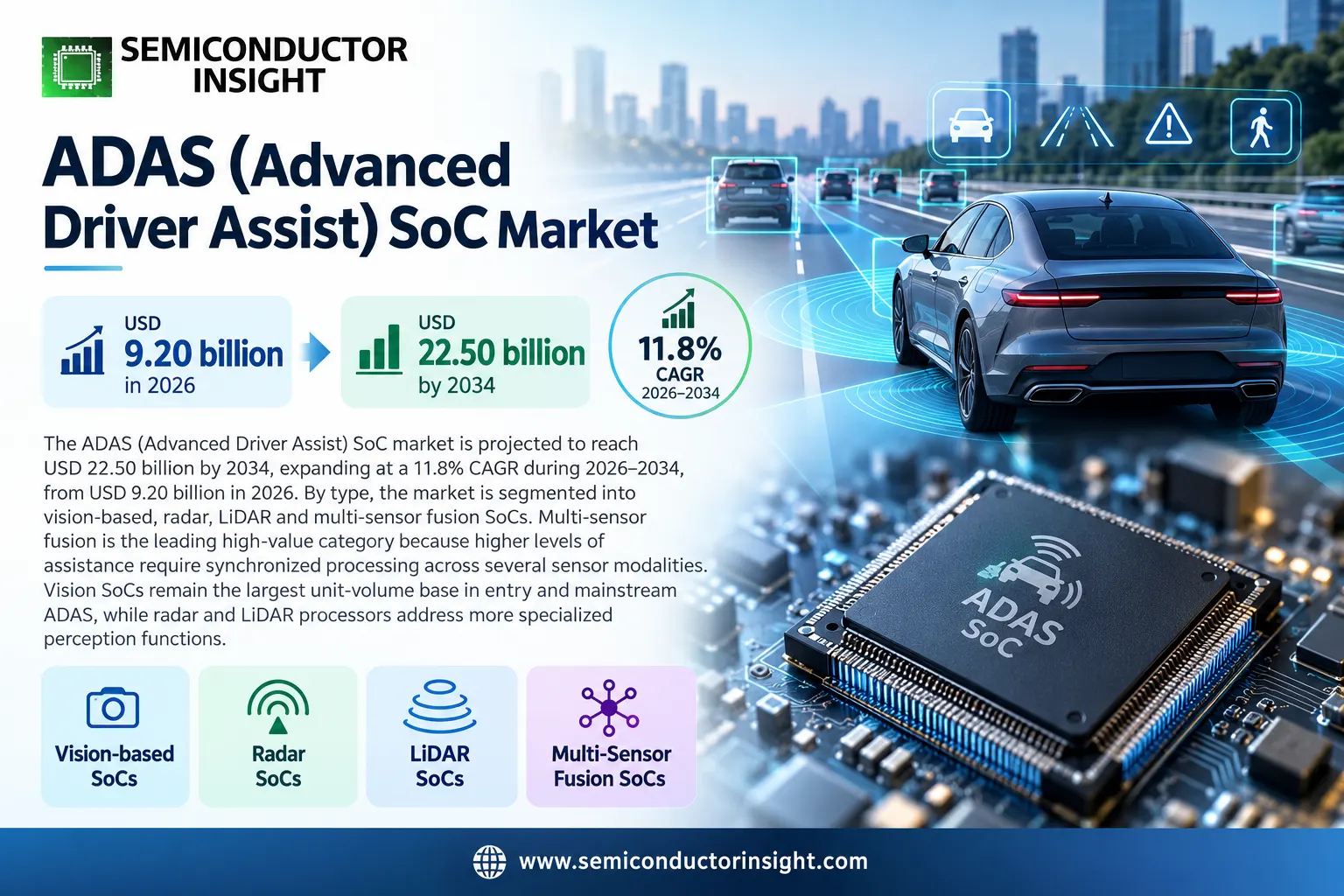
- Market size: The market is valued at USD 8.50 billion in 2025 and is projected to reach USD 22.50 billion by 2034, representing a 11.8% CAGR during 2026–2034.
- Multi-sensor fusion SoCs are the leading architecture, because higher levels of driver assistance require synchronized camera, radar and increasingly LiDAR processing.
- Asia Pacific leads the market, supported by vehicle production, EV adoption and fast deployment of software-defined vehicle architectures in China, Japan and South Korea.
- Adaptive cruise control is the largest application, while automated parking and advanced urban-driving functions increase compute requirements.
- AI-enabled heterogeneous platforms are becoming the market standard, combining CPU, GPU/NPU, ISP, safety islands and dedicated accelerators on automotive-qualified silicon.
ADAS (Advanced Driver Assist) SoC Market Overview
ADAS advanced driver assist SoC market is valued at USD 8.50 billion in 2025 and is projected to reach USD 22.50 billion by 2034, expanding at a 11.8% CAGR during 2026–2034. The 2026 market level is USD 9.20 billion. Asia Pacific leads current demand through China, Japan and South Korea, while North America remains strategically important because NVIDIA, Qualcomm and other leading platform developers are based there. The market expands as ADAS becomes standard equipment across more vehicle classes.
ADAS system-on-chip devices integrate compute, memory interfaces, sensor I/O and safety functions needed to process camera, radar and LiDAR data in real time. They run perception, localization, path-planning and driver-assistance workloads such as adaptive cruise control, emergency braking, lane keeping and parking. Commercial differentiation depends on AI throughput, power efficiency, deterministic latency, automotive safety certification, software tools and the ability to scale one architecture across several autonomy levels.
The architecture is shifting from distributed ECUs toward centralized and domain-level compute. Qualcomm’s Snapdragon Ride family supports scalable ADAS and mixed-criticality vehicle workloads, while NVIDIA DRIVE Thor consolidates automated driving, cockpit and generative-AI workloads around a powerful centralized platform. Mobileye’s EyeQ6H uses specialized accelerators to deliver high computer-vision performance within a low-power automotive envelope.
Automakers increasingly evaluate complete hardware-software platforms rather than silicon alone. A competitive SoC must be paired with perception software, safety frameworks, development tools, reference sensors and long-term automotive support. Design wins are therefore sticky and can span several vehicle generations, but qualification requires years of engineering and close collaboration with OEMs and Tier-1 suppliers.
Segment Analysis: By Type
By type, the market is segmented into vision-based, radar, LiDAR and multi-sensor fusion SoCs. Multi-sensor fusion is the leading high-value category because higher levels of assistance require synchronized processing across several sensor modalities. Vision SoCs remain the largest unit-volume base in entry and mainstream ADAS, while radar and LiDAR processors address more specialized perception functions.
| Type | Commercial role |
|---|---|
| Vision-based SoCs | Camera-centric perception for lane, object and driver-assistance functions. |
| Radar SoCs | Radar signal processing and object detection for safety and ranging. |
| LiDAR SoCs | Point-cloud processing and specialized perception for advanced autonomy. |
| Multi-sensor Fusion SoCs | Centralized processing of camera, radar and LiDAR data for higher-level ADAS. |
Additional Segmentation: By End User
Passenger vehicles are the largest end-user group because ADAS is moving from premium models into mass-market cars. Commercial vehicles and fleets are important because safety, uptime and driver-assistance economics can justify higher system cost. Fleet operators also benefit from centralized software updates and consistent safety features across large vehicle populations.
| End User | Demand characteristics |
|---|---|
| Passenger Vehicles | Largest end-user segment spanning mainstream and premium cars. |
| Commercial Vehicles | Truck, bus and delivery platforms using safety and automation functions. |
| Fleet Operators | Managed fleets prioritizing safety, uptime and software-controlled feature consistency. |
Segment Analysis: By Application
By application, adaptive cruise control is the largest current segment, followed by automatic emergency braking, lane departure warning and parking assistance. These functions increasingly share sensors and compute rather than using separate ECUs. As feature sets expand, centralized SoCs gain value by reusing perception outputs across several applications. Commercial decisions in the ADAS (Advanced Driver Assist) SoC market also depend on qualification history, integration effort, operating reliability, lifecycle support and measurable system-level value.
| Application | Demand characteristics |
|---|---|
| Adaptive Cruise Control | Speed and distance management using camera and radar perception. |
| Automatic Emergency Braking | Real-time object detection and collision-risk processing. |
| Lane Departure Warning | Camera-based lane interpretation and driver alert or steering support. |
| Parking Assistance | Surround vision, ultrasonic and radar processing for low-speed maneuvers. |
| Others | Driver monitoring, highway assist, traffic-jam assist and higher-autonomy functions. |
Additional Segmentation: By Technology
Technology segmentation separates AI-enabled SoCs, traditional processing units and scalable heterogeneous platforms. AI-enabled and heterogeneous architectures are gaining share because neural-network workloads require dedicated accelerators alongside general-purpose CPUs, image processors and safety islands. Traditional processors remain relevant in lower-cost functions but provide less headroom for software-defined feature growth. Commercial decisions in the ADAS (Advanced Driver Assist) SoC market also depend on qualification history, integration effort, operating reliability, lifecycle support and measurable system-level value.
| Technology | Commercial relevance |
|---|---|
| AI-Enabled SoCs | Neural-network accelerators optimized for perception and decision workloads. |
| Traditional Processing Units | MCU/CPU-centric architectures for simpler ADAS functions. |
| Scalable Heterogeneous Platforms | CPU, GPU/NPU, ISP and safety accelerators combined for broad feature scaling. |
Regional Analysis
Asia Pacific leads because China, Japan and South Korea combine large vehicle production, EV adoption and local ADAS semiconductor suppliers. North America remains a major technology hub, Europe contributes premium automotive and safety leadership, and other regions adopt ADAS through global vehicle platforms. Commercial decisions in the ADAS (Advanced Driver Assist) SoC market also depend on qualification history, integration effort, operating reliability, lifecycle support and measurable system-level value.
Why does regional demand differ across the ADAS (Advanced Driver Assist) SoC market?
Regional demand reflects vehicle production, safety regulation and software-defined vehicle adoption. Asia Pacific provides the largest unit opportunity, North America drives high-end compute platforms, and Europe strongly influences functional safety and premium-vehicle requirements. Emerging regions adopt lower-cost ADAS first before moving toward centralized compute. Commercial decisions in the ADAS (Advanced Driver Assist) SoC market also depend on qualification history, integration effort, operating reliability, lifecycle support and measurable system-level value.
| Region | Position | Demand profile | Supplier-selection factor |
|---|---|---|---|
| Asia Pacific | Largest / fastest | EV, passenger vehicle, local SoC vendors | Scale and rapid feature adoption |
| North America | Technology leader | Premium ADAS, software-defined vehicles | High-compute platform innovation |
| Europe | Strategic | Safety, premium automotive | Functional safety and regulation |
| South America | Emerging | Mainstream ADAS | Vehicle platform adoption |
| Middle East & Africa | Emerging | Premium vehicles and fleets | Imported technology |
Competitive Landscape
Mobileye, NVIDIA, Qualcomm, NXP, Texas Instruments, Horizon Robotics, Huawei, Renesas, Infineon, STMicroelectronics, Ambarella and Black Sesame compete across different ADAS tiers. Competition centers on AI throughput per watt, functional safety, sensor interfaces, software stacks and OEM design wins. Commercial decisions in the ADAS (Advanced Driver Assist) SoC market also depend on qualification history, integration effort, operating reliability, lifecycle support and measurable system-level value.
Mobileye’s 2025 ECU series uses EyeQ6H to scale from ADAS toward higher levels of autonomy, while Qualcomm’s Snapdragon Ride platform emphasizes scalable safety-first architecture and NVIDIA DRIVE Thor targets centralized high-performance vehicle compute. These approaches illustrate the shift from single-function processors toward broader platforms. Commercial decisions in the ADAS (Advanced Driver Assist) SoC market also depend on qualification history, integration effort, operating reliability, lifecycle support and measurable system-level value.
Chinese suppliers are increasing competitive intensity in mass-market vehicles by offering locally optimized, cost-efficient ADAS compute. Established global suppliers retain advantages in software ecosystems, safety certification and long OEM relationships, making the market concentrated but increasingly contested. Commercial decisions in the ADAS (Advanced Driver Assist) SoC market also depend on qualification history, integration effort, operating reliability, lifecycle support and measurable system-level value.
| Competitive tier | Representative companies | Primary differentiation |
|---|---|---|
| ADAS platform leaders | Mobileye, NVIDIA, Qualcomm | High-performance SoCs, software stacks and global OEM relationships. |
| Automotive semiconductor leaders | NXP, TI, Renesas, Infineon, ST | Safety MCUs, radar, networking and scalable compute. |
| Regional challengers | Horizon Robotics, Huawei, Black Sesame | China-focused ADAS compute and cost-efficient platforms. |
Key companies profiled
Mobileye, NVIDIA, Qualcomm Technologies, NXP Semiconductors, Texas Instruments, Horizon Robotics, Huawei, Renesas, Infineon, STMicroelectronics, Ambarella and Black Sesame Technologies are included in the competitive scope. Commercial decisions in the ADAS (Advanced Driver Assist) SoC market also depend on qualification history, integration effort, operating reliability, lifecycle support and measurable system-level value.
Production Capacity Analysis
ADAS SoC capacity depends on advanced-node foundry wafers, automotive packaging, memory, substrate supply and long qualification cycles. High-end heterogeneous devices use leading-edge process nodes and advanced packaging, creating exposure to the same constrained capacity used by AI and mobile chips. Commercial decisions in the ADAS (Advanced Driver Assist) SoC market also depend on qualification history, integration effort, operating reliability, lifecycle support and measurable system-level value.
Effective capacity is not just wafer output because automotive devices require safety validation, long product lifetimes and secure supply. OEMs may demand guaranteed availability for a decade or more, so suppliers must balance leading-edge technology with lifecycle commitments. Commercial decisions in the ADAS (Advanced Driver Assist) SoC market also depend on qualification history, integration effort, operating reliability, lifecycle support and measurable system-level value.
Market Dynamics
The market is driven by safety regulation, software-defined vehicles, EV adoption and increasing autonomy levels. Growth is restrained by development cost, functional safety complexity and advanced-node supply risk. Multi-sensor fusion, centralized compute and AI-enabled SoCs provide the strongest premium opportunities. Commercial decisions in the ADAS (Advanced Driver Assist) SoC market also depend on qualification history, integration effort, operating reliability, lifecycle support and measurable system-level value.
Market Drivers
| Driver | Impact | Commercial mechanism |
|---|---|---|
| ADAS standardization | High | More safety features are becoming standard across vehicle tiers. |
| Software-defined vehicles | High | Centralized compute supports feature upgrades over the vehicle lifetime. |
| AI perception | High | Modern ADAS relies on deep neural networks for camera and sensor fusion. |
| EV adoption | Medium-High | EV architectures are highly electronic and easier to centralize. |
ADAS standardization
Automatic emergency braking, lane assistance and adaptive cruise are spreading from premium vehicles into mainstream models, increasing SoC unit demand. Commercial decisions in the ADAS (Advanced Driver Assist) SoC market also depend on qualification history, integration effort, operating reliability, lifecycle support and measurable system-level value. Buyers therefore evaluate technical performance together with manufacturability, supply continuity and the cost of maintaining the solution across its intended service life.
Software-defined vehicles
OEMs want hardware platforms that can run more features through software and over-the-air updates, increasing the value of scalable heterogeneous SoCs. Commercial decisions in the ADAS (Advanced Driver Assist) SoC market also depend on qualification history, integration effort, operating reliability, lifecycle support and measurable system-level value. Buyers therefore evaluate technical performance together with manufacturability, supply continuity and the cost of maintaining the solution across its intended service life.
AI perception
Dedicated NPUs and accelerators improve perception performance per watt, enabling more sensors and more complex functions within automotive thermal limits. Commercial decisions in the ADAS (Advanced Driver Assist) SoC market also depend on qualification history, integration effort, operating reliability, lifecycle support and measurable system-level value. Buyers therefore evaluate technical performance together with manufacturability, supply continuity and the cost of maintaining the solution across its intended service life.
EV adoption
Electric vehicles often use new zonal and centralized architectures, creating favorable conditions for integrated ADAS compute platforms. Commercial decisions in the ADAS (Advanced Driver Assist) SoC market also depend on qualification history, integration effort, operating reliability, lifecycle support and measurable system-level value. Buyers therefore evaluate technical performance together with manufacturability, supply continuity and the cost of maintaining the solution across its intended service life.
Market Restraints
| Restraint | Impact | Commercial consequence |
|---|---|---|
| Development cost | High | Advanced automotive SoCs require large design and software investment. |
| Functional safety | Medium-High | ISO 26262 and cybersecurity requirements lengthen qualification. |
| Advanced-node supply | Medium | High-end ADAS SoCs compete for leading-edge foundry capacity. |
| OEM integration complexity | Medium | Sensors, software and vehicle networks must be co-validated. |
Development cost
AI accelerators, safety islands and automotive interfaces are expensive to develop and validate, favoring large suppliers. Commercial decisions in the ADAS (Advanced Driver Assist) SoC market also depend on qualification history, integration effort, operating reliability, lifecycle support and measurable system-level value. Buyers therefore evaluate technical performance together with manufacturability, supply continuity and the cost of maintaining the solution across its intended service life.
Functional safety
Hardware and software must be developed to strict safety processes, increasing engineering effort and time to market. Commercial decisions in the ADAS (Advanced Driver Assist) SoC market also depend on qualification history, integration effort, operating reliability, lifecycle support and measurable system-level value. Buyers therefore evaluate technical performance together with manufacturability, supply continuity and the cost of maintaining the solution across its intended service life.
Advanced-node supply
Automotive customers require stable long-term supply, which can conflict with rapid process-node transitions. Commercial decisions in the ADAS (Advanced Driver Assist) SoC market also depend on qualification history, integration effort, operating reliability, lifecycle support and measurable system-level value. Buyers therefore evaluate technical performance together with manufacturability, supply continuity and the cost of maintaining the solution across its intended service life.
OEM integration complexity
A strong SoC still requires integration with cameras, radar, maps, middleware and vehicle control, creating lengthy design-in cycles. Commercial decisions in the ADAS (Advanced Driver Assist) SoC market also depend on qualification history, integration effort, operating reliability, lifecycle support and measurable system-level value. Buyers therefore evaluate technical performance together with manufacturability, supply continuity and the cost of maintaining the solution across its intended service life.
Market Opportunities
Centralized compute
One SoC platform can consolidate several ADAS ECUs, reducing wiring and enabling software feature growth. Commercial decisions in the ADAS (Advanced Driver Assist) SoC market also depend on qualification history, integration effort, operating reliability, lifecycle support and measurable system-level value. Buyers therefore evaluate technical performance together with manufacturability, supply continuity and the cost of maintaining the solution across its intended service life.
Multi-sensor fusion
Combining camera, radar and LiDAR on shared compute creates higher silicon value per vehicle. Commercial decisions in the ADAS (Advanced Driver Assist) SoC market also depend on qualification history, integration effort, operating reliability, lifecycle support and measurable system-level value. Buyers therefore evaluate technical performance together with manufacturability, supply continuity and the cost of maintaining the solution across its intended service life.
Mass-market L2/L2+
Cost-optimized AI SoCs can bring richer ADAS to mainstream vehicle segments. Commercial decisions in the ADAS (Advanced Driver Assist) SoC market also depend on qualification history, integration effort, operating reliability, lifecycle support and measurable system-level value. Buyers therefore evaluate technical performance together with manufacturability, supply continuity and the cost of maintaining the solution across its intended service life.
Fleet autonomy
Commercial fleets, delivery and robotaxi systems can justify premium compute through safety and labor economics. Commercial decisions in the ADAS (Advanced Driver Assist) SoC market also depend on qualification history, integration effort, operating reliability, lifecycle support and measurable system-level value. Buyers therefore evaluate technical performance together with manufacturability, supply continuity and the cost of maintaining the solution across its intended service life.
Supply Chain Analysis
Silicon. CPUs, GPUs, NPUs, ISPs, safety islands and interfaces are integrated on automotive-qualified SoCs manufactured at advanced foundries. Commercial decisions in the ADAS (Advanced Driver Assist) SoC market also depend on qualification history, integration effort, operating reliability, lifecycle support and measurable system-level value. Buyers therefore evaluate technical performance together with manufacturability, supply continuity and the cost of maintaining the solution across its intended service life.
Packaging. SoCs are packaged with high-speed memory interfaces and tested across temperature, voltage and lifetime conditions required for vehicles. Commercial decisions in the ADAS (Advanced Driver Assist) SoC market also depend on qualification history, integration effort, operating reliability, lifecycle support and measurable system-level value. Buyers therefore evaluate technical performance together with manufacturability, supply continuity and the cost of maintaining the solution across its intended service life.
System integration. Tier-1 suppliers combine compute with cameras, radar, LiDAR, power delivery and software. Functional-safety validation spans the complete ECU. Commercial decisions in the ADAS (Advanced Driver Assist) SoC market also depend on qualification history, integration effort, operating reliability, lifecycle support and measurable system-level value. Buyers therefore evaluate technical performance together with manufacturability, supply continuity and the cost of maintaining the solution across its intended service life.
Deployment. OEMs integrate ADAS functions into vehicles and update software over time. Long vehicle programs make platform continuity and cybersecurity support critical. Commercial decisions in the ADAS (Advanced Driver Assist) SoC market also depend on qualification history, integration effort, operating reliability, lifecycle support and measurable system-level value. Buyers therefore evaluate technical performance together with manufacturability, supply continuity and the cost of maintaining the solution across its intended service life.
Recent Developments in the ADAS (Advanced Driver Assist) SoC Market
Developments tracked through September 2026 and limited to events that materially affect technology, capacity, adoption or competition.
- 5 September 2025
Qualcomm and BMW introduced Snapdragon Ride Pilot software for scalable assisted driving, combining Qualcomm’s AI perception stack with vehicle-control functions for the Neue Klasse iX3 and other future platforms. Source - 25 August 2025
NVIDIA opened DRIVE AGX Thor developer-kit availability, providing a Blackwell-based automotive platform with DriveOS 7 for advanced autonomous and assisted-driving development. Source - 27 February 2025
Mobileye introduced a modular ECU series based on EyeQ6H, including configurations that scale from ADAS toward automated and autonomous driving. Source
Report Scope & Segmentation
| Attribute | Scope |
|---|---|
| Base year | 2025 |
| Estimated year | 2026 |
| Forecast period | 2026–2034 |
| 2025 market size | USD 8.50 billion |
| 2026 estimated size | USD 9.20 billion |
| 2034 projected size | USD 22.50 billion |
| CAGR (2026–2034) | 11.8% |
| Largest market in 2025 | Asia Pacific |
| By Type | Vision-based SoCs; Radar SoCs; LiDAR SoCs; Multi-sensor Fusion SoCs |
| By Application | Adaptive Cruise Control; Automatic Emergency Braking; Lane Departure Warning; Parking Assistance; Others |
| By End User | Passenger Vehicles; Commercial Vehicles; Fleet Operators |
| By Technology | AI-Enabled SoCs; Traditional Processing Units; Scalable Heterogeneous Platforms |
| Companies profiled | Mobileye; NVIDIA; Qualcomm; NXP; Texas Instruments; Horizon Robotics; Huawei; Renesas; Infineon; STMicroelectronics; Ambarella; Black Sesame |
Frequently Asked Questions
What is the ADAS SoC market size in 2025?
The global ADAS SoC market is valued at USD 8.50 billion in 2025.
What is the market forecast for 2034?
The market is projected to reach USD 22.50 billion by 2034, representing an 11.8% CAGR during 2026–2034. The 2026 market level is USD 9.20 billion.
Which region leads the market?
Asia Pacific leads through large vehicle production, rapid EV adoption and strong local automotive semiconductor ecosystems.
Which SoC type is leading?
Multi-sensor fusion SoCs lead the high-value segment because they combine camera, radar and LiDAR processing.
Which application is largest?
Adaptive cruise control is the largest current application within the underlying segmentation.
Which end user is largest?
Passenger vehicles are the largest end-user segment as ADAS becomes standard across more vehicle classes.
Who are the major suppliers?
Mobileye, NVIDIA, Qualcomm, NXP, Texas Instruments and several Chinese automotive SoC suppliers are major participants.
Why are AI accelerators important?
Neural-network accelerators allow real-time perception and sensor fusion at lower power than general-purpose processing alone.
What limits market growth?
High development cost, functional-safety requirements, foundry capacity and complex OEM integration are the main restraints.
What will drive growth through 2034?
Software-defined vehicles, centralized compute, multi-sensor fusion and broader L2/L2+ adoption will support expansion.
Research Sources & Evidence Base
View research sources used in this market overview
- Qualcomm — Snapdragon Ride. Current scalable ADAS SoC and software platform evidence.
- NVIDIA — DRIVE Hyperion and Thor Safety Milestones. Automotive safety, SoC and centralized-compute evidence.
- Mobileye — EyeQ6H ECU Series. 2025 EyeQ6H and modular ADAS ECU evidence.

Get Sample Report PDF for Exclusive Insights
Report Sample Includes
- Table of Contents
- List of Tables & Figures
- Charts, Research Methodology, and more...