LiDAR Sensors Market Insights
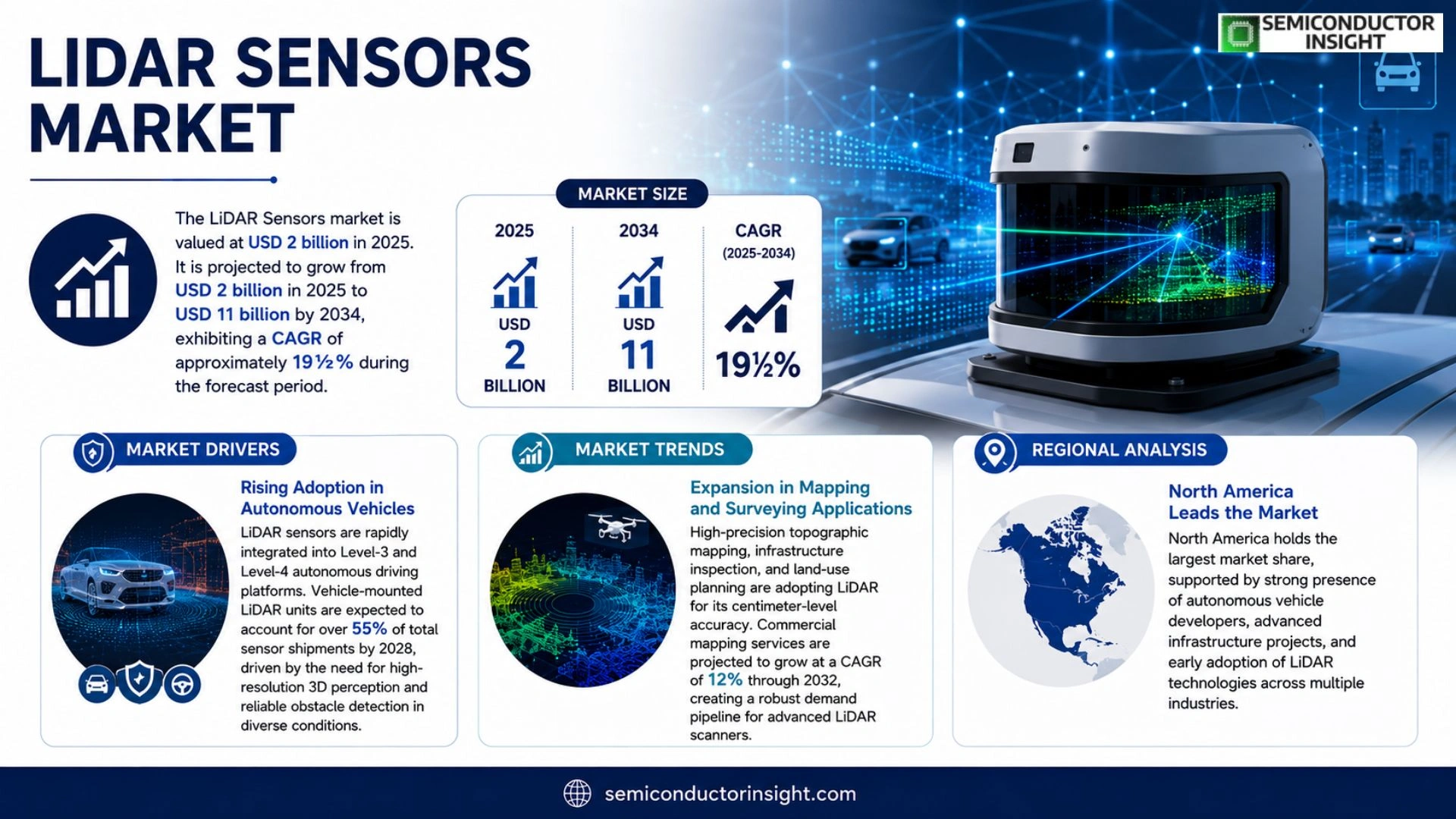
Global LiDAR Sensors market size was valued at USD 2 billion in 2025. The market is projected to grow from USD 2 billion in 2025 to USD 11 billion by 2034, exhibiting a CAGR of approximately 19½ % during the forecast period.
LiDAR (Light Detection and Ranging) sensors are optoelectronic devices that emit laser pulses and measure the time‑of‑flight of reflected signals to generate precise three‑dimensional point clouds of surrounding environments. These sensors enable high‑resolution mapping, object detection, and distance measurement across automotive, aerospace, robotics, and surveying applications.
The market acceleration stems from expanding autonomous‑vehicle programs, increased adoption of advanced driver‑assistance systems (ADAS), growing demand for high‑precision mapping in smart cities, and cost reductions driven by solid‑state technology breakthroughs. Leading manufacturers such as Velodyne Lidar, Luminar Technologies, Innoviz Technologies, and Quanergy are scaling production capacities while forging strategic partnerships with OEMs.
MARKET DRIVERS
Rising Adoption in Autonomous Vehicles
LiDAR Sensors Market is being propelled by rapid integration of LiDAR modules in Level‑3 and Level‑4 autonomous driving platforms. Forecasts indicate that vehicle‑mounted LiDAR units will account for over 55% of total sensor shipments by 2028, driven by the need for high‑resolution 3‑D perception and reliable obstacle detection under diverse lighting conditions.
Expansion in Mapping and Surveying Applications
High‑precision topographic mapping, infrastructure inspection, and land‑use planning are adopting LiDAR for its centimeter‑level accuracy. Commercial mapping services are projected to grow at a compound annual growth rate (CAGR) of 12% through 2032, creating a robust demand pipeline for scanners that provide rapid data capture across large geographic extents.
➤ “LiDAR technology is becoming the backbone of next‑gen perception systems, enabling safer and more efficient autonomous operations.”
In parallel, the surge in smart‑city initiatives is encouraging the deployment of LiDAR‑enabled traffic monitoring and pedestrian analytics, further strengthening the overall growth trajectory of LiDAR Sensors Market.
MARKET CHALLENGES
Technical and Cost Barriers
Despite technological advances, the high bill‑of‑materials for solid‑state and mechanical‑spinning LiDAR units remains a key obstacle. Production costs still exceed $150 per unit for automotive‑grade sensors, limiting price‑sensitive OEM adoption and slowing scale‑up in emerging regions.
Other Challenges
Supply Chain Constraints
Limited wafer‑level fabrication capacity and dependence on specialized optical components create bottlenecks, leading to lead times of up to 20 weeks for high‑volume orders.
MARKET RESTRAINTS
Regulatory and Safety Standards
Stringent automotive safety regulations, such as UN R155, require extensive functional safety validation for LiDAR systems. The certification process adds significant time and expense, discouraging smaller suppliers from entering the market.
Weather Sensitivity
Performance degradation in heavy rain, fog, or snow impacts reliability, especially for critical navigation tasks. This environmental limitation curtails deployment in regions with adverse weather patterns.
Data Processing Overheads
LiDAR generates dense point clouds that demand powerful onboard computing. The associated power consumption and heat dissipation requirements add further constraints to vehicle architecture design.
MARKET OPPORTUNITIES
Emerging Opportunities in Robotics and UAVs
The convergence of robotics, drones, and LiDAR is unlocking new revenue streams. Industrial automation and last‑mile delivery drones benefit from compact, solid‑state LiDAR that delivers real‑time 3‑D mapping within tight payload constraints.
Integration with AI Edge Computing
Edge‑AI processors now enable on‑device object classification directly from raw LiDAR data, reducing latency and bandwidth costs. This synergy creates a compelling value proposition for smart‑factory and autonomous logistics solutions.
Geospatial Services in Emerging Markets
Rapid urbanization in Southeast Asia and Africa is driving demand for affordable LiDAR‑based surveying services. Companies that can offer low‑cost, high‑accuracy scanning solutions are positioned to capture a sizable share of this untapped segment.
LiDAR Sensors Market Trends
Accelerated Adoption in Autonomous Mobility
LiDAR Sensors Market is experiencing a rapid shift driven by the scaling of autonomous‑vehicle programs worldwide. Manufacturers are integrating solid‑state LiDAR designs that combine lower power consumption with higher reliability, enabling original equipment manufacturers to embed sensors directly into vehicle architectures. This trend reduces bill‑of‑materials costs and shortens validation cycles, prompting automotive OEMs to specify LiDAR units as standard components in advanced driver‑assistance systems. As a result, the market sees a steady influx of new model launches and a broader geographic distribution of production facilities.
Other Trends
Smart‑City Mapping and Infrastructure Management
Urban planners are leveraging the high‑resolution point clouds generated by LiDAR sensors to create centimeter‑accurate three‑dimensional maps of cityscapes. These maps support traffic‑flow optimization, utility network monitoring, and public‑safety applications such as rapid disaster assessment. LiDAR Sensors Market benefits from municipal procurement programs that prioritize precise spatial data, encouraging sensor vendors to develop compact, weather‑resilient units tailored for drone‑based surveying and fixed‑mount installations.
Expansion into Robotics and Industrial Automation
Robotics manufacturers are incorporating LiDAR technology to enhance navigation, obstacle avoidance, and collaborative operation in dynamic environments. The trend is especially pronounced in warehouse automation, where LiDAR‑equipped autonomous mobile robots can map aisles in real time and adjust routes on the fly. Concurrently, the industrial sector adopts LiDAR for safety‑monitoring zones around heavy equipment, integrating sensor feedback with control‑system logic to prevent accidental contact. These developments broaden the application base of LiDAR Sensors Market beyond transportation, driving sustained revenue growth across multiple verticals.
COMPETITIVE LANDSCAPE
Key Industry Players
LiDAR Sensors Market Competitive Overview
LiDAR Sensors market is anchored by a few large OEMs that dominate volume production and strategic OEM alliances. Velodyne Lidar, with its longstanding heritage in spinning‑mechanical LiDAR, continues to lead in automotive deployments, while Luminar Technologies leverages its long‑range, high‑performance units to secure multimillion‑dollar contracts with major car manufacturers. Innoviz Technologies supplies solid‑state arrays to several Tier‑1 suppliers, accelerating cost reductions, and Quanergy’s modular platforms have gained traction in logistics and security sectors. These firms collectively shape the market structure, setting pricing baselines and driving standardization across the autonomous‑vehicle ecosystem.
Beyond the core quartet, a diverse set of niche players expands the technology frontier and addresses vertical‑specific demands. Ouster’s multi‑beam solid‑state designs target robotics and mapping, while Aeva combines FMCW ranging with imaging to improve velocity detection for advanced driver‑assistance. Hesai offers high‑density units for high‑resolution mapping, and LeddarTech focuses on automotive‑grade, cost‑optimized chips. RoboSense supplies panoramic sensors for smart‑city infrastructure, Valeo integrates LiDAR into its ADAS portfolio, Samsung’s semiconductor division develops integrated photonic solutions, and Waymo builds its own custom LiDAR to reduce dependency on third parties. These companies enrich the competitive landscape, fostering rapid innovation and creating multiple entry points for customers across automotive, aerospace, and industrial applications.
List of Key LiDAR Sensors Companies Profiled
- Velodyne Lidar
- Luminar Technologies
- Innoviz Technologies
- Quanergy Systems
- Ouster
- Aeva
- Hesai Photonics
- LeddarTech
- RoboSense
- Valeo
- Samsung Semiconductor
- Waymo
Segment Analysis:
| Segment Category | Sub-Segments | Key Insights |
| By Type |
|
Solid‑state LiDAR is emerging as the dominant type due to:
|
| By Application |
|
Autonomous Vehicles drive the market because:
|
| By End User |
|
Automotive OEMs lead adoption for several strategic reasons:
|
| By Wavelength |
|
Near‑Infrared dominates because:
|
| By Deployment Mode |
|
Mobile Platforms capture the most strategic interest because:
|
Regional Analysis: North America
United States
The automotive sector is the largest end-user of LiDAR sensors, primarily for autonomous driving systems. Increasing safety regulations and consumer demand for advanced driver-assistance systems (ADAS) are driving significant growth in this segment.
The defense and aerospace industry represents a substantial portion of the LiDAR market, utilizing sensors for surveillance, reconnaissance, and targeting systems. Advancements in military applications are continuously driving innovation in LiDAR technology.
LiDAR is increasingly employed in infrastructure development and mapping applications, providing detailed geospatial data for urban planning, surveying, and construction projects.
LiDAR technology is utilized in environmental monitoring for tasks such as forestry management, wildlife conservation, and disaster assessment, enabling precise data collection.
North America
The North American LiDAR Sensors Market is characterized by a strong focus on technological innovation and a well-established industrial base. The region benefits from significant research and development funding, fostering advancements in LiDAR sensor technology. The increasing adoption of LiDAR in various sectors, particularly automotive and defense, is driving market growth.
Europe
Europe presents a promising market for LiDAR sensors, driven by stringent environmental regulations and a growing emphasis on smart city initiatives. The automotive industry in Europe is actively integrating LiDAR into autonomous driving platforms. The region’s strong manufacturing base and advanced technological infrastructure further support market growth.
Asia-Pacific
The Asia-Pacific region is poised for significant growth LiDAR Sensors Market, fueled by rapid urbanization, infrastructure development, and increasing investments in autonomous driving. China, in particular, is emerging as a major market for LiDAR sensors, driven by government support and a burgeoning automotive industry.
South America
South America represents a relatively nascent market for LiDAR sensors, with growth potential tied to infrastructure development projects and increasing adoption in mining and agriculture. The demand for LiDAR in mapping and surveying applications is expected to rise in the coming years.
Middle East & Africa
The Middle East & Africa region presents a growth opportunity for LiDAR Sensors Market, driven by increasing investments in infrastructure development, defense spending, and the emergence of smart city projects. The region’s focus on precision agriculture and environmental monitoring is also contributing to market demand.
Report Scope
This market research report provides a comprehensive analysis of the LiDAR Sensors Market , covering the forecast period 2026–2034. It offers detailed insights into market dynamics, technological advancements, competitive landscape, and key trends shaping the industry.
Key focus areas of the report include:
- Market Overview: The report begins with an overview outlining its current market scenario, key growth indicators, and industry transformation drivers. It discusses macroeconomic factors, demand–supply balance, regulatory landscape, and the strategic role of semiconductors in powering advancements across industries such as automotive, telecommunications, consumer electronics, and industrial automation.
- Market Size & Forecast: Historical data and future projections for revenue, unit shipments, and market value across major regions and segments.
- Segmentation Analysis: Detailed breakdown by product type, technology, application, and end-user industry to identify high-growth segments and investment opportunities.
- Regional Insights: Insights into market performance across North America, Europe, Asia-Pacific, Latin America, and the Middle East & Africa, including country-level analysis where relevant.
- Competitive Landscape: Profiles of leading market participants, including their product offerings, R&D focus, manufacturing capacity, pricing strategies, and recent developments such as mergers, acquisitions, and partnerships.
- Technology Trends & Innovation: Assessment of emerging technologies, integration of AI/IoT, semiconductor design trends, fabrication techniques, and evolving industry standards.
- Market Drivers & Restraints: Evaluation of factors driving market growth along with challenges, supply chain constraints, regulatory issues, and market-entry barriers.
- Stakeholder Insights: Insights for component suppliers, OEMs, system integrators, investors, and policymakers regarding the evolving ecosystem and strategic opportunities.
Primary and secondary research methods are employed, including interviews with industry experts, data from verified sources, and real-time market intelligence to ensure the accuracy and reliability of the insights presented.
FREQUENTLY ASKED QUESTIONS:
What is the current market size of LiDAR Sensors Market?
-> LiDAR Sensors market size is projected to grow from USD 2 billion in 2025 to USD 11 billion by 2034.
Which key companies operate LiDAR Sensors Market?
-> Key players include Velodyne Lidar, Luminar Technologies, Innoviz Technologies, Quanergy, among others.
What are the key growth drivers?
-> Key growth drivers include expanding autonomous‑vehicle programs, increased adoption of ADAS, demand for high‑precision mapping in smart cities, and cost reductions from solid‑state technology breakthroughs.
Which region dominates the market?
-> North America is a leading region, while Asia‑Pacific shows the fastest growth trajectory.
What are the emerging trends?
-> Emerging trends include solid‑state LiDAR, AI‑enhanced perception algorithms, and integration of LiDAR with IoT platforms for smart infrastructure.

Get Sample Report PDF for Exclusive Insights
Report Sample Includes
- Table of Contents
- List of Tables & Figures
- Charts, Research Methodology, and more...
 Download Sample Report PDF