
Key Statistics
Key Takeaways
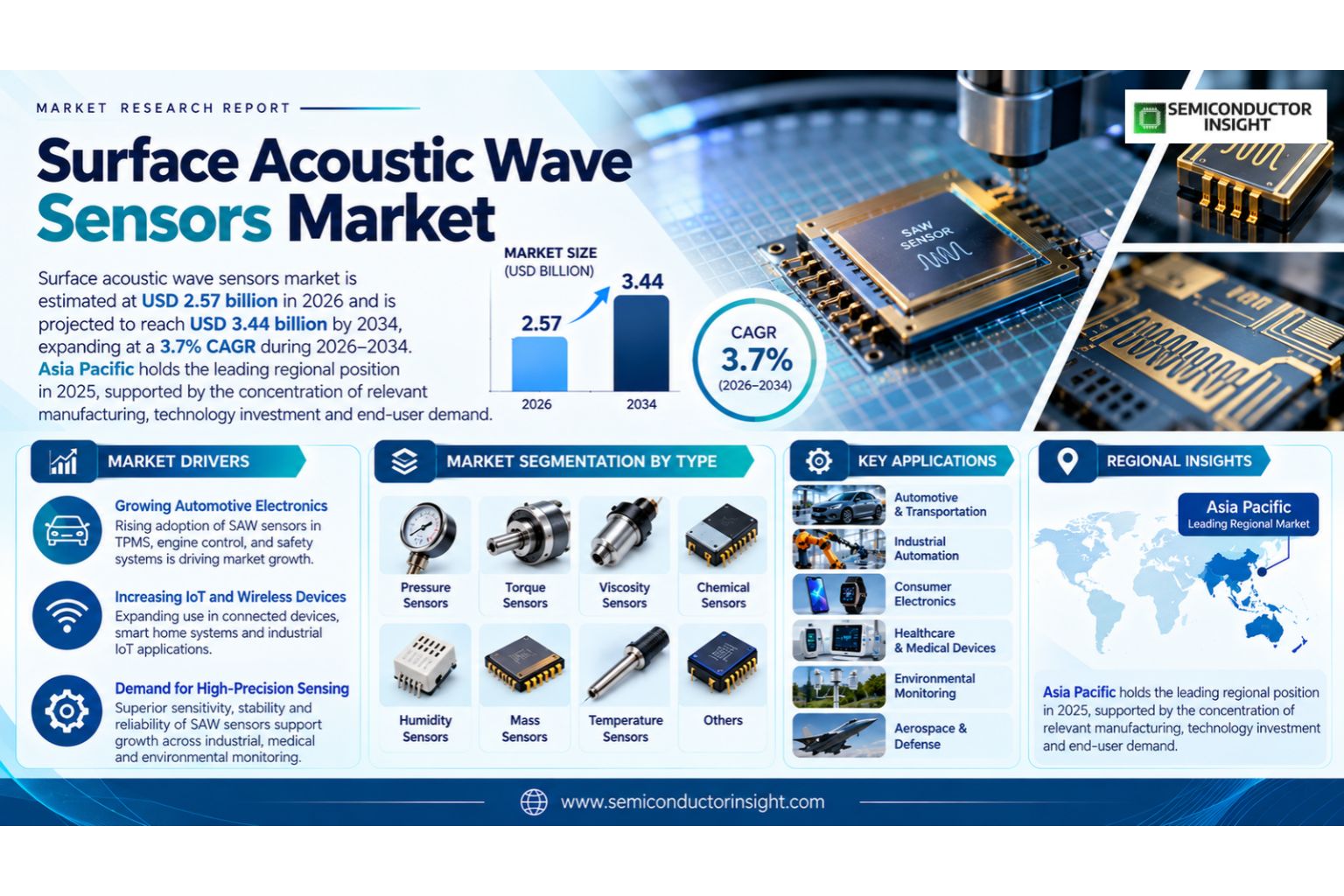
- Surface Acoustic Wave Sensors market is estimated at USD 2.57 billion in 2026 and is projected to reach USD 3.44 billion by 2034, representing a 3.7% CAGR over 2026–2034.
- Temperature Sensors represents the largest type position, while Torque Sensors benefits most from the current shift toward higher-value and more integrated system architectures.
- Automotive is the largest application, while Industrial shows the strongest incremental opportunity as end users expand automation, precision control and data-rich monitoring.
- Asia Pacific holds the leading regional position in 2025 because its industrial base, customer concentration and technology ecosystem create the strongest commercial pull for suppliers.
- The main growth engine is automotive electrification and sensing density, whereas competition from mems and semiconductor sensors remains the most persistent constraint on broader adoption.
- Competitive advantage is shifting toward suppliers that combine core hardware performance with application software, qualification support, integration capability and regional service rather than competing on component specifications alone.
Surface Acoustic Wave Sensors Market Overview
Surface acoustic wave sensors market is estimated at USD 2.57 billion in 2026 and is projected to reach USD 3.44 billion by 2034, expanding at a 3.7% CAGR during 2026–2034. Asia Pacific holds the leading regional position in 2025, supported by the concentration of relevant manufacturing, technology investment and end-user demand.
Surface acoustic wave sensors use acoustic waves travelling along a piezoelectric surface to convert physical or chemical changes into measurable frequency, phase or delay shifts. The market covers pressure, torque, temperature, humidity, viscosity, mass and chemical sensing, together with wireless passive architectures that can operate without a local battery. Commercial demand spans automotive, aerospace, industrial equipment, healthcare and electronics. The technology is particularly attractive where conventional wired or battery-powered sensors are difficult to place because of rotation, high temperature, limited access or electromagnetic constraints.
SAW sensor value is strongest when the sensing environment makes traditional electronics difficult. Passive wireless tags can be interrogated remotely, while the piezoelectric sensing element can tolerate harsh conditions depending on substrate and packaging. Automotive torque and temperature measurement, rotating machinery and sealed industrial systems are therefore important niches. The market competes not only on sensitivity but also on interrogation distance, frequency stability, packaging, calibration and the ability to maintain accuracy across temperature and mechanical stress.
The market should be understood as a system-level purchasing decision rather than a standalone component category. Buyers evaluate performance, qualification risk, integration time, service response and lifecycle cost together. This shifts value toward suppliers with proven application engineering and repeatable production capability. The result is a market in which technical differentiation can support pricing, but only when the supplier can translate specifications into measurable yield, uptime, safety, throughput or maintenance benefits for the end user.
Segment Analysis: By Type
By type, the Surface Acoustic Wave Sensors market is segmented into Pressure Sensors, Torque Sensors, Viscosity Sensors, Chemical Sensors, Humidity Sensors, Mass Sensors, Temperature Sensors, Others. Temperature Sensors holds the leading position, while the fastest growth is concentrated in configurations that solve higher-value integration, reliability or performance requirements rather than purely price-driven use cases.
| Type | Market position and demand characteristics |
|---|---|
| Pressure Sensors | Pressure Sensors serves a distinct set of performance and cost requirements within the market. Its commercial position depends on application fit, technical qualification, integration complexity and the supplier’s ability to maintain repeatable performance across production environments. Established segment reflects the balance between installed-base demand and the rate at which customers are shifting toward more advanced configurations. |
| Torque Sensors | Torque Sensors serves a distinct set of performance and cost requirements within the market. Its commercial position depends on application fit, technical qualification, integration complexity and the supplier’s ability to maintain repeatable performance across production environments. Fastest-growing type reflects the balance between installed-base demand and the rate at which customers are shifting toward more advanced configurations. |
| Viscosity Sensors | Viscosity Sensors serves a distinct set of performance and cost requirements within the market. Its commercial position depends on application fit, technical qualification, integration complexity and the supplier’s ability to maintain repeatable performance across production environments. Established segment reflects the balance between installed-base demand and the rate at which customers are shifting toward more advanced configurations. |
| Chemical Sensors | Chemical Sensors serves a distinct set of performance and cost requirements within the market. Its commercial position depends on application fit, technical qualification, integration complexity and the supplier’s ability to maintain repeatable performance across production environments. Established segment reflects the balance between installed-base demand and the rate at which customers are shifting toward more advanced configurations. |
| Humidity Sensors | Humidity Sensors serves a distinct set of performance and cost requirements within the market. Its commercial position depends on application fit, technical qualification, integration complexity and the supplier’s ability to maintain repeatable performance across production environments. Established segment reflects the balance between installed-base demand and the rate at which customers are shifting toward more advanced configurations. |
| Mass Sensors | Mass Sensors serves a distinct set of performance and cost requirements within the market. Its commercial position depends on application fit, technical qualification, integration complexity and the supplier’s ability to maintain repeatable performance across production environments. Established segment reflects the balance between installed-base demand and the rate at which customers are shifting toward more advanced configurations. |
| Temperature Sensors | Temperature Sensors serves a distinct set of performance and cost requirements within the market. Its commercial position depends on application fit, technical qualification, integration complexity and the supplier’s ability to maintain repeatable performance across production environments. Largest type reflects the balance between installed-base demand and the rate at which customers are shifting toward more advanced configurations. |
| Others | Others serves a distinct set of performance and cost requirements within the market. Its commercial position depends on application fit, technical qualification, integration complexity and the supplier’s ability to maintain repeatable performance across production environments. Established segment reflects the balance between installed-base demand and the rate at which customers are shifting toward more advanced configurations. |
Type selection is increasingly driven by total system economics
Customers increasingly compare surface acoustic wave sensors configurations on total installed value rather than purchase price alone. A higher-cost solution can be preferred when it reduces calibration time, improves yield, eliminates auxiliary hardware or provides better diagnostic information. This favors products that simplify integration and support consistent operation at scale. Commodity configurations remain important for cost-sensitive applications, but margin and strategic differentiation are concentrated in products that solve a difficult measurement, automation or reliability problem.
Segment Analysis: By Application
By application, demand spans Automotive, Aerospace and Defence, Consumer Electronics, Healthcare, Industrial, Others. Automotive forms the largest application base, while Industrial is positioned for the strongest incremental growth as customers increase investment in automation, precision and connected operations.
| Application | Demand characteristics |
|---|---|
| Automotive | Largest application. Purchasing is driven by the requirement to improve process control, reliability, safety or throughput in this application. Buyers typically qualify suppliers on performance under real operating conditions, integration with existing equipment and the economic cost of failure. Growth therefore depends on the pace of capital deployment and the degree to which the technology becomes embedded in standard equipment architectures. |
| Aerospace and Defence | Relevant demand segment. Purchasing is driven by the requirement to improve process control, reliability, safety or throughput in this application. Buyers typically qualify suppliers on performance under real operating conditions, integration with existing equipment and the economic cost of failure. Growth therefore depends on the pace of capital deployment and the degree to which the technology becomes embedded in standard equipment architectures. |
| Consumer Electronics | Relevant demand segment. Purchasing is driven by the requirement to improve process control, reliability, safety or throughput in this application. Buyers typically qualify suppliers on performance under real operating conditions, integration with existing equipment and the economic cost of failure. Growth therefore depends on the pace of capital deployment and the degree to which the technology becomes embedded in standard equipment architectures. |
| Healthcare | Relevant demand segment. Purchasing is driven by the requirement to improve process control, reliability, safety or throughput in this application. Buyers typically qualify suppliers on performance under real operating conditions, integration with existing equipment and the economic cost of failure. Growth therefore depends on the pace of capital deployment and the degree to which the technology becomes embedded in standard equipment architectures. |
| Industrial | Fastest-growing application. Purchasing is driven by the requirement to improve process control, reliability, safety or throughput in this application. Buyers typically qualify suppliers on performance under real operating conditions, integration with existing equipment and the economic cost of failure. Growth therefore depends on the pace of capital deployment and the degree to which the technology becomes embedded in standard equipment architectures. |
| Others | Relevant demand segment. Purchasing is driven by the requirement to improve process control, reliability, safety or throughput in this application. Buyers typically qualify suppliers on performance under real operating conditions, integration with existing equipment and the economic cost of failure. Growth therefore depends on the pace of capital deployment and the degree to which the technology becomes embedded in standard equipment architectures. |
Additional Segment Analysis: By Technology
| Technology | Commercial relevance |
|---|---|
| Frequency Modulated SAW Sensors | This segment represents a distinct commercial configuration within the surface acoustic wave sensors market. Adoption depends on performance requirements, cost, compatibility with the host system and the level of qualification demanded by the target industry. Suppliers that can offer multiple configurations across the same platform improve cross-selling opportunities and reduce the customer’s engineering burden when moving between applications. |
| Time Delayed SAW Sensors | This segment represents a distinct commercial configuration within the surface acoustic wave sensors market. Adoption depends on performance requirements, cost, compatibility with the host system and the level of qualification demanded by the target industry. Suppliers that can offer multiple configurations across the same platform improve cross-selling opportunities and reduce the customer’s engineering burden when moving between applications. |
| Phase Shifted SAW Sensors | This segment represents a distinct commercial configuration within the surface acoustic wave sensors market. Adoption depends on performance requirements, cost, compatibility with the host system and the level of qualification demanded by the target industry. Suppliers that can offer multiple configurations across the same platform improve cross-selling opportunities and reduce the customer’s engineering burden when moving between applications. |
| Others | This segment represents a distinct commercial configuration within the surface acoustic wave sensors market. Adoption depends on performance requirements, cost, compatibility with the host system and the level of qualification demanded by the target industry. Suppliers that can offer multiple configurations across the same platform improve cross-selling opportunities and reduce the customer’s engineering burden when moving between applications. |
Additional Segment Analysis: By Sensing Mode
| Sensing Mode | Commercial relevance |
|---|---|
| Wired/Interrogated | This segment represents a distinct commercial configuration within the surface acoustic wave sensors market. Adoption depends on performance requirements, cost, compatibility with the host system and the level of qualification demanded by the target industry. Suppliers that can offer multiple configurations across the same platform improve cross-selling opportunities and reduce the customer’s engineering burden when moving between applications. |
| Wireless Passive | This segment represents a distinct commercial configuration within the surface acoustic wave sensors market. Adoption depends on performance requirements, cost, compatibility with the host system and the level of qualification demanded by the target industry. Suppliers that can offer multiple configurations across the same platform improve cross-selling opportunities and reduce the customer’s engineering burden when moving between applications. |
Regional Analysis
Asia Pacific leads the Surface Acoustic Wave Sensors market in 2025, while regional growth rates differ according to manufacturing concentration, technology adoption, end-user investment and local supply-chain maturity. The market is not simply a set of geographic revenue pools; each region has a different purchasing logic and supplier-selection process.
How does regional demand differ across the Surface Acoustic Wave Sensors market?
Regional demand is shaped by where the relevant equipment is built, where end users deploy it, and how quickly local customers adopt advanced technologies. Mature regions tend to place greater weight on qualification, software and service, while high-growth manufacturing regions generate more unit demand and new design-in opportunities. Project-led regions can still be commercially attractive when applications are high value. Suppliers therefore need regional product positioning rather than a single global sales approach.
| Region | Position | Growth outlook | Demand profile | Supplier-selection gate |
|---|---|---|---|---|
| Asia Pacific | Largest | High | Manufacturing and technology-led | Local service, qualification and supply reliability |
| North America | High-value established | Moderate-high | Innovation and replacement-led | Local service, qualification and supply reliability |
| Europe | High-value established | Moderate-high | Engineering and regulation-led | Local service, qualification and supply reliability |
| South America | Emerging / project-led | Selective | Project-led | Local service, qualification and supply reliability |
| Middle East & Africa | Emerging / project-led | Selective | Project-led | Local service, qualification and supply reliability |
Key Surface Acoustic Wave Sensors Manufacturers and Competitive Landscape
Competition in the Surface Acoustic Wave Sensors market is shaped by application expertise, product reliability, integration capability and global support. The market includes established multinational suppliers, specialist technology companies and regional competitors, with customer qualification creating meaningful switching costs in demanding applications.
Leading suppliers compete by building platforms that can be adapted across multiple customer requirements without forcing a complete redesign. This lowers development time for the customer and creates cross-selling opportunities for the vendor. Brand reputation matters most in high-cost or safety-critical applications, where the financial impact of unreliable measurement or control can exceed the purchase price of the hardware by a wide margin.
Specialist companies remain important because many applications require niche performance, custom packaging or proprietary algorithms. These firms can win against larger suppliers when they solve a difficult technical problem faster or provide more responsive engineering support. However, scaling from prototype to volume production requires quality systems, manufacturing repeatability and a service model that can support customers in multiple regions.
Regional competitors often enter through cost-sensitive applications and then move upward as product quality improves. Their strongest advantage is usually local access, shorter lead time and willingness to customize. Global suppliers respond by broadening product families and adding software, diagnostics and support services that make direct price comparison more difficult. The result is a tiered market rather than a single winner-takes-all structure.
| Competitive tier | Representative companies | Typical advantage |
|---|---|---|
| Global technology leaders | API Technologies, Vectron International, AVX Corporation, Boston Piezo-Optics, CeramTec | Broad portfolios, strong qualification history, global support and premium applications |
| Established specialists | CTS Corporation, EPCOS, Honeywell International, Teledyne Microwave Solutions, Murata Manufacturing | Focused technical niches, application depth and regional strengths |
| Emerging / niche suppliers | Panasonic, Raltron Electronics, TDK Corporation, Taiyo Yuden, SENSeOR, Althen, Qualtre, Transense Technologies, Pro-Micron, Sensor Technology | Customization, local access and targeted product differentiation |
Companies profiled
The profiled supplier set includes API Technologies, Vectron International, AVX Corporation, Boston Piezo-Optics, CeramTec, CTS Corporation, EPCOS, Honeywell International, Teledyne Microwave Solutions, Murata Manufacturing, Panasonic, Raltron Electronics, TDK Corporation, Taiyo Yuden, SENSeOR, Althen, Qualtre, Transense Technologies, Pro-Micron, Sensor Technology. The competitive relevance of each company varies by geography, product architecture and target application, so customer shortlists are usually narrower than the complete profiled universe.
Surface Acoustic Wave Sensors Production Capacity Analysis
Production capacity for Surface Acoustic Wave Sensors products is concentrated where the enabling components, precision manufacturing skills and end-user industries are already established. Capacity expansion therefore follows both customer proximity and access to specialized process know-how.
The production footprint is constrained by more than factory floor space. Critical inputs can include precision materials, semiconductor or optical components, calibration equipment, clean manufacturing, specialized test systems and engineering labor. Capacity that lacks validated quality systems is not interchangeable with qualified capacity, particularly in semiconductor, automotive, medical or aerospace applications. As a result, suppliers often scale through phased line additions and customer qualification rather than by building large speculative capacity.
Asia Pacific has the strongest manufacturing density for many electronic and precision components, while North America and Europe retain substantial high-value engineering and specialty production. Regional diversification is increasing as customers seek supply resilience, but duplicating advanced production requires process transfer, trained staff and long qualification cycles. The practical supply risk is therefore concentrated in specialized subcomponents and manufacturing know-how rather than in basic assembly alone.
Surface Acoustic Wave Sensors Market Dynamics: Drivers, Restraints and Opportunities
The market outlook combines structural growth from automotive electrification and sensing density with persistent constraints from competition from mems and semiconductor sensors. The strongest suppliers will be those that convert technical performance into lower total cost, better uptime, improved yield or new end-user functionality.
MARKET DRIVERS
| Driver | Impact | Commercial mechanism |
|---|---|---|
| Automotive electrification and sensing density | High | Modern vehicles use more sensors for propulsion control, safety, thermal management and condition monitoring. SAW devices can measure torque, pressure and temperature in rotating o… |
| Wireless passive sensing | High | A SAW sensor can be designed to operate without an on-board battery, with an interrogator transmitting and receiving the acoustic-response signal. Eliminating local power is valuab… |
| Industrial predictive maintenance | Medium-High | Industrial plants increasingly monitor torque, temperature, vibration and process conditions to detect equipment degradation before failure. SAW sensing can place measurement point… |
| Growth in harsh-environment sensing | Medium | Aerospace, energy, industrial and automotive systems expose sensors to temperature extremes, vibration, contamination and electromagnetic noise. Appropriate SAW materials and packa… |
Automotive electrification and sensing density
Modern vehicles use more sensors for propulsion control, safety, thermal management and condition monitoring. SAW devices can measure torque, pressure and temperature in rotating or difficult-to-wire locations, making them relevant to drivetrains, wheel systems and powertrain test environments. OICA reported global vehicle production of 96.4 million units in 2025, providing a large hardware base across which specialized sensing technologies can be deployed.
Wireless passive sensing
A SAW sensor can be designed to operate without an on-board battery, with an interrogator transmitting and receiving the acoustic-response signal. Eliminating local power is valuable for rotating shafts, sealed assemblies and high-temperature environments where batteries or wired slip rings add maintenance burden. This creates a differentiated application space beyond commodity MEMS sensors.
Industrial predictive maintenance
Industrial plants increasingly monitor torque, temperature, vibration and process conditions to detect equipment degradation before failure. SAW sensing can place measurement points on rotating or inaccessible components where conventional wiring is difficult. As machine-health programs become more data-driven, reliable wireless sensing of mechanical load and temperature can reduce unplanned downtime and improve maintenance scheduling.
Growth in harsh-environment sensing
Aerospace, energy, industrial and automotive systems expose sensors to temperature extremes, vibration, contamination and electromagnetic noise. Appropriate SAW materials and packages can offer robust operation while separating the sensing element from active electronics. This makes the technology relevant to high-value applications where sensor replacement is expensive and measurement must continue under demanding conditions.
MARKET RESTRAINTS
| Restraint | Impact | Commercial mechanism |
|---|---|---|
| Competition from MEMS and semiconductor sensors | High | MEMS pressure, inertial and environmental sensors benefit from enormous scale, low cost and deep integration with electronics. In applications where wiring and batteries are accept… |
| Interrogation and RF system complexity | Medium-High | Wireless passive SAW sensing requires an interrogator, antenna design and careful control of frequency, multipath and electromagnetic compatibility. The sensor element may be simpl… |
| Calibration across temperature and mechanical conditions | Medium | Frequency and phase responses can be influenced by temperature, mounting stress and material properties. High-accuracy torque, pressure or temperature applications therefore requir… |
| Fragmented application requirements | Medium | The market spans automotive, industrial, aerospace, healthcare and specialty electronics, each with different frequency regulations, packaging, qualification and lifetime expectati… |
Competition from MEMS and semiconductor sensors
MEMS pressure, inertial and environmental sensors benefit from enormous scale, low cost and deep integration with electronics. In applications where wiring and batteries are acceptable, conventional semiconductor sensors can provide sufficient performance at lower system cost. SAW vendors therefore need to target use cases where passive operation, rotation, high temperature or RF interrogation provides a clear functional advantage.
Interrogation and RF system complexity
Wireless passive SAW sensing requires an interrogator, antenna design and careful control of frequency, multipath and electromagnetic compatibility. The sensor element may be simple, but the overall system can be more complex than a wired sensor. This raises engineering requirements and can slow adoption in cost-sensitive applications without strong systems-integration support.
Calibration across temperature and mechanical conditions
Frequency and phase responses can be influenced by temperature, mounting stress and material properties. High-accuracy torque, pressure or temperature applications therefore require calibration and compensation. Transense’s investment in automated calibration capacity illustrates the importance of production calibration to scale commercial SAW torque sensing while maintaining accuracy across a broad operating range.
Fragmented application requirements
The market spans automotive, industrial, aerospace, healthcare and specialty electronics, each with different frequency regulations, packaging, qualification and lifetime expectations. This fragmentation limits the ability to reuse one product unchanged across all markets and increases application-engineering cost for suppliers.
MARKET OPPORTUNITIES
Electric powertrain torque sensing
Electric and hybrid drivetrains need accurate torque information for efficiency, control and validation. Wireless SAW torque sensing can measure directly on rotating shafts without slip rings, creating an attractive architecture for test systems and selected production applications. Higher power density and thermal loads increase the value of simultaneous torque and temperature information.
High-temperature industrial monitoring
Passive SAW sensors can be deployed near turbines, motors, furnaces and other equipment where batteries or active electronics are difficult to protect. Improved substrates and packaging can extend operation into harsher environments. Suppliers that validate long-term stability and robust interrogation can capture high-value monitoring applications where conventional sensors require frequent maintenance.
Smart tires and wheel-end systems
Wheel-end sensing is a natural use case for passive wireless devices because the rotating environment complicates wiring and battery service. Beyond regulatory tire-pressure monitoring, future systems can measure temperature, strain or load to support predictive maintenance and advanced vehicle dynamics. SAW technology can participate where durability and lifetime outweigh the lowest component cost.
Industrial calibration and volume production
Scaling SAW sensors from prototypes to repeatable industrial production requires automated calibration and controlled manufacturing. Transense’s investment in higher-capacity torque-sensor calibration demonstrates how suppliers can reduce a major bottleneck. Similar automation can lower unit cost and make SAW solutions practical for broader OEM adoption.
Surface Acoustic Wave Sensors Supply Chain Analysis
Raw materials & enabling components
Core manufacturing
Integration & distribution
End-use operation
Raw materials & enabling components
Specialized materials, semiconductor devices, optics, mechanics, RF parts or precision substrates depending on architecture. Value capture rises when a supplier controls a difficult-to-replicate capability such as proprietary design, precision calibration, qualification data or software integration. Bottlenecks become commercially important when they lengthen lead times or limit the ability to qualify alternative suppliers, which is why customers increasingly evaluate resilience as part of sourcing decisions.
Core manufacturing
Fabrication, assembly, calibration, software loading and quality control that establish product performance and repeatability. Value capture rises when a supplier controls a difficult-to-replicate capability such as proprietary design, precision calibration, qualification data or software integration. Bottlenecks become commercially important when they lengthen lead times or limit the ability to qualify alternative suppliers, which is why customers increasingly evaluate resilience as part of sourcing decisions.
Integration & distribution
OEM design-in, distributors, system integrators and applications teams that adapt the product to customer equipment. Value capture rises when a supplier controls a difficult-to-replicate capability such as proprietary design, precision calibration, qualification data or software integration. Bottlenecks become commercially important when they lengthen lead times or limit the ability to qualify alternative suppliers, which is why customers increasingly evaluate resilience as part of sourcing decisions.
End-use operation
Factories, vehicles, research laboratories, infrastructure or industrial assets where recurring replacement and service demand is created. Value capture rises when a supplier controls a difficult-to-replicate capability such as proprietary design, precision calibration, qualification data or software integration. Bottlenecks become commercially important when they lengthen lead times or limit the ability to qualify alternative suppliers, which is why customers increasingly evaluate resilience as part of sourcing decisions.
Recent Developments in the Surface Acoustic Wave Sensors Market
OICA reported that global vehicle production increased from 92.7 million units in 2024 to 96.4 million units in 2025, with growth increasingly concentrated in Asia. Because automotive applications are a major SAW sensor demand pool, higher vehicle output and increasing sensing density expand the potential base for torque, pressure and temperature sensing technologies.
Transense Technologies installed a new automated torque-sensor calibration system as part of a £3 million investment in its SAWsense business. The system is designed to double calibration capacity and handle torque up to 2,500 Nm across temperatures from -20°C to +180°C, addressing a key production bottleneck for higher-volume SAW torque sensing.
Global automotive production remained highly concentrated in Asia, with OICA data showing China, Japan, India and South Korea among the largest producing countries. This concentration reinforces Asia Pacific’s role as the primary volume opportunity for automotive SAW sensing, while Europe and North America remain important for engineering-intensive and high-value applications.
REPORT SCOPE & SEGMENTATION
| Attribute | Coverage |
|---|---|
| Base Year | 2025 |
| Estimated Year | 2026 |
| Forecast Period | 2026–2034 |
| 2025 Market Size | USD 2.48 billion |
| 2026 Market Size | USD 2.57 billion |
| 2034 Projected Market Size | USD 3.44 billion |
| CAGR (2026–2034) | 3.7% |
| Largest Market in 2025 | Asia Pacific |
| By Type | Pressure Sensors, Torque Sensors, Viscosity Sensors, Chemical Sensors, Humidity Sensors, Mass Sensors, Temperature Sensors, Others |
| By Application | Automotive, Aerospace and Defence, Consumer Electronics, Healthcare, Industrial, Others |
| By Technology | Frequency Modulated SAW Sensors, Time Delayed SAW Sensors, Phase Shifted SAW Sensors, Others |
| By Sensing Mode | Wired/Interrogated, Wireless Passive |
| Regions | North America; Europe; Asia Pacific; South America; Middle East & Africa |
| Companies Profiled | API Technologies, Vectron International, AVX Corporation, Boston Piezo-Optics, CeramTec, CTS Corporation, EPCOS, Honeywell International, Teledyne Microwave Solutions, Murata Manufacturing, Panasonic, Raltron Electronics, TDK Corporation, Taiyo Yuden, SENSeOR, Althen, Qualtre, Transense Technologies, Pro-Micron, Sensor Technology |
Frequently Asked Questions
What is the current size of the Surface Acoustic Wave Sensors market?
The global Surface Acoustic Wave Sensors market is estimated at USD 2.57 billion in 2026 and is projected to reach USD 3.44 billion by 2034, representing a 3.7% CAGR during 2026–2034. The 2025 base-year market size is USD 2.48 billion. Growth is supported by higher end-user technology intensity, automation and the need for more reliable or precise system performance.
Which region leads the Surface Acoustic Wave Sensors market?
Asia Pacific holds the leading regional position in 2025. Its advantage reflects the concentration of relevant manufacturing, technology investment and end-user activity. Other regions remain commercially important for premium applications, research, regulation-driven adoption or project demand, so suppliers typically use different channel and service strategies by geography.
Which type leads the Surface Acoustic Wave Sensors market?
Temperature Sensors holds the strongest current type position. Its leadership is tied to broad application coverage, installed-base demand and a favorable balance between performance and cost. Growth within the type segment increasingly depends on automation, digital integration and the ability to reduce total system cost rather than on standalone hardware specifications.
Which application is the largest for Surface Acoustic Wave Sensors?
Automotive forms the largest application base, reflecting the technology’s established role in processes where accuracy, control, reliability or sensing quality directly affects output. Industrial offers a strong incremental opportunity as investment shifts toward more automated, data-rich and performance-sensitive operating environments.
What are the main growth drivers?
The main growth drivers are automotive electrification and sensing density, wireless passive sensing, industrial predictive maintenance and growth in harsh-environment sensing. Together they increase either the number of addressable system installations or the value of technology required per installation, supporting both unit demand and higher-value product configurations.
What are the main restraints on market growth?
Growth is constrained by competition from mems and semiconductor sensors, interrogation and rf system complexity, calibration across temperature and mechanical conditions and fragmented application requirements. These factors affect adoption economics, qualification timing or competitive substitution. Suppliers mitigate them through integration, automation, software, service and more application-specific product design.
Who are the key companies in the Surface Acoustic Wave Sensors market?
Key companies profiled include API Technologies, Vectron International, AVX Corporation, Boston Piezo-Optics, CeramTec, CTS Corporation, EPCOS, Honeywell International, together with additional specialist and regional suppliers. Competitive position varies by product architecture, geography and application. Customers usually shortlist suppliers based on qualification history, performance, integration capability and local support rather than company size alone.
Which technology trends are shaping the market?
The most important technology trends are greater automation, digital connectivity, embedded diagnostics, software-assisted analysis and tighter integration with the host system. These changes move the product from a passive hardware component toward a more intelligent subsystem. Suppliers that can verify performance under production conditions are better positioned to defend pricing and secure long-term design wins.
Where are the strongest new opportunities?
New opportunities are concentrated in electric powertrain torque sensing, high-temperature industrial monitoring, smart tires and wheel-end systems and industrial calibration and volume production. The common theme is that customers are willing to adopt higher-value technology when it enables a new function, reduces maintenance or improves operating economics in a measurable way.
What is the outlook for the Surface Acoustic Wave Sensors market through 2034?
The market is projected to reach USD 3.44 billion by 2034 from USD 2.57 billion in 2026, a 3.7% CAGR. Growth should remain uneven by segment and region, with the best performance coming from applications where the technology becomes embedded in new equipment architectures, automation programs or high-value measurement and control workflows.
Research Sources & Evidence Base
View research sources used for this overview.
- International Organization of Motor Vehicle Manufacturers. Global vehicle production statistics. Supporting evidence for industry activity, technology development, regional demand or competitive context.
- International Organization of Motor Vehicle Manufacturers. Auto industry growth shifted east in 2025. Supporting evidence for industry activity, technology development, regional demand or competitive context.
- Transense Technologies. Automated torque sensor calibration system. Supporting evidence for industry activity, technology development, regional demand or competitive context.
Get Sample Report PDF for Exclusive Insights
Report Sample Includes
- Table of Contents
- List of Tables & Figures
- Charts, Research Methodology, and more...
 Download Sample Report PDF


Be the first to review “Surface Acoustic Wave Sensors Market Size, Share & Industry Analysis, By Type (Pressure Sensors, Torque Sensors, Viscosity Sensors, Chemical Sensors, Humidity Sensors, Mass Sensors, Temperature Sensors, Others), By Application (Automotive, Aerospace & Defence, Consumer Electronics, Healthcare, Industrial, Others), By Technology (Frequency Modulated SAW Sensors, Time Delayed SAW Sensors, Phase Shifted SAW Sensors, Others), By Sensing Mode (Wired/Interrogated, Wireless Passive), and Regional Forecast, 2026-2034”