Key Statistics
Key Takeaways
- Piezoelectric sensors – Sensors hold the larger 2025 revenue pool because acceleration, force, pressure, acoustic and ultrasonic measurement spans industrial machinery, aerospace testing, engines, medical imaging and infrastructure. Their commercial value increasingly includes calibrated signal chains, installation knowledge and analytics, so suppliers that package transducers with electronics and software can capture more than the ceramic element value.
- Stack and multilayer actuators – Stack and multilayer devices are the fastest-growing actuator architecture where compact dimensions, high blocking force and nanometer-scale control justify specialized drive electronics. Semiconductor tools, photonics, microscopy and precision dispensing reward repeatability and closed-loop behavior, causing buyers to evaluate the complete motion subsystem rather than treating the actuator as an interchangeable component.
- North American leadership – North America held the largest 2025 market position through aerospace and defense testing, industrial measurement, medical technology and research demand. The region also hosts application engineering and high-value instrumentation channels, which support premium calibrated systems even when piezoceramic fabrication or high-volume electronics assembly occurs in Europe and Asia. For the piezoelectric sensors & actuators market, the commercial consequence of north america held the largest 2025 market position is that qualification evidence, integration support and lifecycle reliability influence the purchase alongside the nominal component specification. Within this piezoelectric sensors & actuators market context, suppliers that connect those requirements to documented process performance can protect design-in positions, while buyers reduce changeover risk and unplanned engineering work.
- Asia Pacific growth – Asia Pacific is the fastest-growing region because electronics, automotive, semiconductor equipment and industrial automation scale simultaneously in China, Japan, South Korea and Southeast Asia. Regional suppliers combine high-volume ceramic processing with compact component integration, while local machine builders create design-ins for haptics, ultrasound, positioning and predictive-maintenance systems. For the piezoelectric sensors & actuators market, the commercial consequence of asia pacific is the fastest-growing region because electronics, is that qualification evidence, integration support and lifecycle reliability influence the purchase alongside the nominal component specification. Within this piezoelectric sensors & actuators market context, suppliers that connect those requirements to documented process performance can protect design-in positions, while buyers reduce changeover risk and unplanned engineering work.
- Commercial restraint – Custom mechanical interfaces, drive electronics, calibration, temperature behavior and material regulations extend design cycles. Lead zirconate titanate remains widely used because of performance, but lead-content restrictions and application-specific exemptions increase documentation and substitution work, especially in European and medical programs where a material change can trigger requalification. For the piezoelectric sensors & actuators market, the commercial consequence of custom mechanical interfaces, drive electronics, calibration, temperature behavior is that qualification evidence, integration support and lifecycle reliability influence the purchase alongside the nominal component specification. Within this piezoelectric sensors & actuators market context, suppliers that connect those requirements to documented process performance can protect design-in positions, while buyers reduce changeover risk and unplanned engineering work.
- Competitive shift – The market expands from USD 3.223 billion in 2025 to USD 4.994 billion by 2034 at a 5.0% CAGR during 2026–2034. Competition is moving from discrete elements toward application-ready subsystems. Kistler combines piezoelectric measurement with cloud-enabled monitoring, PI integrates actuators with stages, sensors and controllers, and TDK packages piezoceramics for haptic and ultrasonic functions, raising software, calibration and service importance.
Piezoelectric Sensors & Actuators Market Overview
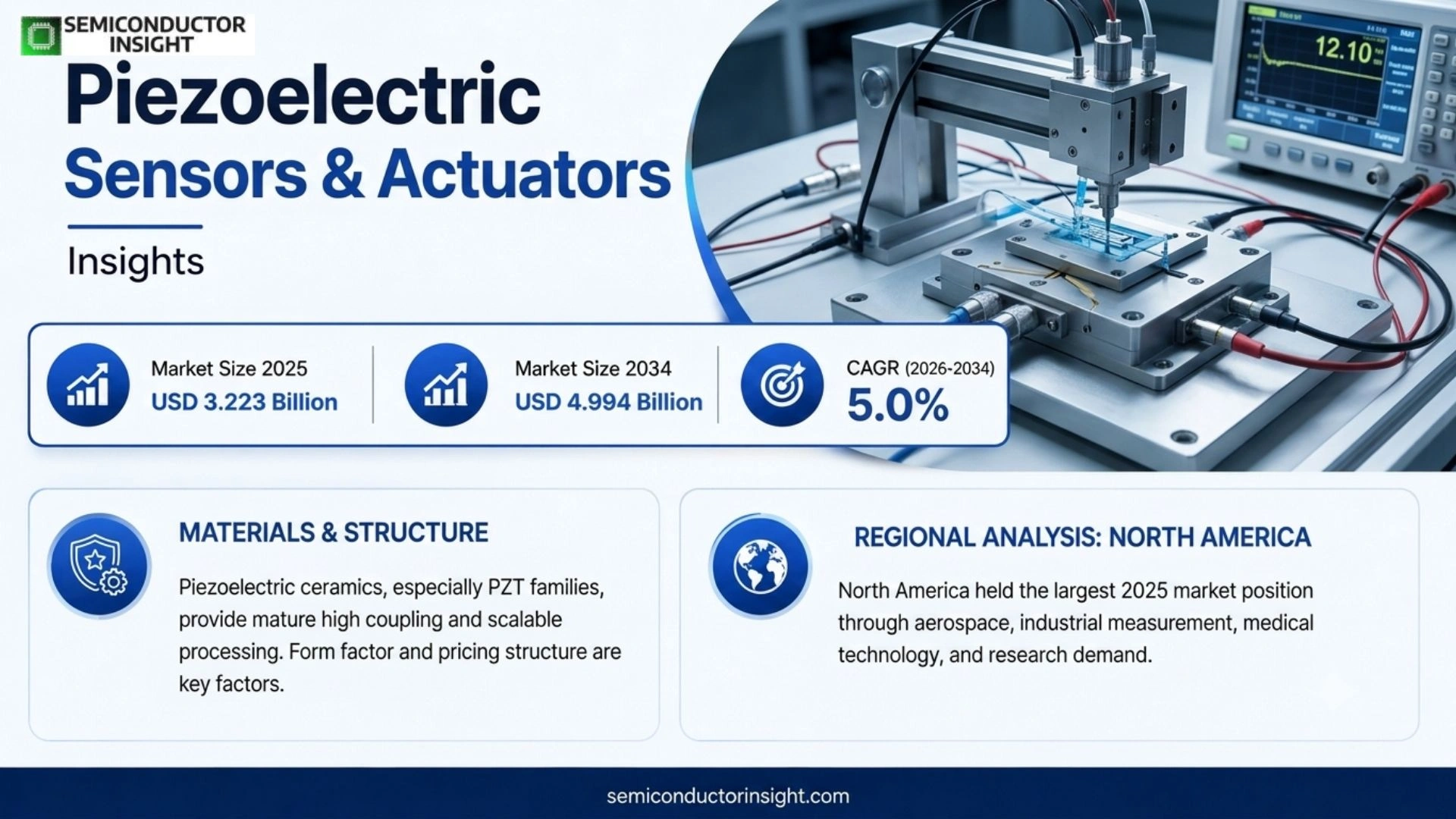
Piezoelectric Sensors & Actuators Market was valued at USD 3.223 billion in 2025 and is projected to reach USD 4.994 billion by 2034, expanding at a 5.0% CAGR during 2026–2034. North America held the largest regional position in 2025, while Asia Pacific presents the strongest expansion profile as industrial condition monitoring, precision semiconductor positioning, medical ultrasound, automotive haptics and structural-health systems turn mechanical energy conversion into measurable system performance.
Piezoelectric sensors convert mechanical stress, vibration, pressure or acoustic energy into electrical charge, while piezoelectric actuators convert an applied electric field into controlled displacement or force. The market spans ceramic elements, single crystals, polymer and composite devices, packaged transducers, stack and bending actuators, ultrasonic components, calibrated sensors and motion subsystems whose performance depends on mechanical integration and electronics.
The scope includes piezoelectric accelerometers, pressure and force sensors, acoustic and ultrasonic transducers, stack, multilayer, bender, tube and inertia actuators, plus application-specific modules and related calibration or controller value where sold as part of the device solution. It excludes purely capacitive, resistive, optical or electromagnetic products that do not use the piezoelectric effect.
A piezo device is selected because it responds quickly, occupies little space and couples electrical and mechanical domains without gears or coils. Those advantages come with system requirements: sensors need charge or voltage conditioning, actuators need stable high-voltage or high-current drivers, and both require preload, mounting and temperature management. Commercial differentiation therefore emerges at the integration boundary rather than from material coefficients alone.
Demand is broadening from laboratory and test uses toward embedded industrial monitoring, structural-health systems, smart meters, haptic interfaces and production motion control. In June 2025 PI introduced a 25 × 29 × 11 mm miniature stage using a piezoelectric biphase inertia drive with 10 nm minimum incremental motion, while Kistler’s May 2025 pressure sensors supported 350°C and 450 bar operation in large engines.
Segment Analysis: By Type
By functional type, the market is segmented into piezoelectric sensors and piezoelectric actuators. Sensors hold the larger 2025 position because vibration, force, pressure and ultrasonic measurement serve many installed applications, while actuators grow faster in precision positioning, haptics, microfluidics and semiconductor or photonics systems that need compact, high-response motion without electromagnetic interference.
| Type | Technical role | Market position |
|---|---|---|
| Piezoelectric Sensors | Sensors generate charge or voltage when stressed, enabling measurement of dynamic force, pressure, acceleration, strain, impact and acoustic waves. Product performance depends on crystal or ceramic selection, preload, sealing, temperature compensation, cable noise and signal conditioning. Calibrated transducers and complete measurement chains command more value than bare elements because uncertainty must be controlled at system level. | Largest type in 2025. The installed base spans industrial condition monitoring, aerospace testing, vehicle development, combustion analysis, medical ultrasound, flow metering and structural monitoring. Growth increasingly comes from permanent monitoring and connected diagnostics rather than laboratory-only measurements, benefiting vendors that combine rugged sensors with edge electronics, digital calibration records and analysis software. |
| Stack and Multilayer Actuators | Stacked piezoceramic layers produce high force and fine displacement from a compact volume. Multilayer designs reduce required voltage relative to thicker monolithic stacks, while mechanical preload and amplification structures tailor travel. Drivers, position sensors and flexure guidance are frequently integrated because hysteresis, creep and thermal behavior must be managed for repeatable closed-loop motion. | Fastest-growing actuator architecture. Semiconductor equipment, photonics, microscopy, dispensing and active vibration control reward nanometer or micrometer precision and millisecond response. Suppliers that deliver actuator, mechanics, sensor and controller as a characterized subsystem reduce buyer integration risk and can defend premium pricing, though custom loads and lifetime profiles keep qualification application specific. |
| Bender and Bimorph Actuators | Bending structures combine active layers so differential strain creates greater travel than an unamplified stack, typically at lower force. They support valves, pumps, optical alignment and compact mechanisms where millimeter-scale motion is more important than maximum blocking force. Packaging must limit moisture, depolarization and stress concentration while preserving the intended mechanical boundary conditions. | A mature but innovative segment serving microfluidics, haptics, optical systems and industrial valves. Demand grows when device makers replace solenoids or motors to reduce size, noise or electromagnetic emissions. Commercial adoption depends on robust mounting and low-cost drivers because a favorable ceramic element price can be offset by mechanical redesign and control-electronics complexity. |
| Ultrasonic Transducers and Specialty Forms | Discs, rings, tubes, plates, composites and single crystals generate or receive acoustic energy for imaging, ranging, cleaning, welding, flow measurement and nondestructive testing. Frequency, acoustic impedance, matching layers, backing, electrodes and array geometry determine application performance. Medical and industrial products often require extensive calibration and reliability documentation. For the piezoelectric sensors & actuators market, the commercial consequence of discs, rings, tubes, plates, composites and single crystals is that qualification evidence, integration support and lifecycle reliability influence the purchase alongside the nominal component specification. Within this piezoelectric sensors & actuators market context, suppliers that connect those requirements to documented process performance can protect design-in positions, while buyers reduce changeover risk and unplanned engineering work. | A diverse value pool with large application differences. Medical imaging and therapy favor high-performance arrays and composites; smart meters emphasize stable, low-cost flow measurement; industrial inspection and welding require power handling and durability. Suppliers compete through material libraries, acoustic modeling, assembly and regulatory support rather than one universal product platform. |
Materials, form factor and pricing structure
Piezoelectric ceramics, especially PZT families, provide mature high coupling and scalable processing; single crystals offer higher strain or sensitivity for premium medical and precision uses; polymers supply flexibility and acoustic matching; composites tailor impedance and geometry. Pricing rises sharply from bare discs to calibrated sensors, packaged arrays or closed-loop stages because electrodes, preload, housing, electronics, calibration, software and application certification can exceed the active-material cost.
Segment Analysis: By Application
By application, the market is segmented into industrial manufacturing, automotive and mobility, medical and life sciences, consumer electronics, aerospace and defense, and infrastructure or energy. Industrial applications hold a broad installed base, while semiconductor positioning, medical ultrasound, connected condition monitoring and automotive haptics create the fastest value expansion through application-specific packaged systems.
| Application | Demand characteristics |
|---|---|
| Industrial and Manufacturing | Factories use piezoelectric accelerometers, force sensors and acoustic devices for condition monitoring, process control and quality assurance, while actuators position optics, valves, stages and dispensing systems. Purchasing is triggered by avoided downtime, reduced scrap or improved throughput. Vendors increasingly bundle sensors with edge electronics and software so maintenance teams can act on data rather than manage raw charge signals. |
| Automotive and Mobility | Applications include combustion pressure, knock and vibration measurement, ultrasonic parking or ranging, occupant interfaces, haptics and precise fluid-control actuation. Qualification emphasizes temperature range, shock, humidity, lifetime and functional safety. Electrification removes some combustion uses but adds tactile interfaces, battery-production inspection and quieter cabins where active noise or vibration management becomes more valuable. |
| Medical and Life Sciences | Ultrasound imaging, therapy, dental equipment, microfluidic pumps, drug delivery and precision microscopy use piezoelectric transducers and actuators. Clinical performance depends on acoustic efficiency, biocompatible packaging, sterilization compatibility and stable calibration. Regulatory documentation and long design cycles create high switching costs, allowing suppliers with validated materials and manufacturing records to defend durable program revenue. |
| Semiconductor, Photonics and Precision Instruments | Nanometer-scale stages, optical alignment, wafer inspection, lithography support and micro-dispensing use piezo actuators because they respond rapidly without backlash. The buyer values closed-loop accuracy, drift, settling time and clean-vacuum compatibility. PI’s June 2025 B-421 BIX stage demonstrated 10 nm incremental motion and 6 nm resolution in a 25 × 29 × 11 mm package. |
| Aerospace, Defense and Research | Aircraft testing, structural monitoring, active vibration control, adaptive optics and space instrumentation demand high sensitivity or precision under severe environmental conditions. Programs require traceable calibration, radiation or vacuum compatibility and extended availability. Order volumes may be lower than consumer applications, but engineering content and qualification value are high, favoring specialists with application scientists and controlled materials. |
| Infrastructure, Energy and Marine | Bridge monitoring, turbines, pipelines and large engines use piezoelectric sensors to detect vibration, impact, pressure and acoustic emissions. Kistler’s May 2025 large-engine sensors operate at 350°C with a 450 bar overload range and support closed-loop combustion control. The economic case combines asset life, fuel efficiency, safety and reduced inspection labor. |
Regional Analysis
North America held the largest 2025 market position through aerospace, industrial measurement, medical technology and research demand. Asia Pacific grows fastest through electronics, automotive and factory automation; Europe remains a precision-engineering and regulation center; South America emphasizes mining, energy and infrastructure monitoring; the Middle East and Africa focus on oil, gas, aviation and critical assets.
How does regional demand differ across the piezoelectric sensors and actuators market?
North America monetizes calibrated high-value systems, Europe combines precision engineering with materials regulation, and Asia Pacific joins component scale with fast-growing electronics and industrial demand. South America purchases around harsh-environment asset monitoring, while Middle East and African demand is project-led around energy, aviation and infrastructure. These mechanisms require different packaging, certification, channel and service models.
| Region | Position | Growth outlook | Demand profile | Market access gate |
|---|---|---|---|---|
| North America | Largest in 2025 For the piezoelectric sensors & actuators market, the commercial consequence of largest in 2025 is that qualification evidence, integration support and lifecycle reliability influence the purchase alongside the nominal component specification. Within this piezoelectric sensors & actuators market context, suppliers that connect those requirements to documented process performance can protect design-in positions, while buyers reduce changeover risk and unplanned engineering work. | High For the piezoelectric sensors & actuators market, the commercial consequence of high is that qualification evidence, integration support and lifecycle reliability influence the purchase alongside the nominal component specification. Within this piezoelectric sensors & actuators market context, suppliers that connect those requirements to documented process performance can protect design-in positions, while buyers reduce changeover risk and unplanned engineering work. | Aerospace, medical, industrial measurement and research For the piezoelectric sensors & actuators market, the commercial consequence of aerospace, medical, industrial measurement and research is that qualification evidence, integration support and lifecycle reliability influence the purchase alongside the nominal component specification. Within this piezoelectric sensors & actuators market context, suppliers that connect those requirements to documented process performance can protect design-in positions, while buyers reduce changeover risk and unplanned engineering work. | Calibration traceability, application support and program qualification For the piezoelectric sensors & actuators market, the commercial consequence of calibration traceability, application support and program qualification is that qualification evidence, integration support and lifecycle reliability influence the purchase alongside the nominal component specification. Within this piezoelectric sensors & actuators market context, suppliers that connect those requirements to documented process performance can protect design-in positions, while buyers reduce changeover risk and unplanned engineering work. |
| Asia Pacific | Fastest-growing For the piezoelectric sensors & actuators market, the commercial consequence of fastest-growing is that qualification evidence, integration support and lifecycle reliability influence the purchase alongside the nominal component specification. Within this piezoelectric sensors & actuators market context, suppliers that connect those requirements to documented process performance can protect design-in positions, while buyers reduce changeover risk and unplanned engineering work. | Highest For the piezoelectric sensors & actuators market, the commercial consequence of highest is that qualification evidence, integration support and lifecycle reliability influence the purchase alongside the nominal component specification. Within this piezoelectric sensors & actuators market context, suppliers that connect those requirements to documented process performance can protect design-in positions, while buyers reduce changeover risk and unplanned engineering work. | Electronics, automotive, semiconductor equipment and automation For the piezoelectric sensors & actuators market, the commercial consequence of electronics, automotive, semiconductor equipment and automation is that qualification evidence, integration support and lifecycle reliability influence the purchase alongside the nominal component specification. Within this piezoelectric sensors & actuators market context, suppliers that connect those requirements to documented process performance can protect design-in positions, while buyers reduce changeover risk and unplanned engineering work. | Local cost, scale, design-in support and automotive quality systems For the piezoelectric sensors & actuators market, the commercial consequence of local cost, scale, design-in support and automotive quality is that qualification evidence, integration support and lifecycle reliability influence the purchase alongside the nominal component specification. Within this piezoelectric sensors & actuators market context, suppliers that connect those requirements to documented process performance can protect design-in positions, while buyers reduce changeover risk and unplanned engineering work. |
| Europe | Precision-engineering stronghold For the piezoelectric sensors & actuators market, the commercial consequence of precision-engineering stronghold is that qualification evidence, integration support and lifecycle reliability influence the purchase alongside the nominal component specification. Within this piezoelectric sensors & actuators market context, suppliers that connect those requirements to documented process performance can protect design-in positions, while buyers reduce changeover risk and unplanned engineering work. | Moderate to high For the piezoelectric sensors & actuators market, the commercial consequence of moderate to high is that qualification evidence, integration support and lifecycle reliability influence the purchase alongside the nominal component specification. Within this piezoelectric sensors & actuators market context, suppliers that connect those requirements to documented process performance can protect design-in positions, while buyers reduce changeover risk and unplanned engineering work. | Industrial, medical, automotive and photonics For the piezoelectric sensors & actuators market, the commercial consequence of industrial, medical, automotive and photonics is that qualification evidence, integration support and lifecycle reliability influence the purchase alongside the nominal component specification. Within this piezoelectric sensors & actuators market context, suppliers that connect those requirements to documented process performance can protect design-in positions, while buyers reduce changeover risk and unplanned engineering work. | RoHS documentation, functional safety and engineered subsystems For the piezoelectric sensors & actuators market, the commercial consequence of rohs documentation, functional safety and engineered subsystems is that qualification evidence, integration support and lifecycle reliability influence the purchase alongside the nominal component specification. Within this piezoelectric sensors & actuators market context, suppliers that connect those requirements to documented process performance can protect design-in positions, while buyers reduce changeover risk and unplanned engineering work. |
| South America | Emerging For the piezoelectric sensors & actuators market, the commercial consequence of emerging is that qualification evidence, integration support and lifecycle reliability influence the purchase alongside the nominal component specification. Within this piezoelectric sensors & actuators market context, suppliers that connect those requirements to documented process performance can protect design-in positions, while buyers reduce changeover risk and unplanned engineering work. | Selective For the piezoelectric sensors & actuators market, the commercial consequence of selective is that qualification evidence, integration support and lifecycle reliability influence the purchase alongside the nominal component specification. Within this piezoelectric sensors & actuators market context, suppliers that connect those requirements to documented process performance can protect design-in positions, while buyers reduce changeover risk and unplanned engineering work. | Mining, energy, transport and research For the piezoelectric sensors & actuators market, the commercial consequence of mining, energy, transport and research is that qualification evidence, integration support and lifecycle reliability influence the purchase alongside the nominal component specification. Within this piezoelectric sensors & actuators market context, suppliers that connect those requirements to documented process performance can protect design-in positions, while buyers reduce changeover risk and unplanned engineering work. | Ruggedization, distributor support and calibration access For the piezoelectric sensors & actuators market, the commercial consequence of ruggedization, distributor support and calibration access is that qualification evidence, integration support and lifecycle reliability influence the purchase alongside the nominal component specification. Within this piezoelectric sensors & actuators market context, suppliers that connect those requirements to documented process performance can protect design-in positions, while buyers reduce changeover risk and unplanned engineering work. |
| Middle East & Africa | Project-led For the piezoelectric sensors & actuators market, the commercial consequence of project-led is that qualification evidence, integration support and lifecycle reliability influence the purchase alongside the nominal component specification. Within this piezoelectric sensors & actuators market context, suppliers that connect those requirements to documented process performance can protect design-in positions, while buyers reduce changeover risk and unplanned engineering work. | High from low base For the piezoelectric sensors & actuators market, the commercial consequence of high from low base is that qualification evidence, integration support and lifecycle reliability influence the purchase alongside the nominal component specification. Within this piezoelectric sensors & actuators market context, suppliers that connect those requirements to documented process performance can protect design-in positions, while buyers reduce changeover risk and unplanned engineering work. | Oil and gas, aviation, infrastructure and universities For the piezoelectric sensors & actuators market, the commercial consequence of oil and gas, aviation, infrastructure and universities is that qualification evidence, integration support and lifecycle reliability influence the purchase alongside the nominal component specification. Within this piezoelectric sensors & actuators market context, suppliers that connect those requirements to documented process performance can protect design-in positions, while buyers reduce changeover risk and unplanned engineering work. | Environmental qualification, service coverage and project bankability For the piezoelectric sensors & actuators market, the commercial consequence of environmental qualification, service coverage and project bankability is that qualification evidence, integration support and lifecycle reliability influence the purchase alongside the nominal component specification. Within this piezoelectric sensors & actuators market context, suppliers that connect those requirements to documented process performance can protect design-in positions, while buyers reduce changeover risk and unplanned engineering work. |
Key Piezoelectric Sensor and Actuator Manufacturers and Competitive Landscape
Competition is fragmented across materials, transducers, calibrated instrumentation and complete precision-motion systems. TE Connectivity, Honeywell, PCB Piezotronics and Kistler serve measurement applications; PI, CTS/Noliac, CeramTec, Kyocera, TDK and Murata span actuators or piezoceramic components; specialist firms compete through custom crystals, polymers, high-power devices and application engineering. For the piezoelectric sensors & actuators market, the commercial consequence of competition is fragmented across materials, transducers, calibrated instrumentation is that qualification evidence, integration support and lifecycle reliability influence the purchase alongside the nominal component specification. Within this piezoelectric sensors & actuators market context, suppliers that connect those requirements to documented process performance can protect design-in positions, while buyers reduce changeover risk and unplanned engineering work.
Measurement suppliers compete through calibration, packaging and signal-chain knowledge. A force or acceleration sensor is useful only when mounting, cable noise, charge amplification, temperature behavior and uncertainty are understood. Companies with calibration laboratories, application engineers and data platforms can create recurring service relationships, while element-only competitors remain exposed to price and customer integration capability.
Motion suppliers compete through complete subsystem performance. Actuator displacement alone does not guarantee positioning accuracy because hysteresis, creep, preload, flexure design, sensor feedback and controller bandwidth interact. PI’s portfolio strategy illustrates how stages, sensors, electronics and software surround the piezo stack. This integration raises switching costs and lets suppliers price against customer throughput or resolution rather than ceramic volume.
High-volume electronics players compete through materials scale, miniaturized packaging and global quality systems. TDK, Murata, Kyocera and related firms can move piezoceramic functions into haptics, ultrasonic sensing and compact modules. Automotive and consumer programs demand cost reduction, but qualification, moisture resistance and consistent acoustic or tactile performance prevent unrestricted commodity substitution.
Corporate identities also change. Meggitt is part of Parker Hannifin, KEMET is part of Yageo, and Noliac operates within CTS. The report preserves recognizable technology brands while mapping them to current owners. This matters because acquisition can broaden distribution and electronics capability, but it may also change portfolio priorities, manufacturing footprints and customer support structures.
Tier structure
| Tier | Companies | Basis of competition |
|---|---|---|
| Measurement and sensor systems | TE Connectivity; Honeywell; PCB Piezotronics; Kistler Group; Parker Meggitt For the piezoelectric sensors & actuators market, the commercial consequence of te connectivity; honeywell; pcb piezotronics; kistler group; parker is that qualification evidence, integration support and lifecycle reliability influence the purchase alongside the nominal component specification. Within this piezoelectric sensors & actuators market context, suppliers that connect those requirements to documented process performance can protect design-in positions, while buyers reduce changeover risk and unplanned engineering work. | Calibrated force, pressure, vibration and acoustic measurement, rugged packaging, aerospace or industrial qualification, application engineering, signal conditioning and lifecycle calibration. Competitive advantage is established through trusted uncertainty, environmental performance and the ability to connect measurements to operating or development decisions. For the piezoelectric sensors & actuators market, the commercial consequence of calibrated force, pressure, vibration and acoustic measurement, rugged is that qualification evidence, integration support and lifecycle reliability influence the purchase alongside the nominal component specification. Within this piezoelectric sensors & actuators market context, suppliers that connect those requirements to documented process performance can protect design-in positions, while buyers reduce changeover risk and unplanned engineering work. |
| Precision motion and specialist piezo | Physik Instrumente and PI Ceramic; CTS/Noliac; Piezosystem Jena; Kinetic Ceramics; APC International For the piezoelectric sensors & actuators market, the commercial consequence of physik instrumente and pi ceramic; cts/noliac; piezosystem jena; is that qualification evidence, integration support and lifecycle reliability influence the purchase alongside the nominal component specification. Within this piezoelectric sensors & actuators market context, suppliers that connect those requirements to documented process performance can protect design-in positions, while buyers reduce changeover risk and unplanned engineering work. | Actuators, stages, custom ceramics, high-power devices and application-specific motion. Suppliers differentiate through material formulations, preload and mechanical design, controllers, closed-loop sensors, vacuum or nonmagnetic options and the engineering capacity to characterize the complete subsystem under the customer’s load and duty cycle. For the piezoelectric sensors & actuators market, the commercial consequence of actuators, stages, custom ceramics, high-power devices and application-specific is that qualification evidence, integration support and lifecycle reliability influence the purchase alongside the nominal component specification. Within this piezoelectric sensors & actuators market context, suppliers that connect those requirements to documented process performance can protect design-in positions, while buyers reduce changeover risk and unplanned engineering work. |
| High-volume materials and components | Kyocera; Murata Manufacturing; TDK; KEMET/Yageo; TAIYO YUDEN; CeramTec; Johnson Matthey For the piezoelectric sensors & actuators market, the commercial consequence of kyocera; murata manufacturing; tdk; kemet/yageo; taiyo yuden; ceramtec; is that qualification evidence, integration support and lifecycle reliability influence the purchase alongside the nominal component specification. Within this piezoelectric sensors & actuators market context, suppliers that connect those requirements to documented process performance can protect design-in positions, while buyers reduce changeover risk and unplanned engineering work. | Piezoceramic materials, ultrasonic and haptic components, electronic integration and high-volume quality systems. Competition spans cost, miniaturization, moisture reliability, electrode systems, acoustic efficiency and automotive-grade manufacturing. Product participation varies, so the report evaluates actual device and materials roles rather than treating every company as a direct competitor in every segment. For the piezoelectric sensors & actuators market, the commercial consequence of piezoceramic materials, ultrasonic and haptic components, electronic integration is that qualification evidence, integration support and lifecycle reliability influence the purchase alongside the nominal component specification. Within this piezoelectric sensors & actuators market context, suppliers that connect those requirements to documented process performance can protect design-in positions, while buyers reduce changeover risk and unplanned engineering work. |
Key companies profiled
- TE Connectivity Ltd.
- Honeywell International Inc.
- PCB Piezotronics, Inc.
- APC International, Ltd.
- CeramTec GmbH
- CTS Corporation / Noliac
- Kistler Group
- Parker Hannifin / Meggitt
- Physik Instrumente (PI) SE & Co. KG / PI Ceramic
- Kyocera Corporation
- Murata Manufacturing Co., Ltd.
- TDK Corporation
- KEMET / Yageo Group
- TAIYO YUDEN CO., LTD.
- Johnson Matthey
- Piezosystem Jena GmbH
- Kinetic Ceramics, Inc.
- DSM
Piezoelectric Manufacturing and Qualification Capacity Analysis
Effective supply capacity spans piezoceramic powder and tape preparation, electrode printing, lamination, co-firing or sintering, poling, dicing, assembly, packaging, calibration and subsystem integration. High-volume component capacity is strongest in Asia, precision motion and specialty ceramics are prominent in Europe, and North America carries substantial calibrated sensor, aerospace and medical integration capability.
Sensors and actuators do not share one fungible production line. A low-cost ultrasonic disk, a high-temperature pressure sensor, a medical array and a preloaded multilayer stack use different materials, geometry, electrodes, packaging and quality systems. Capacity must therefore be evaluated by qualified product family. Equipment availability alone cannot substitute for poling recipes, material history, calibration infrastructure or customer-specific approvals.
Material and electrode choices affect both economics and reliability. Conventional multilayer devices may use silver-bearing systems, while TDK highlighted copper internal electrodes as a response to precious-metal cost and moisture-related failure. Moving electrode chemistry can improve cost or durability, but it changes co-firing and interface behavior, requiring process control and application qualification before capacity becomes commercially interchangeable.
Calibration is a capacity stage for measurement products. Pressure, force and acceleration sensors require controlled reference equipment, environmental testing and traceable records; aerospace, medical and engine applications may add long qualification and audit cycles. A manufacturer can increase transducer assembly output yet still face a bottleneck in calibration throughput, engineering review or customer acceptance.
System integration is the corresponding capacity stage for actuators. Flexures, preload, position feedback, drivers and software transform piezoceramic strain into reliable motion. PI’s nine production sites and sixteen sales and service subsidiaries, disclosed in June 2025, illustrate the distributed engineering network required to support precision applications. Capacity therefore includes application teams and service, not only ceramic presses and furnaces.
Piezoelectric Sensors & Actuators Market Dynamics: Drivers, Restraints and Opportunities
Market growth is driven by predictive maintenance, precision automation, medical ultrasound, haptic interfaces and structural monitoring. Restraints include integration complexity, material regulation, calibration cost and substitution by MEMS, capacitive, optical or electromagnetic technologies. Opportunity is strongest where fast response, high force density, dynamic sensing or nanometer motion solves a measurable system problem.
MARKET DRIVERS
Drivers Impact Analysis*
| Factor | Directional impact on CAGR forecast | Geographic relevance | Time horizon |
|---|---|---|---|
| Permanent condition monitoring converts periodic instrumentation purchases into installed sensor networks linked to edge electronics, analytics and maintenance workflows. For the piezoelectric sensors & actuators market, the commercial consequence of permanent condition monitoring converts periodic instrumentation purchases into is that qualification evidence, integration support and lifecycle reliability influence the purchase alongside the nominal component specification. Within this piezoelectric sensors & actuators market context, suppliers that connect those requirements to documented process performance can protect design-in positions, while buyers reduce changeover risk and unplanned engineering work. | High | North America, Europe and Asia Pacific | 2026–2034 |
| Semiconductor, photonics and microscopy systems require compact, backlash-free nanometer motion, increasing demand for preloaded actuators, flexure stages and closed-loop controllers. For the piezoelectric sensors & actuators market, the commercial consequence of semiconductor, photonics and microscopy systems require compact, backlash-free is that qualification evidence, integration support and lifecycle reliability influence the purchase alongside the nominal component specification. Within this piezoelectric sensors & actuators market context, suppliers that connect those requirements to documented process performance can protect design-in positions, while buyers reduce changeover risk and unplanned engineering work. | High | United States, Germany, Japan, South Korea and Taiwan | Immediate and ongoing |
| Medical ultrasound, microfluidics and therapy create high-value transducer programs with long lifecycles and demanding acoustic or regulatory performance. For the piezoelectric sensors & actuators market, the commercial consequence of medical ultrasound, microfluidics and therapy create high-value transducer is that qualification evidence, integration support and lifecycle reliability influence the purchase alongside the nominal component specification. Within this piezoelectric sensors & actuators market context, suppliers that connect those requirements to documented process performance can protect design-in positions, while buyers reduce changeover risk and unplanned engineering work. | Medium to high | North America, Europe and Asia Pacific | Medium to long term |
| Haptics, smart meters and automotive ultrasonic functions expand high-volume packaged-device demand when suppliers meet cost, moisture and automotive-quality targets. For the piezoelectric sensors & actuators market, the commercial consequence of haptics, smart meters and automotive ultrasonic functions expand is that qualification evidence, integration support and lifecycle reliability influence the purchase alongside the nominal component specification. Within this piezoelectric sensors & actuators market context, suppliers that connect those requirements to documented process performance can protect design-in positions, while buyers reduce changeover risk and unplanned engineering work. | Medium | Asia Pacific and global automotive markets | 2026–2030 |
Predictive maintenance and connected measurement
Factories and infrastructure owners want earlier warning of bearing, impact and structural problems. Piezoelectric sensors capture high-frequency dynamic events that lower-bandwidth technologies may miss. The technology response is a rugged transducer with edge conditioning and analytics; the commercial response is a monitoring service or system sale; the market effect is more sensors per asset and recurring software or calibration value.
Precision semiconductor and photonics motion
Inspection, alignment, microscopy and dispensing require nanometer or micrometer control with rapid settling and no mechanical backlash. Piezo stacks and inertia drives provide fine motion in compact, nonmagnetic packages. Suppliers integrate flexures, sensors and controllers, reducing buyer engineering. PI’s 2025 stage launch with 10 nm incremental motion demonstrates this subsystem opportunity.
Medical ultrasound and microfluidics
Piezoelectric arrays create and receive ultrasound for imaging and therapy, while benders or stacks drive pumps and valves in laboratory and drug-delivery systems. Customers need acoustic efficiency, stable packaging and regulatory documentation. Suppliers with material libraries and array assembly expertise can secure long programs, though qualification time delays revenue and makes production consistency essential.
Haptics and human-machine interfaces
Automotive, industrial and consumer interfaces seek precise tactile confirmation without bulky motors. Multilayer piezoceramic actuators respond quickly and can produce designed waveforms across surfaces. TDK’s PowerHap architecture illustrates a packaged response that combines the core with mechanical amplification. Adoption grows when drivers become affordable and designers can predict feel across mounting conditions.
MARKET RESTRAINTS
Restraints Impact Analysis*
| Factor | Directional impact on CAGR forecast | Geographic relevance | Time horizon |
|---|---|---|---|
| Application-specific mechanics, electronics and calibration extend development cycles and prevent a bare element from being substituted without system redesign. For the piezoelectric sensors & actuators market, the commercial consequence of application-specific mechanics, electronics and calibration extend development cycles is that qualification evidence, integration support and lifecycle reliability influence the purchase alongside the nominal component specification. Within this piezoelectric sensors & actuators market context, suppliers that connect those requirements to documented process performance can protect design-in positions, while buyers reduce changeover risk and unplanned engineering work. | High negative | Global | Immediate |
| Lead-content regulation and customer sustainability requirements create material-development and requalification work for PZT-based devices. For the piezoelectric sensors & actuators market, the commercial consequence of lead-content regulation and customer sustainability requirements create material-development is that qualification evidence, integration support and lifecycle reliability influence the purchase alongside the nominal component specification. Within this piezoelectric sensors & actuators market context, suppliers that connect those requirements to documented process performance can protect design-in positions, while buyers reduce changeover risk and unplanned engineering work. | Medium negative | Europe and global exporters | Medium term |
| MEMS, capacitive, optical, strain-gauge and electromagnetic alternatives can offer lower cost or easier electronics in static or high-volume applications. For the piezoelectric sensors & actuators market, the commercial consequence of mems, capacitive, optical, strain-gauge and electromagnetic alternatives can is that qualification evidence, integration support and lifecycle reliability influence the purchase alongside the nominal component specification. Within this piezoelectric sensors & actuators market context, suppliers that connect those requirements to documented process performance can protect design-in positions, while buyers reduce changeover risk and unplanned engineering work. | Medium negative | Consumer, automotive and industrial | Ongoing |
| Temperature drift, hysteresis, creep, moisture and fatigue require compensation and conservative lifetime design. For the piezoelectric sensors & actuators market, the commercial consequence of temperature drift, hysteresis, creep, moisture and fatigue require is that qualification evidence, integration support and lifecycle reliability influence the purchase alongside the nominal component specification. Within this piezoelectric sensors & actuators market context, suppliers that connect those requirements to documented process performance can protect design-in positions, while buyers reduce changeover risk and unplanned engineering work. | Medium negative | Harsh and precision applications | Ongoing |
Integration complexity raises total system cost
A sensor needs correct mounting, cabling, conditioning and calibration; an actuator needs preload, mechanics, a driver and sometimes closed-loop feedback. Errors at these interfaces can dominate material performance. Buyers therefore incur non-recurring engineering and qualification, limiting adoption where a cheaper alternative meets requirements. Suppliers must provide reference designs and application support to reduce this barrier.
Lead regulation and materials transition
PZT remains widely used because its electromechanical performance and manufacturing base are mature, but lead content creates regulatory documentation and substitution pressure. Lead-free ceramics can address policy goals yet may change strain, Curie temperature, aging or process yield. Customers in medical, automotive and aerospace applications cannot change material without reliability and system requalification.
Competing sensing and actuation technologies
MEMS accelerometers, strain gauges, capacitive sensors and optical systems can outperform piezo devices in static measurement, integration or digital output, while voice coils and motors provide longer travel. Piezoelectric technology wins only where bandwidth, force density, compactness, low electromagnetic signature or fine motion matters enough to offset electronics and integration cost.
Nonlinear behavior and harsh environments
Hysteresis, creep and temperature sensitivity complicate open-loop positioning, while moisture, depolarization, electrode migration and mechanical fatigue affect lifetime. Closed-loop sensors and controls can compensate but add cost and packaging. Measurement devices face cable noise and thermal effects. These realities make application characterization essential and constrain catalog-only selling in demanding environments.
MARKET OPPORTUNITIES
Sensor-to-cloud condition monitoring
Kistler’s 2025 expansion into cloud-based bridge monitoring illustrates the opportunity to connect piezoelectric transducers with data acquisition, connectivity and analytics. Vendors can price against avoided inspections and downtime rather than sensor units. Success requires installation standards, cybersecurity, actionable thresholds and long-term data support, creating partnerships among sensor, gateway, software and asset-service companies.
Copper-electrode and lead-reduced designs
TDK’s March 2026 communication on copper rather than silver internal electrodes shows how materials engineering can address precious-metal cost and moisture reliability. Separately, lead-reduced or lead-free piezoceramics can unlock sustainability-sensitive programs. The opportunity belongs to suppliers that preserve coupling, lifetime and manufacturing yield while giving customers a documented migration path.
Miniature precision stages
Compact inertia and stack actuators can move optics, probes and microfluidic components inside space-constrained instruments. PI’s 25 × 29 × 11 mm stage demonstrates how mechanical integration converts piezo strain into a sellable axis with 10 nm incremental motion. Growth extends to semiconductor inspection, portable microscopy, life-science automation and photonic alignment.
Harsh-environment energy and infrastructure sensors
Kistler’s 350°C, 450 bar large-engine sensors show that packaging and crystal engineering can extend piezoelectric measurement into alternative-fuel engines and marine efficiency. Similar opportunities exist in turbines, pipelines, mining and bridges. Vendors benefit when they combine high-temperature materials with welded connections, calibration and analytics that survive remote service conditions. For the piezoelectric sensors & actuators market, the commercial consequence of kistler’s 350°c, 450 bar large-engine sensors show that is that qualification evidence, integration support and lifecycle reliability influence the purchase alongside the nominal component specification. Within this piezoelectric sensors & actuators market context, suppliers that connect those requirements to documented process performance can protect design-in positions, while buyers reduce changeover risk and unplanned engineering work.
Piezoelectric Technology Value Chain Analysis
The value chain runs from ceramic, crystal, polymer and electrode materials through forming, sintering, poling and dicing, then into transducer or actuator assembly, electronics, calibration, subsystem integration and application service. Value migrates toward the stage that removes customer uncertainty: material suppliers sell coefficients, while system providers sell a verified measurement or motion outcome.
Active materials and electrodes. For the piezoelectric sensors & actuators market, upstream value depends on documented composition, lot consistency and compatibility with downstream thermal or electrical processing. Within the piezoelectric sensors & actuators market, material substitutions can change shrinkage, coupling, insulation, corrosion or lifetime, so suppliers need controlled change notices and incoming verification. Within the piezoelectric sensors & actuators market, strategic sourcing therefore balances price with traceability and qualification continuity.
Device fabrication and packaging. For the piezoelectric sensors & actuators market, manufacturing value is created by yield and repeatability across multiple coupled steps. Within the piezoelectric sensors & actuators market, defects introduced early may appear only after poling, joining, thermal mapping or final calibration, increasing scrap. Within the piezoelectric sensors & actuators market, process controls, metrology and experienced engineering teams become barriers to entry because a visually acceptable component may still fail electrical or application performance.
Electronics, calibration and subsystems. For the piezoelectric sensors & actuators market, integration is where component specifications are converted into a customer outcome. Within the piezoelectric sensors & actuators market, equipment builders combine the device with mechanics, electronics, software and safety controls, then validate it under representative loads and environments. Within the piezoelectric sensors & actuators market, winning this stage creates durable design-in revenue, while any uncontrolled material or process change can reopen qualification and delay a product launch.
OEM integration and lifecycle service. For the piezoelectric sensors & actuators market, lifecycle service protects uptime and preserves the installed base. Within the piezoelectric sensors & actuators market, customers need spares, failure analysis, recalibration, refurbishment or compatible replacements long after original qualification. Within the piezoelectric sensors & actuators market, suppliers that maintain drawings, lot history and regional support can earn recurring revenue and reduce buyer risk, whereas discontinuity may force an expensive system redesign or process revalidation.
Recent Developments in the Piezoelectric Sensors & Actuators Market
Official announcements and publications are dated to their original release; each entry links the event to a measurable technology, investment or market-access implication. For the piezoelectric sensors & actuators market, the commercial consequence of official announcements and publications are dated to their is that qualification evidence, integration support and lifecycle reliability influence the purchase alongside the nominal component specification. Within this piezoelectric sensors & actuators market context, suppliers that connect those requirements to documented process performance can protect design-in positions, while buyers reduce changeover risk and unplanned engineering work.
- March 2026
Kistler reported CHF 424 million in 2025 sales and announced preparation for a highly automated sensor factory at its Winterthur headquarters. The company also planned to invest around 9% of annual revenue in research and development during 2026, linking piezoelectric measurement expertise with automation, cloud-enabled monitoring and expanded Asian market support. Source - 25 March 2026
TDK addressed precious-metal cost and moisture reliability in multilayer piezo actuators by promoting copper rather than conventional silver internal electrodes. The materials change illustrates how electrode chemistry can influence both economics and field performance. Commercial adoption still requires device-level lifetime evidence and customer qualification because co-firing, interfaces and drive conditions interact with the active ceramic. Source - 29 October 2025
Physik Instrumente described its contribution to the Extremely Large Telescope using hybrid motor-spindle and piezo actuation that exceeds 2 nm positioning accuracy over travel up to 10 mm. The custom system demonstrates how piezoelectric value expands into long-duration, application-engineered motion platforms whose mechanics, controls and environmental compensation create substantial barriers to substitution. Source - 17 June 2025
PI launched the B-421 BIX miniature linear stage with a 25 × 29 × 11 mm footprint, velocity up to 14 mm/s, minimum incremental motion of 10 nm and resolution up to 6 nm. The product targets semiconductor, microscopy, photonics and beam-steering applications, showing the commercial shift from bare actuators to integrated precision axes. Source - May 2025
Kistler introduced piezoelectric cylinder-pressure sensors 6636A2 and 7636A2 for large engines, supporting operation to 350°C and a dynamic overload range of 450 bar. The company connected the devices to closed-loop combustion control and alternative fuels including hydrogen, ammonia and methanol, broadening harsh-environment sensor demand in marine, power and energy systems. Source
REPORT SCOPE & SEGMENTATION
| Attribute | Details |
|---|---|
| Category | Electronic Components > Sensors and Motion Control > Piezoelectric Sensors and Actuators |
| Study Period | 2021–2034 |
| Base Year | 2025 |
| Forecast Period | 2026–2034 |
| Market Size | USD 3.223 billion in 2025; USD 4.994 billion by 2034; 5.0% CAGR during 2026–2034 |
| By Type | Piezoelectric Sensors; Stack and Multilayer Actuators; Bender and Bimorph Actuators; Ultrasonic Transducers and Specialty Forms |
| By Application | Industrial and Manufacturing; Automotive and Mobility; Medical and Life Sciences; Semiconductor, Photonics and Precision Instruments; Aerospace, Defense and Research; Infrastructure, Energy and Marine |
| By End User | OEMs; System Integrators; Industrial Asset Operators; Medical and Scientific Organizations |
| Regions | North America; Europe; Asia Pacific; South America; Middle East & Africa |
| Companies | TE Connectivity Ltd.; Honeywell International Inc.; PCB Piezotronics, Inc.; APC International, Ltd.; CeramTec GmbH; CTS Corporation / Noliac; Kistler Group; Parker Hannifin / Meggitt; Physik Instrumente (PI) SE & Co. KG / PI Ceramic; Kyocera Corporation; Murata Manufacturing Co., Ltd.; TDK Corporation; KEMET / Yageo Group; TAIYO YUDEN CO., LTD.; Johnson Matthey; Piezosystem Jena GmbH; Kinetic Ceramics, Inc.; DSM |
Frequently Asked Questions
What is the current size of the piezoelectric sensors and actuators market?
The global market was valued at USD 3.223 billion in 2025. It covers piezoelectric sensors, actuators, ultrasonic transducers and application-specific modules, including associated calibration or controller value when sold as part of the device solution. It excludes products that rely solely on capacitive, resistive, optical or electromagnetic principles without piezoelectric energy conversion.
What will the market be worth by 2034?
The market is projected to reach USD 4.994 billion by 2034, representing a corrected 5.0% CAGR during 2026–2034. Expansion reflects industrial monitoring, precision motion, medical ultrasound, haptics and infrastructure sensing. The rate is moderated by application-specific qualification and substitution from alternative sensor or actuator technologies where extreme bandwidth or precision is unnecessary.
Which region leads the market?
North America held the largest market position in 2025 because aerospace, medical, industrial measurement, research and defense customers purchase high-value calibrated sensors and motion systems. Asia Pacific is expected to grow fastest through electronics, automotive, semiconductor equipment and automation scale, supported by Japanese materials expertise and expanding Chinese and Korean device integration.
Which product type holds the largest share?
Piezoelectric sensors hold the larger revenue pool because vibration, force, pressure, acoustic and ultrasonic measurement spans industrial, aerospace, automotive, medical and infrastructure applications. Actuators represent a smaller but faster-growing precision opportunity, especially for stack, multilayer and inertia-drive systems used in semiconductor equipment, photonics, microscopy, haptics and microfluidics. For the piezoelectric sensors & actuators market, the commercial consequence of piezoelectric sensors hold the larger revenue pool because is that qualification evidence, integration support and lifecycle reliability influence the purchase alongside the nominal component specification. Within this piezoelectric sensors & actuators market context, suppliers that connect those requirements to documented process performance can protect design-in positions, while buyers reduce changeover risk and unplanned engineering work.
How do piezoelectric sensors and actuators work?
A piezoelectric sensor generates electrical charge when mechanical stress changes the polarization of an active material. An actuator applies an electric field to create controlled strain, displacement or force. Practical products add electrodes, preload, housings, matching layers, cables, electronics and control because material conversion alone does not provide calibrated measurement or repeatable system motion.
What are the main growth drivers?
The strongest drivers are permanent condition monitoring, nanometer-scale precision automation, medical ultrasound and microfluidics, automotive and industrial haptics, ultrasonic flow measurement and structural-health systems. Each creates demand when piezoelectric response solves a measurable problem such as earlier fault detection, faster settling, compact force generation, acoustic efficiency or operation without electromagnetic interference.
What are the main restraints?
Integration cost, material regulation, hysteresis, creep, temperature and moisture effects, calibration requirements and competing technologies restrain the market. MEMS, strain-gauge, capacitive, optical or electromagnetic alternatives may be better for static, low-cost or long-travel applications. Piezoelectric suppliers must therefore prove application-level performance and reduce engineering burden through packaged subsystems. For the piezoelectric sensors & actuators market, the commercial consequence of integration cost, material regulation, hysteresis, creep, temperature and is that qualification evidence, integration support and lifecycle reliability influence the purchase alongside the nominal component specification. Within this piezoelectric sensors & actuators market context, suppliers that connect those requirements to documented process performance can protect design-in positions, while buyers reduce changeover risk and unplanned engineering work.
Which companies are profiled?
The report profiles TE Connectivity, Honeywell, PCB Piezotronics, APC International, CeramTec, CTS/Noliac, Kistler, Parker Meggitt, PI and PI Ceramic, Kyocera, Murata, TDK, KEMET/Yageo, TAIYO YUDEN, Johnson Matthey, Piezosystem Jena, Kinetic Ceramics and DSM. Corporate ownership and actual sensor, actuator, materials or adjacent roles are distinguished. For the piezoelectric sensors & actuators market, the commercial consequence of the report profiles te connectivity, honeywell, pcb piezotronics, is that qualification evidence, integration support and lifecycle reliability influence the purchase alongside the nominal component specification. Within this piezoelectric sensors & actuators market context, suppliers that connect those requirements to documented process performance can protect design-in positions, while buyers reduce changeover risk and unplanned engineering work.
Where is manufacturing capacity concentrated?
High-volume piezoceramic and electronic-component capacity is concentrated in Asia, particularly Japan and China, while Europe is strong in precision motion, specialty ceramics and calibrated measurement. North America contributes aerospace, medical and industrial sensor integration. Effective capacity also includes poling, packaging, calibration, application engineering and customer qualification, so ceramic-furnace output alone is not comparable.
What are the leading opportunities?
Leading opportunities include sensor-to-cloud condition monitoring, miniature closed-loop stages, medical arrays, smart-meter ultrasound, haptic interfaces, copper-electrode architectures, lead-reduced materials and harsh-environment sensors for engines and infrastructure. Suppliers capture the most value when they provide a verified measurement or motion outcome with electronics, software and service rather than selling an uncharacterized active element.
Get Sample Report PDF for Exclusive Insights
Report Sample Includes
- Table of Contents
- List of Tables & Figures
- Charts, Research Methodology, and more...
 Download Sample Report PDF