MARKET INSIGHTS
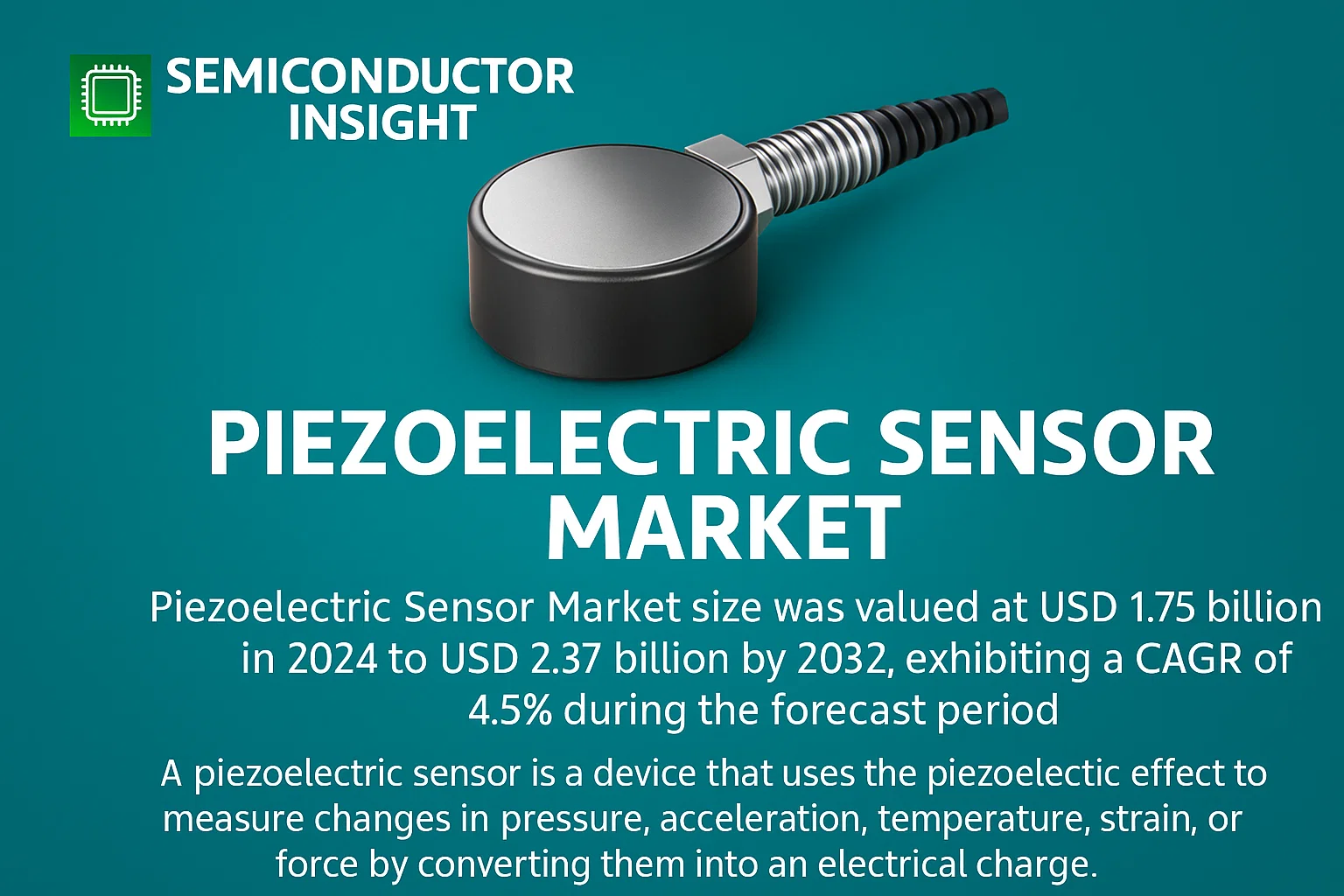
Global Piezoelectric Sensor Market size was valued at USD 1.75 billion in 2024 to USD 2.37 billion by 2032, exhibiting a CAGR of 4.5% during the forecast period.
A piezoelectric sensor is a device that uses the piezoelectric effect to measure changes in pressure, acceleration, temperature, strain, or force by converting them into an electrical charge. These sensors are known for their high frequency response, ruggedness, and ability to operate in harsh environments.
The market growth is primarily driven by increasing demand across industrial manufacturing for process control and predictive maintenance, as well as expanding applications in the automotive sector for engine monitoring and safety systems. Furthermore, advancements in medical devices and the growing adoption of industrial IoT are creating new opportunities for market expansion. North America is the largest producer of piezoelectric sensors, holding a dominant market share of about 35%, followed by Europe with a share of approximately 25%. Key players such as PCB Piezotronics, Honeywell, Meggitt Sensing Systems, Brüel & Kjær, and Kistler Group collectively hold a significant portion of the global market.
MARKET DRIVERS
Proliferation in Industrial Automation and Industry 4.0
Global push towards industrial automation and the adoption of Industry 4.0 principles is a primary driver for the Piezoelectric Sensor Market. These sensors are essential for condition monitoring, predictive maintenance, and real-time process control in manufacturing environments. Their ability to operate in harsh conditions and provide high-frequency response makes them indispensable for monitoring vibrations, pressure, and force in machinery, thereby improving operational efficiency and reducing downtime.
Growing Demand from Consumer Electronics and Automotive Sectors
The expanding consumer electronics market, particularly for smartphones, wearables, and touchscreen devices, relies heavily on piezoelectric sensors for haptic feedback, pressure sensing, and acoustic applications. Concurrently, the automotive industry’s integration of advanced driver-assistance systems (ADAS) and the development of electric vehicles are creating significant demand for these sensors in applications like parking assistance, airbag deployment systems, and battery management.
➤ Advancements in Healthcare and Medical Devices
In the medical field, piezoelectric sensors are critical components in ultrasonic imaging devices, patient monitoring systems, and minimally invasive surgical tools. The increasing demand for portable and wearable medical devices for continuous health monitoring is further propelling market growth. Their high sensitivity and reliability are vital for accurate diagnostic and therapeutic applications.
MARKET CHALLENGES
High Competition and Price Sensitivity
Piezoelectric Sensor Market is characterized by intense competition among numerous global and regional players, leading to significant price pressure. This environment challenges manufacturers to maintain profitability while investing in research and development for next-generation products. Additionally, the presence of alternative sensor technologies, such as capacitive and piezoresistive sensors, creates a highly competitive landscape.
Other Challenges
Material Limitations and Performance Trade-offs
While piezoelectric materials like PZT are widely used, they face limitations related to temperature stability and aging effects, which can impact long-term reliability in critical applications. Developing materials that offer higher Curie temperatures and improved stability without sacrificing sensitivity or increasing cost remains a significant technical challenge for the industry.
Integration Complexity in Miniaturized Systems
The ongoing trend towards device miniaturization, especially in consumer electronics and IoT, presents challenges in integrating piezoelectric sensors into compact designs. Achieving the required performance in a smaller footprint often involves complex manufacturing processes and can lead to higher unit costs, posing a barrier for high-volume, cost-sensitive applications.
MARKET RESTRAINTS
Sensitivity to Environmental Factors
Piezoelectric sensors can be sensitive to extreme temperatures, humidity, and electromagnetic interference, which can limit their use in certain harsh industrial or outdoor environments. This necessitates additional protective packaging or signal conditioning, increasing the overall system cost and complexity and restraining adoption in some cost-sensitive market segments.
Fluctuating Raw Material Costs
The production of high-performance piezoelectric ceramics, such as lead zirconate titanate (PZT), relies on raw materials whose prices can be volatile. Fluctuations in the costs of key elements like lead, zirconium, and titanium can directly impact manufacturing costs and profit margins for sensor producers, creating uncertainty and potentially slowing market growth.
MARKET OPPORTUNITIES
Expansion in Energy Harvesting Applications
The growing focus on sustainable energy solutions presents a significant opportunity for piezoelectric sensors in energy harvesting. These sensors can convert ambient mechanical vibrations from machinery, infrastructure, or even human movement into electrical energy, powering wireless sensor networks and low-power electronic devices, which is particularly promising for the Internet of Things (IoT) ecosystem.
Emergence of Structural Health Monitoring
There is increasing investment in infrastructure development and maintenance worldwide. Piezoelectric sensors are ideal for structural health monitoring (SHM) of bridges, buildings, wind turbines, and aircraft, where they can detect strain, vibrations, and cracks in real-time. This application offers a substantial growth avenue, driven by the need for predictive maintenance and enhanced public safety.
Advancements in Aerospace and Defense
The aerospace and defense sectors continue to demand highly reliable and durable sensing solutions. Opportunities are emerging for piezoelectric sensors in applications such as aircraft engine health monitoring, shock detection, and active vibration control systems. The stringent performance requirements and the critical nature of these applications support the adoption of advanced, albeit higher-cost, piezoelectric solutions.
Piezoelectric Sensor Market Trends
Sustained Growth Driven by Diverse Industrial Applications
Global Piezoelectric Sensor Market is on a steady growth trajectory, with its valuation projected to increase from USD 1748 million in 2024 to USD 2369 million by 2032, representing a compound annual growth rate (CAGR) of 4.5%. This consistent expansion is largely attributed to the sensor’s fundamental utility in converting physical parameters like pressure, acceleration, temperature, strain, or force into measurable electrical signals. The technology’s reliability, high-frequency response, and durability under harsh conditions make it indispensable across numerous sectors.
Other Trends
Consolidated Market Leadership
The competitive landscape of the Piezoelectric Sensor Market is characterized by the presence of established global players. The top five manufacturersPCB Piezotronics, Honeywell, Meggitt Sensing Systems, Bruel and Kjaer, and Kistler Groupcollectively hold a significant portion of the market, estimated at approximately 20%. This indicates a moderately concentrated market where technological expertise and a strong global presence are key competitive advantages. North America remains the largest production hub, accounting for about 35% of the market, followed by Europe with a 25% share.
Segmentation by Application
The market’s diversification is evident in its application segments, which include Industrial & Manufacturing, Automotive, Medical Device, and Aerospace. The industrial sector is a major consumer, utilizing these sensors for equipment monitoring, process control, and predictive maintenance. In the automotive industry, they are critical for safety systems, engine knock detection, and airbag deployment. The medical device segment leverages their precision for diagnostic equipment and surgical tools, while the aerospace sector relies on them for structural health monitoring and testing.
Regional Market Dynamics and Future Prospects
Geographically, the market’s development potential varies. While North America and Europe are mature markets with strong manufacturing bases, the Asia-Pacific region presents significant growth opportunities driven by rapid industrialization and increasing investments in automotive and electronics manufacturing. The ongoing research and development efforts by key players to enhance sensor sensitivity, miniaturization, and integration with IoT platforms are expected to unlock new applications, further propelling market growth in the coming years.
COMPETITIVE LANDSCAPE
Key Industry Players
Market Dominated by Established Players with a High Degree of Fragmentation
Global Piezoelectric Sensor Market is characterized by a consolidated leadership tier and a long tail of specialized participants. The top five manufacturersPCB Piezotronics, Honeywell, Meggitt Sensing Systems, Bruel and Kjaer, and Kistler Group collectively account for approximately 20% of the global market share, underscoring a significant level of market concentration at the very top. North America is the largest producing region, holding about 35% of the market, which bolsters the position of key US-based players. These leading companies possess extensive product portfolios, strong brand recognition, and global distribution networks, allowing them to serve major industries like industrial manufacturing, automotive, and aerospace with high-reliability solutions for measuring pressure, acceleration, force, and vibration.
Beyond the market leaders, the competitive landscape is highly fragmented with numerous players competing in specific niches, applications, or geographic regions. These companies often focus on specialized sensor types, custom solutions, or cost-effective alternatives to cater to specific segments of the medical device sector or regional industrial markets. This fragmentation fosters intense competition on factors such as price, product performance, and technical support. While the top players drive innovation in high-end applications, the wider competitive field ensures a steady supply of diverse solutions, contributing to the overall growth and dynamism of the Piezoelectric Sensor Market globally.
List of Key Piezoelectric Sensor Companies Profiled
- PCB Piezotronics
- Honeywell
- Meggitt Sensing Systems
- Brüel & Kjær
- Kistler Group
- TE Connectivity
- Dytran Instruments
- Ceramtec GmbH
- APC International Ltd.
- RION
- Kyowa Electronic Instruments
- Piezo Systems, Inc.
- Metrix Instrument
- DJB Instruments
Segment Analysis:
| Segment Category | Sub-Segments | Key Insights |
| By Type |
|
Piezoelectric Accelerometers are the dominant product type, largely driven by their critical role in structural health monitoring and vibration analysis across industrial and automotive sectors. These sensors are favored for their robustness, high-frequency response, and reliability in harsh environments. The versatility of accelerometers in applications ranging from predictive maintenance to inertial navigation systems continues to fuel demand. Emerging innovations in materials and miniaturization are enhancing their capabilities, securing their leading market position over force and pressure sensors, which are more specialized in their application scope. |
| By Application |
|
Industrial & Manufacturing represents the most significant application segment, underpinned by the widespread adoption of piezoelectric sensors for predictive maintenance, process control, and machinery condition monitoring. This dominance is attributed to the relentless drive for operational efficiency, quality control, and automation across global manufacturing industries. The automotive sector follows closely, utilizing these sensors extensively for engine knock detection, safety system testing, and NVH (Noise, Vibration, and Harshness) analysis. The high-performance requirements in aerospace and the precision needed in medical devices create specialized, high-value niches for sensor technology. |
| By End User |
|
OEMs (Original Equipment Manufacturers) constitute the leading end-user segment, as they integrate piezoelectric sensors directly into a vast array of new equipment, machinery, and vehicles. This segment’s leadership is fueled by the continuous demand for advanced, sensor-enabled products that offer enhanced functionality, safety, and diagnostic capabilities in sectors like automotive, industrial automation, and consumer electronics. System integrators play a crucial role in creating custom solutions for complex applications, while the aftermarket segment is growing steadily, driven by the need for sensor replacement, calibration services, and retrofitting of existing systems with modern monitoring capabilities. |
| By Signal Type |
|
Digital/IEPE Sensors are the prevailing signal type in the modern market, owing to their integrated electronics which simplify signal conditioning and enable compatibility with standard data acquisition systems. Their convenience, improved signal-to-noise ratio, and relative immunity to cable noise have made them the preferred choice for a majority of industrial and laboratory applications. While traditional analog sensors remain important for high-temperature applications, and charge mode sensors are essential for measuring extremely high-level dynamic signals, the trend is decisively shifting towards digital solutions that offer plug-and-play functionality and greater reliability in complex system integrations. |
| By Material |
|
Ceramics (e.g., PZT) are the leading material segment, extensively used due to their excellent piezoelectric properties, high Curie temperature, and cost-effectiveness for mass production. Their high sensitivity and ability to be manufactured in various shapes make them ideal for a broad spectrum of sensor types, from accelerometers to ultrasonic transducers. Polymer films like PVDF are gaining prominence in flexible and wearable sensor applications, while single crystals such as quartz are valued for their stability and precision in demanding environments like aerospace. Composite materials are emerging to offer tailored properties that combine the benefits of different material classes for specialized high-performance applications. |
Regional Analysis: Piezoelectric Sensor Market
Asia-Pacific
Asia-Pacific’s position as the world’s manufacturing center creates unparalleled demand for piezoelectric sensors used in process control, condition monitoring, and robotics. The relentless push towards Industry 4.0 and smart factory initiatives across the region ensures the integration of these sensors for precision and operational efficiency.
The massive and growing consumer electronics industry, particularly in China, South Korea, and Taiwan, is a primary driver. Piezoelectric sensors are essential components in devices for haptic feedback, touchscreens, and microphones, with local manufacturers constantly innovating to meet global demand for smarter, more interactive devices.
The region’s strong automotive production, especially in Japan, South Korea, and increasingly in Thailand and Indonesia, utilizes piezoelectric sensors extensively for safety systems, engine management, and in-cabin applications. The shift towards electric and autonomous vehicles in these markets presents significant new growth avenues for advanced sensor solutions.
Substantial government support for technological advancement, particularly in China’s “Made in China 2025” policy and similar initiatives in other countries, fosters a favorable environment for sensor development. High concentrations of research institutions and tech companies drive continuous innovation in piezoelectric materials and applications.
North America
North America remains a highly significant and technologically advanced market for piezoelectric sensors, characterized by strong demand from the aerospace, defense, and medical sectors. The presence of leading aircraft manufacturers and defense contractors in the United States drives the need for high-reliability sensors used in structural health monitoring, navigation, and avionics. The region’s advanced healthcare industry utilizes these sensors extensively in diagnostic imaging equipment, surgical tools, and patient monitoring devices. Furthermore, ongoing research and development activities in universities and corporate labs focus on next-generation piezoelectric materials, particularly for energy harvesting and MEMS applications, ensuring the region maintains a competitive edge in innovation despite cost pressures from Asian manufacturing.
Europe
The European market for piezoelectric sensors is mature and stable, with strong foundations in the automotive, industrial, and environmental monitoring sectors. Germany, as a hub for high-end automotive engineering and industrial automation (Industrie 4.0), is a key consumer, using sensors for precision manufacturing and vehicle safety systems. The region has stringent regulations regarding emissions and industrial safety, which drives the adoption of sensors for monitoring and control. A strong focus on sustainability and green technologies also promotes the use of piezoelectric energy harvesting systems in building automation and IoT applications. Collaborative research projects within the EU foster advancements in smart materials and sensor technologies, though the market growth is tempered by the well-established industrial base.
South America
The Piezoelectric Sensor Market in South America is emerging, with growth primarily driven by the industrial and automotive sectors in countries like Brazil and Argentina. The mining and oil & gas industries represent key end-users, employing sensors for equipment monitoring and predictive maintenance in harsh environments. The automotive sector, while smaller than in other regions, shows potential for growth as local production expands. However, market development is often challenged by economic volatility and lower levels of industrial automation compared to more developed regions. The adoption of newer technologies is gradual, with a focus on cost-effective solutions for basic industrial applications rather than cutting-edge innovations.
Middle East & Africa
The market in the Middle East & Africa is nascent but holds potential, particularly in the Middle East due to investments in infrastructure and industrial diversification away from oil dependence. The oil & gas industry is the primary user of piezoelectric sensors for downhole monitoring and flow measurement. There is growing interest in using these sensors for condition monitoring in new industrial cities and smart city projects in the GCC countries. In Africa, the market is largely undeveloped, with limited local manufacturing and reliance on imports for industrial and medical applications. Growth is expected to be slow, tied to broader economic development and industrialization efforts across the continent.
Report Scope
This market research report provides a comprehensive analysis of the Piezoelectric Sensor Market, covering the forecast period 2025–2032. It offers detailed insights into market dynamics, technological advancements, competitive landscape, and key trends shaping the industry.
Key focus areas of the report include:
- Market Overview: The report begins with an overview outlining its current market scenario, key growth indicators, and industry transformation drivers. It discusses macroeconomic factors, demand–supply balance, regulatory landscape, and the strategic role of these sensors in powering advancements across industries such as industrial & manufacturing, automotive, medical devices, and aerospace.
- Market Size & Forecast: Historical data and future projections for revenue, unit shipments, and market value across major regions and segments.
- Segmentation Analysis: Detailed breakdown by product type, technology, application, and end-user industry to identify high-growth segments and investment opportunities.
- Regional Insights: Insights into market performance across North America, Europe, Asia-Pacific, Latin America, and the Middle East & Africa, including country-level analysis where relevant.
- Competitive Landscape: Profiles of leading market participants, including their product offerings, R&D focus, manufacturing capacity, pricing strategies, and recent developments such as mergers, acquisitions, and partnerships.
- Technology Trends & Innovation: Assessment of emerging technologies, integration of AI/IoT, sensor design trends, fabrication techniques, and evolving industry standards.
- Market Drivers & Restraints: Evaluation of factors driving market growth along with challenges, supply chain constraints, regulatory issues, and market-entry barriers.
- Stakeholder Insights: Insights for component suppliers, OEMs, system integrators, investors, and policymakers regarding the evolving ecosystem and strategic opportunities.
Primary and secondary research methods are employed, including interviews with industry experts, data from verified sources, and real-time market intelligence to ensure the accuracy and reliability of the insights presented.
FREQUENTLY ASKED QUESTIONS:
What is the current market size of Piezoelectric Sensor Market?
-> Piezoelectric Sensor Market size was valued at USD 1.75 billion in 2024 to USD 2.37 billion by 2032, exhibiting a CAGR of 4.5% during the forecast period.
Which key companies operate in Piezoelectric Sensor Market?
-> Key players include PCB Piezotronics, Honeywell, Meggitt Sensing Systems, Brüel & Kjær, and Kistler Group, among others. The top 5 manufacturers held a combined market share of about 20% in 2024.
What are the key growth drivers?
-> Key growth drivers include increasing demand from industrial automation, advancements in automotive safety systems, growth in medical device applications, and the expansion of aerospace sectors.
Which region dominates the market?
-> North America is the largest producer and dominant market, with a share of about 35%. It is followed by Europe with a market share of 25%.
What is a piezoelectric sensor?
-> A piezoelectric sensor is a device that uses the piezoelectric effect to measure changes in pressure, acceleration, temperature, strain, or force by converting them to an electrical charge.

Get Sample Report PDF for Exclusive Insights
Report Sample Includes
- Table of Contents
- List of Tables & Figures
- Charts, Research Methodology, and more...
 Download Sample Report PDF