
Market Insights
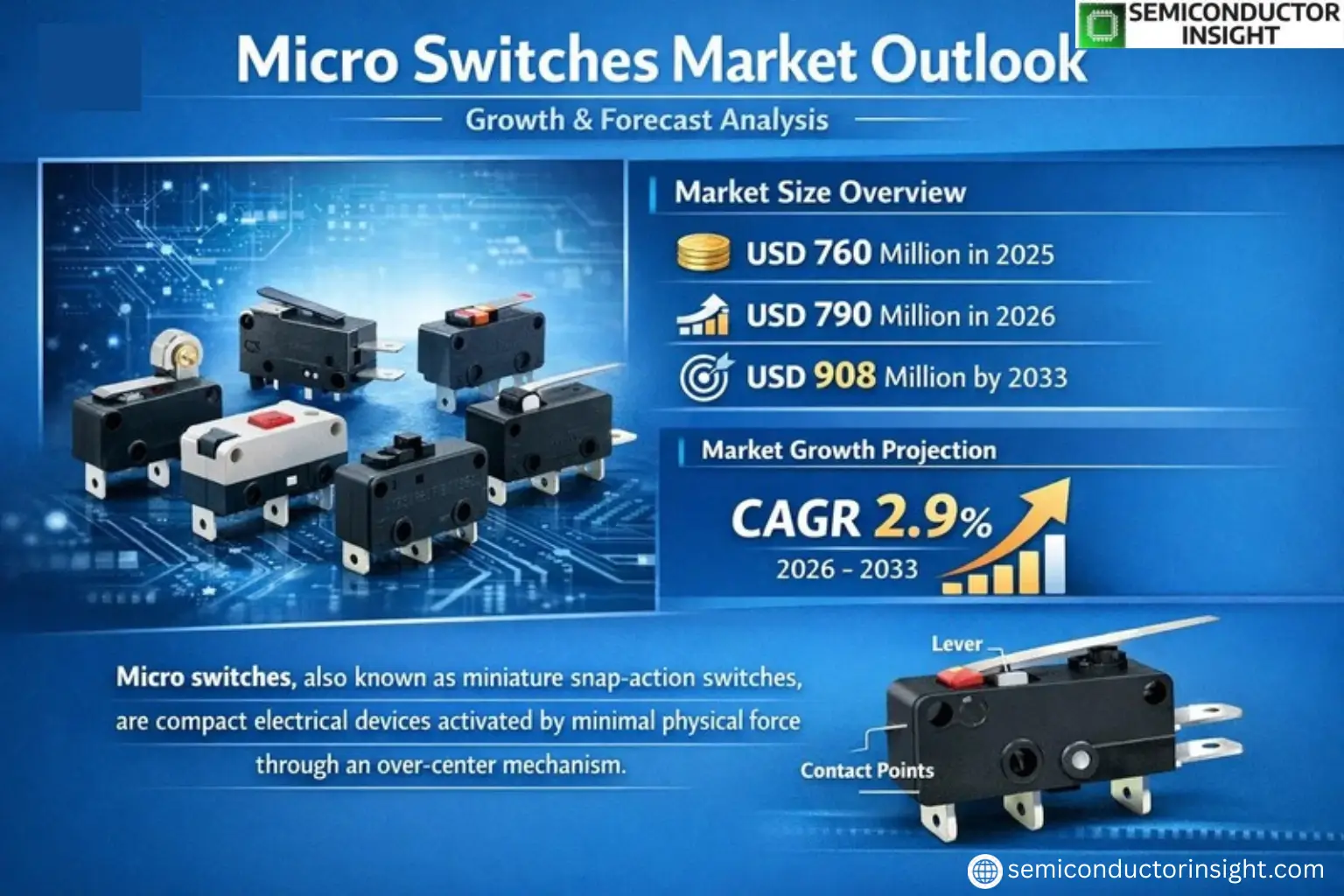
Global Micro Switches Market size was valued at USD 760 million in 2025. The market is projected to grow from USD 790 million in 2026 to USD 908 million by 2033, exhibiting a CAGR of 2.9% during the forecast period.
Micro switches, also known as miniature snap-action switches, are compact electrical devices activated by minimal physical force through an over-center mechanism. These switches ensure reliable operation at precise actuator positions, distinguishing them from other switch types. Their widespread adoption stems from cost efficiency and durability, with lifespans exceeding 1 million cycles for standard models and reaching 10 million cycles for heavy-duty variants.
The market growth is driven by increasing automation across industries and technological advancements in switch design. Key sectors such as automotive electronics and smart appliances demonstrate strong demand, with waterproof (IP67-rated) switches capturing 45% of automotive applications. Emerging IoT applications contribute significantly, with low-power micro switches experiencing over 25% annual growth in smart devices. Leading manufacturers continue innovating through MEMS technology integration, achieving micron-level precision for specialized industrial applications.
MARKET DRIVERS
Increasing Automation Across Industries
The rapid adoption of automation in industrial, automotive, and consumer electronics sectors is a key driver for the Micro Switches Market. These components are critical for precision control in automated systems, with demand growing at approximately 6.8% annually.
Expansion of IoT Applications
Micro switches play a vital role in IoT-enabled devices, particularly in smart home systems and industrial monitoring. Global IoT market’s projected growth to USD 1.5 trillion by 2026 directly benefits micro switch manufacturers.
Stringent safety regulations across industries are further accelerating the adoption of high-reliability micro switches in safety-critical applications.
MARKET CHALLENGES
Price Pressure from Alternative Technologies
Micro Switches Market faces competition from emerging sensor technologies that offer similar functionality at competitive price points, particularly in consumer electronics applications.
Other Challenges
Miniaturization Demands
As devices become smaller, manufacturers must develop micro switches that maintain reliability in compact form factors, requiring significant R&D investment.
Material Cost Volatility
Fluctuations in raw material prices, especially for specialty metals used in contacts, impact production costs and profit margins in the Micro Switches Market.
MARKET RESTRAINTS
Technical Limitations in Harsh Environments
While micro switches offer excellent performance in standard conditions, maintaining reliability in extreme temperatures and corrosive environments remains a technical challenge limiting market expansion in certain industrial segments.
Long Product Lifecycles
The durability of micro switches (often lasting millions of cycles) reduces replacement frequency, creating a restraint for market growth despite increasing installation volumes.
MARKET OPPORTUNITIES
Advancements in Medical Equipment
The healthcare sector presents significant growth potential for micro switches, particularly in diagnostic equipment and surgical devices requiring precise, sterile switching solutions.
EV Charging Infrastructure
Global push for electric vehicles is driving demand for reliable micro switches in charging stations, with the market expected to grow at 28% CAGR through 2028.
Micro Switches Market Trends
Technology Upgrade and Intelligent Transformation
Global Micro Switches Market, valued at USD 760 million in 2025, is projected to reach USD 908 million by 2033, growing at 2.9% CAGR. This growth is fueled by intelligent integration with AI and IoT technologies. Micro switches now embed sensors and chips for environmental monitoring, enabling automated control in smart homes and industrial equipment protection systems.
Other Trends
Miniaturization and Precision Advancements
MEMS technology drives size reduction, increasing micro-switch adoption in wearables by over 30%. Modern switches achieve micron-level precision with stroke errors controlled within ±0.01mm, meeting demands from medical instruments and aerospace applications.
Application Expansion Across Industries
Traditional automotive applications now account for 45% of waterproof switch (IP67) demand, while smart appliances integrate 6-8 switches per unit. Emerging IoT devices drive 25% annual growth in low-power switches. The medical sector shows increasing adoption for precision control in surgical equipment and patient monitoring systems.
Regional Market Dynamics
Eastern China dominates with 30% market share, supported by industrial robot and NEV production. Meanwhile, Japan maintains leadership in ultra-thin switch technology (0.5mm models), while Southeast Asia focuses on cost-sensitive mid-range products. North America shows steady demand from aerospace and defense applications.
Material Innovation and Supply Chain Shifts
High-temperature resistant materials like ceramic contacts emerge as key differentiators. The Yangtze and Pearl River Delta clusters now account for 35% of global production. Customized orders from automotive and medical sectors exceed 50%, accelerating flexible manufacturing adoption across the Micro Switches Market.
COMPETITIVE LANDSCAPE
Key Industry Players
Global Micro Switches Market Dominated by Japanese and European Manufacturers
Micro Switches Market exhibits moderate consolidation with Omron Corporation, ALPS Alpine, and ZF (Cherry) collectively holding over 35% global market share in 2025. Japanese manufacturers lead in high-precision applications through patented snap-action mechanisms, while European players dominate automotive-grade switches through stringent quality certifications. The competitive landscape shows increasing R&D focus on MEMS-based ultra-miniature switches, with Omron’s latest V-151 series achieving 0.5mm actuation stroke at ±0.01mm repeat accuracy. Pricing strategies vary significantly by region, with Chinese manufacturers like Dongnan Electronics competing through 20-30% cost advantages in standard type switches.
Niche specialists are gaining traction in emerging segments – TE Connectivity and Honeywell lead in aerospace/medical certified switches, while Hua-Jie and Toneluck captured 18% of smart home applications through rapid IoT integration. The market saw 7 strategic acquisitions since 2022, notably ZF’s purchase of C&K to expand industrial portfolio. Regional clusters show distinct specialization: Shenzhen-based suppliers focus on consumer electronics, while German manufacturers concentrate on automotive safety systems requiring 10M+ operation cycles. Tariff impacts have accelerated localized production, with Panasonic and Marquardt establishing new facilities in Mexico and India respectively.
List of Key Micro Switches Companies Profiled
- Omron
- ALPS Alpine
- ZF (CHERRY)
- Johnson Electric (Burgess)
- Panasonic
- Torex
- Honeywell
- Dongnan Electronics
- TE Connectivity
- Zippy Technology
- Marquardt
- Littelfuse (C&K)
- Kaihua Electronics
- ITW Switches
- Schaltbau
Segment Analysis:
| Segment Category | Sub-Segments | Key Insights |
| By Type |
|
Standard Type dominates due to its cost-effectiveness and wide compatibility across applications.
|
| By Application |
|
Automobile Industry shows strongest growth trajectory with expanding use cases:
|
| By End User |
|
Industrial Equipment Manufacturers represent the most sophisticated demand:
|
| By Technology |
|
Smart/IoT Enabled switches show strongest innovation momentum:
|
| By Material |
|
Metal Alloy remains industry standard with growing specialty demand:
|
Regional Analysis: Global Micro Switches Market
Asia-Pacific
China’s robust electronics manufacturing cluster provides cost-effective micro switch solutions with quick turnaround times, making it the preferred sourcing destination for global OEMs. Local manufacturers excel in high-volume production while maintaining competitive pricing.
Japanese manufacturers lead in producing ultra-reliable micro switches for mission-critical applications in automotive and medical equipment. Their focus on miniaturization and extreme durability sets industry benchmarks for performance standards.
India’s expanding appliance and automotive sectors are creating new demand for micro switches, with local production gradually increasing to reduce import dependency. Government policies favoring domestic manufacturing are accelerating market growth.
Vietnam, Thailand, and Malaysia are emerging as alternative production bases for micro switches, benefiting from competitive labor costs and free trade agreements that facilitate exports to Western markets.
North America
The North American Micro Switches Market maintains steady growth driven by technological advancements and stringent safety regulations. The United States leads in industrial and aerospace applications requiring high-reliability switching solutions. Increased automation across manufacturing facilities and smart home adoption are key growth drivers. Regional manufacturers focus on developing IP-rated and explosion-proof variants for specialized applications while integrating smart connectivity features to align with Industry 4.0 trends.
Europe
Europe’s mature Micro Switches Market emphasizes energy efficiency and sustainability in product designs. Germany remains the technology leader with precision-engineered solutions for automotive and industrial equipment. EU directives on product safety and electromagnetic compatibility influence design requirements across the region. Eastern European countries are witnessing growing demand from appliance manufacturers establishing production facilities in lower-cost locations.
Middle East & Africa
The MEA region shows increasing micro switch adoption in oil & gas equipment, security systems, and building automation. Gulf Cooperation Council countries drive premium product demand for harsh environment applications. Africa’s market remains price-sensitive but shows potential in appliance replacements and infrastructure development projects requiring basic switching solutions.
South America
Brazil dominates South America’s Micro Switches Market with strong appliance manufacturing and automotive sectors. Economic volatility impacts market growth but creates opportunities for cost-optimized solutions. Regional trade agreements facilitate micro switch imports while local assembly operations are expanding to serve domestic demand more efficiently.
Report Scope
This market research report provides a comprehensive analysis of the Micro Switches Market, covering the forecast period 2025–2033. It offers detailed insights into market dynamics, technological advancements, competitive landscape, and key trends shaping the industry.
Key focus areas of the report include:
- Market Overview: The report begins with an overview outlining its current market scenario, key growth indicators, and industry transformation drivers. It discusses macroeconomic factors, demand-supply balance, regulatory landscape, and the strategic role of micro switches in powering advancements across industries such as automotive, consumer electronics, industrial automation, and medical instruments.
- Market Size & Forecast: Historical data and future projections for revenue, unit shipments, and market value across major regions and segments.
- Segmentation Analysis: Detailed breakdown by product type (Standard, Ultraminiature, Sub-miniature), application (Appliance Industry, Automobile Industry, Electronic Equipment), and end-user industry.
- Regional Insights: Insights into market performance across North America, Europe, Asia-Pacific, Latin America, and Middle East & Africa, including country-level analysis.
- Competitive Landscape: Profiles of leading market participants, including their product offerings, market share, and recent developments.
- Technology Trends & Innovation: Assessment of emerging technologies including AI/IoT integration, MEMS technology, and precision engineering advancements.
- Market Drivers & Restraints: Evaluation of factors driving market growth along with challenges, supply chain constraints, and regulatory issues.
- Stakeholder Insights: Strategic opportunities for manufacturers, suppliers, investors, and policymakers.
Primary and secondary research methods are employed, including interviews with industry experts and data from verified sources to ensure accurate insights.
FREQUENTLY ASKED QUESTIONS:
What is the current market size of Micro Switches Market?
-> Micro Switches Market size was valued at USD 760 million in 2025. The market is projected to grow from USD 790 million in 2026 to USD 908 million by 2033, exhibiting a CAGR of 2.9% during the forecast period.
What is the growth rate (CAGR) of the Micro Switches Market?
-> The market is expected to grow at a CAGR of 2.9% during 2025-2033.
Which key companies operate in Micro Switches Market?
-> Key players include Omron, ALPS, ZF(CHERRY), Johnson Electric(Burgess), Panasonic, Honeywell, TE, and Marquardt, among others.
What are the key growth drivers?
-> Key growth drivers include rising demand from automotive electronics, smart appliances averaging 6-8 switches per unit, and 25%+ annual growth in IoT applications.
Which region dominates the market?
-> Asia-Pacific dominates with Eastern China holding over 30% share, while Japan leads in precision switch technology.
What are the emerging trends?
-> Emerging trends include MEMS-based miniaturization, smart integration with AI/IoT, and high-precision switches with ±0.01mm accuracy.

Get Sample Report PDF for Exclusive Insights
Report Sample Includes
- Table of Contents
- List of Tables & Figures
- Charts, Research Methodology, and more...
 Download Sample Report PDF



Be the first to review “Micro Switches Market Size, Emerging Trends, Technological Advancements, and Business Strategies 2026-2033”