
Image Processing Module Market MARKET INSIGHTS
Global Image Processing Module Market was valued at 7316 million in 2024 and is projected to reach USD 13680 million by 2032, at a CAGR of 10.9% during the forecast period.
Image Processing Module Market is a hardware or software component designed to collect, process, analyze, and optimize image data. These modules are integrated into devices such as cameras, smartphones, medical equipment, industrial robots, and autonomous vehicles, leveraging advanced algorithms to perform functions like image enhancement, feature extraction, target recognition, and noise reduction. Core technologies employed include image filtering, edge detection, pattern recognition, and machine learning, enabling applications across medical imaging, security surveillance, intelligent manufacturing, and consumer electronics.
The market growth is primarily driven by increasing demand for high-quality imaging solutions, rapid advancements in artificial intelligence, and the proliferation of automation across industries. The medical sector, in particular, has seen substantial adoption due to the rising need for precise diagnostic tools. Additionally, innovations in autonomous vehicles and smart cameras are propelling market expansion. Key players such as Honeywell Aerospace, Renesas Electronics, and OMNIVISION are investing heavily in R&D to enhance module capabilities, further fueling industry growth.
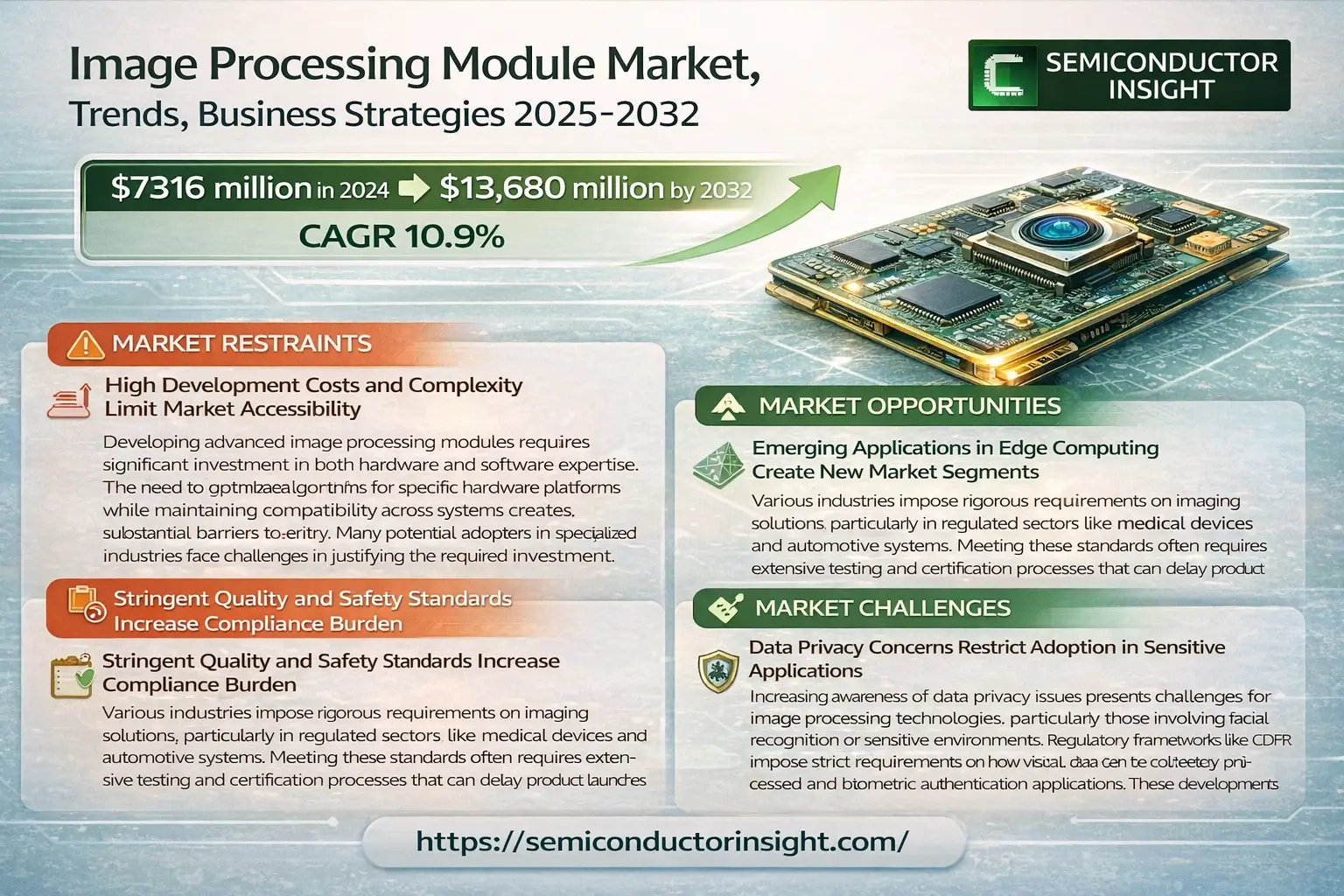
Image Processing Module Market MARKET DYNAMICS
Image Processing Module Market MARKET DRIVERS
Increasing Adoption of AI and Machine Learning Across Industries to Boost Market Growth
The integration of artificial intelligence and machine learning in Image Processing Module Market is revolutionizing how visual data is analyzed. Industries such as healthcare use AI-powered image recognition for early disease detection, with medical imaging AI projected to grow as part of global digital transformation efforts. In manufacturing, smart vision systems powered by advanced Image Processing Module Market enable real-time quality control, reducing defect rates significantly compared to manual inspection. Furthermore, autonomous vehicles rely on sophisticated image processing for object detection and navigation, creating substantial demand for high-performance modules that can process multiple camera feeds simultaneously.
Growth in Smartphone and Consumer Electronics Market Driving Miniaturized Solutions
The consumer electronics sector’s expansion is creating robust demand for compact, efficient Image Processing Module Market. Smartphone manufacturers increasingly incorporate advanced computational photography features that require real-time image processing capabilities. The average premium smartphone now contains multiple specialized image signal processors working in concert with AI accelerators. This trend extends to emerging product categories like AR/VR headsets and smart home devices with vision capabilities. As consumer expectations for camera quality and AI-enhanced imaging continue rising, manufacturers are pushing the boundaries of what integrated processing modules can achieve in constrained form factors.
Expansion of Industrial Automation Creating Demand for Robust Vision Systems
Factory automation adoption is accelerating worldwide, with industrial Image Processing Module Market becoming essential components in modern production lines. These systems enable automated inspection, robotic guidance, and process monitoring at speeds and accuracy levels unattainable by human workers. The growing emphasis on Industry 4.0 principles is further driving adoption, as enterprises seek to implement connected vision systems that integrate with broader manufacturing execution systems. This is particularly evident in sectors where precision is paramount, such as semiconductor manufacturing and pharmaceutical production, where even minor defects can have serious consequences.
Image Processing Module Market MARKET RESTRAINTS
High Development Costs and Complexity Limit Market Accessibility
Developing advanced Image Processing Module Market requires significant investment in both hardware and software expertise. The need to optimize algorithms for specific hardware platforms while maintaining compatibility across systems creates substantial barriers to entry. Many potential adopters in specialized industries face challenges in justifying the required investment, particularly for custom solutions. This is compounded by the rapid pace of technological change, which can make systems obsolete within relatively short development cycles. The complexity of integrating these modules into existing workflows also presents implementation challenges that can slow adoption rates.
Stringent Quality and Safety Standards Increase Compliance Burden
Various industries impose rigorous requirements on imaging solutions, particularly in regulated sectors like medical devices and automotive systems. Meeting these standards often requires extensive testing and certification processes that can delay product launches and increase costs significantly. For medical applications, modules must demonstrate consistent performance under various conditions while meeting strict accuracy thresholds. In automotive applications, reliability and safety certifications demand robust validation processes that can extend development timelines. These compliance requirements, while necessary for ensuring performance and safety, create substantial hurdles for both manufacturers and end-users.
Image Processing Module Market MARKET OPPORTUNITIES
Emerging Applications in Edge Computing Create New Market Segments
The shift toward edge computing presents substantial opportunities for image processing module providers. By moving processing closer to data sources, edge-based vision systems can reduce latency and bandwidth requirements while improving privacy and security. This is particularly relevant for applications like smart city infrastructure and retail analytics, where real-time processing of multiple video streams provides significant operational advantages. The growing adoption of IoT devices with vision capabilities further expands potential applications, enabling distributed intelligence across numerous endpoints. Providers that can offer power-efficient, high-performance modules optimized for edge deployment stand to benefit from these developments.
Advancements in 3D Imaging Technology Open New Possibilities
Recent progress in 3D vision systems creates opportunities across multiple industries. In healthcare, 3D imaging enables more accurate diagnostics and surgical planning, while in manufacturing, it improves quality control for complex geometries. The consumer electronics sector continues to innovate with depth-sensing cameras for augmented reality and biometric authentication applications. These developments drive demand for specialized processing modules capable of handling the increased computational load and data volume associated with 3D image processing. As the technology matures and costs decrease, additional applications in areas like logistics, agriculture, and security are likely to emerge.
Image Processing Module Market MARKET CHALLENGES
Data Privacy Concerns Restrict Adoption in Sensitive Applications
Increasing awareness of data privacy issues presents challenges for image processing technologies, particularly those involving facial recognition or sensitive environments. Regulatory frameworks like GDPR impose strict requirements on how visual data can be collected, processed and stored. These concerns are especially acute in public sector deployments and consumer-facing applications, where misuse could have significant reputational consequences. Companies must balance the benefits of advanced image processing with ethical considerations and compliance obligations, which can sometimes limit implementation options or require substantial modifications to system architectures.
Hardware Limitations Constrain Performance in Demanding Applications
While image processing algorithms continue advancing rapidly, hardware constraints remain a persistent challenge. Applications requiring real-time processing of ultra-high resolution video or complex AI models often push current processing architectures to their limits. Thermal management, power efficiency, and memory bandwidth limitations create trade-offs that designers must carefully balance. In mobile and embedded applications, these constraints are particularly acute, forcing developers to make difficult choices between performance, accuracy, and power consumption. Overcoming these limitations requires ongoing innovation in both semiconductor technology and algorithm optimization techniques.
IMAGE PROCESSING MODULE MARKET TRENDS
AI-Powered Image Analysis to Drive Market Expansion
The integration of Artificial Intelligence (AI) and Machine Learning (ML) in Image Processing Module Market is transforming industries by enhancing real-time decision-making capabilities. Modern AI-driven modules utilize deep learning algorithms to improve accuracy in object detection, facial recognition, and anomaly detection. For instance, in the medical industry, AI-powered modules assist in diagnosing diseases from X-rays and MRIs with a precision rate exceeding 92%. Meanwhile, industrial automation leverages these technologies for quality control in manufacturing, reducing human error by nearly 40%. The dominance of AI in processing complex visual data is accelerating adoption across sectors, creating a ripple effect in the market.
Other Trends
Edge Computing and Real-Time Processing
The shift towards edge computing has emerged as a key driver for Image Processing Module Market, particularly in applications requiring low latency and high efficiency. Devices equipped with edge-based modules process data locally instead of relying on cloud-based solutions, significantly reducing response times. In the security and surveillance sector, real-time facial recognition systems process multiple data streams simultaneously, enabling faster threat detection. Similarly, autonomous vehicles utilize edge processing for immediate obstacle recognition, improving safety. The demand for on-device processing is projected to grow at a 15% CAGR as industries prioritize speed and data security.
Growth of Industrial Automation and Smart Manufacturing
The rise of Industry 4.0 is fueling demand for advanced Image Processing Module Market in smart factories, where they play a critical role in robotic vision systems and predictive maintenance. High-resolution cameras combined with sophisticated processing modules enable automated inspection of precision components, reducing defects by up to 30% in electronics manufacturing. Collaborative robots (cobots) equipped with these modules perform intricate assembly tasks with sub-millimeter accuracy, streamlining production lines. As more industries transition to automated workflows, the need for multi-sensor imaging solutions will continue to expand, reinforcing market growth.
COMPETITIVE LANDSCAPE
Key Industry Players
Technological Innovation and Strategic Investments Drive Market Competition
Global Image Processing Module Market features a dynamic competitive environment, characterized by the presence of multinational corporations and specialized technology providers. Honeywell Aerospace and Renesas Electronics emerged as dominant players in 2024, leveraging their expertise in industrial automation and semiconductor-based imaging solutions. Their market leadership stems from continuous R&D investments and partnerships with OEMs across medical, automotive, and consumer electronics sectors.
Festo Corporation and Komatsu NTC Ltd. have significantly expanded their market share through customized image processing solutions for manufacturing automation. These companies benefit from the growing Industry 4.0 adoption, where real-time image analysis becomes critical for quality control and predictive maintenance applications.
Meanwhile, several companies are pursuing diversification strategies to capture emerging opportunities. OMNIVISION strengthened its position in smartphone cameras through advanced CMOS sensors, while Micro Technica Corporation focused on niche applications in microscopic imaging for semiconductor inspection.
The competitive intensity is further accentuated by regional specialists like Jenoptik in Europe and Shikino in Asia, who combine localized manufacturing with tailored solutions for their respective markets. Market leaders are actively acquiring startups specializing in AI-powered image recognition to enhance their technological capabilities.
List of Key Image Processing Module Companies Profiled
- Honeywell Aerospace (U.S.)
- Abaco Systems (U.S.)
- Festo Corporation (Germany)
- Renesas Electronics (Japan)
- Komatsu NTC Ltd. (Japan)
- Micro Technica Corporation (Japan)
- OMNIVISION (U.S.)
- Shikino (Japan)
- ViSCO (Japan)
- Vee Technologies (India)
- Imatest (U.S.)
- CRS iiMotion (Germany)
- FRAMOS (Germany)
- HEUFT (Germany)
- Wenglor (Germany)
- Jenoptik (Germany)
Segment Analysis:
By Type
Image Import Module Leads Due to Rising Demand for Real-Time Data Processing
The market is segmented based on type into:
- Image Import Module
- Image Export Module
- Edge Processing Modules
- Cloud-Based Processing Modules
- Others
By Application
Medical Industry Dominates with High Adoption of Diagnostic Imaging Technologies
The market is segmented based on application into:
- Medical Industry
- Manufacturing Industry
- Consumer Electronics
- Automotive
- Security & Surveillance
By Technology
Machine Learning-Based Processing Gains Traction for Advanced Recognition Capabilities
The market is segmented based on technology into:
- Traditional Image Processing
- Machine Learning-Based Processing
- Deep Learning Algorithms
- Computer Vision Systems
By Component
Hardware Segment Maintains Strong Position Due to Specialized Processing Chips
The market is segmented based on component into:
- Hardware
- Software
- Services
Regional Analysis: Image Processing Module Market
Asia-Pacific
The Asia-Pacific region dominates the global Image Processing Module Market, accounting for the largest revenue share due to rapid industrialization and technological advancements. China stands as the key contributor, supported by its expansive consumer electronics manufacturing sector and government initiatives like “Made in China 2025”, which prioritizes smart manufacturing. Japan and South Korea follow closely, driven by innovations in autonomous vehicles and robotics. Despite cost sensitivity, growing demand for AI-powered imaging in healthcare and surveillance is accelerating adoption. Challenges include fragmented regulatory frameworks and intellectual property concerns, though investments in R&D continue to strengthen local capabilities.
North America
North America, led by the U.S., is a hub for cutting-edge image processing technologies, particularly in medical imaging and autonomous systems. The region benefits from robust R&D expenditure, with companies like Honeywell Aerospace and Abaco Systems driving innovation. Strict FDA regulations for medical devices ensure high-quality standards, while defense contracts spur demand for advanced vision systems in aerospace. However, high manufacturing costs and competition from Asia-Pacific suppliers pose challenges. The focus remains on edge computing and AI integration, with Silicon Valley startups contributing to niche applications like real-time video analytics.
Europe
Europe’s market thrives on precision engineering and stringent compliance with EU GDPR for data-intensive applications. Germany leads in industrial automation, leveraging image modules for quality control in manufacturing. The automotive sector, especially in Germany and France, integrates these modules for ADAS (Advanced Driver-Assistance Systems). Meanwhile, the U.K. and Nordic countries emphasize healthcare innovations, such as AI-driven diagnostic tools. While growth is steady, high costs and reliance on imports for semiconductor components limit scalability, prompting initiatives like the European Chips Act to bolster local supply chains.
South America
South America shows gradual growth, with Brazil and Argentina emerging as focal points. The automotive and agriculture sectors increasingly adopt image processing for autonomous machinery and crop monitoring. However, economic instability and underdeveloped infrastructure hinder large-scale deployments. Local manufacturers face competition from global players, though partnerships with universities aim to nurture talent in machine vision. Investments in smart cities and surveillance systems are rising, albeit at a slower pace compared to other regions.
Middle East & Africa
The MEA region is in the nascent stage, with growth concentrated in the UAE, Saudi Arabia, and South Africa. Oil and gas industries utilize imaging modules for pipeline inspections, while smart city projects in Dubai drive demand for surveillance technologies. Limited local expertise and reliance on imports constrain market expansion, but initiatives like Saudi Vision 2030 are fostering digital transformation. Despite low penetration, sectors like healthcare and retail present untapped potential for scalable solutions.
Report Scope
This market research report provides a comprehensive analysis of the global Image Processing Module market, covering the forecast period 2024–2032. It offers detailed insights into market dynamics, technological advancements, competitive landscape, and key trends shaping the industry.
Key focus areas of the report include:
- Market Size & Forecast: Historical data and future projections for revenue, unit shipments, and market value across major regions and segments. Global Image Processing Module market was valued at USD 7,316 million in 2024 and is projected to reach USD 13,680 million by 2032, growing at a CAGR of 10.9% during the forecast period.
- Segmentation Analysis: Detailed breakdown by product type (Image Import Module, Image Export Module), application (Medical Industry, Manufacturing Industry, Consumer Electronics), and end-user industry to identify high-growth segments and investment opportunities.
- Regional Outlook: Insights into market performance across North America, Europe, Asia-Pacific, Latin America, and the Middle East & Africa, including country-level analysis where relevant. The U.S. market size is estimated at USD million in 2024, while China is expected to reach USD million by 2032.
- Competitive Landscape: Profiles of leading market participants, including their product offerings, R&D focus, manufacturing capacity, pricing strategies, and recent developments such as mergers, acquisitions, and partnerships. Key players include Honeywell Aerospace, Abaco Systems, Festo Corporation, Renesas Electronics, and OMNIVISION, among others.
- Technology Trends & Innovation: Assessment of emerging technologies, integration of AI/IoT, semiconductor design trends, fabrication techniques, and evolving industry standards in Image Processing Module Market.
- Market Drivers & Restraints: Evaluation of factors driving market growth along with challenges, supply chain constraints, regulatory issues, and market-entry barriers.
- Stakeholder Analysis: Insights for component suppliers, OEMs, system integrators, investors, and policymakers regarding the evolving ecosystem and strategic opportunities.
Primary and secondary research methods are employed, including interviews with industry experts, data from verified sources, and real-time market intelligence to ensure the accuracy and reliability of the insights presented.
FREQUENTLY ASKED QUESTIONS:
What is the current market size of Global Image Processing Module Market?
-> Image Processing Module Market was valued at 7316 million in 2024 and is projected to reach USD 13680 million by 2032, at a CAGR of 10.9% during the forecast period.
Which key companies operate in Global Image Processing Module Market?
-> Key players include Honeywell Aerospace, Abaco Systems, Festo Corporation, Renesas Electronics, OMNIVISION, Shikino, ViSCO, and Vee Technologies, among others.
What are the key growth drivers?
-> Key growth drivers include increasing demand for high-quality imaging in medical diagnostics, advancements in AI-based image processing, and rising adoption in industrial automation and consumer electronics.
Which region dominates the market?
-> Asia-Pacific is the fastest-growing region, driven by China and Japan, while North America remains a dominant market due to technological advancements.
What are the emerging trends?
-> Emerging trends include integration of deep learning algorithms, edge computing for real-time processing, and miniaturization of Image Processing Module Market.
Get Sample Report PDF for Exclusive Insights
Report Sample Includes
- Table of Contents
- List of Tables & Figures
- Charts, Research Methodology, and more...


