
Radar Tank Gauge Market Insights
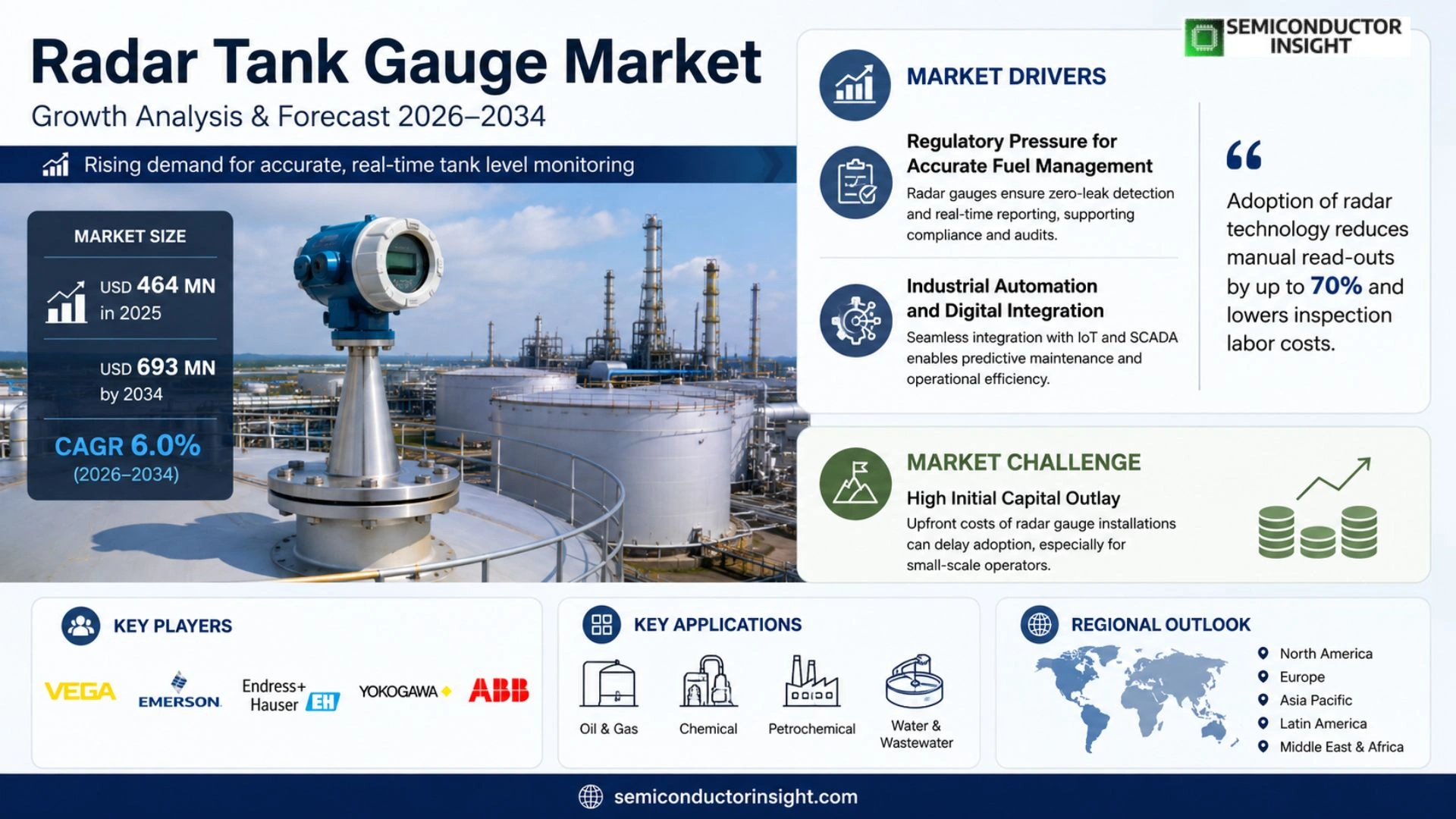
Radar Tank Gauge market size was valued at USD 464 million in 2025 and forecasts indicate it will rise to USD 693 million by 2034, reflecting a CAGR of 6.0% over the forecast horizon.
Radar tank gauge is a non‑contact level measuring instrument that employs microwave (radar) technology. By transmitting and receiving electromagnetic waves, it accurately determines the level of liquids, slurries or solids within tanks, silos or vessels without physical contact.
In 2025, worldwide production reached roughly 565 k units, with an average selling price of about USD 900 per unit. The sector remains highly concentrated in Europe and North America, where manufacturers such as Emerson and Kongsberg dominate. Emerging opportunities exist for domestic suppliers as demand expands across oil‑gas storage, fine‑chemical processing and water‑treatment applications.
MARKET DRIVERS
Regulatory Pressure for Accurate Fuel Management
Stringent environmental regulations worldwide compel operators of storage facilities to adopt precise measurement technologies. Radar‑based level sensors meet the demand for zero‑leak detection and real‑time reporting, making them a preferred choice for compliance audits. This shift fuels a noticeable uptake in Radar Tank Gauge market as firms replace legacy float‑type gauges.
Industrial Automation and Digital Integration
Manufacturers are embedding radar gauges into broader IoT ecosystems to enable predictive maintenance and remote monitoring. The ability to feed high‑resolution data into SCADA platforms creates operational efficiencies that translate directly into cost savings. Consequently, end‑users are allocating capital toward radar solutions that can be seamlessly integrated with existing digital infrastructures.
➤ “Adoption of radar technology reduces manual read‑outs by up to 70 % and lowers inspection labor costs,”
These efficiency gains are especially pronounced in petrochemical complexes where inventory accuracy influences downstream production planning. Companies that standardize on radar gauges report tighter inventory variance, which in turn improves profitability across the supply chain.
MARKET CHALLENGES
High Initial Capital Outlay
Despite long‑term savings, the upfront cost of radar gauge installations remains a barrier for small‑scale operators. Budget constraints can delay projects, prompting some facilities to defer upgrades in favor of incremental maintenance of older systems.
Other Challenges
Installation Complexity
Mounting radar transducers on existing tanks often requires specialized engineering, particularly in retrofit scenarios where space is limited. The need for skilled technicians adds to project timelines and expense.
Moreover, the calibration process must account for variables such as foam, vapor, and turbulence, demanding expertise that is not uniformly available across all regions.
MARKET RESTRAINTS
Temperature Extremes and Signal Attenuation
Radar sensors operating in extreme thermal environments can experience drift, requiring more frequent recalibration. In cold climates, ice accumulation on the antenna may degrade signal integrity, while in hot zones, electronic components can overheat, shortening device lifespan.
These technical constraints limit adoption in regions where climatic conditions deviate significantly from standard operating ranges, compelling manufacturers to invest in ruggedized designs that increase overall system cost.
MARKET OPPORTUNITIES
Emergence of Low‑Cost Radar Modules
Advancements in semiconductor fabrication have yielded compact radar modules at a fraction of previous prices. This price compression opens Radar Tank Gauge market to mid‑tier storage facilities that previously could not justify the investment.
Coupled with the rise of cloud‑based analytics platforms, these affordable modules enable real‑time data aggregation across dispersed assets, presenting a compelling value proposition for logistics operators seeking end‑to‑end visibility.
Radar Tank Gauge Market Trends
Shift to High‑Frequency Intelligent Gauges
Radar Tank Gauge market recorded roughly $464 million in 2025 and is forecasted to reach about $693 million by 2034. Production volumes of 565 k units in 2025, paired with an average unit price near $900, illustrate a healthy revenue base. A noticeable technical pivot is the adoption of 80 GHz and higher frequency bands, which deliver narrower beams and better obstacle avoidance inside complex tanks. Vendors are embedding AI‑based echo processing and predictive‑maintenance algorithms, turning a once‑stand‑alone level sensor into a connected asset within industrial IoT ecosystems. This evolution is especially pronounced in oil‑storage and fine‑chemical facilities, where real‑time inventory accuracy reduces downtime and lowers safety risks.
Other Trends
Manufacturing Precision and Reliability
Manufacturing of Radar Tank Gauges now hinges on tighter integration of microwave electronics with precision‑machined housings. The process starts with bonding the high‑frequency patch onto a chip that forms the signal‑transmission core. The assembly is then sealed within die‑cast aluminum or stainless‑steel enclosures designed for rigorous electromagnetic shielding. Antenna elements undergo either CNC machining or high‑precision injection molding to meet exact beam‑forming tolerances and corrosion resistance. Final quality steps such as helium mass‑spectrometry leak testing and high‑temperature aging ensure airtightness and long‑term stability, crucial for explosion‑proof and sanitary applications. These manufacturing advances support higher reliability metrics, which in turn justify premium pricing in regulated sectors.
Regional Consolidation and Emerging Players
Geographically, Radar Tank Gauge market remains concentrated in Europe, the United States, and other developed economies, with manufacturers like Emerson, Kongsberg, and Siemens dominating high‑volume segments. Nonetheless, domestic suppliers in China and other Asian economies are expanding their design and production capabilities, targeting niche applications where cost sensitivity outweighs the need for ultra‑high frequency performance. This emerging competition pressures incumbent players to innovate faster and reconsider pricing structures, while also opening distribution channels in fast‑growing petrochemical hubs across Asia. For customers, the shifting landscape creates opportunities to source locally, reduce lead times, and leverage regional technical support, thereby influencing capital‑allocation decisions across the broader process‑automation portfolio.
COMPETITIVE LANDSCAPE
Key Industry Players
Global Radar Tank Gauge Competitive Overview
Radar tank gauge segment is dominated by a handful of multinational engineering firms that combine advanced microwave circuitry with rugged housings for harsh process environments. Siemens AG leverages its broad automation portfolio to embed radar sensors into integrated plant‑wide monitoring solutions, while Emerson’s Rosemount line focuses on high‑frequency (80 GHz and above) units that deliver narrow‑beam performance for oil‑field storage tanks. Endress+Hauser, a Swiss specialist, differentiates through proprietary AI‑driven echo processing that supports predictive maintenance, positioning its devices as the de‑facto standard in petrochemical plants across Europe and North America. These leaders benefit from deep R&D spend, extensive service networks, and the ability to bundle gauges with digital asset‑management platforms, allowing them to command premium pricing and secure the majority of global sales volume.
Beyond the tier‑one manufacturers, a diverse set of regional players fills niche requirements and drives incremental innovation. KROHNE and VEGA, both German‑based, concentrate on sanitary‑grade designs for the pharmaceutical and food‑beverage sectors, where explosion‑proof certification and cleanability are paramount. Asian entrants such as Supmea, Shanghai Youbang Automation, and Shaanxi Shengke Electronic Technology focus on cost‑effective units for water‑treatment and municipal applications, often partnering with local system integrators. Companies like BinMaster and APG Sensors target the US‑based oil‑service market with modular radar kits that can be retrofitted onto existing vessels, while Hawk Measurement and Pulsar Measurement specialize in custom antenna engineering for slurry handling in mining operations. This breadth of players creates a competitive tapestry where product differentiation hinges on frequency range, intelligence features, and compliance with industry‑specific standards.
List of Key Radar Tank Gauge Companies Profiled
- Siemens AG
- Endress+Hauser
- Honeywell International Inc.
- Emerson Electric Co.
- Schneider Electric
- KROHNE Group
- VEGA Group
- ABB Ltd.
- APG Sensors
- BinMaster
- Supmea
- Hawk Measurement
- Magnetrol International
- Pulsar Measurement
- Shanghai Youbang Automation
Segment Analysis:
| Segment Category | Sub-Segments | Key Insights |
| By Type |
|
FMCW Radar Level Gauge
|
| By Application |
|
Oil & Gas Storage
|
| By End User |
|
Process Plants
|
| By Technology Integration |
|
AI‑Driven Echo Processing
|
| By Environmental Suitability |
|
Explosion‑Proof Designs
|
Regional Analysis: Radar Tank Gauge Market
North America
Recent revisions to occupational safety codes in the United States and Canada emphasize precise fluid‑level monitoring, nudging operators toward radar technology. Compliance audits now reference specific performance metrics, compelling firms to replace legacy gauges that cannot meet the latest verification criteria.
Large refineries and petrochemical complexes are integrating radar gauges into critical process loops to minimize downtime. The technology’s immunity to vapor, foam, and temperature swings aligns with the operational demands of high‑throughput facilities, fostering broader acceptance across the sector.
North American R&D labs focus on embedding IoT connectivity within radar units, enabling real‑time data streams to cloud‑based dashboards. Such capabilities allow operators to perform condition‑based interventions, sharpening the competitive edge of early adopters.
A dense supplier ecosystem shortens lead times for custom gauge configurations. Localized component sourcing also reduces exposure to global logistics disruptions, ensuring steady project execution for capital‑intensive installations.
Europe
European manufacturers have leaned into sustainability mandates, prompting a shift toward radar gauges that minimize leak risks and support environmental reporting. Nations with strong offshore wind infrastructure, such as Denmark and the United Kingdom, are retrofitting marine storage tanks with radar solutions to meet stringent maritime safety standards. Concurrently, the region’s diverse regulatory framework encourages vendors to develop modular products adaptable to multiple compliance regimes, fostering a market where flexibility becomes a key differentiator for success.
Asia‑Pacific
In Asia‑Pacific, rapid urbanization and expanding petrochemical capacity generate a growing appetite for reliable tank‑level monitoring. Countries like China and India are witnessing infrastructure upgrades where radar technology replaces mechanical gauges that suffer from corrosive environments. The competitive landscape is characterized by aggressive pricing strategies from regional manufacturers, yet end‑users increasingly value the long‑term reliability of higher‑grade systems, creating a bifurcated market that balances cost concerns with performance expectations.
South America
South American markets, particularly Brazil and Argentina, are experiencing a resurgence in hydrocarbon exploration, which in turn fuels demand for robust measurement tools. Radar gauges offer the non‑intrusive advantage needed for tanks handling volatile liquids under fluctuating temperature regimes. Local operators are also aligning with global best practices to attract foreign investment, making compliance with international standards a decisive factor in supplier selection.
Middle East & Africa
The Middle East & Africa region leverages its extensive oil reserves, and radar tank gauges are increasingly viewed as essential for maintaining the integrity of massive storage facilities. Harsh desert climates and high‑temperature operations demand sensors that can endure extreme conditions without calibration drift. Meanwhile, emerging markets in Africa are initiating pilot projects that prioritize safety and operational transparency, positioning radar technology as a catalyst for modernizing their nascent industrial sectors.
Report Scope
This market research report provides a comprehensive analysis of the Radar Tank Gauge Market , covering the forecast period 2026–2034. It offers detailed insights into market dynamics, technological advancements, competitive landscape, and key trends shaping the industry.
Key focus areas of the report include:
- Market Overview: The report begins with an overview outlining its current market scenario, key growth indicators, and industry transformation drivers. It discusses macroeconomic factors, demand–supply balance, regulatory landscape, and the strategic role of semiconductors in powering advancements across industries such as automotive, telecommunications, consumer electronics, and industrial automation.
- Market Size & Forecast: Historical data and future projections for revenue, unit shipments, and market value across major regions and segments.
- Segmentation Analysis: Detailed breakdown by product type, technology, application, and end-user industry to identify high-growth segments and investment opportunities.
- Regional Insights: Insights into market performance across North America, Europe, Asia-Pacific, Latin America, and the Middle East & Africa, including country-level analysis where relevant.
- Competitive Landscape: Profiles of leading market participants, including their product offerings, R&D focus, manufacturing capacity, pricing strategies, and recent developments such as mergers, acquisitions, and partnerships.
- Technology Trends & Innovation: Assessment of emerging technologies, integration of AI/IoT, semiconductor design trends, fabrication techniques, and evolving industry standards.
- Market Drivers & Restraints: Evaluation of factors driving market growth along with challenges, supply chain constraints, regulatory issues, and market-entry barriers.
- Stakeholder Insights: Insights for component suppliers, OEMs, system integrators, investors, and policymakers regarding the evolving ecosystem and strategic opportunities.
Primary and secondary research methods are employed, including interviews with industry experts, data from verified sources, and real-time market intelligence to ensure the accuracy and reliability of the insights presented.
FREQUENTLY ASKED QUESTIONS:
What is the current market size of Radar Tank Gauge Market?
-> Radar Tank Gauge market forecasts indicate it will rise to USD 693 million by 2034, reflecting a CAGR of 6.0% over the forecast horizon.
Which key companies operate in Radar Tank Gauge Market?
-> Key players include Emerson, Kongsberg, Siemens AG, Endress+Hauser, Honeywell, Schneider, Flowline, VEGA, KROHNE Group, and ABB, among others.
What are the key growth drivers?
-> Key growth drivers include adoption of high‑frequency (>80 GHz) radar technology, integration of AI‑based echo processing, industrial IoT connectivity, and increasing demand for non‑contact level measurement in oil & gas storage and fine‑chemical processing.
Which region dominates the market?
-> Europe holds the largest share, supported by strong manufacturing bases in Germany, France and the U.K., while North America (especially the United States) also shows significant concentration.
What are the emerging trends?
-> Emerging trends include wide‑band 80 GHz+ radar sensors, built‑in predictive‑maintenance algorithms, seamless integration with tank‑management software, and the shift toward fully digital, AI‑enabled inventory control systems.
Get Sample Report PDF for Exclusive Insights
Report Sample Includes
- Table of Contents
- List of Tables & Figures
- Charts, Research Methodology, and more...
 Download Sample Report PDF





