Key Statistics
Key Takeaways
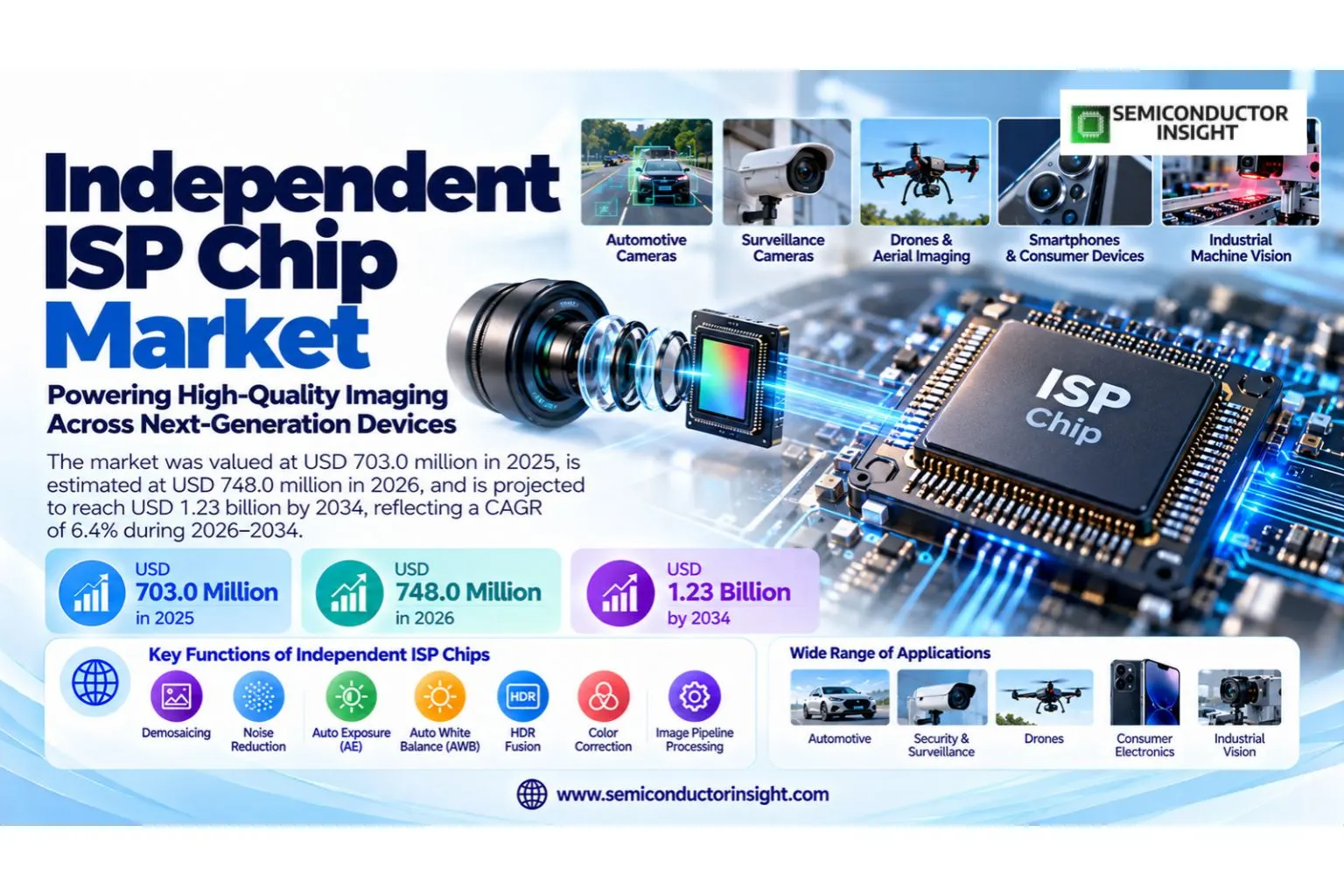
- The market is valued at USD 703.0 million in 2025 and is projected to reach USD 1.23 billion by 2034, representing a 6.4% CAGR over 2026–2034.
- Supports HDR is a major product segment, while adjacent technology variants are expanding as performance, integration and cost requirements evolve.
- Consumer Electronics is a leading application area, supported by rising deployment across Automotive, Security.
- Asia Pacific is the largest market in 2025, reflecting the current concentration of demand, manufacturing capacity and ecosystem maturity.
Independent ISP Chip Market Overview
Independent ISP Chip devices are standalone image-signal processors placed between a CMOS image sensor and the system processor. They perform demosaicing, noise reduction, auto exposure, auto white balance, HDR fusion, color correction and other image-pipeline functions without relying on an ISP integrated inside the main SoC. Commercial adoption of Independent ISP Chip products therefore depends on how effectively suppliers translate core device performance into compact, manufacturable systems that meet application-specific reliability, cost and integration requirements.
Standalone ISPs remain valuable where developers need sensor flexibility, specialized image tuning or deterministic camera processing independent of the host processor. Automotive, surveillance, robotics and industrial systems increasingly combine ISP functions with AI acceleration, creating a market that overlaps traditional image processing and edge perception. Across the value chain, customers are placing greater weight on lifecycle support, interoperability and predictable production quality, which is shifting competition away from headline specifications alone and toward complete platform performance.
Segment Analysis: By Type
HDR-capable ISP chips dominate higher-value designs because modern cameras must preserve detail across bright and dark regions without excessive noise or motion artifacts. Within this segmentation axis, purchasing decisions are increasingly shaped by qualification requirements, integration complexity, power or thermal constraints, and the ability of suppliers to support several product generations without forcing major system redesigns.
| Type | Market relevance |
|---|---|
| Supports HDR | Largest value segment in automotive, security and premium cameras. |
| HDR Not Supported | Used in cost-sensitive or controlled-light systems. |
Segment Analysis: By Application
Consumer electronics remains a large volume market, while automotive and security cameras create stronger requirements for HDR, low latency, multi-camera processing and long-term supply. Within this segmentation axis, purchasing decisions are increasingly shaped by qualification requirements, integration complexity, power or thermal constraints, and the ability of suppliers to support several product generations without forcing major system redesigns.
| Application | Market relevance |
|---|---|
| Consumer Electronics | Drones, cameras and smart devices. |
| Automotive | ADAS, cabin and viewing cameras. |
| Security | Surveillance and machine vision. |
| Others | Medical, robotics and specialty imaging. |
Segment Analysis: By Sensor Interface
MIPI CSI-2 is the mainstream sensor interface, while multi-sensor aggregation becomes important in automotive and robotics where several cameras feed a common processing device. Within this segmentation axis, purchasing decisions are increasingly shaped by qualification requirements, integration complexity, power or thermal constraints, and the ability of suppliers to support several product generations without forcing major system redesigns.
| Sensor Interface | Market relevance |
|---|---|
| MIPI CSI-2 | Mainstream high-speed camera interface. |
| Parallel / Legacy | Legacy and specialized camera systems. |
| Multi-Sensor Aggregation | Automotive and robotics multi-camera architectures. |
Segment Analysis: By Processing Capability
Standalone single-camera ISP remains important, but multi-camera and ISP-plus-AI architectures are growing as smart cameras add detection and perception near the image source. Within this segmentation axis, purchasing decisions are increasingly shaped by qualification requirements, integration complexity, power or thermal constraints, and the ability of suppliers to support several product generations without forcing major system redesigns.
| Processing Capability | Market relevance |
|---|---|
| Single-Camera ISP | Cost-effective dedicated image pipeline. |
| Multi-Camera ISP | Processes several synchronized streams. |
| ISP + AI / Vision Acceleration | Adds neural or vision acceleration near the camera. |
Regional Analysis
Asia Pacific leads through camera, electronics and automotive manufacturing, while North America and Europe remain strong in automotive, machine-vision and high-value embedded-camera design. Regional share is influenced not only by end-market demand but also by local manufacturing depth, component qualification, engineering support and the speed with which new Independent ISP Chip platforms move from design-in to volume deployment.
| Region | 2025 Position | Growth Outlook | Demand Profile |
|---|---|---|---|
| Asia Pacific | Largest | Strong | Camera and electronics manufacturing led |
| North America | High-value market | Strong | Automotive, robotics and industrial vision led |
| Europe | Specialty automotive market | Moderate-strong | Automotive and industrial imaging led |
| South America | Emerging | Selective | Security and industrial cameras led |
| Middle East & Africa | Developing | Moderate | Security and smart-city led |
Detailed Regional Blocks
Why is Asia Pacific important to this market?
Asia Pacific leads because China, Taiwan, South Korea and Japan manufacture large volumes of cameras, consumer electronics and automotive modules. The region also hosts several independent ISP vendors. In Asia Pacific, buyers also weigh supplier responsiveness, certification, logistics and long-term availability, so ecosystem maturity can be as important as nominal product performance when programs move into sustained production.
| Country / Subregion | Role | Market Context |
|---|---|---|
| China | Largest electronics base | Security cameras and consumer devices create volume. |
| Japan | Imaging technology hub | Specialist ISP and sensor companies support high-quality cameras. |
| Taiwan | IC design and module hub | Camera and embedded-system suppliers integrate standalone ISPs. |
- THine continues to offer standalone ISP devices and a camera development kit supporting sensor selection and image tuning.
- Asian security-camera and automotive-module supply chains create recurring demand for independent image processing.
- Local design houses can optimize ISP firmware for specific sensors and optical modules.
Why is North America important to this market?
North America has strong demand in machine vision, drones, robotics and automotive cameras where independent processing can offload the host processor or support specialized sensors. In North America, buyers also weigh supplier responsiveness, certification, logistics and long-term availability, so ecosystem maturity can be as important as nominal product performance when programs move into sustained production.
| Country / Subregion | Role | Market Context |
|---|---|---|
| United States | Largest regional market | Robotics, machine vision and automotive electronics drive demand. |
| Canada | AI and imaging research | Computer-vision systems create selective demand. |
| Mexico | Electronics manufacturing | Camera-module assembly provides downstream demand. |
- onsemi’s AP1302 is an active 13MP imaging co-processor that performs on-chip image processing for IoT, drones and machine vision.
- indie’s 2026 iND881 combines a multi-camera ISP with an NPU and DSP for automotive and humanoid perception.
- Edge AI increases the value of architectures that combine image conditioning and inference close to the sensor.
Why is Europe important to this market?
Europe is a strong specialist market because automotive, industrial automation and embedded-vision companies need reliable camera processing with long product lifecycles. In Europe, buyers also weigh supplier responsiveness, certification, logistics and long-term availability, so ecosystem maturity can be as important as nominal product performance when programs move into sustained production.
| Country / Subregion | Role | Market Context |
|---|---|---|
| Germany | Automotive and machine vision | Industrial and vehicle cameras support ISP demand. |
| France | Embedded imaging | Automotive and industrial systems create use cases. |
| United Kingdom | Imaging and robotics | Design teams use standalone camera processors selectively. |
- Automotive cameras benefit from external ISP flexibility when sensor selection changes across vehicle trims.
- Machine-vision systems often require custom tuning for controlled lighting and specific optics.
- Long industrial lifecycles support standalone processors when host SoCs change more frequently.
Why is South America important to this market?
South America is a smaller market where demand enters through surveillance, industrial inspection and imported camera systems. In South America, buyers also weigh supplier responsiveness, certification, logistics and long-term availability, so ecosystem maturity can be as important as nominal product performance when programs move into sustained production.
| Country / Subregion | Role | Market Context |
|---|---|---|
| Brazil | Largest regional base | Security and industrial cameras support demand. |
| Argentina | Embedded systems niche | Specialist electronics create small volumes. |
| Chile | Industrial monitoring | Mining and infrastructure create selected imaging demand. |
- Security cameras provide the largest recurring use case.
- Most ISP chips arrive inside finished camera modules.
- Cost sensitivity favors mature HDR-capable devices with broad sensor support.
Why is Middle East & Africa important to this market?
Middle East and Africa demand is driven mainly by surveillance, smart-city cameras and selected industrial systems. Gulf markets provide the strongest high-value deployments. In Middle East & Africa, buyers also weigh supplier responsiveness, certification, logistics and long-term availability, so ecosystem maturity can be as important as nominal product performance when programs move into sustained production.
| Country / Subregion | Role | Market Context |
|---|---|---|
| United Arab Emirates | Smart-city and security demand | Advanced camera systems support independent ISPs. |
| Saudi Arabia | Infrastructure and security | Large projects increase camera deployments. |
| South Africa | Security and industrial market | Surveillance creates steady demand. |
- Multi-camera security systems can use dedicated ISPs to standardize output across different sensors.
- HDR is particularly valuable in outdoor scenes with strong sunlight and deep shadow.
- Local chip design is limited, so demand is mostly fulfilled through imported modules.
Competitive Landscape
The market includes STMicroelectronics, onsemi, Fullhan, Socionext, Nextchip, Altek, Pixelplus and THine. Competition centers on image quality, supported sensor interfaces, HDR, tuning tools, latency, power and increasingly the integration of AI or multi-camera processing.
| Company | Position | Relevant capability |
|---|---|---|
| STMicroelectronics | Key participant | Competes through product breadth, integration capability, qualification and customer support. |
| onsemi | Key participant | AP1302 standalone 13MP imaging co-processor for machine vision, drones and IoT. |
| Fullhan Microelectronics | Key participant | Competes through product breadth, integration capability, qualification and customer support. |
| Socionext | Key participant | Competes through product breadth, integration capability, qualification and customer support. |
| Nextchip | Key participant | Competes through product breadth, integration capability, qualification and customer support. |
| Altek Corporation | Key participant | Competes through product breadth, integration capability, qualification and customer support. |
| Pixelplus | Key participant | Competes through product breadth, integration capability, qualification and customer support. |
| THine Electronics | Key participant | Standalone ISP products plus GUI-based camera development kit for sensor tuning. |
| indie Semiconductor | Key participant | Edge perception SoCs combining multi-camera ISP with AI compute. |
Production Capacity Analysis
Independent ISP production uses mature and midrange CMOS nodes, so wafer capacity is generally more available than leading-edge AI processors. The harder constraint is image-pipeline IP, firmware tuning and long-term software support. Scaling output without degrading quality requires disciplined process control, stable upstream materials and test coverage that catches performance drift before products reach customers.
Asia provides most fabrication and camera-module assembly, while design expertise is distributed across Japan, Taiwan, China, the United States and Europe. Vendor capacity includes application engineering because customers often need sensor-specific tuning. Regional supply resilience is therefore increasingly tied to second-source planning, local technical support and the ability to qualify alternate production routes without changing system behavior.
Market Dynamics
Integrated ISPs inside application processors reduce the standalone addressable market in smartphones, but independent chips retain value where designers need host independence, sensor flexibility or specialized image quality. This changes how vendors position products: system-level value, integration simplicity and operating efficiency increasingly determine design wins alongside the core semiconductor or component specification.
The market is moving toward convergence with edge AI. New devices increasingly place NPU, DSP or computer-vision acceleration beside the ISP so cameras can perform perception locally rather than streaming raw data to a central processor. Customers are consequently evaluating total ownership cost and qualification risk over a full product lifecycle, rather than focusing only on the initial purchase price or a single benchmark.
Market Drivers
| Factor | Analyst Interpretation |
|---|---|
| Higher-quality embedded cameras | HDR, noise reduction and color tuning require sophisticated image pipelines. |
| Automotive multi-camera growth | Vehicles need deterministic low-latency processing across several cameras. |
| Machine vision and robotics | Independent ISPs let designers pair specialized sensors with embedded processors. |
| Edge AI integration | Combining ISP and NPU functions reduces data movement and host workload. |
Market Restraints
| Factor | Analyst Interpretation |
|---|---|
| Integrated ISP competition | Many application processors already include capable image pipelines. |
| Firmware tuning burden | Image quality depends heavily on sensor-specific calibration and software. |
| Fragmented sensor ecosystem | Different resolutions, interfaces and HDR modes increase support complexity. |
| Price pressure | Standalone chips must justify their BOM cost against integrated alternatives. |
Market Opportunities
| Factor | Analyst Interpretation |
|---|---|
| ISP + NPU devices | Smart cameras can combine image conditioning and neural inference in one chip. |
| Automotive camera processors | ADAS and cabin systems need multi-camera, HDR and safety-oriented processing. |
| Robotics and humanoids | Multiple vision streams require low-latency local processing. |
| Sensor-agnostic camera platforms | Development kits can shorten time to market across multiple CMOS sensors. |
Supply Chain Analysis
The independent ISP supply chain combines standard CMOS fabrication with substantial firmware and application-engineering content. A successful product must be paired with camera sensors, tuned image pipelines and development tools rather than shipped as an isolated IC. Quality assurance, traceability and coordination between component makers, module integrators and OEMs are critical because failures discovered late in the chain can be far more expensive than the underlying component itself.
| Supply Chain Stage | Role in the Market |
|---|---|
| ISP architecture and silicon design | Image pipelines, memory interfaces and control processors are implemented in CMOS. |
| Wafer fabrication and packaging | Foundries manufacture and package standalone ISP chips. |
| Sensor tuning and firmware | Vendors create calibration files, algorithms and development kits for specific sensors. |
| Camera-system integration | OEMs combine ISP, sensor, optics and host processors in embedded cameras. |
Recent Developments
| Date | Development | Source |
|---|---|---|
| June 2026 | indie Semiconductor launched the iND881 edge-AI SoC combining a multi-camera ISP with an NPU, DSP and CPU for automotive and humanoid perception. | indie Semiconductor |
| 2026 | onsemi continues active support for the AP1302, a 13MP imaging co-processor with on-chip image-processing capabilities for machine vision, drones and IoT. | onsemi |
| 2026 | THine continues to offer standalone ISP devices with a GUI-based camera development kit for sensor selection and image-quality tuning. | THine Electronics |
Report Scope & Segmentation
| Scope Item | Coverage |
|---|---|
| Base Year | 2025 |
| Estimated Year | 2026 |
| Forecast Period | 2026–2034 |
| 2025 Market Size | USD 703.0 million |
| 2026 Estimated Size | USD 748.0 million |
| 2034 Forecast Size | USD 1.23 billion |
| CAGR (2026–2034) | 6.4% |
| Largest Market in 2025 | Asia Pacific |
| Category | Signal Processing / Image Signal Processors / Independent ISP Chips |
| By Type | Supports HDR, HDR Not Supported |
| By Application | Consumer Electronics, Automotive, Security, Others |
| By Sensor Interface | MIPI CSI-2, Parallel / Legacy, Multi-Sensor Aggregation |
| By Processing Capability | Single-Camera ISP, Multi-Camera ISP, ISP + AI / Vision Acceleration |
Frequently Asked Questions
What is the 2025 market size of the Independent ISP Chip market?
The market is valued at USD 703.0 million in 2025.
What is the projected 2034 market size of the Independent ISP Chip market?
The market is projected to reach USD 1.23 billion by 2034.
What is the CAGR of the Independent ISP Chip market from 2026 to 2034?
The market is expected to expand at a CAGR of 6.4% during 2026–2034.
Which region leads the Independent ISP Chip market?
Asia Pacific is the largest market in 2025 based on the current demand, manufacturing and deployment structure.
Which type segment is important in the Independent ISP Chip market?
Supports HDR is a major segment, while adjacent product variants are gaining share as performance and integration requirements evolve.
What is the main application for Independent ISP Chip products?
Consumer Electronics is a leading application, with additional growth coming from Automotive, Security.
What drives growth in the Independent ISP Chip market?
HDR, noise reduction and color tuning require sophisticated image pipelines.
What is a key restraint for the Independent ISP Chip market?
Many application processors already include capable image pipelines.
Which companies participate in the Independent ISP Chip market?
Key participants include STMicroelectronics, onsemi, Fullhan Microelectronics, Socionext, Nextchip, alongside other specialized suppliers and system companies.
What technology trend is shaping the Independent ISP Chip market?
Smart cameras can combine image conditioning and neural inference in one chip.
Research Sources & Evidence Base
View research sources used for this overview.
- THine Electronics — Image Signal Processor: Standalone ISP architecture and camera-development tools. Source
- onsemi — AP1302 Image Signal Processor: 13MP standalone ISP specifications and applications. Source
- indie Semiconductor — iND881 Edge AI SoC: 2026 multi-camera ISP plus NPU architecture for automotive and robotics. Source

Get Sample Report PDF for Exclusive Insights
Report Sample Includes
- Table of Contents
- List of Tables & Figures
- Charts, Research Methodology, and more...
 Download Sample Report PDF