The Global Automotive Interface Chip Market size was estimated at USD 165.10 million in 2023 and is projected to reach USD 871.24 million by 2032, exhibiting a CAGR of 20.30% during the forecast period.
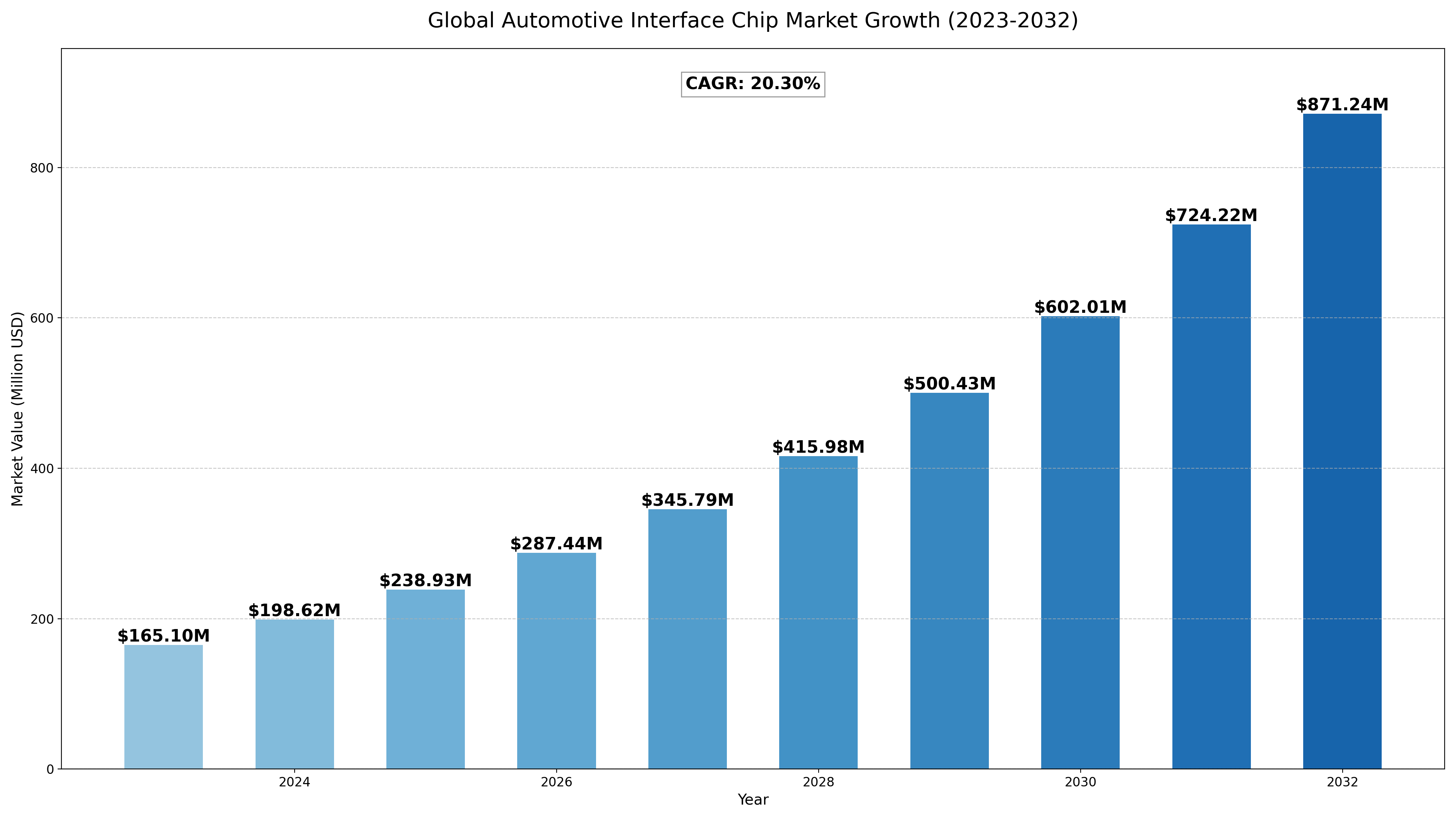
North America Automotive Interface Chip market size was estimated at USD 59.29 million in 2023, at a CAGR of 17.40% during the forecast period of 2025 through 2032.
An Automotive Interface Chip is a specialized semiconductor component used in vehicles to enable communication and data exchange between various electronic systems and devices within the car. These chips facilitate the integration of sensors, control systems, infotainment, and communication modules, ensuring seamless operation of automotive electronics such as navigation, safety features, and connectivity systems. They often handle tasks like signal conversion, power management, and data transmission across different protocols within the vehicle’s electronic architecture.
Report Overview
Isolated Chips are the integration of isolation technology with a communication interface. There are many integrated isolated interfaces available, but this video focuses on isolated CAN, RS-485 and I2C, with considerations for isolating a communication interface. Thsi report focus on the Automotive Interface Chip ?market.
This report provides a deep insight into the global Automotive Interface Chip market covering all its essential aspects. This ranges from a macro overview of the market to micro details of the market size, competitive landscape, development trend, niche market, key market drivers and challenges, SWOT analysis, value chain analysis, etc.
The analysis helps the reader to shape the competition within the industries and strategies for the competitive environment to enhance the potential profit. Furthermore, it provides a simple framework for evaluating and accessing the position of the business organization. The report structure also focuses on the competitive landscape of the Global Automotive Interface Chip Market, this report introduces in detail the market share, market performance, product situation, operation situation, etc. of the main players, which helps the readers in the industry to identify the main competitors and deeply understand the competition pattern of the market.
In a word, this report is a must-read for industry players, investors, researchers, consultants, business strategists, and all those who have any kind of stake or are planning to foray into the Automotive Interface Chip market in any manner.
Global Automotive Interface Chip Market: Market Segmentation Analysis
The research report includes specific segments by region (country), manufacturers, Type, and Application. Market segmentation creates subsets of a market based on product type, end-user or application, Geographic, and other factors. By understanding the market segments, the decision-maker can leverage this targeting in the product, sales, and marketing strategies. Market segments can power your product development cycles by informing how you create product offerings for different segments.
Key Company
- ADI
- Texas Instruments
- Infineon Technologies AG
- NXP Semiconductors
- Shanghai Chipanalog Microelectronics
- NOVOSENSE
- NVE
- 2Pai Semiconductor
- Silicon Internet of Things Technology
- Guangzhou Zhiyuan Electronics
- Isolated Chip
- Non-Isolated Chip
- Commercial Vehicle
- Passenger Car
- North America (USA, Canada, Mexico)
- Europe (Germany, UK, France, Russia, Italy, Rest of Europe)
- Asia-Pacific (China, Japan, South Korea, India, Southeast Asia, Rest of Asia-Pacific)
- South America (Brazil, Argentina, Columbia, Rest of South America)
- The Middle East and Africa (Saudi Arabia, UAE, Egypt, Nigeria, South Africa, Rest of MEA)
- Industry drivers, restraints, and opportunities covered in the study
- Neutral perspective on the market performance
- Recent industry trends and developments
- Competitive landscape & strategies of key players
- Potential & niche segments and regions exhibiting promising growth covered
- Historical, current, and projected market size, in terms of value
- In-depth analysis of the Automotive Interface Chip Market
- Overview of the regional outlook of the Automotive Interface Chip Market:
- Access to date statistics compiled by our researchers. These provide you with historical and forecast data, which is analyzed to tell you why your market is set to change
- This enables you to anticipate market changes to remain ahead of your competitors
- You will be able to copy data from the Excel spreadsheet straight into your marketing plans, business presentations, or other strategic documents
- The concise analysis, clear graph, and table format will enable you to pinpoint the information you require quickly
- Provision of market value data for each segment and sub-segment
- Indicates the region and segment that is expected to witness the fastest growth as well as to dominate the market
- Analysis by geography highlighting the consumption of the product/service in the region as well as indicating the factors that are affecting the market within each region
- Competitive landscape which incorporates the market ranking of the major players, along with new service/product launches, partnerships, business expansions, and acquisitions in the past five years of companies profiled
- Extensive company profiles comprising of company overview, company insights, product benchmarking, and SWOT analysis for the major market players
- The current as well as the future market outlook of the industry concerning recent developments which involve growth opportunities and drivers as well as challenges and restraints of both emerging as well as developed regions
- Includes in-depth analysis of the market from various perspectives through Porters five forces analysis
- Provides insight into the market through Value Chain
- Market dynamics scenario, along with growth opportunities of the market in the years to come
- 6-month post-sales analyst support
In case of any queries or customization requirements, please connect with our sales team, who will ensure that your requirements are met.
Drivers
- Growth in Automotive Electronics
The automotive industry is rapidly embracing advanced electronic systems, driven by increasing demand for features such as autonomous driving, infotainment, and advanced driver-assistance systems (ADAS). Automotive interface chips are crucial in facilitating communication between different vehicle components, making them integral to modern automotive electronics. - Rising Demand for Electric Vehicles (EVs)
The expansion of the electric vehicle market requires sophisticated electrical and communication systems for managing battery management, power distribution, and charging infrastructure. Automotive interface chips play a vital role in these systems by enabling efficient data transmission and ensuring safety, thus boosting their demand in EVs. - Need for High-Speed Data Transfer
As vehicles become more connected, the demand for high-speed data transfer between in-vehicle systems increases. Automotive interface chips are key to enabling faster communication between sensors, control units, and infotainment systems, ensuring seamless integration and operation of these systems. - Integration of Advanced Safety Features
The automotive sector is increasingly focused on enhancing vehicle safety through systems such as collision detection, lane-keeping assistance, and automated braking. These systems rely on fast and reliable data transfer, which is facilitated by automotive interface chips, thereby driving market growth.
Restraints
- High Development Costs
The development of advanced automotive interface chips involves substantial research and development (R&D) costs, particularly for new technologies such as those used in autonomous vehicles. These high costs can limit the adoption of new chips, especially in price-sensitive markets. - Complex Regulatory Requirements
Automotive systems must meet stringent safety and regulatory standards, including compliance with standards such as ISO 26262 for functional safety. Developing interface chips that meet these requirements can be a complex and costly process, slowing down market expansion. - Supply Chain Challenges
The semiconductor industry has faced ongoing supply chain issues, such as chip shortages and delays in raw material procurement. These disruptions affect the timely production and delivery of automotive interface chips, hindering the overall market growth.
Opportunities
- Advancements in Autonomous Driving
As autonomous driving technology evolves, the need for more sophisticated communication between various vehicle systems grows. Automotive interface chips are pivotal in ensuring the seamless exchange of data between sensors, control units, and processors. This creates significant growth opportunities for chip manufacturers in the autonomous driving space. - Wireless Communication Integration
The growing integration of wireless communication technologies, such as 5G, Wi-Fi, and Bluetooth, into vehicles opens new avenues for automotive interface chips. These chips will be essential in enabling real-time data exchange between vehicles and infrastructure, supporting vehicle-to-everything (V2X) communication systems. - Smart Manufacturing and IoT
The rise of Industry 4.0 and the Internet of Things (IoT) in manufacturing provides opportunities for automotive interface chips to be used in vehicle-to-cloud communications and predictive maintenance systems. These applications are expected to boost the demand for high-performance, reliable interface chips in the automotive sector. - Expansion of Infotainment and Connectivity Features
As in-car entertainment and connectivity systems become more advanced, there is an increasing need for high-performance interface chips that can support high-speed data transfer and integration of various multimedia and communication systems. This trend is creating substantial opportunities for automotive interface chip manufacturers.
Challenges
- Technological Complexity
The integration of multiple communication protocols and interfaces, such as CAN, LIN, Ethernet, and FlexRay, into a single chip adds complexity to the design and manufacturing process. Ensuring interoperability between these different standards is a challenge that manufacturers must overcome. - High Performance and Low Latency Requirements
Automotive applications, particularly those related to safety and real-time data processing, require chips that can deliver high performance with minimal latency. Meeting these stringent requirements can be challenging, as even slight delays or errors can compromise the safety and reliability of the vehicle. - Environmental and Durability Concerns
Automotive interface chips must be designed to withstand extreme environmental conditions, such as high temperatures, humidity, and vibration, which are common in vehicles. Ensuring the durability and reliability of chips under these harsh conditions remains a significant challenge for manufacturers.

Get Sample Report PDF for Exclusive Insights
Report Sample Includes
- Table of Contents
- List of Tables & Figures
- Charts, Research Methodology, and more...
 Download Sample Report PDF