
Color CMOS Image Sensors Market Insights
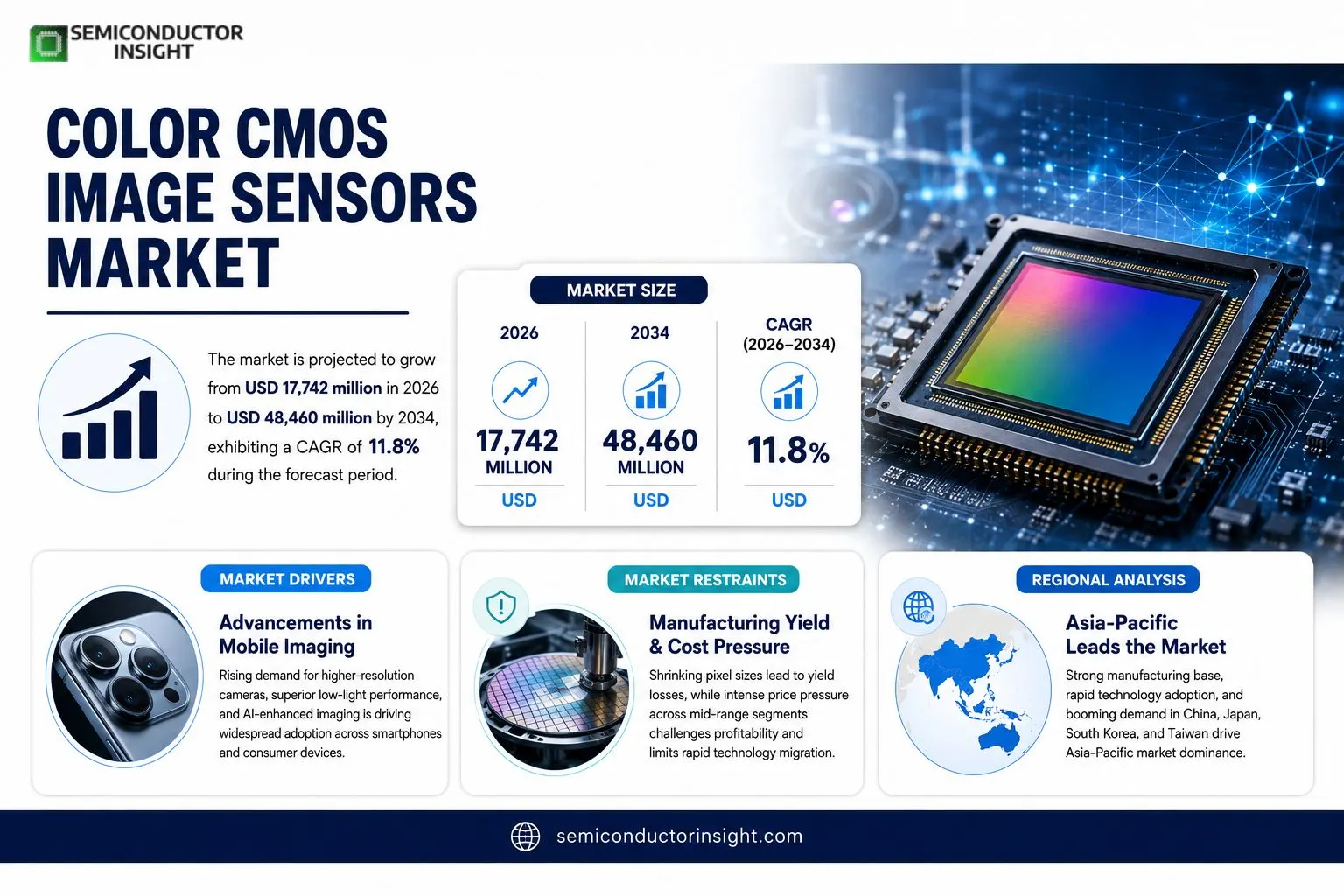
Color CMOS Image Sensors market size was valued at USD 17,742 million in 2026 to USD 48,460 million by 2034, delivering a CAGR of approximately 11.8% over the forecast horizon.
A Color CMOS Image Sensor (Color CIS) captures and distinguishes color information by employing a color filter array on each pixel surface; this converts wavelength‑specific optical signals into electrical outputs. It remains the dominant sensor type across consumer electronics, automotive vision systems, industrial machine‑vision and emerging medical imaging applications.The sector’s expansion is fueled by escalating demand for high‑resolution cameras in smartphones and autonomous‑driving platforms, alongside cost‑effective advances in stacked‑sensor architectures and ‑shutter technologies. Strong vertical integrationfrom wafer‑scale substrates supplied by a handful of equipment leaders such as ASML and Applied Materialsto downstream OEMs accelerates time‑to‑market, while recent launches of Sony’s next‑generation stacked sensor and Samsung’s BSI‑enhanced modules illustrate how leading players are capitalising on these growth vectors.
MARKET DRIVERS
Advancements in Mobile Imaging
The relentless demand for higher‑resolution selfies and video frames has compelled smartphone OEMs to adopt newer Color CMOS Image Sensors that deliver superior low‑light performance. Recent sensor generations now pack over 50 million pixels within a 1/2.55‑inch footprint, enabling manufacturers to differentiate premium devices without expanding chassis dimensions.
Automotive ADAS Integration
Advanced driver‑assistance systems (ADAS) rely on fast, accurate visual perception. Color CMOS sensors equipped with on‑chip HDR and ‑shutter capabilities provide the frame rates necessary for lane‑keep and pedestrian detection. Industry estimates suggest that roughly 30 % of new vehicle platforms will incorporate such sensors by 2027, creating a sizable baseline demand.
➤ Manufacturers that streamline sensor‑to‑module assembly can shave 0.2 seconds off image‑processing latency, a competitive edge in both consumer and automotive tiers.
Beyond hardware, software‑defined imaging pipelines are extracting more value from each pixel. Machine‑learning algorithms now calibrate color balance in real time, raising the perceived quality of modest‑spec sensors and expanding the addressable market for cost‑conscious device makers.
MARKET CHALLENGES
Cost Sensitivity Across Segments
While performance expectations rise, price pressure remains acute, especially in mid‑range smartphones where a 10 % increase in sensor cost can erode profit margins. Suppliers must balance wafer‑scale economies with the need for specialized process steps, such as deep‑trenches for on‑chip lenses.
Other Challenges
Supply Chain Volatility
Recent geopolitical tensions have disrupted the flow of high‑purity silicon wafers, leading to lead times that occasionally exceed 12 weeks. This uncertainty forces OEMs to hold larger safety stocks, inflating working‑capital requirements.
MARKET RESTRAINTS
Manufacturing Yield Limitations
As pixel sizes shrink below 0.7 µm, defect density on the wafer surface becomes a critical bottleneck. Even marginal yield losses translate into noticeable cost overruns, prompting many fab operators to hesitate before committing to next‑generation process nodes for Color CMOS Image Sensors.
MARKET OPPORTUNITIES
Emerging XR Devices
Extended‑reality headsets and smart glasses demand compact sensors with high dynamic range and low power draw. Early prototypes demonstrate that a 2 MP Color CMOS sensor can render immersive 90 fps visuals while consuming less than 150 mW, positioning the technology as a cornerstone for the next wave of wearable computing.
Color CMOS Image Sensors Market Trends
Automotive ADAS & Autonomous Systems Fuel Sensor Innovation
The automotive sector is reshaping the Color CMOS Image Sensors Market as vehicle manufacturers integrate increasingly sophisticated camera arrays for advanced driver‑assistance systems and level‑2/3 autonomy. Sensors now must survive high engine bay temperatures, comply with AEC‑Q100 certification, and deliver dynamic ranges beyond 120 dB to capture scenes with extreme contrast. This pressure compels designers to adopt stacked pixel architectures and on‑chip HDR pipelines, while foundries accelerate mask iterations to keep pace with model year cycles. Suppliers that can guarantee reliability under automotive stress see elevated pricing power, and OEMs gain a decisive edge in safety‑critical features.
Other Trends
Miniaturization and Advanced Packaging in Consumer Devices
The consumer electronics arena, despite approaching smartphone saturation, still pushes the envelope of sensor shrinkage and resolution. Manufacturers pursue sub‑0.8 µm pixel pitches and integrate flip‑chip or wafer‑level packaging to cram more megapixels into thinner modules, enabling ultra‑high‑definition video and AI‑enhanced imaging in wearables and drones. Because module thickness directly impacts device ergonomics, packaging partners that master chip‑scale solutions secure long‑term design wins. Even as unit volumes plateau, the premium segment that values low‑light performance and computational photography fuels incremental revenue for firms that can combine miniaturization with superior signal‑to‑noise ratios.
Industrial Vision and Medical Imaging Drive Specialized Sensor Architectures
Industrial automation and medical imaging represent niches where performance outweighs cost, prompting the Color CMOS Image Sensors Market to diversify into ‑shutter and high‑frame‑rate designs. Machine‑vision lines rely on ‑shutter arrays to eliminate motion skew, while diagnostic endoscopes demand compact sensors with low radiation susceptibility. These applications stimulate collaboration across the upstream material suppliers, midstream design houses, and downstream system integrators, reinforcing a feedback loop that elevates the overall technical bar. Geographically, high‑end wafer fabrication remains anchored in Japan, South Korea, the United States and Taiwan, whereas the bulk of end‑user demand emanates from China, shaping where investment in capacity expansion is most likely to occur.
COMPETITIVE LANDSCAPE
Key Industry Players
Competitive Dynamics in the Color CMOS Image Sensors Market
Sony Semiconductor Solutions remains the dominant force, leveraging its stacked‑CIS architecture and deep vertical integration to capture a sizeable share of high‑end smartphone and automotive camera deployments. Samsung Electronics follows closely, exploiting its advanced 45‑nm and 28‑nm process lines to deliver large‑pixel sensors that satisfy both consumer‑grade and automotive‑grade specifications. The market structure is heavily weighted toward these two IDMs, whose control over wafer fabrication, design IP, and packaging enables swift iteration cycles and strong pricing power across the value chain.Beyond the incumbents, a cadre of specialist firms enriches the competitive landscape. OmniVision and On Semiconductor supply a broad portfolio of fabless designs, often targeting niche applications such as drones, AR/VR headsets, and low‑cost IoT cameras. GalaxyCore, a Chinese player, has accelerated its R&D to bridge the gap between mass‑market and premium segments, especially in emerging automotive ADAS markets. Panasonic, SmartSens Technology, Canon, and SOI contribute differentiated technologiesranging from ‑shutter solutions for machine vision to high‑dynamic‑range imaging for security surveillance. Their focused product roadmaps generate incremental pressure on pricing and spur innovation in packaging and sensor miniaturization.
List of Key Color CMOS Image Sensors Companies Profiled
- Sony Semiconductor Solutions
- Samsung Electronics
- OmniVision Technologies
- STMicroelectronics
- On Semiconductor
- GalaxyCore
- Panasonic
- SmartSens Technology
- Canon Inc.
- SOI (Silicon on Insulator) Systems
- Huawei HiSilicon
- Toshiba
- Texas Instruments
- Qualcomm
Segment Analysis:
| Segment Category | Sub-Segments | Key Insights |
| By Type |
|
Shutter
|
| By Application |
|
Automotive
|
| By End User |
|
Smartphone manufacturers
|
| By Architecture |
|
Stacked CMOS
|
| By Pixel Size |
|
Small Pixel
|
Regional Analysis: Color CMOS Image Sensors Market
Taiwan’s foundry capacity and South Korea’s memory‑chip expertise combine to deliver a continuous pipeline of advanced process nodes, enabling sensor makers to push pixel density while maintaining low power draw. This capability underpins the region’s ability to meet demanding automotive and AR/VR specifications.
Smartphone penetration in India and Southeast Asia is accelerating, prompting OEMs to prioritize sensors that excel in low‑light color reproduction. The resulting demand cascade influences design priorities across the supply chain.
Recent geopolitical shifts have led manufacturers to diversify sourcing, yet the region’s integrated ecosystemspanning wafer fabrication to packagingremains unrivaled, cushioning disruption and preserving lead‑time advantage.
Government incentives for semiconductor R&D, coupled with strategic initiatives to expand 5G infrastructure, reinforce investment cycles, ensuring a steady flow of resources toward next‑generation color sensor technologies.
North America
The United States maintains a strong position in high‑end sensor development, driven by deep pockets in autonomous‑driving and advanced robotics. Research institutions collaborate closely with leading firms to explore novel color filter array architectures, pushing the envelope of dynamic range. While manufacturing remains outsourced, the emphasis on design innovation and intellectual property creation sustains a premium segment within the Color CMOS Image Sensors Market. Companies that can align their product roadmaps with emerging AI‑enabled imaging applications find fertile ground for differentiation in this market.
Europe
European automotive manufacturers are championing the integration of color CMOS sensors into driver‑assistance systems, leveraging stringent safety regulations to dictate sensor quality. Parallelly, the region’s focus on sustainability drives manufacturers to adopt greener fabrication processes, positioning European‑sourced sensors as environmentally responsible options. Collaborative standards bodies across the EU foster interoperability, encouraging component suppliers to fine‑tune sensor algorithms for cross‑market applicability.
South America
In Brazil and Argentina, modest yet growing demand for smart‑city surveillance and agricultural imaging is nudging local distributors toward color CMOS solutions that balance resolution with cost efficiency. The market’s maturity level prompts import reliance, yet regional initiatives to develop assembly capabilities hint at a gradual shift toward localized value addition, especially for niche applications such as precision farming.
Middle East & Africa
Infrastructure projects in the Gulf, particularly around autonomous logistics hubs, have sparked interest in ruggedized color CMOS sensors capable of withstanding extreme temperatures. Meanwhile, African markets are experiencing early adoption of mobile imaging for health diagnostics and e‑commerce, prompting OEMs to tailor sensor packages for lower‑bandwidth environments. Partnerships with regional technology incubators aim to embed sensor technology into emerging IoT ecosystems, laying groundwork for future demand acceleration.
Report Scope
This market research report provides a comprehensive analysis of the Color CMOS Image Sensors Market , covering the forecast period 2026–2034. It offers detailed insights into market dynamics, technological advancements, competitive landscape, and key trends shaping the industry.
Key focus areas of the report include:
- Market Overview: The report begins with an overview outlining its current market scenario, key growth indicators, and industry transformation drivers. It discusses macroeconomic factors, demand–supply balance, regulatory landscape, and the strategic role of semiconductors in powering advancements across industries such as automotive, telecommunications, consumer electronics, and industrial automation.
- Market Size & Forecast: Historical data and future projections for revenue, unit shipments, and market value across major regions and segments.
- Segmentation Analysis: Detailed breakdown by product type, technology, application, and end-user industry to identify high-growth segments and investment opportunities.
- Regional Insights: Insights into market performance across North America, Europe, Asia-Pacific, Latin America, and the Middle East & Africa, including country-level analysis where relevant.
- Competitive Landscape: Profiles of leading market participants, including their product offerings, R&D focus, manufacturing capacity, pricing strategies, and recent developments such as mergers, acquisitions, and partnerships.
- Technology Trends & Innovation: Assessment of emerging technologies, integration of AI/IoT, semiconductor design trends, fabrication techniques, and evolving industry standards.
- Market Drivers & Restraints: Evaluation of factors driving market growth along with challenges, supply chain constraints, regulatory issues, and market-entry barriers.
- Stakeholder Insights: Insights for component suppliers, OEMs, system integrators, investors, and policymakers regarding the evolving ecosystem and strategic opportunities.
Primary and secondary research methods are employed, including interviews with industry experts, data from verified sources, and real-time market intelligence to ensure the accuracy and reliability of the insights presented.
FREQUENTLY ASKED QUESTIONS:
What is the current market size of Color CMOS Image Sensors Market?
-> Color CMOS Image Sensors market was valued at USD 17,742 million in 2026 and is projected to reach USD 39,937 million by 2032, growing at a CAGR of 11.8% during the forecast period.
Which key companies operate in Color CMOS Image Sensors Market?
-> Key players include Sony Semiconductor Solutions, Samsung Electronics, OmniVision, STMicroelectronics, ON Semiconductor, GalaxyCore, Panasonic, Smartsens Technology, Canon, SOI.
What are the key growth drivers?
-> Key growth drivers include rising demand for high‑resolution imaging in smartphones, expanding automotive ADAS and autonomous‑driving camera systems, increased adoption of AI‑enabled vision in industrial automation, and the shift toward stacked and ‑shutter CIS architectures.
Which region dominates the market?
-> Asia‑Pacific dominates the market, led by China’s massive consumption and strong manufacturing capabilities in Japan, South Korea, and Taiwan.
What are the emerging trends?
-> Emerging trends include stacked CMOS sensors with edge AI processing, integration of high dynamic range (HDR) and ‑shutter technologies, and growing adoption of automotive‑grade CIS meeting AEC‑Q100 standards.

Get Sample Report PDF for Exclusive Insights
Report Sample Includes
- Table of Contents
- List of Tables & Figures
- Charts, Research Methodology, and more...
 Download Sample Report PDF


