Semiconductor Cybersecurity Hardware Market Insights
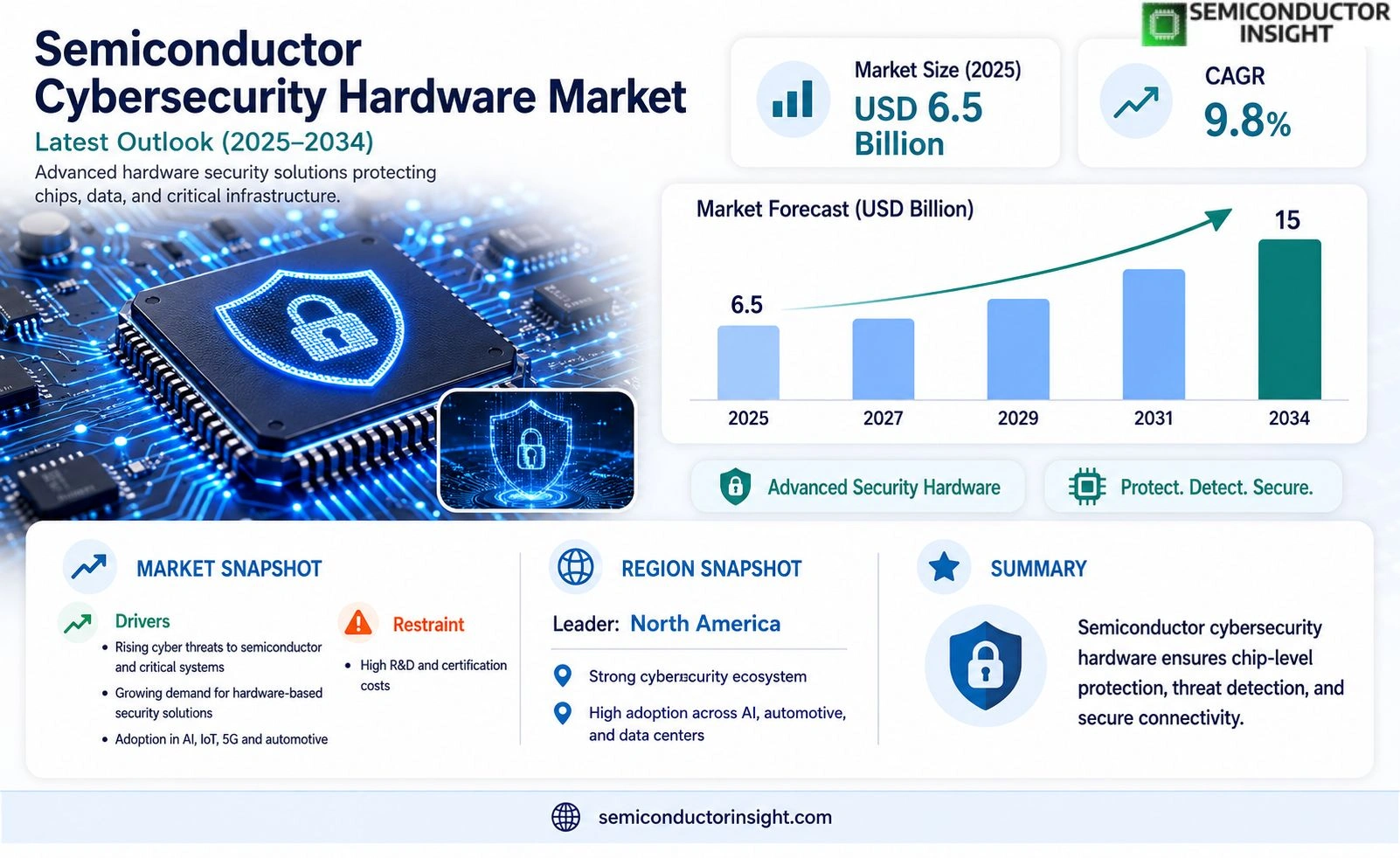
Global Semiconductor Cybersecurity Hardware Market size was valued at USD 6.5 billion in 2025. The market is projected to grow from USD 6.5 billion in 2025 to USD 15 billion by 2034, exhibiting a CAGR of 9.8% during the forecast period.
Semiconductor cybersecurity hardware comprises integrated security modules such as trusted platform modules (TPMs), secure enclaves, physical unclonable functions (PUFs), and cryptographic accelerators that are embedded directly into silicon chips to protect data integrity, confidentiality, and device authentication.
The market is experiencing rapid expansion because rising cyber‑threat sophistication drives demand for on‑chip protection, while the proliferation of IoT devices and edge computing creates new attack surfaces. Furthermore, regulatory pressure for secure supply chains accelerates adoption across automotive, finance, and telecommunications sectors. Recent initiatives illustrate this momentum: in March 2024 Intel announced the acquisition of a leading hardware‑security startup to enhance its enclave portfolio, and companies such as NXP Semiconductors, Infineon Technologies, Samsung Electronics, and AMD continue to broaden their security‑focused product lines.
MARKET DRIVERS
Rising Demand for Secure Edge Devices
Semiconductor Cybersecurity Hardware Market is being propelled by the exponential growth of edge computing and IoT deployments, which require tamper‑resistant cryptographic processors to protect data at the source. Enterprises are increasingly prioritizing hardware‑based key management to mitigate latency and reduce reliance on cloud‑centric security models.
Regulatory Momentum and Government Initiatives
Stringent data‑protection regulations across North America, Europe, and Asia‑Pacific are compelling manufacturers to embed security functions directly into silicon. Government‑funded programs that promote trusted supply chains are also accelerating adoption of specialized security chips in critical infrastructure.
➤ “Hardware‑rooted security is no longer optional; it is a prerequisite for resilient digital ecosystems.”
These drivers collectively create a robust foundation for sustained investment in advanced encryption modules, secure boot solutions, and physically unclonable functions with Semiconductor Cybersecurity Hardware Market.
MARKET CHALLENGES
Complex Integration and Legacy Compatibility
Many OEMs face difficulty integrating next‑generation security silicon with existing product lines that rely on legacy architectures. The need to redesign firmware, validate new security protocols, and ensure backward compatibility can delay time‑to‑market and increase development costs.
Other Challenges
Supply Chain Vulnerabilities
Global component shortages and the risk of counterfeit chips introduce uncertainty. Companies must invest in rigorous provenance tracking and secure manufacturing practices, which adds layers of operational overhead.
MARKET RESTRAINTS
High Cost of Advanced Cryptographic Silicon
Advanced security processors involve sophisticated design cycles, specialized fabrication processes, and extensive testing, resulting in higher unit costs compared with standard logic chips. Price sensitivity in volume‑driven markets can restrain broader adoption.
Furthermore, low‑margin segments such as consumer electronics may defer integration of premium security hardware until economies of scale are realized.
Limited availability of skilled design talent capable of implementing side‑channel resistant architectures also slows product rollout, reinforcing the cost barrier.
MARKET OPPORTUNITIES
Emerging AI‑Enabled Security Modules
Integrating AI inference engines with cryptographic cores enables real‑time anomaly detection directly on the chip, opening opportunities for autonomous threat mitigation in autonomous vehicles and industrial control systems.
The rollout of 5G and cloud‑native infrastructure demands secure edge gateways that can perform rapid encryption/decryption without offloading to external servers, creating a fertile market for low‑latency security silicon.
Strategic partnerships between semiconductor foundries and cybersecurity firms are fostering co‑development of bespoke security IP, while recent M&A activity signals confidence in long‑term growth prospects for Semiconductor Cybersecurity Hardware Market.
Semiconductor Cybersecurity Hardware Market Trends
Rapid Adoption Fueled by IoT Expansion
The proliferation of Internet‑of‑Things devices and edge‑computing nodes has expanded the attack surface for digital systems. As a result, original equipment manufacturers are integrating on‑chip protection mechanisms,such as trusted platform modules, secure enclaves, and physical unclonable functions,directly into silicon designs. This shift reduces reliance on external security modules and improves latency for cryptographic operations. Vendors like Intel, NXP Semiconductors, Infineon Technologies, Samsung Electronics, and AMD are broadening their security‑focused portfolios, targeting sectors where data integrity and device authentication are mission‑critical. The overall momentum reflects a clear industry consensus: embedding security at the semiconductor level is now a baseline requirement rather than an optional upgrade.
Other Trends
Hardware‑Based Trust Anchors for Automotive and Finance
Automotive manufacturers and financial institutions are confronting stricter regulatory mandates for secure supply chains. Hardware‑based trust anchors, implemented through cryptographic accelerators and secure boot technologies, provide immutable roots of trust that can be validated throughout a product’s lifecycle. Recent deployments illustrate this trend: major automotive OEMs have specified secure enclave chips for next‑generation infotainment and autonomous‑driving platforms, while banking hardware accelerators are being certified for high‑value transaction processing. The emphasis on immutable hardware roots reduces the risk of firmware tampering and supports compliance with emerging standards such as ISO/SAE 21434 and PCI SSC.
Regulatory Pressure and Strategic Acquisitions
Regulatory pressure is accelerating the adoption of secure silicon across multiple verticals. Governments and industry bodies are mandating secure component verification, driving OEMs to source chips with built‑in cryptographic capabilities. Strategic moves in the ecosystem,such as Intel’s March 2024 acquisition of a leading hardware‑security startup,highlight the commercial value placed on expanding enclave portfolios. These acquisitions not only bring mature IP into larger product lines but also accelerate time‑to‑market for next‑generation security features. As firms align product roadmaps with regulatory expectations, Semiconductor Cybersecurity Hardware Market is poised for sustained, architecture‑driven growth.
COMPETITIVE LANDSCAPE
Key Industry Players
Semiconductor Cybersecurity Hardware Market: Competitive Dynamics, Strategic Initiatives, and Leading Innovators Shaping the Future of On-Chip Security
Semiconductor Cybersecurity Hardware Market is characterized by intense competition among a blend of established semiconductor giants and specialized security-focused firms. Intel Corporation maintains a prominent position in the landscape, continuously strengthening its hardware security portfolio through strategic acquisitions, including its March 2024 acquisition of a leading hardware-security startup to enhance its secure enclave capabilities. NXP Semiconductors, Infineon Technologies, and AMD are equally aggressive in expanding their security-centric product lines, offering trusted platform modules (TPMs), cryptographic accelerators, and physical unclonable functions (PUFs) embedded directly into silicon. Samsung Electronics also holds a significant market share, leveraging its advanced fabrication capabilities to integrate secure enclaves and authentication modules across consumer electronics and enterprise-grade chips. The market, valued at USD 6.5 billion in 2025 and projected to reach USD 15 billion by 2034 at a CAGR of 9.8%, reflects a highly competitive environment where differentiation is driven by innovation in on-chip protection, supply chain security compliance, and cross-industry deployment across automotive, telecommunications, and financial services sectors.
Beyond the dominant players, several specialized and emerging firms are carving meaningful niches within the semiconductor cybersecurity hardware ecosystem. Microchip Technology and STMicroelectronics are recognized for their robust TPM and secure microcontroller offerings, particularly targeting IoT edge devices and industrial automation applications. Qualcomm Incorporated integrates hardware-level security into its mobile and connected device chipsets, while Arm Holdings provides foundational secure architecture intellectual property widely licensed across the industry. Rambus Inc. focuses specifically on cryptographic semiconductor IP cores, positioning itself as a critical enabler for chip designers. Additionally, Lattice Semiconductor has gained traction in FPGA-based security solutions for low-power edge deployments. As regulatory mandates for secure hardware in critical infrastructure intensify and the proliferation of IoT attack surfaces accelerates, these companies are investing heavily in R&D partnerships, certification programs, and next-generation PUF and secure boot technologies to sustain competitive advantage in this rapidly evolving market.
List of Key Semiconductor Cybersecurity Hardware Companies Profiled
- Intel Corporation
- NXP Semiconductors
- Infineon Technologies AG
- Advanced Micro Devices, Inc. (AMD)
- Samsung Electronics Co., Ltd.
- Microchip Technology Inc.
- STMicroelectronics N.V.
- Qualcomm Incorporated
- Arm Holdings plc
- Rambus Inc.
- Lattice Semiconductor Corporation
- Texas Instruments Incorporated
- Renesas Electronics Corporation
- Marvell Technology, Inc.
- Broadcom Inc.
Segment Analysis:
| Segment Category | Sub-Segments | Key Insights |
| By Type |
|
Secure Enclaves are emerging as the leading type because they provide isolated execution environments that protect critical code and data from sophisticated attacks.
|
| By Application |
|
Automotive Systems dominate this dimension as manufacturers demand tamper‑resistant modules to safeguard vehicle communication networks and autonomous driving functions.
|
| By End User |
|
OEMs are the primary adopters because they embed security hardware directly into final products to meet regulatory expectations and protect brand integrity.
|
| By Security Function |
|
Authentication stands out as the core function because it establishes device identity and trust before any data exchange occurs.
|
| By Device Integration |
|
Processor‑level Integration is gaining prominence as it embeds security directly within the central processing unit, delivering the highest performance and lowest latency protection.
|
Regional Analysis: North America
North America
Government initiatives focused on bolstering cybersecurity across critical sectors are significantly impacting the Semiconductor Cybersecurity Hardware Market. New regulations and standards are driving demand for compliance-ready solutions within the hardware market.
Growing concerns regarding the security of the semiconductor supply chain are accelerating the adoption of robust semiconductor cybersecurity hardware. Organizations are prioritizing solutions that provide end-to-end protection, from design and manufacturing to deployment and operation.
The increasing adoption of cloud computing necessitates robust semiconductor cybersecurity hardware solutions that can effectively protect data and applications hosted in the cloud. This integration is a critical aspect of the evolving hardware market.
The application of artificial intelligence (AI) and machine learning (ML) within semiconductor cybersecurity hardware is gaining traction. These technologies are enabling proactive threat detection and automated response mechanisms, enhancing the overall security posture of hardware.
North America
The demand for advanced semiconductor cybersecurity hardware is directly linked to the region’s extensive network of technology companies and its critical infrastructure sectors. The need for enhanced protection against evolving cyber threats within embedded systems and IoT devices is a key driver. Companies are investing in hardware-based security solutions to mitigate risks at the device level, ensuring the integrity and confidentiality of sensitive data. The convergence of hardware and software security is becoming increasingly important, fostering innovation in this space. Semiconductor Cybersecurity Hardware Market trends indicate a strong focus on zero-trust architectures and secure boot processes within the hardware market.
Europe
Europe presents a steadily growing market for Semiconductor Cybersecurity Hardware Market, driven by stringent data privacy regulations and a proactive approach to cybersecurity. The emphasis on protecting critical infrastructure and industrial control systems is a major factor influencing investment in advanced semiconductor cybersecurity hardware. European regulations like GDPR are pushing organizations to prioritize data security, further bolstering demand. The hardware market in Europe is witnessing a shift towards secure-by-design principles for semiconductor components.
Asia-Pacific
Asia-Pacific is anticipated to be the fastest-growing region for the Semiconductor Cybersecurity Hardware Market. Rapid digitalization, increasing IoT adoption, and a growing threat landscape are fueling demand for robust security solutions. Several countries in the region are investing heavily in strengthening their cybersecurity infrastructure, creating significant opportunities for semiconductor cybersecurity hardware providers. The hardware market in this region is characterized by a diverse range of players catering to various industry needs. The focus on securing emerging technologies like 5G and edge computing is a key driver.
South America
South America is an emerging market for the Semiconductor Cybersecurity Hardware Market, with increasing awareness of cybersecurity risks and a growing need to protect digital assets. The expansion of e-commerce and financial services is driving demand for secure semiconductor hardware solutions. While the market is still relatively nascent, there is significant potential for growth in the coming years. The hardware market in South America is focusing on cost-effective security solutions to meet the needs of various businesses.
Middle East & Africa
The Middle East & Africa region represents a developing market for the Semiconductor Cybersecurity Hardware Market. Increasing investments in digital transformation and government initiatives to enhance cybersecurity are contributing to market growth. The region is witnessing a rising demand for secure semiconductor hardware solutions across various sectors, including finance, healthcare, and government. The hardware market in this region is focused on providing tailored solutions to address specific regional security challenges.
Report Scope
This market research report provides a comprehensive analysis of the Semiconductor Cybersecurity Hardware Market , covering the forecast period 2026–2034. It offers detailed insights into market dynamics, technological advancements, competitive landscape, and key trends shaping the industry.
Key focus areas of the report include:
- Market Overview: The report begins with an overview outlining its current market scenario, key growth indicators, and industry transformation drivers. It discusses macroeconomic factors, demand–supply balance, regulatory landscape, and the strategic role of semiconductors in powering advancements across industries such as automotive, telecommunications, consumer electronics, and industrial automation.
- Market Size & Forecast: Historical data and future projections for revenue, unit shipments, and market value across major regions and segments.
- Segmentation Analysis: Detailed breakdown by product type, technology, application, and end-user industry to identify high-growth segments and investment opportunities.
- Regional Insights: Insights into market performance across North America, Europe, Asia-Pacific, Latin America, and the Middle East & Africa, including country-level analysis where relevant.
- Competitive Landscape: Profiles of leading market participants, including their product offerings, R&D focus, manufacturing capacity, pricing strategies, and recent developments such as mergers, acquisitions, and partnerships.
- Technology Trends & Innovation: Assessment of emerging technologies, integration of AI/IoT, semiconductor design trends, fabrication techniques, and evolving industry standards.
- Market Drivers & Restraints: Evaluation of factors driving market growth along with challenges, supply chain constraints, regulatory issues, and market-entry barriers.
- Stakeholder Insights: Insights for component suppliers, OEMs, system integrators, investors, and policymakers regarding the evolving ecosystem and strategic opportunities.
Primary and secondary research methods are employed, including interviews with industry experts, data from verified sources, and real-time market intelligence to ensure the accuracy and reliability of the insights presented.
FREQUENTLY ASKED QUESTIONS:
What is the current market size of Semiconductor Cybersecurity Hardware Market?
-> Semiconductor Cybersecurity Hardware Market was valued at USD 6.5 billion in 2025 and is expected to reach USD 15 billion by 2034, exhibiting a CAGR of 9.8%.
Which key companies operate Semiconductor Cybersecurity Hardware Market?
-> Key players include Intel, NXP Semiconductors, Infineon Technologies, Samsung Electronics, and AMD, among others.
What are the key growth drivers?
-> Key growth drivers include rising cyber‑threat sophistication, proliferation of IoT and edge devices, regulatory pressure for secure supply chains, and increasing adoption in automotive, finance, and telecommunications sectors.
Which region dominates the market?
-> The market shows strong adoption globally, with notable demand in North America, Europe, and Asia‑Pacific, making it a truly worldwide growth opportunity.
What are the emerging trends?
-> Emerging trends include integration of trusted platform modules, secure enclaves, physical unclonable functions, cryptographic accelerators, and strategic acquisitions to strengthen hardware‑security portfolios.

Get Sample Report PDF for Exclusive Insights
Report Sample Includes
- Table of Contents
- List of Tables & Figures
- Charts, Research Methodology, and more...
 Download Sample Report PDF