
Key Statistics
Key Takeaways
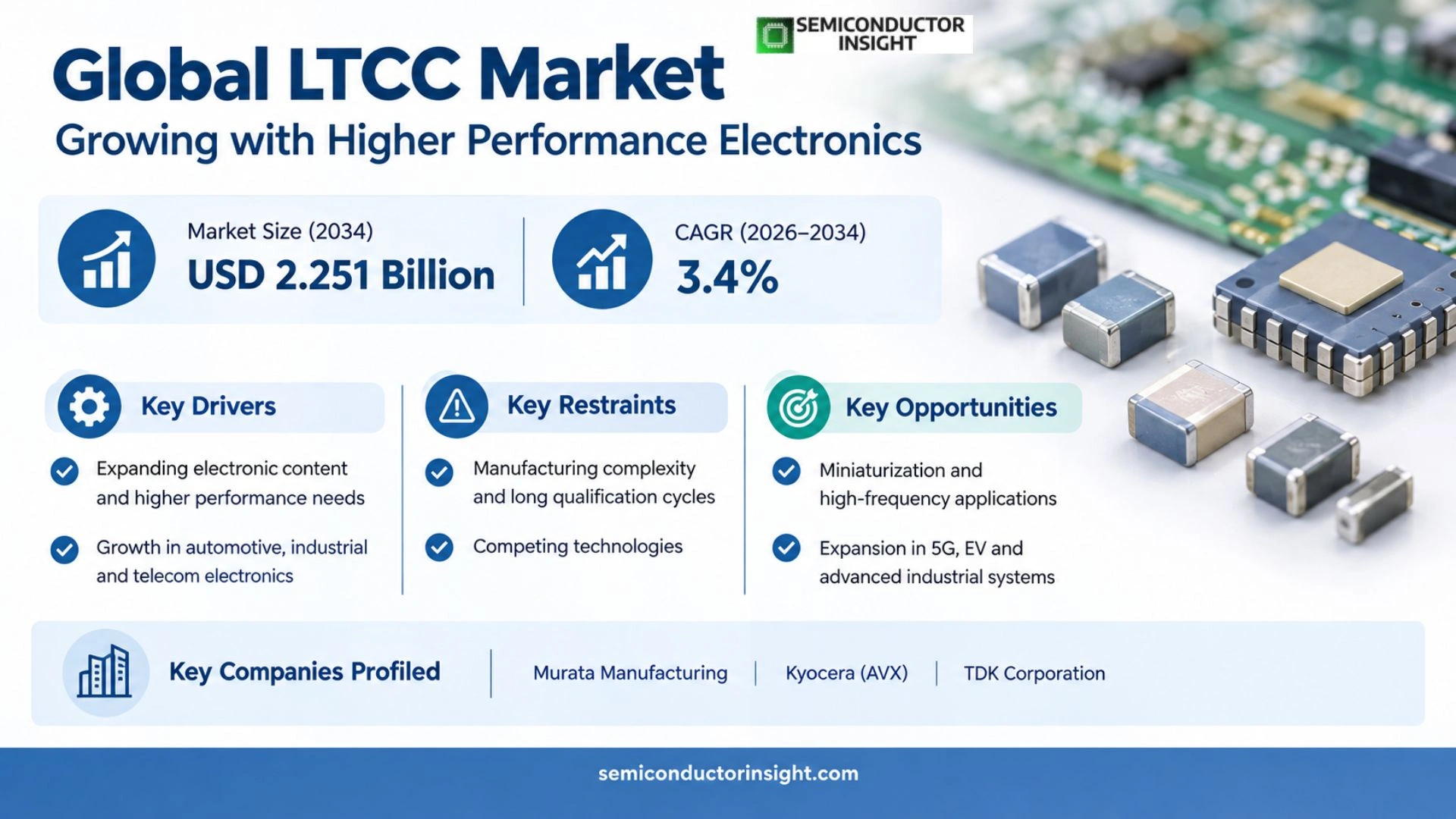
- The validated forecast places the market at USD 1.670 billion in 2025 and USD 2.251 billion by 2034, representing a 3.4% CAGR during 2026–2034. The trajectory reflects measured expansion rather than a speculative step-change, with value growth tied to higher electronic content and technically demanding designs.
- LTCC components form the volume anchor because filters, couplers, antennas and integrated passive devices use multilayer ceramic construction to reduce footprint while maintaining predictable radio-frequency behaviour.
- Consumer electronics remains the largest application group, while automotive radar, vehicle connectivity, aerospace electronics and industrial sensing provide longer qualification cycles and attractive reliability-led opportunities.
- Asia Pacific is the largest market and manufacturing centre: Japan supplies advanced multilayer ceramic technology, while China, South Korea and Taiwan concentrate downstream electronics production and design activity.
- Technology selection is the central competitive issue. LTCC wins where embedded passives, dimensional stability and environmental endurance create system value, but acoustic-wave filters and organic integration can be superior for selected frequency, loss or cost requirements.
Global LTCC Market Overview
Global LTCC Market was valued at USD 1.670 billion in 2025 and is projected to reach USD 2.251 billion by 2034, growing at a CAGR of 3.4% during 2026–2034. Asia Pacific held the largest regional position in 2025, supported by concentrated manufacturing, downstream electronics production and established component supply networks.
Low-Temperature Co-Fired Ceramic is a multilayer ceramic technology in which glass-ceramic tapes, conductive pastes and via structures are laminated and co-fired at temperatures typically around 850–900°C. The lower firing temperature allows use of low-resistance conductors such as silver and enables multiple electrical functions to be embedded inside a three-dimensional ceramic structure. The report scope includes LTCC Components, LTCC Ceramic Substrates, LTCC Modules and LTCC Ceramic Shell/Housings, with Consumer Electronics, Aerospace and Military, Automobile Electronics and Other applications.
The market’s value proposition is strongest where an electronic assembly needs miniaturization, RF performance, dimensional stability and environmental durability at the same time. LTCC structures can integrate inductors, capacitors, transmission lines, filters, antennas, cavities and interconnects across stacked layers, reducing the number of discrete parts and shortening RF signal paths. That integration can improve repeatability and packaging density, although the design and manufacturing process is more specialized than ordinary PCB fabrication and requires close coordination between materials, circuit layout, firing shrinkage and electrical test.
The report scope also separates the market by function into Filters, Couplers, Duplexers, Power Amplifiers and Others. These functions show why the addressable market is broader than a ceramic substrate category alone. LTCC can be sold as a material platform, a patterned substrate, a complete RF component, a module or a protective ceramic housing. Supplier economics therefore differ: high-volume consumer RF components emphasize automation and cost, while aerospace, defense and specialized modules can support higher prices through customization, reliability screening and long-term program support.
Segment Analysis: By Type
By type, the LTCC market is segmented into LTCC Components · LTCC Ceramic Substrates · LTCC Modules · LTCC Ceramic Shell/Housings. Each category represents a different degree of integration, qualification burden and value capture, so suppliers compete through a combination of material performance, design support, manufacturing consistency, package architecture and application-specific testing rather than through unit price alone.
| Type | Market interpretation |
|---|---|
| LTCC Components | LTCC components include compact filters, couplers, splitters, antennas, integrated passives and other multilayer devices in which conductive traces and passive structures are formed inside the ceramic stack. The commercial advantage is functional integration in a small footprint with stable high-frequency behavior. Murata’s 2025 SX126x integrated passive device is a current example: a proprietary LTCC process replaced several discrete matching components with a single 2.00 mm × 1.25 mm component, reducing board space while preserving RF performance. |
| LTCC Ceramic Substrates | Ceramic substrates provide the multilayer interconnect platform on which active and passive devices can be mounted or integrated. They are used where dimensional stability, thermal resistance, hermeticity or controlled RF properties justify a premium over organic substrates. Demand comes from RF modules, automotive electronics, industrial controls, sensors and specialized semiconductor packaging. Competition centers on dielectric properties, layer count, via quality, surface finish, warpage, conductor resistance, thermal cycling performance and the supplier’s ability to maintain dimensional tolerance after co-firing shrinkage. |
| LTCC Modules | LTCC modules combine substrates, embedded passives and mounted active devices into higher-function assemblies such as communication modules, antenna modules, Bluetooth or IoT modules and power-amplifier related structures. These products capture more value per unit because the supplier participates in circuit integration and packaging rather than selling only ceramic material. Module demand benefits from smaller wireless products and industrial sensing, but suppliers face stronger design responsibility and must manage semiconductor availability, RF tuning, test coverage and customer-specific qualification. |
| LTCC Ceramic Shell/Housings | LTCC ceramic shells and housings serve applications requiring mechanically stable, electrically functional or hermetic packaging around semiconductor and sensor devices. Aerospace, military, medical and industrial electronics can value ceramics for resistance to heat, moisture and harsh environments. Volumes are generally lower than mainstream consumer components, but qualification barriers and custom geometry can support attractive margins. Competitive differentiation depends on metallization, sealing compatibility, cavity design, dimensional control and the ability to integrate feedthroughs or passive functions within the housing itself. |
Segment Analysis: By Application
By application, the market covers Consumer Electronics · Aerospace and Military · Automobile Electronics · Others. Demand varies by production volume and qualification intensity: consumer programmes reward scale and miniaturisation, while automotive, industrial, aerospace, medical or security designs place greater weight on reliability evidence, long product availability and system-level performance under demanding operating conditions.
| Application | Demand characteristics |
|---|---|
| Consumer Electronics | Consumer electronics is the largest application segment because smartphones, wearables, routers, wireless peripherals and connected devices use compact RF front-end components, antennas and integrated passive structures. Global 5G adoption strengthens the radio-content requirement: Ericsson reported 2.94 billion 5G subscriptions at the end of 2025 and 3.1 billion by the first quarter of 2026. LTCC suppliers benefit when products require high-density multilayer integration, but intense price competition and alternative RF technologies keep margins dependent on performance differentiation and manufacturing scale. |
| Aerospace and Military | Aerospace and military systems value LTCC for thermal stability, high-frequency performance, rugged construction and the possibility of integrating passive circuits into hermetic or near-hermetic packages. Radar, satellite communication, electronic warfare and guidance electronics can justify premium materials because reliability and predictable RF behavior outweigh consumer-level cost constraints. Qualification periods are long and program volumes can be modest, so suppliers need stable materials, documented process controls and the ability to support product configurations for many years after initial design approval. |
| Automobile Electronics | Automotive electronics demand grows with radar, telematics, GNSS, V2X, connectivity modules and advanced driver-assistance systems. LTCC’s ability to maintain electrical behavior through temperature cycling and vibration makes it suitable for RF and sensing modules where reliability is essential. The opportunity increases as vehicles add more wireless links and radar channels, but automotive customers impose strict change-control and traceability requirements. Suppliers that already hold qualified materials and production processes can benefit from long production runs once a module is designed into a vehicle platform. |
| Others | Other applications include industrial automation, medical devices, IoT gateways, scientific instrumentation, semiconductor equipment and specialized sensors. These markets are fragmented but commercially important because many require unusual combinations of miniaturization, thermal stability, high-frequency operation or embedded passives. LTCC can reduce board area and improve environmental robustness when ordinary PCB solutions become difficult to package. Suppliers often compete through application engineering and customization rather than pure scale, and successful designs can create durable recurring revenue because customer requalification is expensive. |
Regional Analysis
Asia Pacific is the largest regional market for LTCC products, combining an established component-production ecosystem with major downstream customers. North America and Europe are strategically important for premium, automotive, aerospace, industrial and specialised applications, while South America and Middle East & Africa are primarily import- and project-led markets where distributor reach, local support and supply continuity shape vendor selection.
How does regional demand differ across this market?
Asia Pacific is the largest LTCC market and production region because Japan, China, South Korea and Taiwan combine major ceramic-component suppliers with large electronics, telecom and automotive manufacturing bases. The report scope identifies China as the largest consuming country and Japan as the largest producer. North America is strategically important for aerospace, defense, communications and specialized electronics, while Europe benefits from automotive, industrial and RF engineering. South America and Middle East & Africa are smaller direct production markets, with demand primarily embedded in imported communication, automotive and industrial equipment.
| Region | Market position | Demand profile | Commercial gate |
|---|---|---|---|
| Asia Pacific | Largest | Consumer electronics, telecom, automotive, modules and local manufacturing | Scale, local customer qualification, materials control and price competitiveness |
| North America | High-value specialty market | Aerospace, defense, telecom, industrial and IoT systems | Reliability documentation, RF performance, customization and long-term support |
| Europe | Automotive and industrial market | Vehicle connectivity, radar, industrial electronics and specialized modules | Automotive qualification, traceability and engineering integration |
| South America | Import-led growth market | Telecom equipment, automotive electronics and industrial systems | Distribution, landed cost and OEM supply-chain access |
| Middle East & Africa | Infrastructure-led emerging market | 5G/FWA, defense, energy and imported electronics | Project access, technical support and regional logistics |
Key LTCC Manufacturers and Competitive Landscape
The LTCC competitive landscape includes global technology leaders, diversified semiconductor or component groups, RF and imaging specialists, and regional manufacturers. The report profiles every named company across product positioning, manufacturing footprint, application exposure, recent development activity and strategic strengths; the complete coverage list is reproduced below so the intended company universe is explicit.
The LTCC market is led by Japanese ceramic and passive-component manufacturers with deep materials and multilayer manufacturing expertise, but the profiled company list also includes RF specialists, module houses and a substantial group of Chinese and Taiwanese suppliers. Murata, Kyocera, TDK and Taiyo Yuden benefit from strong materials science, global automotive and electronics relationships and long qualification histories. Regional competitors increasingly challenge standard components through shorter lead times and aggressive pricing, while specialized suppliers defend positions through custom RF design, packaging or application-specific integration.
Competitive advantage rests on process control because LTCC manufacturing requires predictable ceramic shrinkage, accurate via registration, reliable conductor co-firing and repeatable dielectric behavior across many layers. A supplier that can design an RF circuit but cannot hold dimensional and electrical tolerances at volume will struggle to qualify. Conversely, high manufacturing quality without application engineering can limit access to complex modules. Leading vendors therefore combine materials development, electromagnetic simulation, multilayer design, automated production and electrical test, while distributors and module houses extend access to lower-volume aerospace and industrial customers.
| Competitive tier | Companies and positioning |
|---|---|
| Global ceramic and passive leaders | Murata Manufacturing, Kyocera (AVX), TDK Corporation, Taiyo Yuden, Samsung Electro-Mechanics and Yokowo combine materials expertise, multilayer manufacturing and global electronics or automotive customer access. Their scale supports automated production, broad qualification coverage and investment in alternative RF technologies alongside LTCC. |
| RF and specialized module suppliers | Mini-Circuits, API Technologies (CMAC), IMST GmbH, MST, Selmic, NEO Tech, Raltron Electronics and other specialists compete through custom RF design, module integration, aerospace or industrial expertise and lower-volume engineering support rather than global ceramic scale. |
| Asian growth and regional suppliers | ACX Corp, Yageo (Chilisin), Walsin Technology, GSC-Tech, Shenzhen Sunlord Electronics, Microgate, BDStar (Glead), Fenghua Advanced Technology, YanChuang Optoelectronic Technology, CETC 43rd Institute, Elit Fine Ceramics, Shenzhen Zhenhuafu Electronics, Zhuzhou Hondda Electronics, SoarTech and Tensky expand regional supply options and intensify competition in standard LTCC components and modules. |
Key companies profiled
- Murata Manufacturing
- Kyocera (AVX)
- TDK Corporation
- Mini-Circuits
- Taiyo Yuden
- Samsung Electro-Mechanics
- Yokowo
- KOA (Via Electronic)
- Hitachi Metals
- Nikko
- Adamant Namiki
- Bosch
- IMST GmbH
- MST
- API Technologies (CMAC)
- Selmic
- NEO Tech
- NTK/NGK
- Raltron Electronics
- NeoCM
- ACX Corp
- Yageo (Chilisin)
- Walsin Technology
- GSC-Tech Corp
- Shenzhen Sunlord Electronics
- Microgate
- BDStar (Glead)
- Fenghua Advanced Technology
- YanChuang Optoelectronic Technology
- CETC 43rd Institute
- Elit Fine Ceramics
- Shenzhen Zhenhuafu Electronics
- Zhuzhou Hondda Electronics
- SoarTech
- Tensky
LTCC Production Capacity Analysis
Production capacity is a material competitive factor in the LTCC market because electrical performance depends on specialised processes, qualified materials, repeatable yields and application-specific test capability. Capacity cannot be assessed only by nominal factory floor area: effective supply is the output that passes dimensional, electrical, reliability and customer qualification requirements at the required product mix.
LTCC production capacity is determined by a sequence of specialized operations: ceramic powder and glass formulation, tape casting, via punching or laser formation, conductive paste printing, layer alignment, lamination, co-firing, singulation, plating, assembly and electrical test. Bottlenecks can arise in high-precision printing, lamination alignment, furnace throughput or RF test rather than in raw ceramic availability alone. Capacity should therefore be evaluated by qualified product family and layer complexity, because a line optimized for commodity passives cannot automatically produce high-layer-count aerospace modules without process and customer requalification.
Regional capacity is concentrated in Asia, particularly Japan and Greater China, reflecting the location of major ceramic passive manufacturers and downstream electronics customers. Scale matters in consumer and telecom products because component prices are low and volumes can be very high, but specialized capacity remains valuable for automotive and defense customers that require controlled materials and long product lifecycles. Suppliers increasingly balance dedicated high-volume lines with flexible engineering capacity. The most valuable capacity is qualified capacity: equipment, materials and process windows already approved for customer programs can generate stronger economics than nominal unqualified furnace or assembly space.
LTCC Market Dynamics: Drivers, Restraints and Opportunities
LTCC market growth reflects expanding electronic content and higher performance requirements, moderated by manufacturing complexity, long qualification cycles and competing technologies. The impact ranges below are directional analytical estimates rather than additive forecasts; they show the relative pressure each factor can place on the baseline CAGR when other assumptions remain broadly stable.
The central market dynamic is the tension between miniaturization and technology substitution. LTCC remains attractive because it embeds three-dimensional passive structures in a mechanically stable ceramic stack, yet RF system designers now have more alternatives, including acoustic-wave filters, organic integrated passives and semiconductor-based front-end integration. As frequency rises, conductor loss, dielectric behavior and package parasitics become more critical. Suppliers must therefore continuously improve material formulations and geometry while targeting functions where LTCC’s multilayer integration and environmental stability provide a system-level advantage rather than competing only on legacy designs.
Customer qualification creates long commercial cycles. A telecom consumer device can move quickly when a component is pin-compatible, but automotive, aerospace and military programs may require months or years of validation. This slows initial adoption but protects revenue once a part is designed in. Supply-chain regionalization adds another dynamic: electronics customers increasingly want geographically diversified sources after recent component shortages. Regional LTCC suppliers can use this trend to win second-source qualifications, while global leaders can defend share by operating multiple sites and offering broader technical support.
MARKET DRIVERS
Drivers Impact Analysis*
| Driver | (~) % impact on CAGR forecast | Geographic relevance | Impact timeline |
|---|---|---|---|
| 5G radio and connected-device content | +0.9% | Asia Pacific, North America, Europe | Medium term (2–4 years) |
| Automotive radar, telematics and V2X adoption | +0.8% | Europe, Japan, China, North America | Long term (≥4 years) |
| Integrated-passive miniaturisation | +0.6% | Global design centres | Short term (≤2 years) |
| Aerospace and defence electronics renewal | +0.5% | North America, Europe, Middle East | Long term (≥4 years) |
| Industrial IoT and harsh-environment sensing | +0.4% | Global | Medium term (2–4 years) |
| Regional second-source qualification | +0.3% | China, Europe, North America | Medium term (2–4 years) |
5G and advanced wireless connectivity are the most visible volume drivers. Ericsson reported 2.94 billion 5G subscriptions at the end of 2025 and expects 6.4 billion by 2031, while 5G already carried 48% of global mobile data traffic at end-2025. More advanced radio networks and devices require filters, couplers, duplexers, antennas and integrated passive networks across multiple frequency bands. LTCC captures part of this demand where compact multilayer structures, stable dielectric characteristics and embedded passive integration are advantageous, particularly in sub-6 GHz infrastructure, IoT radios and specialized RF modules.
Automotive electronics is a second driver because vehicles increasingly integrate radar, telematics, GNSS, V2X, wireless connectivity and sensor modules that must function through wide temperature ranges and vibration. LTCC can provide compact RF and ceramic packaging with long-term dimensional stability, supporting automotive-grade modules. As vehicle platforms become more centralized and connected, RF content per vehicle rises. The commercial opportunity is strengthened by long production lifecycles, but suppliers must meet stringent qualification and change-management requirements before they can convert electronic-content growth into durable LTCC revenue.
MARKET RESTRAINTS
Restraints Impact Analysis*
| Restraint | (~) % impact on CAGR forecast | Geographic relevance | Impact timeline |
|---|---|---|---|
| Higher cost than ordinary organic PCB solutions | −0.9% | Global price-sensitive applications | Persistent |
| Substitution by acoustic-wave and organic RF technologies | −0.8% | Advanced wireless markets | Medium term (2–4 years) |
| Co-firing shrinkage and yield-control complexity | −0.5% | All manufacturing regions | Persistent |
| Long automotive and defence qualification cycles | −0.4% | Europe, North America, Japan | Long term (≥4 years) |
| Silver-paste and specialty-material cost exposure | −0.3% | Global | Short term (≤2 years) |
High manufacturing cost relative to ordinary organic PCBs is the primary restraint. LTCC requires ceramic tapes, metallization pastes, multilayer alignment, controlled firing and specialized inspection, while silver or gold conductors can materially increase bill-of-material cost. For low-frequency circuits or applications where environmental stability is not critical, conventional PCB or molded-module approaches can be cheaper. Customers therefore adopt LTCC when miniaturization, RF performance, reliability or embedded-passive integration justifies the premium, limiting the technology’s addressable market to applications with a clear system-level benefit.
Technology substitution is the second major restraint. Murata’s July 2025 XBAR announcement stated that traditional LTCC and conventional BAW approaches can fall short for some high-frequency filter requirements, particularly where wide bandwidth and low insertion loss are needed above 3 GHz. Organic integrated passive devices can also offer favorable cost or thermal characteristics in selected designs. These alternatives do not eliminate LTCC, but they force suppliers to keep improving dielectric loss, conductor performance, integration density and package size while avoiding commodity competition in functions better served by another technology.
MARKET OPPORTUNITIES
Integrated passive devices represent a strong opportunity because designers increasingly want fewer discrete RF components and smaller board area. Murata’s November 2025 LTCC IPD for Semtech’s SX126x radios shows how multiple matching elements can be consolidated into a single 2.00 mm × 1.25 mm package. Similar integration can simplify IoT, industrial wireless, automotive and compact communication modules. Suppliers that co-design with chipset vendors can become specified reference-design partners, which improves design-win visibility and can create recurring volume across many downstream device manufacturers using the same radio platform.
Automotive radar, V2X and harsh-environment electronics create a second opportunity for higher-value LTCC products. These applications need stable RF performance and strong reliability under temperature cycling, vibration and moisture exposure. Specialized multilayer substrates and modules can integrate filters, antennas, couplers or sensor interfaces while reducing external interconnects. As automotive platforms move toward more cameras, radars and connected functions, component density rises even if vehicle unit growth is moderate. Suppliers with automotive-qualified processes can therefore expand value per vehicle through more complex ceramic modules rather than only higher unit volumes.
LTCC Supply Chain Analysis
The LTCC supply chain links specialty materials and wafer or ceramic processing equipment to high-precision manufacturing, packaging, distribution and downstream system integration. Commercial resilience depends on qualified alternate materials, realistic yield assumptions, geographic redundancy and traceable process controls because a nominal second source is not interchangeable until the customer has validated electrical behaviour, reliability and package compatibility.
The LTCC supply chain begins with high-purity ceramic powders, glass additives, binders, solvents and conductor pastes, followed by green-tape production and multilayer fabrication. Equipment includes tape casters, screen printers, via-forming systems, alignment and lamination presses, controlled-atmosphere furnaces, singulation tools and RF test systems. Finished ceramic components can then be assembled with semiconductors, connectors or shields into modules before reaching smartphone, telecom, automotive, aerospace or industrial OEMs. Because electrical performance is linked to material formulation and firing behavior, suppliers often keep core materials and process recipes tightly controlled.
Supply risk is concentrated in specialty materials, qualified metallization systems and the limited number of manufacturers able to produce high-layer-count ceramic structures at scale. Customers manage this through dual sourcing where possible, but second-source qualification can be difficult because dielectric constants, shrinkage and package dimensions differ among material systems. Regional suppliers are expanding to reduce dependence on Japanese incumbents, while global leaders use multiple factories and long customer relationships to defend continuity. Channel partners remain important for lower-volume industrial and aerospace buyers that need technical support without direct high-volume procurement contracts.
Recent Developments in the LTCC Market
Developments tracked to September 2026 and linked to official company or industry sources.
- June 2026 Published
Ericsson reported that global 5G subscriptions reached 3.1 billion in the first quarter of 2026 after 162 million net additions during the quarter, and forecast 6.4 billion subscriptions by 2031. Ericsson also reported that 5G networks carried 48% of global mobile traffic at the end of 2025. The expansion supports continued demand for RF filters, couplers, antennas and integrated passive modules, providing a broad downstream growth environment for LTCC suppliers even as individual functions face technology substitution. Source - November 2025 Published
Murata developed an LTCC integrated passive device for Semtech’s LoRa Connect SX126x family. The new 2.00 mm × 1.25 mm component replaces a series of discrete matching components from the reference design and is offered in variants optimized for U.S./European ISM bands and Eurocentric efficiency requirements. The launch demonstrates LTCC’s continuing role in shrinking sub-GHz IoT radio front ends while simplifying RF implementation for equipment designers. Source - July 2025 Published
Murata began mass production and commercial shipment of a high-frequency XBAR filter covering 5150–7125 MHz. Murata positioned the architecture as overcoming limitations encountered by traditional LTCC and conventional BAW filters for demanding higher-frequency wireless applications. For the LTCC market, this development is strategically important because it confirms that growth will be application-selective: ceramic multilayer products remain valuable, but suppliers must defend against alternative RF platforms as Wi-Fi 7, 5G-Advanced and future 6G move into wider and higher frequency bands. Source - June 2025 Published
Ericsson’s Sub-Saharan Africa outlook highlighted fixed-wireless access and expanding mobile connectivity as important infrastructure themes. For LTCC suppliers, the relevance lies in the additional radios, customer-premises equipment and compact RF signal-conditioning functions required as broadband coverage expands, although component capture depends on frequency plan and system architecture. Source - 2025 Published
Murata’s Value Report highlighted LTCC as a core technology derived from the company’s dielectric expertise and noted its use in communication filters and multilayer substrates. The disclosure is important because it shows LTCC remaining embedded in the technology portfolio of one of the world’s largest passive-component manufacturers while the company simultaneously invests in alternative RF technologies. That parallel strategy suggests future market value will come from selecting LTCC where multilayer ceramic integration creates the strongest system advantage rather than treating the technology as a universal RF solution. Source
REPORT SCOPE & SEGMENTATION
| Attribute | Details |
|---|---|
| Study Period | 2021–2034 |
| Base Year | 2025 |
| Estimated Year | 2026 |
| Forecast Period | 2026–2034 |
| Historical Period | 2021–2025 |
| Market Size 2025 | USD 1.670 billion |
| Market Size 2034 | USD 2.251 billion |
| Growth Rate | CAGR of 3.4% from 2026–2034 |
| Unit | Value in USD billion and shipment or production volume where disclosed |
| Segmentation | By Type, By Application, additional technology axis and By Region |
| By Type | LTCC Components · LTCC Ceramic Substrates · LTCC Modules · LTCC Ceramic Shell/Housings |
| By Application | Consumer Electronics · Aerospace and Military · Automobile Electronics · Others |
| By Function | Filters · Couplers · Duplexers · Power Amplifiers · Others |
| By Region | Each region analysed by type, application and countryNorth AmericaU.S., Canada, MexicoEuropeGermany, France, U.K., Italy, Nordic Countries, BeneluxAsia PacificChina, Japan, South Korea, India, Southeast AsiaSouth AmericaBrazil, Argentina, Rest of South AmericaMiddle East & AfricaTurkey, Israel, Saudi Arabia, UAE, Rest of MEA |
| Key Companies Profiled | Murata Manufacturing; Kyocera (AVX); TDK Corporation; Mini-Circuits; Taiyo Yuden; Samsung Electro-Mechanics; Yokowo; KOA (Via Electronic); Hitachi Metals; Nikko; Adamant Namiki; Bosch; IMST GmbH; MST; API Technologies (CMAC); Selmic; NEO Tech; NTK/NGK; Raltron Electronics; NeoCM; ACX Corp; Yageo (Chilisin); Walsin Technology; GSC-Tech Corp; Shenzhen Sunlord Electronics; Microgate; BDStar (Glead); Fenghua Advanced Technology; YanChuang Optoelectronic Technology; CETC 43rd Institute; Elit Fine Ceramics; Shenzhen Zhenhuafu Electronics; Zhuzhou Hondda Electronics; SoarTech; Tensky |
| Customization Scope | Free report customization equivalent to up to four analyst working days with purchase, including additions or alterations to country, regional and segment coverage. |
Frequently Asked Questions
What is the Global LTCC Market size in 2025?
The Global LTCC Market is valued at USD 1.670 billion in 2025 and is projected to reach USD 2.251 billion by 2034, representing a 3.4% CAGR during 2026–2034. The estimate covers the complete stated product, application, technology and regional scope, and the 2034 endpoint was extended from the report’s published anchors using the endpoint-implied compound annual relationship rather than an unrelated third-party forecast.
What is the projected market size by 2034?
The 2034 LTCC projection extends the report’s published endpoint relationship through the requested horizon. It should be interpreted as a constant-rate rebasing scenario: actual annual results can vary with device production, qualification timing, technology substitution, pricing and regional investment, but the method keeps the terminal value mathematically consistent with the validated source anchors and the forecast period used throughout this overview.
Which region is largest?
Asia Pacific is the largest regional market because the region combines the largest production base with the strongest concentration of electronics, telecom and automotive customers. Japan is the leading producer in the report scope and hosts Murata, Kyocera, TDK and Taiyo Yuden, while China is the largest consuming country. South Korea and Taiwan add advanced electronics and RF-module ecosystems, giving suppliers both upstream manufacturing scale and downstream design-in opportunities.
Which product types are included?
The controlling type segmentation includes LTCC Components, LTCC Ceramic Substrates, LTCC Modules and LTCC Ceramic Shell/Housings. Components include filters, couplers and integrated passives; substrates provide multilayer interconnect platforms; modules combine ceramic structures with active and passive devices; and housings support packaging or hermetic functions. These categories have different economics, with commodity components relying on scale while specialized modules and housings can support higher margins through engineering and qualification.
What applications drive demand?
Consumer Electronics is the largest application group, while Aerospace and Military and Automobile Electronics provide higher-reliability demand. Wireless devices use LTCC filters, antennas and integrated passives; automotive systems use ceramic structures in radar, telematics and connected modules; and aerospace programs value thermal stability and reliability. Other industrial and medical systems create fragmented but technically attractive opportunities where embedded passives, small size or harsh-environment performance justify ceramic multilayer technology.
Why is 5G important to LTCC demand?
5G increases the number of RF bands, antennas and signal-conditioning functions in devices and network equipment. Ericsson reported 2.94 billion 5G subscriptions at the end of 2025 and 3.1 billion by the first quarter of 2026, with 5G carrying 48% of global mobile traffic at end-2025. LTCC can capture filters, couplers, antennas and integrated passive functions where multilayer ceramic performance is suitable, although alternative RF technologies compete in higher-frequency bands.
What are the biggest restraints?
The largest restraints are manufacturing cost, design complexity and technology substitution. LTCC requires specialized ceramic tapes, metallization pastes, multilayer alignment and controlled co-firing, making it more expensive than ordinary PCB technology. Acoustic-wave filters and organic integrated passives can also outperform LTCC in specific frequency or cost requirements. Suppliers therefore need to target applications where stable dielectric behavior, embedded passives, environmental reliability and three-dimensional integration provide a clear system benefit.
Which companies are profiled?
The report profiles 35 companies spanning global ceramic leaders, RF specialists and regional suppliers. The list includes Murata Manufacturing, Kyocera (AVX), TDK Corporation, Mini-Circuits, Taiyo Yuden, Samsung Electro-Mechanics, Yokowo, KOA, Hitachi Metals, Nikko, Adamant Namiki, Bosch, IMST, MST, API Technologies, Selmic, NEO Tech, NTK/NGK, Raltron, NeoCM, ACX, Yageo, Walsin, GSC-Tech, Sunlord and additional Chinese specialist manufacturers.
What are the strongest opportunities?
The strongest opportunities are integrated passive devices, automotive radar and connectivity modules, IoT radio front ends and specialized aerospace or industrial packages. Murata’s 2025 SX126x LTCC IPD demonstrates how multiple discrete matching components can be replaced with a single small ceramic device. Similar integration can reduce board area and assembly complexity, creating a stronger value proposition than selling a standard substrate or passive component solely on price.
How does LTCC compete with alternative RF technologies?
LTCC competes by offering multilayer integration, stable dielectric properties, temperature resistance and the ability to embed passive structures inside a ceramic stack. Acoustic-wave filters can offer superior performance in specific high-frequency bands, while organic integrated passives may reduce cost or improve compatibility with standard boards. Murata’s 2025 product strategy illustrates this coexistence: it launched both a new LTCC IPD and an XBAR filter, indicating that successful suppliers increasingly match each RF function to the most suitable technology.
Get Sample Report PDF for Exclusive Insights
Report Sample Includes
- Table of Contents
- List of Tables & Figures
- Charts, Research Methodology, and more...
 Download Sample Report PDF






