Aerospace & Defense Power SiC Market Insights
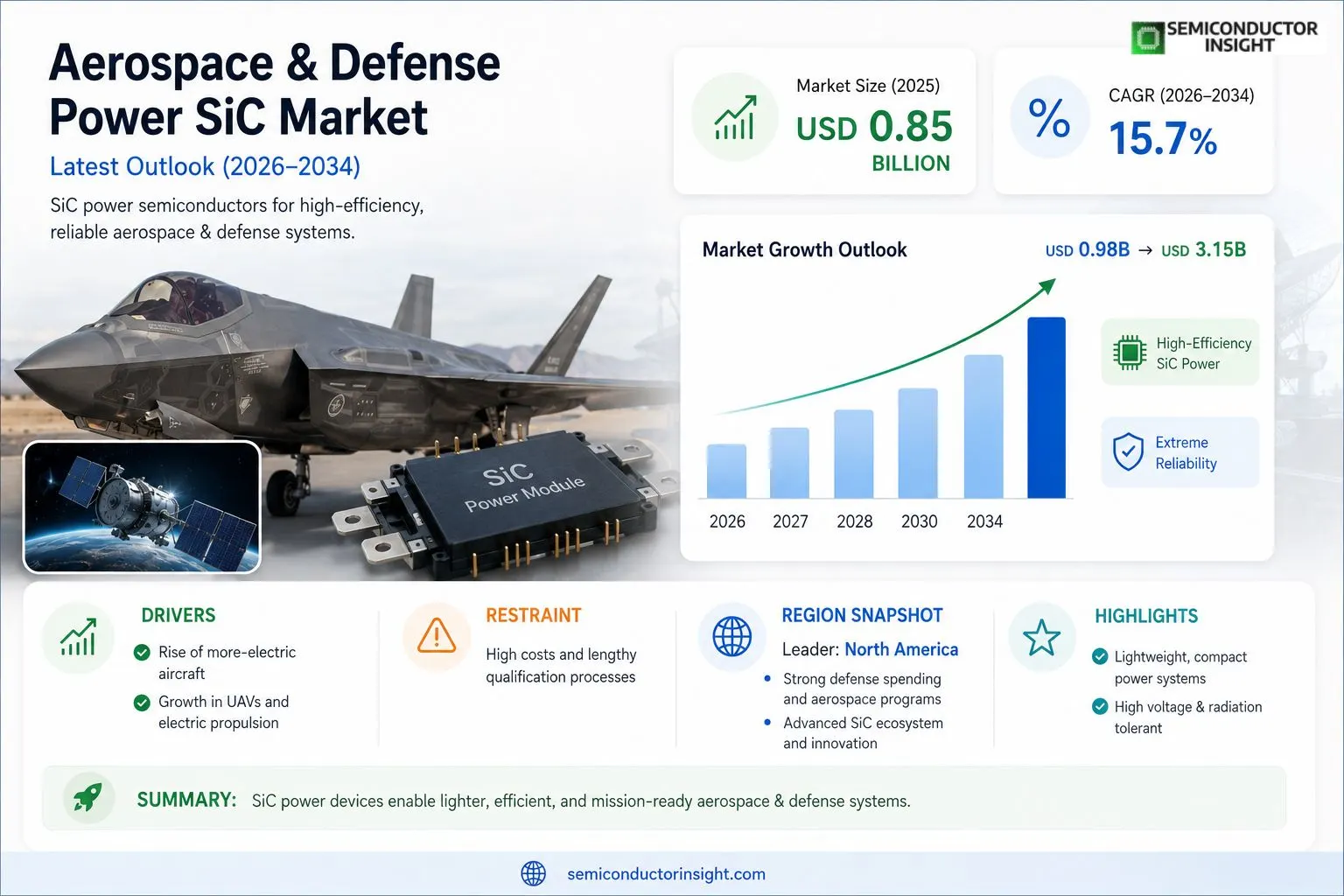
Global Aerospace & Defense Power SiC Market size was valued at USD 0.85 billion in 2025. The market is projected to grow from USD 0.98 billion in 2026 to USD 3.15 billion by 2034, exhibiting a CAGR of 15.7% during the forecast period.
Aerospace and Defense Power SiC refers to silicon carbide-based power semiconductor devices engineered for demanding applications in aircraft, spacecraft, military vehicles, and defense systems. These wide-bandgap semiconductors deliver superior performance compared to traditional silicon, including higher voltage handling, greater thermal conductivity, faster switching speeds, and enhanced radiation tolerance. Key components encompass SiC MOSFETs, diodes, and power modules optimized for high-efficiency power conversion, electric propulsion systems, radar equipment, and onboard electrical networks.
The market is experiencing robust expansion driven by increasing demand for more-electric aircraft, advancements in unmanned aerial vehicles, and the push toward hybrid-electric and all-electric propulsion in both commercial and defense sectors. Rising defense budgets worldwide, coupled with the need for lightweight, compact, and reliable power electronics capable of operating in extreme temperatures and harsh environments, further accelerate adoption. Silicon carbide technology enables significant reductions in system size and weight while improving overall efficiency and thermal management, which proves critical for mission-critical aerospace platforms.
Furthermore, ongoing modernization programs in military electronics and growing investments in space exploration contribute to sustained momentum. Key players continue to innovate with higher-voltage SiC devices tailored for aerospace requirements, supporting next-generation radar, directed energy weapons, and satellite power systems. This combination of technological advantages and sector-specific demands positions Aerospace & Defense Power SiC Market for strong long-term growth.
MARKET DRIVERS
Rising Demand for High-Efficiency Power Systems in Next-Generation Platforms
Aerospace & Defense Power SiC Market is propelled by the increasing adoption of silicon carbide (SiC) devices in satellites, aircraft, and military systems. SiC offers superior thermal conductivity, higher voltage operation, and radiation tolerance compared to traditional silicon, enabling compact, lightweight power converters essential for space-constrained applications. This is particularly critical for small-satellite constellations and electric propulsion systems, where higher power density directly translates to greater payload capacity and extended mission durations.
Advancements in Wide-Bandgap Materials and Electrification Trends
Government and commercial investments in deep-space missions, reusable launch vehicles, and hybrid-electric aircraft are accelerating the shift toward SiC-based power electronics. These devices support higher bus voltages and reduce cooling requirements, resulting in significant weight savings and improved overall system efficiency. In defense applications, SiC enhances performance in radar systems, directed-energy weapons, and unmanned aerial vehicles operating in extreme environments.
➤ SiC power devices provide 3–5 times higher power density and improved radiation tolerance, allowing designers to shrink converter footprints and ease thermal constraints in aerospace platforms.
The ongoing modernization of military fleets and the proliferation of high-throughput satellites further drive demand, positioning SiC as a key enabler for sustainable and high-performance aerospace and defense power architectures.
MARKET CHALLENGES
High Costs and Qualification Barriers for Mission-Critical Applications
Despite performance advantages, Aerospace & Defense Power SiC Market faces hurdles from elevated material and manufacturing costs relative to silicon-based alternatives. Extensive qualification processes for radiation-hardened and high-reliability components extend development timelines and increase non-recurring engineering expenses, slowing broader adoption in cost-sensitive programs.
Other Challenges
Supply Chain Vulnerabilities
Dependence on specialized substrates and geopolitical factors affecting raw material availability create risks for consistent production scaling in Aerospace & Defense Power SiC Market. Global supply constraints for high-performance semiconductor materials can lead to delays in platform integration.
Technical Integration with Legacy Systems
Incorporating SiC devices into existing aerospace and defense architectures requires significant redesign efforts to address compatibility, thermal management, and electromagnetic interference issues, posing engineering challenges for system integrators.
MARKET RESTRAINTS
Lengthy Certification and Radiation-Hardening Requirements
Stringent certification standards and lengthy testing protocols for radiation tolerance in space and defense environments act as major restraints in Aerospace & Defense Power SiC Market. These processes can extend product introduction timelines by 18–36 months, limiting rapid deployment in fast-evolving programs. The high initial investment required for specialized fabrication and qualification further constrains smaller suppliers and delays market expansion despite strong underlying demand for efficient power solutions.
MARKET OPPORTUNITIES
Expansion in Electric Propulsion and Advanced Defense Systems
Significant opportunities exist in Aerospace & Defense Power SiC Market driven by the growth of electric and hybrid propulsion in aircraft and spacecraft. SiC enables higher efficiency power conditioning, reduced system weight, and improved thermal performance, unlocking new capabilities in urban air mobility, hypersonic vehicles, and deep-space exploration. Domestic supply chain initiatives and investments in wide-bandgap semiconductor manufacturing present avenues for regional players to capture value through vertically integrated solutions tailored to high-reliability aerospace and defense requirements.
Aerospace & Defense Power SiC Market Trends
Growing Adoption of SiC in More-Electric Aircraft and Electric Propulsion Systems
Aerospace & Defense Power SiC Market is witnessing strong momentum as manufacturers increasingly integrate silicon carbide power devices into more-electric aircraft architectures. These wide-bandgap semiconductors provide superior voltage handling, thermal conductivity, and switching speeds compared to traditional silicon solutions. This enables more efficient power conversion and management in electric propulsion systems, onboard electrical networks, and radar equipment operating under demanding conditions.
Other Trends
Rising Demand from Unmanned Aerial Vehicles and Military Modernization Programs
Advancements in unmanned aerial vehicles are accelerating the use of SiC-based MOSFETs, diodes, and power modules. Defense sectors worldwide are prioritizing lightweight and compact power electronics that maintain reliability in extreme temperatures and harsh environments. Ongoing military electronics modernization programs further support this shift, allowing systems to achieve better overall efficiency and reduced size and weight critical for mission success.
Expanding Role in Space Exploration and Next-Generation Defense Technologies
Investments in space exploration are creating additional opportunities for Aerospace & Defense Power SiC Market applications, particularly in satellite power systems. Key industry players are developing higher-voltage SiC devices tailored specifically for aerospace requirements. These innovations support advanced radar systems, directed energy weapons, and hybrid-electric platforms across both commercial and defense sectors. The technology’s enhanced radiation tolerance makes it especially valuable for spacecraft and high-altitude operations where performance consistency is essential.Collectively, these trends highlight the strategic importance of silicon carbide power semiconductors in addressing the evolving needs of aerospace and defense industries. As platforms transition toward greater electrification, SiC technology continues to deliver measurable improvements in system performance, thermal management, and operational reliability across a wide range of applications.
COMPETITIVE LANDSCAPE
Key Industry Players
Aerospace & Defense Power SiC Market Features a Concentrated Competitive Landscape Led by Specialized Wide-Bandgap Semiconductor Innovators
Aerospace & Defense Power SiC Market is dominated by a select group of vertically integrated leaders with strong capabilities in high-reliability, radiation-hardened silicon carbide devices. Wolfspeed stands out as a pioneering force, leveraging its extensive SiC substrate and device expertise to supply critical power components for electric propulsion, radar systems, and satellite platforms. The market structure remains moderately consolidated, with top players investing heavily in qualification processes for stringent MIL-STD and aerospace standards to address extreme temperature, vibration, and radiation requirements.
Other significant players include established semiconductor giants expanding their high-voltage SiC portfolios alongside niche specialists focused on defense-grade modules. These companies are driving innovation in SiC MOSFETs and diodes optimized for more-electric aircraft architectures, directed energy weapons, and space power systems, while strategic partnerships with airframe manufacturers and defense primes accelerate adoption and secure long-term supply chains.
List of Key Aerospace & Defense Power SiC Companies Profiled
- Wolfspeed, Inc.
- Infineon Technologies AG
- STMicroelectronics
- onsemi (Semiconductor Components Industries, LLC)
- ROHM Co., Ltd.
- Microchip Technology Inc.
- GeneSiC Semiconductor (Navitas)
- Mitsubishi Electric Corporation
- Fuji Electric Co., Ltd.
- Toshiba Electronic Devices & Storage Corporation
- Renesas Electronics Corporation
- GE Aerospace
- Qorvo, Inc.
- Semikron Danfoss
Segment Analysis:
| Segment Category | Sub-Segments | Key Insights |
| By Type |
|
SiC MOSFETs stand out as the leading type due to their exceptional switching speeds and high voltage capabilities that enable efficient power conversion in demanding aerospace environments. These devices offer superior thermal conductivity, allowing reliable operation under extreme temperature fluctuations typical in high-altitude and space missions. Their compact design supports the miniaturization of power electronics, crucial for weight-sensitive aircraft platforms. Additionally, enhanced radiation hardness makes them ideal for satellite and defense systems where durability against cosmic rays is essential. |
| By Application |
|
Electric Propulsion Systems represent the leading application segment as they drive the transition toward more-electric and hybrid-electric aircraft architectures. SiC technology facilitates higher power densities while reducing overall system weight and improving energy efficiency in propulsion inverters and converters. This enables extended range and enhanced maneuverability in both commercial and military platforms. The fast switching characteristics also minimize heat generation, simplifying thermal management in tightly integrated aerospace designs and supporting sustainable aviation initiatives through optimized power delivery. |
| By End User |
|
Unmanned Aerial Vehicles emerge as the prominent end user category owing to the critical need for lightweight, high-reliability power solutions that extend mission endurance and payload capacity. SiC devices provide robust performance in harsh operational conditions, including rapid altitude changes and electromagnetic interference common in UAV deployments. Their ability to handle high power loads in compact packages supports advanced sensor suites and communication systems. This segment benefits significantly from ongoing advancements in autonomous systems requiring efficient energy management for prolonged surveillance and tactical operations. |
| By Voltage Rating |
|
High Voltage devices lead this segment by addressing the stringent power requirements of large-scale aerospace platforms and advanced defense electronics. They deliver outstanding insulation properties and reduced conduction losses, enabling efficient transmission of substantial electrical loads across extensive aircraft electrical architectures. High voltage SiC solutions excel in environments demanding superior breakdown strength and thermal stability, supporting radar arrays and energy-intensive weapons systems. Their integration helps achieve overall system optimization by minimizing cooling needs and enhancing fault tolerance in mission-critical scenarios. |
| By Integration Level |
|
Power Modules dominate as the preferred integration level for their ability to combine multiple SiC components into robust, pre-tested assemblies that accelerate system design cycles. These modules provide enhanced thermal performance and reduced parasitic inductance, which are vital for high-frequency switching in aerospace power distribution. Their standardized packaging ensures consistent reliability across diverse platforms while simplifying qualification processes for defense certifications. This approach also promotes better space utilization and improved electromagnetic compatibility in densely packed avionics bays. |
Regional Analysis: Aerospace & Defense Power SiC Market
North America
North America excels through cutting-edge R&D in wide-bandgap semiconductors, enabling SiC devices that outperform traditional silicon in power conversion efficiency for aerospace applications. Collaborative innovation centers drive the development of radiation-hardened and high-voltage SiC solutions essential for space and hypersonic defense systems.
Close partnerships between established primes and specialized SiC suppliers facilitate seamless integration of advanced power electronics into legacy and future platforms. This integrated approach ensures optimized performance in avionics, directed energy weapons, and electrified propulsion architectures.
Strategic policy frameworks and sustained investment in domestic semiconductor capabilities bolster Aerospace & Defense Power SiC Market. Emphasis on secure supply chains and next-gen military electrification creates favorable conditions for accelerated commercialization of SiC technologies.
World-class research facilities and innovation districts concentrate expertise in materials science and power systems engineering. These hubs nurture breakthroughs in SiC substrate quality and device packaging tailored to the stringent reliability requirements of aerospace and defense environments.
Europe
Europe maintains a strong position in Aerospace & Defense Power SiC Market through its emphasis on collaborative programs and sustainable aviation initiatives. Countries with prominent aerospace industries focus on developing efficient power systems for commercial and military aircraft, leveraging SiC technology to reduce weight and improve thermal management in complex electrical architectures. Regional consortia promote knowledge sharing among manufacturers, research organizations, and defense agencies, driving advancements in SiC-based inverters and converters suitable for both fixed-wing platforms and rotary systems. Regulatory frameworks supporting green defense technologies further encourage the integration of high-performance silicon carbide solutions across European programs.
Asia-Pacific
The Asia-Pacific region demonstrates rapid evolution in Aerospace & Defense Power SiC Market, fueled by expanding defense modernization efforts and growing indigenous aerospace capabilities. Nations are increasingly investing in domestic semiconductor technologies to support next-generation fighter aircraft, naval vessels, and satellite constellations. Strategic focus on high-reliability power electronics aligns well with SiC advantages in harsh operating environments typical of regional defense applications. Collaborative ventures and technology transfer initiatives accelerate the build-up of local expertise in SiC device fabrication and system integration, positioning the region as an emerging force in advanced power solutions for aerospace platforms.
South America
South America shows growing interest in Aerospace & Defense Power SiC Market, primarily through modernization of existing fleets and development of regional aerospace infrastructure. Countries are exploring SiC technologies to enhance the performance and reliability of surveillance aircraft, transport platforms, and border security systems. While the market remains developing, partnerships with global technology providers facilitate knowledge transfer and gradual adoption of advanced power electronics. Emphasis on operational efficiency in challenging climates creates opportunities for SiC solutions that deliver superior thermal stability and reduced maintenance requirements across defense applications.
Middle East & Africa
The Middle East & Africa region is progressively incorporating SiC power technologies within its Aerospace & Defense strategies, driven by ambitions to strengthen air defense capabilities and diversify industrial bases. Investments target high-performance electronics for unmanned systems, missile defense, and advanced radar installations where SiC offers critical advantages in power handling and environmental resilience. Strategic initiatives to build local manufacturing competencies complement technology acquisitions from established players. The extreme operating conditions prevalent in the region highlight the value of silicon carbide’s robustness, supporting expanded utilization in both current and future defense platforms.
Report Scope
This market research report provides a comprehensive analysis of the Aerospace & Defense Power SiC Market , covering the forecast period 2026–2034. It offers detailed insights into market dynamics, technological advancements, competitive landscape, and key trends shaping the industry.
Key focus areas of the report include:
- Market Overview: The report begins with an overview outlining its current market scenario, key growth indicators, and industry transformation drivers. It discusses macroeconomic factors, demand–supply balance, regulatory landscape, and the strategic role of semiconductors in powering advancements across industries such as automotive, telecommunications, consumer electronics, and industrial automation.
- Market Size & Forecast: Historical data and future projections for revenue, unit shipments, and market value across major regions and segments.
- Segmentation Analysis: Detailed breakdown by product type, technology, application, and end-user industry to identify high-growth segments and investment opportunities.
- Regional Insights: Insights into market performance across North America, Europe, Asia-Pacific, Latin America, and the Middle East & Africa, including country-level analysis where relevant.
- Competitive Landscape: Profiles of leading market participants, including their product offerings, R&D focus, manufacturing capacity, pricing strategies, and recent developments such as mergers, acquisitions, and partnerships.
- Technology Trends & Innovation: Assessment of emerging technologies, integration of AI/IoT, semiconductor design trends, fabrication techniques, and evolving industry standards.
- Market Drivers & Restraints: Evaluation of factors driving market growth along with challenges, supply chain constraints, regulatory issues, and market-entry barriers.
- Stakeholder Insights: Insights for component suppliers, OEMs, system integrators, investors, and policymakers regarding the evolving ecosystem and strategic opportunities.
Primary and secondary research methods are employed, including interviews with industry experts, data from verified sources, and real-time market intelligence to ensure the accuracy and reliability of the insights presented.
FREQUENTLY ASKED QUESTIONS:
What is the current market size of Aerospace & Defense Power SiC Market?
-> Aerospace & Defense Power SiC Market was valued at USD 0.85 billion in 2025 and is expected to reach USD 3.15 billion by 2034.
Which key companies operate in Aerospace & Defense Power SiC Market?
-> Key players include leading SiC semiconductor manufacturers focused on aerospace-grade solutions, among others.
What are the key growth drivers?
-> Key growth drivers include increasing demand for more-electric aircraft, advancements in unmanned aerial vehicles, hybrid-electric and all-electric propulsion systems, rising defense budgets, and need for lightweight high-efficiency power electronics in harsh environments.
Which region dominates the market?
-> North America is a dominant market due to strong defense spending and aerospace programs, while Asia-Pacific is the fastest-growing region.
What are the emerging trends?
-> Emerging trends include higher-voltage SiC devices, integration in electric propulsion systems, radiation-tolerant power modules, and innovations for directed energy weapons and satellite power systems.

Get Sample Report PDF for Exclusive Insights
Report Sample Includes
- Table of Contents
- List of Tables & Figures
- Charts, Research Methodology, and more...