LTCC Ceramic Substrates Market Insights
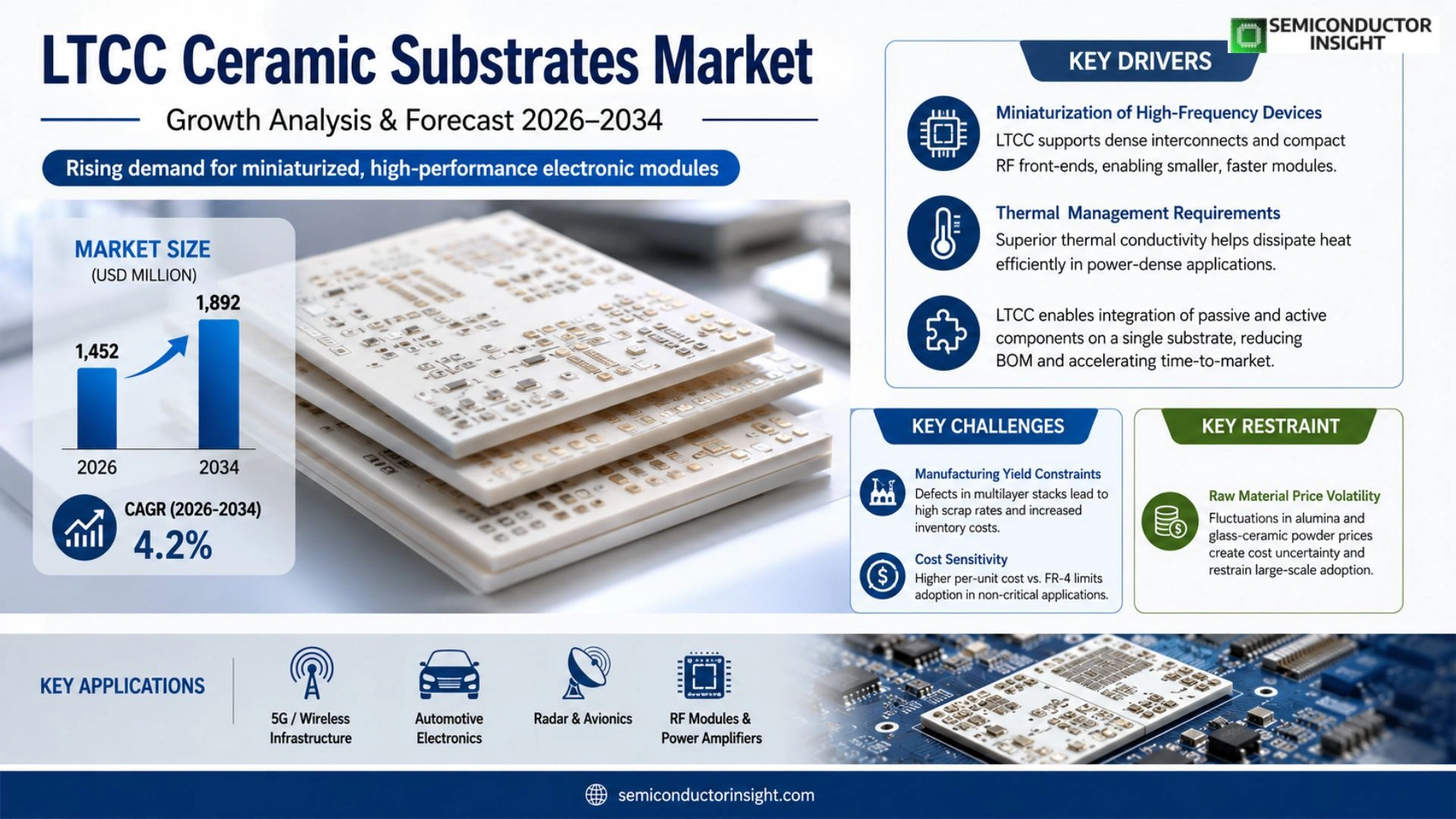
Global LTCC Ceramic Substrates market size was valued at USD 1,441 million in 2025. Forecasts indicate growth from USD 1,452 million in 2026 up to USD 1,892 million by 2034, reflecting a CAGR of 4.2 % over the period.
LTCC stands for Low‑Temperature Co‑Fired Ceramics and is often referred to as glass‑ceramic because its composition blends glass frits with alumina powders. The technology enables co‑firing of low‑resistance metal conductors,typically copper,at temperatures below 1,000 °C, which reduces transmission loss compared with conventional alumina substrates. Consequently, LTCC substrates are employed for high‑frequency modules, advanced semiconductor packaging, and emerging millimeter‑wave applications such as 5G/6G front‑end modules.
The upward trajectory stems from several interrelated forces: the rollout of next‑generation wireless standards creates demand for low‑loss passive components; electrification of vehicles fuels adoption of radar and sensor modules that rely on compact high‑frequency substrates; and the proliferation of IoT wearables pushes manufacturers toward miniaturized yet reliable platforms. Leading suppliers,including Murata Manufacturing, Kyocera (AVX), TDK Corporation, Mini‑Circuits and Taiyo Yuden,continue expanding capacity and introducing fine‑line metallization processes that further lower insertion loss. Recent collaborations between major substrate makers and automotive OEMs underscore the strategic importance of LTCC in future electronic ecosystems.
MARKET DRIVERS
Miniaturization of High‑Frequency Devices
The relentless push toward smaller, faster electronic modules forces designers to seek substrates that can host dense interconnects without compromising signal integrity. LTCC technology delivers multilayer architectures that accommodate complex routing, making it an obvious choice for LTCC Ceramic Substrates Market. As system‑in‑package (SiP) concepts mature, manufacturers are increasingly specifying LTCC for RF front‑ends, where every millimeter of board space translates directly into performance gains.
Thermal Management Requirements
Power‑dense modules such as automotive radar and base‑station amplifiers generate heat that must be dissipated efficiently. The ceramic matrix of LTCC offers superior thermal conductivity compared with organic laminates, allowing engineers to spread heat across the stack rather than concentrate it at a single point. This advantage has nudged procurement teams to allocate a larger share of their budget to ceramic substrates, reinforcing growth patterns in the sector.
➤ LTCC enables the integration of passive and active components on a single substrate, collapsing bill of materials and shortening time‑to‑market.
Beyond technical merit, supply‑chain resilience is gaining attention. Companies that have diversified their source base for LTCC wafers report fewer production halts, a factor that is subtly reshaping purchasing strategies across LTCC Ceramic Substrates Market. As a result, the market is seeing a gradual shift from price‑only negotiations toward value‑oriented contracts.
MARKET CHALLENGES
Manufacturing Yield Constraints
Achieving high yields on multilayer ceramic stacks remains a technical hurdle. Minute defects introduced during screen‑printing or sintering can cascade through the dielectric layers, leading to scrap rates that exceed 10 % in some facilities. This reality forces end‑users to maintain safety inventories, inflating overall system costs and dampening demand elasticity.
Other Challenges
Cost Sensitivity
While the performance benefits of LTCC are clear, the per‑unit price still lags behind conventional FR‑4 solutions. OEMs operating under tight margin pressures often perform cost‑benefit analyses that favor lower‑cost alternatives for non‑critical functions, limiting the breadth of adoption.
MARKET RESTRAINTS
Raw Material Price Volatility
The cost of high‑purity alumina and glass‑ceramic powders fluctuates with mineral extraction cycles and geopolitical trade policies. When raw‑material prices spike, manufacturers must either absorb the uplift or pass it on, both of which can contract order volumes. This price uncertainty acts as a brake on large‑scale rollout, especially in price‑sensitive segments such as consumer electronics.
MARKET OPPORTUNITIES
Emerging 5G Infrastructure
5G base stations rely on high‑frequency filters and power amplifiers that operate in the millimeter‑wave spectrum. LTCC ceramic substrates provide the low loss and dimensional stability required for these components, opening a niche where performance outweighs cost considerations. Early adopters are already reporting reduced module footprints and improved thermal margins, suggesting a fertile ground for market expansion.
Automotive ADAS and Electrification
Advanced driver‑assistance systems (ADAS) and electric‑vehicle power electronics demand substrates that can survive harsh temperature cycles while supporting high‑frequency signal paths. LTCC’s inherent reliability and ability to embed passive elements align perfectly with these requirements, presenting a clear pathway for LTCC Ceramic Substrates Market to capture a growing share of the automotive supply chain.
LTCC Ceramic Substrates Market Trends
Emerging Demand for High‑Frequency Modules
LTCC Ceramic Substrates Market showed a valuation of roughly US$1,441 million in 2025 and is expected to reach close to US$1,892 million by 2032. The upward trajectory is anchored in the rollout of 5G and the imminent shift toward 6G, which require passive components with exceptionally low loss at millimeter‑wave frequencies. LTCC’s ability to integrate copper conductors at sub‑1000 °C firing temperatures yields transmission losses that are markedly lower than those of traditional alumina substrates, a technical edge that manufacturers are exploiting in smartphone front‑end modules and satellite transceivers. This performance advantage translates into smaller BOM footprints and higher system reliability, prompting tier‑1 OEMs to qualify LTCC parts for next‑generation radio units. Consequently, supplier investment in fine‑line metallization and low‑loss dielectrics has accelerated, reshaping the competitive landscape and creating entry barriers for new players lacking advanced sintering capabilities.
Other Trends
Regional Growth Disparities
North America remains the largest regional contributor, with revenues projected to climb from US$339.86 million in 2024 to about US$427.93 million by 2031. Europe’s expansion is modest, moving from US$104.6 million to roughly US$113 million in the same horizon, reflecting slower adoption of high‑frequency automotive radar solutions. In contrast, China’s market is expected to rise from US$478.38 million to US$554.82 million, driven by aggressive government funding for electric‑vehicle sensor arrays and domestic 5G infrastructure. These divergent paths underscore the importance of tailoring go‑to‑market strategies: firms targeting the Chinese automotive segment must prioritize compliance with local sustainability standards for sintering processes, while those eyeing the North American communications segment should focus on the integration of LTCC with advanced system‑in‑package (SiP) architectures.
Consolidation and Innovation Pressure
The competitive dynamics are being reshaped by a wave of consolidation among the ten largest players, who collectively command roughly 80 % of global revenue. Companies such as Murata, Kyocera, and TDK are leveraging scale to broaden their product portfolios beyond traditional RF modules into hybrid LTCC‑organic packages that address the growing need for miniaturized IoT devices. This strategic diversification is complemented by R&D spend focused on energy‑efficient sintering and eco‑friendly glass‑ceramic formulations, aligning product development with emerging environmental regulations. For downstream designers, the result is a richer set of design‑in options that can reduce time‑to‑market for next‑generation wearables and automotive radar units. The net effect is a market that, while steady in its overall growth, is becoming increasingly differentiated by technology depth and the ability to deliver ultra‑low‑loss, high‑reliability solutions at scale.
COMPETITIVE LANDSCAPE
Key Industry Players
LTCC Ceramic Substrates – Competitive Overview
The LTCC market is tightly concentrated, with a handful of Japanese and Korean giants controlling roughly 80 % of global revenue. Murata Manufacturing leads the segment by leveraging its deep dielectric expertise and vertically integrated production, enabling it to serve high‑frequency RF modules and automotive radar with tight tolerances. Kyocera (AVX) follows closely, differentiating through advanced glass‑ceramic formulations that deliver lower loss at mmWave frequencies, a capability that has secured sizable contracts with 5G handset makers. TDK Corporation and Taiyo Yuden complement the top tier by pairing material science innovations with aggressive pricing, allowing them to capture mid‑range smartphone and IoT applications. Samsung Electro‑Mechanics expands the competitive set by integrating LTCC in its System‑in‑Package (SiP) portfolio, while Yokowo and KOA (Via Electronic) focus on niche automotive and aerospace customers that demand extreme reliability under thermal stress.
Beyond the headline players, a robust second tier contributes specialized value. Proterial Ltd., Nikko and Orbray provide custom‑size substrates for defense and satellite markets, exploiting their low‑volume, high‑mix production lines. European firms such as IMST GmbH, NEO Tech and SEMCNS Co., Ltd bring strong design‑for‑manufacturability credentials that appeal to OEMs seeking rapid prototyping. Bosch and Raltron Electronics leverage their automotive heritage to embed LTCC in power‑train sensors, while ACX Corp and Yageo (Chilisin) target cost‑sensitive consumer electronics through economies of scale. Walsin Technology, Microgate and several Chinese manufacturers round out the landscape, offering competitive pricing for large‑volume IoT modules and expanding the supply base for emerging 6G research.
List of Key LTCC Ceramic Substrates Companies Profiled
- Murata Manufacturing
- Kyocera (AVX)
- TDK Corporation
- Taiyo Yuden
- Samsung Electro‑Mechanics
- Yokowo
- KOA (Via Electronic)
- Proterial Ltd.
- Nikko
- Orbray
- Bosch
- IMST GmbH
- NEO Tech
- SEMCNS Co., Ltd
- Walsin Technology
- Microgate
Segment Analysis:
| Segment Category | Sub-Segments | Key Insights |
| By Type |
|
LTCC Components
|
| By Application |
|
Consumer Electronics & Communications
|
| By End User |
|
Smartphone manufacturers
|
| By Substrate Function |
|
RF Substrates
|
| By Integration Approach |
|
Hybrid LTCC‑Organic Modules
|
Regional Analysis: LTCC Ceramic Substrates Market
Asia‑Pacific
Localized wafer‑fab capacity paired with a dense network of component distributors shortens order‑to‑delivery cycles. This proximity allows manufacturers to respond swiftly to design revisions without incurring the penalties of long‑haul logistics, strengthening customer loyalty in fast‑moving electronics segments.
Telecom infrastructure upgrades and the rollout of 5G/mmWave networks are compelling system integrators to adopt high‑frequency LTTC substrates. The same pressure is evident in automotive safety systems, where radar modules rely on the material’s low dielectric loss for reliable long‑range detection.
Regional standards bodies have tightened limits on hazardous substances, pushing suppliers toward lead‑free ceramic formulations. Compliance has become a decisive factor in sourcing decisions, especially for products destined for European and North American markets.
Venture capital and corporate venture arms are allocating capital to startups that fuse LTCC technologies with advanced packaging. The influx of funding accelerates innovation cycles, prompting incumbent firms to explore joint‑development agreements to retain market relevance.
North America
North America remains a pivotal market for LTCC Ceramic Substrates Market, largely because of its concentration of defense contractors and high‑end aerospace firms. These customers demand substrates that can tolerate rigorous thermal cycling while maintaining signal integrity, a requirement that drives continuous refinements in material engineering. Additionally, the region’s robust intellectual‑property framework encourages domestic firms to protect novel multilayer designs, fostering a competitive environment where differentiation hinges on performance rather than cost alone.
Europe
European manufacturers are channeling LTCC Ceramic Substrates Market toward sustainability and regulatory compliance. The EU’s strict RoHS directives have catalyzed a shift toward eco‑conscious production methods, prompting foundries to adopt alternative firing processes that lower emissions. Simultaneously, the rise of smart‑city initiatives across major metros generates demand for compact, high‑frequency modules that benefit from LTCC’s dimensional stability. The confluence of policy pressure and urban digitalization creates a nuanced growth avenue for substrate suppliers targeting the European segment.
South America
In South America, LTCC Ceramic Substrates Market is being shaped by a gradual modernization of telecommunications infrastructure. Nations such as Brazil and Argentina are expanding 4G networks while laying the groundwork for future 5G deployments, prompting local assemblers to explore LTCC solutions for base‑station components. Although the region’s manufacturing base is less dense than other continents, strategic partnerships with Asian suppliers are reducing entry barriers and allowing South American firms to leverage proven designs without extensive in‑house R&D.
Middle East & Africa
The Middle East & Africa presents a distinctive blend of high‑value defense contracts and emerging consumer‑electronics demand. Gulf Cooperation Council countries invest heavily in aerospace and satellite programs that require reliable high‑frequency substrates, positioning LTCC Ceramic Substrates Market as a critical enabler of regional technological sovereignty. Meanwhile, African telecom operators are upgrading networks to accommodate mobile broadband growth, creating ancillary demand for compact, ruggedized modules supplied by LTCC technology.
Report Scope
This market research report provides a comprehensive analysis of the LTCC Ceramic Substrates Market , covering the forecast period 2026–2034. It offers detailed insights into market dynamics, technological advancements, competitive landscape, and key trends shaping the industry.
Key focus areas of the report include:
- Market Overview: The report begins with an overview outlining its current market scenario, key growth indicators, and industry transformation drivers. It discusses macroeconomic factors, demand–supply balance, regulatory landscape, and the strategic role of semiconductors in powering advancements across industries such as automotive, telecommunications, consumer electronics, and industrial automation.
- Market Size & Forecast: Historical data and future projections for revenue, unit shipments, and market value across major regions and segments.
- Segmentation Analysis: Detailed breakdown by product type, technology, application, and end-user industry to identify high-growth segments and investment opportunities.
- Regional Insights: Insights into market performance across North America, Europe, Asia-Pacific, Latin America, and the Middle East & Africa, including country-level analysis where relevant.
- Competitive Landscape: Profiles of leading market participants, including their product offerings, R&D focus, manufacturing capacity, pricing strategies, and recent developments such as mergers, acquisitions, and partnerships.
- Technology Trends & Innovation: Assessment of emerging technologies, integration of AI/IoT, semiconductor design trends, fabrication techniques, and evolving industry standards.
- Market Drivers & Restraints: Evaluation of factors driving market growth along with challenges, supply chain constraints, regulatory issues, and market-entry barriers.
- Stakeholder Insights: Insights for component suppliers, OEMs, system integrators, investors, and policymakers regarding the evolving ecosystem and strategic opportunities.
Primary and secondary research methods are employed, including interviews with industry experts, data from verified sources, and real-time market intelligence to ensure the accuracy and reliability of the insights presented.
FREQUENTLY ASKED QUESTIONS:
What is the current market size of LTCC Ceramic Substrates Market?
-> LTCC Ceramic Substrates market forecasts indicate growth from USD 1,452 million in 2026 up to USD 1,892 million by 2034, reflecting a CAGR of 4.2 %
Which key companies operate in LTCC Ceramic Substrates Market?
-> Key players include Murata Manufacturing, Kyocera (AVX), TDK Corporation, Mini-Circuits, Taiyo Yuden, Samsung Electro-Mechanics, Yokowo, KOA (Via Electronic), Proterial, Ltd, among others.
What are the key growth drivers?
-> Key growth drivers include the rollout of 5G and beyond, electrification of vehicles and ADAS adoption, proliferation of IoT and wearable devices, and continuous R&D in low‑loss dielectrics and fine‑line metallization.
Which region dominates the market?
-> Asia‑Pacific is the dominant region, with China accounting for the largest share, followed by North America.
What are the emerging trends?
-> Emerging trends include further miniaturization through advanced printing and layering, hybrid LTCC‑organic packaging, mmWave/terahertz modules for 6G, and sustainability‑focused sintering technologies.
Get Sample Report PDF for Exclusive Insights
Report Sample Includes
- Table of Contents
- List of Tables & Figures
- Charts, Research Methodology, and more...
 Download Sample Report PDF