Electrolytic DC Source Market Insights
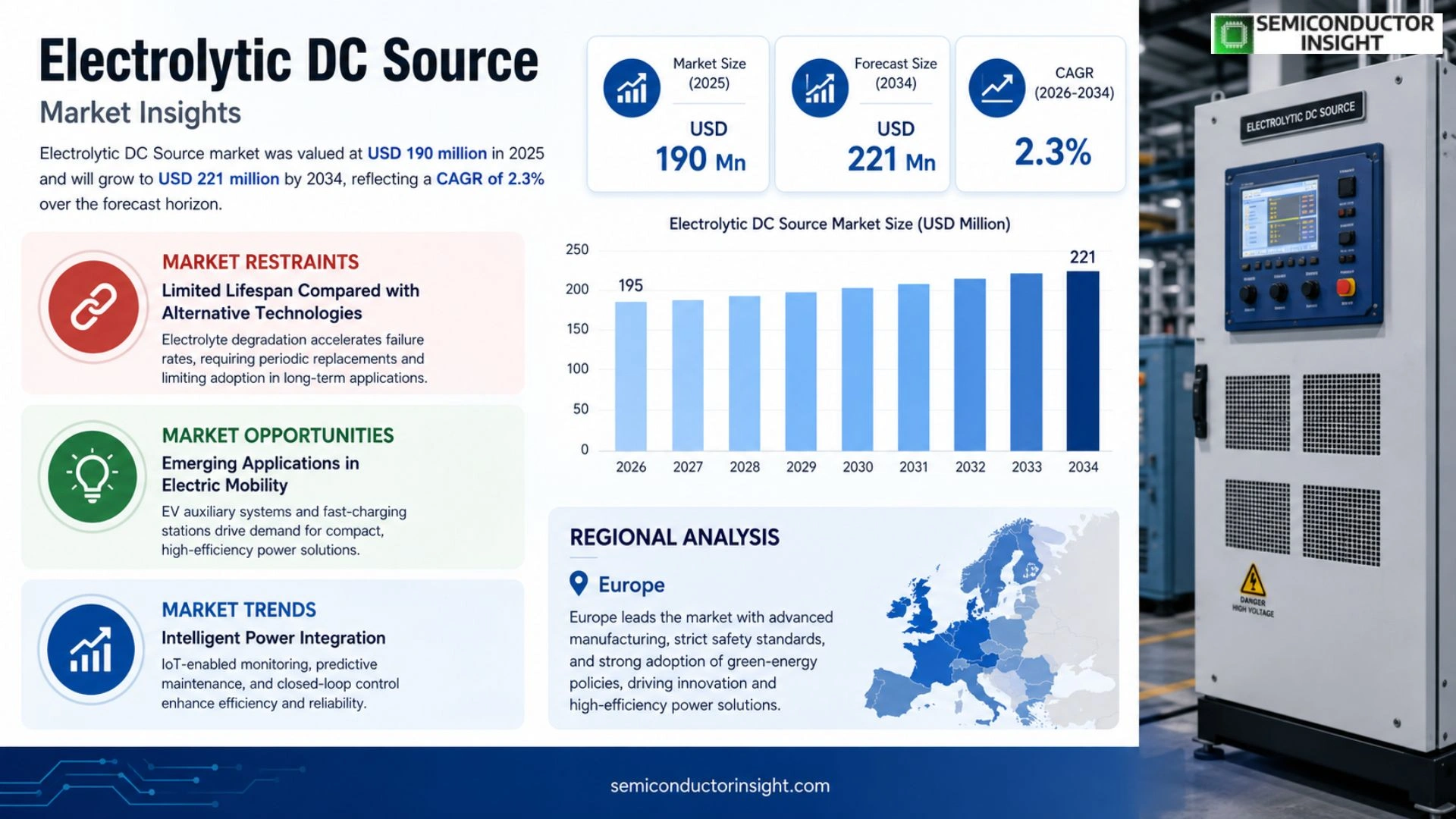
Electrolytic DC Source market was valued at USD 190 million in 2025 and will grow to USD 221 million by 2034, reflecting a CAGR of 2.3% over the forecast horizon.
An Electrolytic DC Source is a specialized direct‑current power supply designed for electrochemical processes such as electrolysis, delivering precisely controlled, stable current that drives non‑spontaneous redox reactions at electrodes immersed in an electrolyte solution.
Growth is supported by expanding green‑hydrogen projects, increased automation in metal finishing, and rising demand for energy‑efficient power solutions across industrial sectors.
MARKET DRIVERS
Rising Demand for High‑Efficiency Power Supplies
Electrolytic DC Source Market is benefitting from a surge in demand for power solutions that deliver high conversion efficiency. Data‑center operators are upgrading legacy supplies to reduce electricity spend, while renewable‑energy installations prefer electrolytic modules for their low loss profile. This shift translates into tighter design margins and a stronger case for capital allocation toward electro‑lytic technologies.
Stringent Energy‑Saving Regulations
Governments across Europe and Asia have introduced performance standards that penalize excess heat generation. Manufacturers responding to these rules are redesigning products around electrolytic DC sources because they meet efficiency thresholds without resorting to complex cooling schemes. The regulatory pressure not only creates a compliance imperative but also opens avenues for premium pricing on compliant units.
➤ Clients that prioritize total cost of ownership are increasingly selecting electrolytic DC sources, recognizing that lower operational losses offset higher upfront outlays within a three‑to‑five‑year horizon.
Beyond compliance, the reliability of electrolytic designs,characterized by fewer moving parts and predictable voltage behavior,offers OEMs a competitive edge when pitching to sectors such as medical equipment and aerospace, where uptime is non‑negotiable.
MARKET CHALLENGES
High Initial Capital Expenditure
Deploying electrolytic DC sources typically requires larger upfront investment than switching‑mode alternatives. The cost premium stems from specialized materials and precision manufacturing processes. For mid‑size manufacturers, this creates a budgeting hurdle that can defer adoption, especially when project financing is limited.
Other Challenges
Component Availability
The supply chain for high‑purity electrolytes and custom‑rated capacitors has tightened amid global material shortages. Lead times have lengthened, prompting procurement teams to maintain higher safety stocks, which in turn raises inventory costs.
MARKET RESTRAINTS
Limited Lifespan Compared with Alternative Technologies
While electrolytic DC sources excel in efficiency, their operational lifespan trails that of solid‑state options. Electrolyte degradation under thermal stress accelerates failure rates, compelling end‑users to schedule periodic replacements. This durability gap discourages adoption in applications where long‑term serviceability is paramount.
Consequently, OEMs often hedge their portfolios with hybrid architectures, pairing electrolytic modules with longer‑lasting solid‑state converters to balance performance and durability, thereby tempering pure market penetration.
MARKET OPPORTUNITIES
Emerging Applications in Electric Mobility
Electric‑vehicle platforms are exploring electrolytic DC sources for auxiliary systems such as lighting, infotainment, and power‑train control units. The technology’s low ripple voltage aligns with the stringent electrical quality demands of modern EV architectures, opening a niche where efficiency gains translate directly into extended driving range.
In addition, the rollout of charging infrastructure in urban centers creates demand for compact, high‑efficiency power supplies that can handle variable load profiles. Electrolytic DC sources, with their smooth voltage regulation, are positioned to meet these needs, especially in fast‑charging stations where grid interaction is critical.
Investors focusing on next‑generation mobility are therefore incentivized to fund R&D that enhances electrolyte stability, potentially unlocking a broader spectrum of automotive applications and expanding the overall Electrolytic DC Source Market footprint.
Electrolytic DC Source Market Trends
Intelligent Power Integration Reshapes Electrolytic DC Source Market
The most visible shift in Electrolytic DC Source Market is the migration toward connected, algorithm‑driven power supplies. Manufacturers are embedding IoT sensors, predictive‑maintenance analytics, and closed‑loop control software directly into rectifiers and pulse generators. This integration yields measurable energy savings,often 5‑10 % per unit,by constantly adjusting voltage‑current profiles to match process demand. Customers in metal finishing and hydrogen production value the reduction in unplanned downtime, which translates into higher overall equipment effectiveness. Suppliers that can demonstrate a quantifiable improvement in deposit quality or electrolyzer efficiency through real‑time data are commanding premium pricing and establishing longer service contracts.
Other Trends
Sustainability‑Driven Regenerative Designs
A parallel trend gaining traction is the adoption of regenerative power architectures that capture energy during reverse‑polarity phases, such as anodic stripping in plating lines. By feeding reclaimed power back into the grid or reusing it for ancillary equipment, factories align with tightening carbon‑intensity regulations while lowering operating expenditures. The cost advantage is amplified in high‑current, continuous‑flow applications where energy consumption dominates total spend. Vendors that offer water‑cooled, high‑efficiency converters with built‑in energy‑recovery modules are differentiating themselves in regions like Europe and North America, where sustainability certifications increasingly influence procurement decisions.
Geographic Realignment and Competitive Pressure
While Asia‑Pacific remains the production hub for volume‑oriented devices, North America and Europe are consolidating market share in the premium, smart‑system segment. This divergence reflects divergent customer bases: legacy heavy‑industry users in China prioritize cost and volume, whereas aerospace and automotive suppliers in the West demand ultra‑stable, low‑ripple outputs compatible with strict quality standards. The competitive landscape is fragmenting; global giants such as ABB and Siemens defend high‑margin niches, while a growing cohort of mid‑size firms focuses on customized solutions for emerging green‑hydrogen projects. Raw‑material price volatility,particularly for copper and silicon,pressures manufacturers to optimise bill‑of‑materials, prompting a shift toward modular designs that can be upgraded without full system replacement. Companies that balance cost‑effective manufacturing with advanced digital features are poised to capture the evolving demand across Electrolytic DC Source Market.
COMPETITIVE LANDSCAPE
Key Industry Players
Electrolytic DC Source Market – Competitive Overview
The segment is dominated by a handful of multinational engineering firms that leverage deep power‑electronics expertise and global service networks. ABB, Siemens and Dynapower command the high‑value, intelligent‑control niche, supplying SMPS‑based systems that embed IoT telemetry and AI‑driven diagnostics for hydrogen electrolyzers and aerospace‑grade plating lines. Their ability to integrate proprietary semiconductor modules with robust thermal management translates into premium margins and long‑term service contracts. The presence of these giants forces mid‑tier manufacturers to differentiate through cost‑effective SCR rectifiers or regional customization, preserving a fragmented but resilient supply base.
Beyond the global leaders, a dozen specialist manufacturers sustain the volume‑driven core of the market. Companies such as Chiyoda Electronics, AEG, Kikusui and Darrah Electric focus on traditional thyristor platforms that meet the price expectations of large‑scale metal‑finishing operations in China and Southeast Asia. Emerging challengers like GERE, Efficient Power and Nenghua have begun embedding basic remote‑monitoring firmware, positioning themselves to capture customers transitioning toward smarter equipment without the price premium of the top tier. This tiered competitive structure creates a clear strategic pathway: firms that can upscale their digital capabilities while retaining cost discipline are likely to secure the most attractive growth pockets.
List of Key Electrolytic DC Source Companies Profiled
- ABB
- Siemens
- Dynapower
- Chiyoda Electronics
- AEG
- Kikusui
- Darrah Electric
- GERE
- Efficient Power
- Nenghua
- KaiDeLi
- Yueyang
- Chroma
- Ainuo
Segment Analysis:
| Segment Category | Sub-Segments | Key Insights |
| By Type |
|
Switch‑mode Power Supplies
|
| By Application |
|
Metal Finishing
|
| By End User |
|
Automotive Component Manufacturers
|
| By Power Level |
|
High‑Power
|
| By Cooling Method |
|
Water‑Cooled
|
Regional Analysis: Electrolytic DC Source Market
Europe
The EU’s tightening of electrical equipment directives compels manufacturers to certify electrolytic DC sources against stricter harmonic distortion limits and lifecycle assessments. Certification pathways, though demanding, provide market entrants with a clear benchmark that many global competitors struggle to match, giving European suppliers a competitive moat.
Heavy‑equipment producers in the Nordics and Central Europe have embedded electrolytic DC modules into automated assembly lines, citing superior voltage regulation under variable loads. This pragmatic shift reduces energy waste and aligns plant‑level power strategies with broader sustainability targets.
Recent geopolitical strains prompted European firms to diversify raw‑material sourcing for electrolytic plates, leaning on intra‑EU alliances. The resulting supply‑chain elasticity curtails lead‑time volatility, a factor that customers increasingly weigh when selecting power solutions.
Research clusters around Eindhoven and Stuttgart are piloting hybrid electrolytic‑solid‑state architectures that promise faster response times. These collaborations blur the line between component design and system integration, setting the stage for next‑generation DC sourcing.
North America
North America’s market dynamic revolves around demand from data‑center developers seeking compact, high‑efficiency power conversion. U.S. manufacturers leverage advanced automation to shrink footprint while delivering tighter control loops, a requirement for AI‑driven workloads. Canadian firms, though smaller, focus on ruggedized designs for mining and oil‑field applications, where temperature extremes test component durability. The regional emphasis on rapid time‑to‑market drives a competitive environment where product portfolios are frequently refreshed to meet evolving performance criteria.
Asia‑Pacific
In Asia‑Pacific, Electrolytic DC Source Market is propelled by the scale of electronics assembly in China, Vietnam, and South Korea. Local OEMs favor electrolytic solutions that can be mass‑produced at low cost yet retain acceptable efficiency for consumer‑grade devices. Simultaneously, Japan’s precision equipment sector demands higher‑grade modules for semiconductor lithography, injecting a premium‑segment demand that offsets the mass‑market price pressure. Regional trade agreements facilitate component flow across borders, but intellectual‑property concerns remain a strategic consideration for multinational players.
South America
South American activity centers on mining and renewable‑energy integration, where electrolytic DC sources serve as reliable back‑up for solar‑farm inverters. Brazil’s expanding hydro‑electric grid encourages retrofits of older rectifier stations with modern DC converters that improve grid stability. Market participants note that local financing schemes favor solutions with longer service intervals, making durability a key selling point. However, logistical constraints and tariff structures still shape pricing strategies for imported modules.
Middle East & Africa
The Middle East & Africa region experiences a niche but growing demand driven by water‑treatment plants and petrochemical complexes seeking precise voltage control under high‑temperature conditions. UAE firms have begun localizing production of electrolytic plates to reduce dependence on European imports, while South Africa’s industrial parks adopt DC sources to support expanding logistics hubs. The prevailing challenge lies in aligning the high‑specification requirements of oil‑refining operations with cost‑sensitive utilities, prompting vendors to offer modular upgrade paths that balance performance with budget constraints.
Report Scope
This market research report provides a comprehensive analysis of the Electrolytic DC Source Market , covering the forecast period 2026–2034. It offers detailed insights into market dynamics, technological advancements, competitive landscape, and key trends shaping the industry.
Key focus areas of the report include:
- Market Overview: The report begins with an overview outlining its current market scenario, key growth indicators, and industry transformation drivers. It discusses macroeconomic factors, demand–supply balance, regulatory landscape, and the strategic role of semiconductors in powering advancements across industries such as automotive, telecommunications, consumer electronics, and industrial automation.
- Market Size & Forecast: Historical data and future projections for revenue, unit shipments, and market value across major regions and segments.
- Segmentation Analysis: Detailed breakdown by product type, technology, application, and end-user industry to identify high-growth segments and investment opportunities.
- Regional Insights: Insights into market performance across North America, Europe, Asia-Pacific, Latin America, and the Middle East & Africa, including country-level analysis where relevant.
- Competitive Landscape: Profiles of leading market participants, including their product offerings, R&D focus, manufacturing capacity, pricing strategies, and recent developments such as mergers, acquisitions, and partnerships.
- Technology Trends & Innovation: Assessment of emerging technologies, integration of AI/IoT, semiconductor design trends, fabrication techniques, and evolving industry standards.
- Market Drivers & Restraints: Evaluation of factors driving market growth along with challenges, supply chain constraints, regulatory issues, and market-entry barriers.
- Stakeholder Insights: Insights for component suppliers, OEMs, system integrators, investors, and policymakers regarding the evolving ecosystem and strategic opportunities.
Primary and secondary research methods are employed, including interviews with industry experts, data from verified sources, and real-time market intelligence to ensure the accuracy and reliability of the insights presented.
FREQUENTLY ASKED QUESTIONS:
What is the current market size of Electrolytic DC Source Market?
-> Electrolytic DC Source market was valued at USD 190 million in 2025 and will grow to USD 221 million by 2034, reflecting a CAGR of 2.3%
Which key companies operate in Electrolytic DC Source Market?
-> Key players include ABB, Siemens, Dynapower, Chiyoda Electronics, AEG, Chroma, Kikusui, Darrah Electric, among others.
What are the key growth drivers?
-> Key growth drivers include global push for green hydrogen production, electrification of transportation, and increasing industrial automation.
Which region dominates the market?
-> Asia-Pacific dominates consumption and manufacturing, driven by China’s large electroplating and metallurgy sectors.
What are the emerging trends?
-> Emerging trends include digitalization with IoT and AI-driven predictive maintenance, smart connected power supplies, and regenerative power supply technologies.
Get Sample Report PDF for Exclusive Insights
Report Sample Includes
- Table of Contents
- List of Tables & Figures
- Charts, Research Methodology, and more...
 Download Sample Report PDF