Digital Bipolar Junction Transistors (BJT) Market Insights
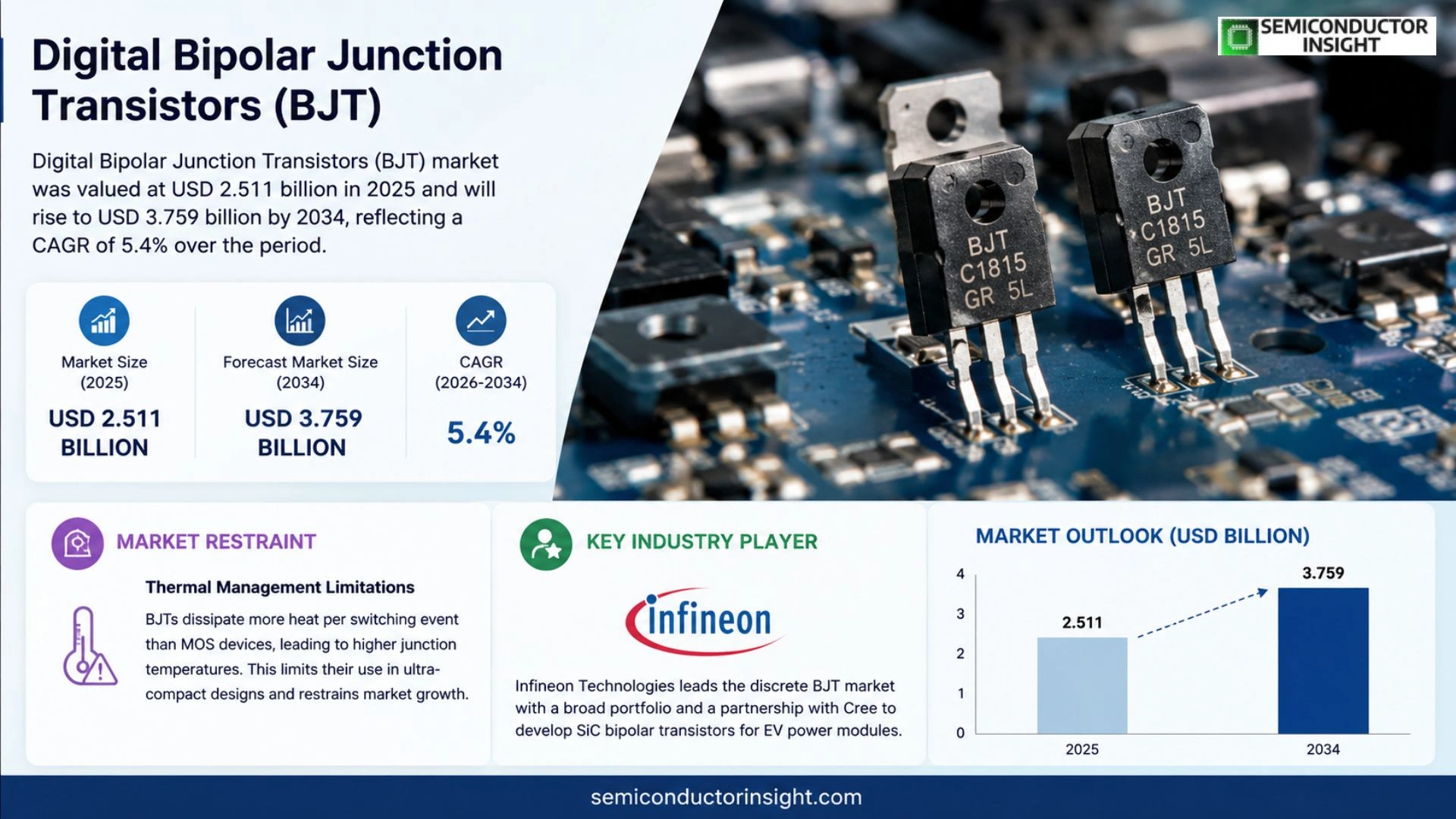
Digital Bipolar Junction Transistors (BJT) market was valued at USD 2.511 billion in 2025 and will rise to USD 3.759 billion by 2034, reflecting a CAGR of 5.4 % over the period.
Bipolar Junction Transistors are three‑terminal semiconductor devices,Base, Collector, and Emitter,formed by two sequential p‑n junctions. They operate with both electrons and holes as charge carriers, enabling high‑gain amplification and switching functions across NPN and PNP configurations.
Demand persists because industrial automation, consumer electronics, and communication systems still rely on BJTs for analog amplification, high‑frequency switching, and reliable power control despite competition from MOSFETs.
MARKET DRIVERS
Escalating Demand for High‑Speed Digital Logic
Automotive electrification and the rollout of 5G base stations are forcing designers to seek devices that combine fast switching with robust gain characteristics. Digital Bipolar Junction Transistors (BJT) Market players are benefitting from this shift because BJUs can handle higher current densities than comparable MOS devices while still delivering crisp digital transitions. The result is a measurable uptick in volume orders from Tier‑1 suppliers that are re‑architecting power‑train control modules.
Integration with Advanced Packaging Technologies
System‑in‑package (SiP) and chip‑on‑wafer approaches are reducing parasitic inductance, a historic weakness for BJTs. By embedding the transistor within a tightly coupled substrate, manufacturers are able to meet the sub‑nanosecond rise‑time requirements of next‑gen radar and lidar modules. This packaging evolution is a direct catalyst for higher unit pricing, as customers are willing to pay a premium for performance‑critical builds.
➤ “The convergence of digital control loops and power‑dense applications is reshaping the demand curve for BJTs, turning a legacy component into a strategic asset.”
Collectively, these forces are not merely incremental; they are redefining product road‑maps across semiconductor OEMs. Companies that align R&D spend with the need for tighter switching margins and integrated thermal solutions are positioning themselves to capture the bulk of the emerging spend.
MARKET CHALLENGES
Cost Pressures from Competing Device Families
The price advantage of CMOS‑based logic continues to erode BJT market share in cost‑sensitive applications. End users frequently benchmark total cost of ownership, factoring in both silicon price and ancillary cooling infrastructure. When a cheaper MOSFET can meet the same performance envelope, procurement teams default to the lower‑cost option, limiting the upside for BJT vendors.
Other Challenges
Design Complexity
Implementing BJTs in mixed‑signal environments demands careful biasing networks and precise thermal modeling. Engineers must allocate additional design resources, which translates into longer time‑to‑market cycles and heightened validation expenses.
MARKET RESTRAINTS
Thermal Management Limitations
Despite advances in substrate materials, BJTs still dissipate more heat per switching event than their MOS counterparts. In densely packed modules, excessive junction temperature can trigger premature degradation, forcing designers to over‑engineer heat‑sink solutions. This thermal ceiling curtails the applicability of BJTs in ultra‑compact form factors, thereby restraining market expansion.
MARKET OPPORTUNITIES
Emergence of Edge‑AI and Autonomous Systems
Edge‑AI processors and autonomous driving controllers require deterministic switching at high current levels,a niche where BJTs excel. Manufacturers that can deliver devices with integrated heat‑spreading layers are likely to secure contracts for safety‑critical modules, where reliability trumps cost. This segment is projected to become a pivotal growth engine for Digital Bipolar Junction Transistors (BJT) Market over the next five years.
Digital Bipolar Junction Transistors (BJT) Market Trends
Industrial Automation and Power‑Control Momentum
The surge in factory‑floor robotics and modular power‑conversion units has lifted demand for discrete devices that can sustain high current swings while preserving linear gain. Digital Bipolar Junction Transistors (BJT) excel in these roles because their base‑controlled operation delivers rapid turn‑around and low‑noise amplification, attributes that silicon‑controlled switches struggle to match at similar price points. As manufacturers adopt plug‑and‑play control modules, the bill of materials increasingly contains NPN and PNP stacks sized for TO‑220 or SOT‑23 footprints, a pattern observable across recent procurement logs from major OEMs. This shift does not merely reflect cost considerations; it signals a strategic choice to preserve signal integrity in environments where electromagnetic interference is a design constraint.
Other Trends
Supply Chain Resilience
Recent disruptions in wafer‑fab capacity have prompted BJT suppliers to diversify upstream silicon sources and to pre‑stage critical dopant inventories. Companies such as Infineon and ROHM have announced dual‑line production for automotive‑grade transistors, thereby reducing lead times for safety‑critical modules. The emphasis on localized testing hubs in Europe and North America further insulates Digital Bipolar Junction Transistors (BJT) Market from cross‑border logistics bottlenecks, an approach that aligns with customers’ demand for traceable, qualified parts in regulated sectors.
Emerging Applications in Electric Vehicles
Electric‑propulsion architectures increasingly rely on high‑frequency switching stages for battery‑management and motor‑control functions. While MOSFETs dominate bulk power paths, BJ‑type devices retain a niche in driver circuits where precise current regulation and thermal stability are paramount. The 2024 Infineon‑Cree SiC bipolar collaboration illustrates a market response that blends the high‑breakdown voltage of silicon carbide with the linearity of bipolar conduction, offering a path to lower switching losses in on‑board chargers. Parallelly, Nexperia’s rollout of compact high‑frequency BJTs in DFN packages addresses packaging constraints within dense power modules, suggesting a modest but steady expansion of BJT usage in next‑generation EV platforms.
COMPETITIVE LANDSCAPE
Key Industry Players
Digital BJT Market Competitive Overview
Infineon Technologies dominates the discrete BJT segment thanks to its extensive catalog of high‑reliability devices and its recent partnership with Cree to introduce silicon‑carbide bipolar transistors for electric‑vehicle power modules. The company leverages a vertically integrated supply chain that spans wafer production, advanced packaging and end‑user testing, allowing it to retain price leverage while meeting automotive‑grade qualification requirements. This concentration of capability creates a barrier for smaller entrants and forces them to specialize in niche form factors or application‑specific variants. Market structure therefore reflects a clear hierarchy: a handful of global OEMs capture the bulk of automotive and industrial volume, while a broader base of focused firms competes on performance nuances such as low‑noise or ultra‑high‑frequency operation.
Beyond the tier‑one group, several manufacturers have carved out meaningful positions by targeting particular segments. ROHM and STMicroelectronics supply a mix of standard and automotive‑grade BJTs, emphasizing compact DFN packages that suit space‑constrained IoT modules. Toshiba’s strength lies in RF‑optimized transistors used in communication hardware, whereas onsemi differentiates through a portfolio of high‑current discrete devices for power‑conversion equipment. Nexperia, Diodes Incorporated and Panjit each maintain robust distribution networks in Europe and Asia, focusing on low‑cost, high‑volume parts for consumer electronics. Additional niche players such as Vishay, Microchip Technology, Skyworks Solutions, and Renesas Electronics contribute specialized products,ranging from complementary BJT pairs to silicon‑germanium hybrid devices,that address emerging requirements in 5G front‑ends and automotive sensor interfaces.
List of Key Digital Bipolar Junction Transistors Companies Profiled
- Infineon Technologies
- ROHM Semiconductor
- STMicroelectronics
- Toshiba
- onsemi
- Nexperia
- Diodes Incorporated
- PanJit International
- Vishay Intertechnology
- Microchip Technology
- Skyworks Solutions
- Renesas Electronics
Segment Analysis:
| Segment Category | Sub-Segments | Key Insights |
| By Type |
|
Leading Segment – NPN devices dominate discrete usage because they offer higher current gain and easier biasing. • Engineers favour NPN for classic audio amplification and switching due to predictable performance. • PNP devices remain critical in complementary pairs, enabling symmetrical push‑pull stages in high‑fidelity circuits. • Digital transistor arrays are emerging in mixed‑signal ICs, providing compact integration while preserving bipolar characteristics. |
| By Application |
|
Leading Segment – Industrial control systems rely heavily on BJTs for robust switching under harsh environments. • Their linear amplification capability supports precise sensor interfacing. • Automotive power‑train modules adopt high‑frequency BJTs for rapid switching in torque‑control converters. • Communication hardware benefits from low‑noise bipolar stages in RF front‑ends, sustaining relevance despite CMOS competition. |
| By End User |
|
Leading Segment – Electronics OEMs prefer discrete BJTs for legacy designs where component replaceability and proven reliability are paramount. • They value the straightforward bias networks and thermal stability. • Automotive manufacturers integrate bipolar devices in safety‑critical subsystems, appreciating their deterministic switching characteristics. • Communication equipment providers use high‑frequency BJTs to achieve low phase‑noise in transmitter stages, ensuring signal integrity. |
| By Process Technology |
|
Leading Segment – Silicon remains the workhorse process, delivering consistent electrical parameters across temperature ranges. • SiGe devices are gaining traction for high‑frequency applications due to superior carrier mobility. • RF‑optimized bipolar transistors are specialized for wireless front‑ends, offering low noise figures. • Germanium BJTs survive in niche low‑voltage analog circuits where their higher intrinsic gain is beneficial. |
| By Power |
|
Leading Segment – Low‑power devices dominate portable and IoT designs, where energy efficiency is critical. • Medium‑power BJTs are preferred in motor‑drive modules for balanced voltage handling. • High‑power variants support power‑conversion stages in electric‑vehicle inverters. • High‑frequency BJTs address the needs of 5G and advanced radar systems, delivering fast switching with controlled parasitics. |
Regional Analysis: Digital Bipolar Junction Transistors (BJT) Market
Vehicle electrification drives engineers toward digital BJTs for power‑train control units, where thermal robustness reduces cooling requirements. The shift toward integrated driver‑assist modules amplifies demand for devices that can coexist with high‑frequency microcontrollers, positioning BJTs as a preferred complement to silicon‑based logic.
5G rollout accelerates the need for amplifiers capable of handling dense signal environments. Digital BJTs, with their superior gain control, enable base‑station designers to fine‑tune output power without sacrificing linearity, fostering more efficient spectrum utilization.
Smart factories rely on precision motor drives that benefit from the low‑offset voltage of digital BJTs. Their ability to operate reliably under variable load conditions reduces downtime, a critical factor for high‑mix, low‑volume production lines.
Wearables and portable health devices demand power management ICs with tight regulation. Integrating digital BJTs allows designers to achieve fast switching while maintaining battery longevity, a decisive advantage in ultra‑compact products.
Europe
European manufacturers leverage a dense network of research institutions to push the envelope on BJT‑based mixed‑signal architectures. Automotive suppliers across Germany and France are embedding digital BJTs into high‑efficiency chargers for electric fleets, reducing heat dissipation in constrained chassis spaces. Meanwhile, the region’s focus on sustainability drives OEMs to select components that enable lower overall system power loss, aligning with stringent EU energy directives. Collaborative standards‑setting bodies are also harmonizing testing protocols, which simplifies cross‑border component qualification and accelerates time to market for niche applications such as railway signaling.
Asia‑Pacific
The Asia‑Pacific landscape is defined by rapid scaling of consumer electronics production and an emerging emphasis on electric mobility. Chinese fab operators are optimizing BJT process flows to meet the volume requirements of smartphones and tablets, where fast transient response is prized. In parallel, Indian startups targeting renewable‑energy micro‑grids favor digital BJTs for inverter stages, citing their ability to handle wide voltage swings without extensive thermal management. The region’s cost‑focused engineering culture ensures that BJT solutions are tuned for both performance and affordability, a balance that fuels widespread adoption across disparate market segments.
South America
South American markets are experiencing a modest but steady increase in demand for rugged power modules, particularly in mining and agricultural equipment. Digital BJTs are valued for their durability in harsh environmental conditions common to the Andes and the Amazon basin. Local design houses are beginning to integrate these devices into telemetry units that transmit real‑time data from remote sites, thereby enhancing operational transparency. Government incentives aimed at modernizing infrastructure have created a modest pipeline for BJT‑enabled renewable‑energy projects, suggesting a gradual expansion of the market niche.
Middle East & Africa
In the Middle East and Africa, Digital Bipolar Junction Transistors (BJT) Market is being shaped by investments in smart‑grid initiatives and oil‑field automation. Operators in the Gulf Cooperation Council are deploying BJT‑based converters to improve the efficiency of solar‑to‑grid interfaces, where heat tolerance simplifies installation in desert climates. African telecom providers, expanding 4G/5G coverage, are adopting BJT amplifiers to enhance base‑station reliability in remote locations. The convergence of energy‑transition policies and telecom expansions creates a fertile environment for BJT technologies to gain foothold in a region traditionally dominated by legacy silicon solutions.
Report Scope
This market research report provides a comprehensive analysis of the Digital Bipolar Junction Transistors (BJT) Market , covering the forecast period 2026–2034. It offers detailed insights into market dynamics, technological advancements, competitive landscape, and key trends shaping the industry.
Key focus areas of the report include:
- Market Overview: The report begins with an overview outlining its current market scenario, key growth indicators, and industry transformation drivers. It discusses macroeconomic factors, demand–supply balance, regulatory landscape, and the strategic role of semiconductors in powering advancements across industries such as automotive, telecommunications, consumer electronics, and industrial automation.
- Market Size & Forecast: Historical data and future projections for revenue, unit shipments, and market value across major regions and segments.
- Segmentation Analysis: Detailed breakdown by product type, technology, application, and end-user industry to identify high-growth segments and investment opportunities.
- Regional Insights: Insights into market performance across North America, Europe, Asia-Pacific, Latin America, and the Middle East & Africa, including country-level analysis where relevant.
- Competitive Landscape: Profiles of leading market participants, including their product offerings, R&D focus, manufacturing capacity, pricing strategies, and recent developments such as mergers, acquisitions, and partnerships.
- Technology Trends & Innovation: Assessment of emerging technologies, integration of AI/IoT, semiconductor design trends, fabrication techniques, and evolving industry standards.
- Market Drivers & Restraints: Evaluation of factors driving market growth along with challenges, supply chain constraints, regulatory issues, and market-entry barriers.
- Stakeholder Insights: Insights for component suppliers, OEMs, system integrators, investors, and policymakers regarding the evolving ecosystem and strategic opportunities.
Primary and secondary research methods are employed, including interviews with industry experts, data from verified sources, and real-time market intelligence to ensure the accuracy and reliability of the insights presented.
FREQUENTLY ASKED QUESTIONS:
What is the current market size of Digital Bipolar Junction Transistors (BJT) Market?
-> Digital Bipolar Junction Transistors (BJT) market was valued at USD 3.759 billion by 2034, reflecting a CAGR of 5.4 % during the forcast period
Which key companies operate in Digital Bipolar Junction Transistors (BJT) Market?
-> Key players include Infineon, ROHM, STMicroelectronics, Toshiba, Onsemi, Nexperia, Diodes Incorporated, Panjit, among others.
What are the key growth drivers?
-> Key growth drivers include industrial automation, consumer electronics, communication infrastructure, electric vehicles, and renewable energy systems.
Which region dominates the market?
-> Asia‑Pacific leads the market, while Europe remains a significant region.
What are the emerging trends?
-> Emerging trends include SiC bipolar transistors, high‑frequency BJT developments, and integration of BJTs in mixed‑signal and IoT applications.

Get Sample Report PDF for Exclusive Insights
Report Sample Includes
- Table of Contents
- List of Tables & Figures
- Charts, Research Methodology, and more...
 Download Sample Report PDF