High-Side MOSFET Gate Driver Market Insights
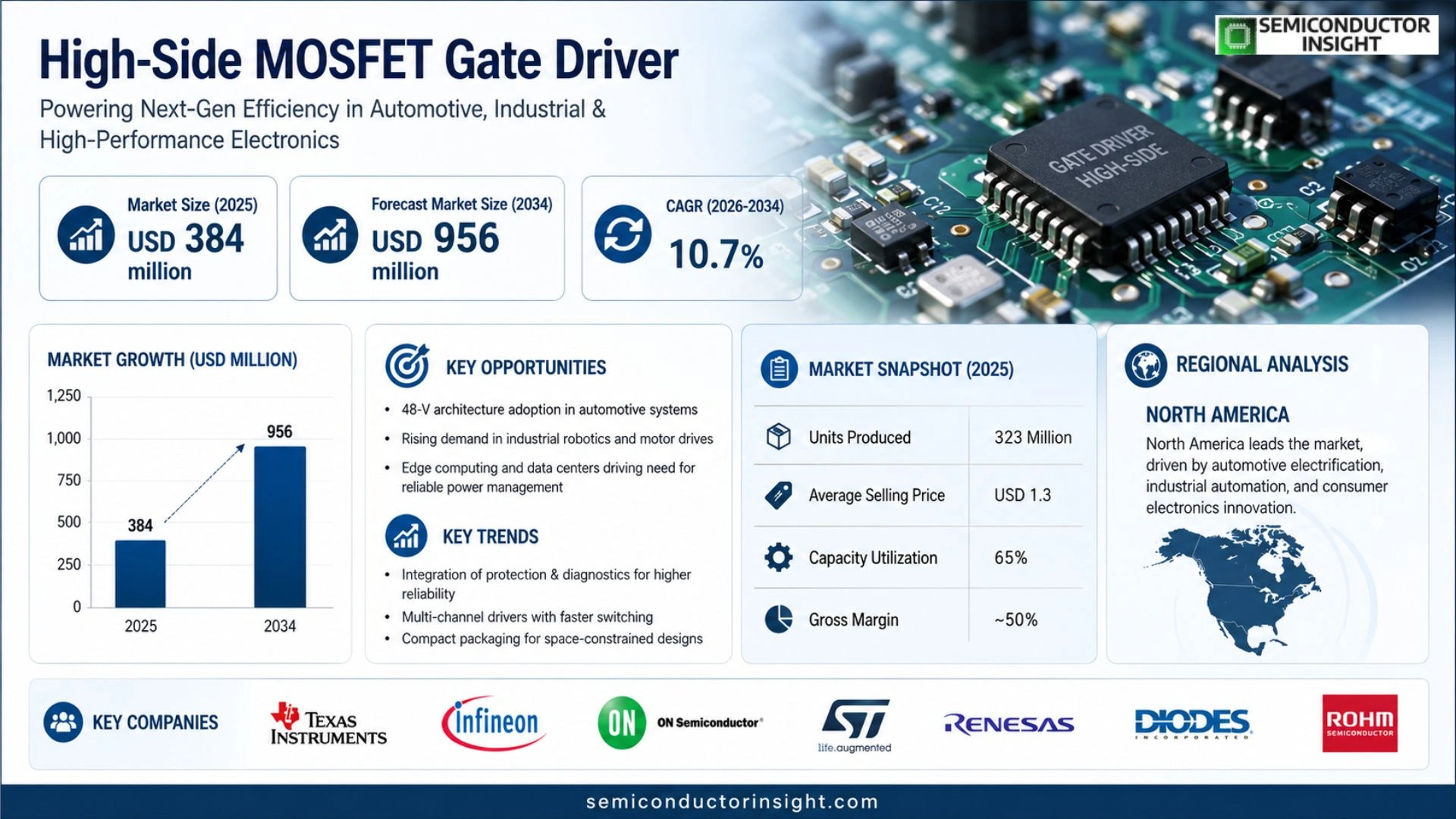
High‑Side MOSFET Gate Driver market was valued at USD 384 million in 2025 and is projected to reach USD 956 million by 2034, exhibiting a CAGR of approximately 10.7 % during the forecast period.
High‑Side MOSFET Gate Drivers are integrated circuits designed to drive high‑side power MOSFETs, converting control signals into stable gate‑drive waveforms while embedding protection and diagnostic functions that enable efficient switching and reliable operation in automotive and industrial power systems.
In 2025 production reached roughly 323 million units
MARKET DRIVERS
Rising Demand for Efficient Power Conversion
The shift toward electric‑propulsion, high‑density data‑center architectures, and renewable‑energy integration is forcing system designers to seek power stages that lose less energy as heat. High-Side MOSFET Gate Driver Market suppliers that can deliver sub‑nanosecond switching with low gate charge are being favored because they enable converters that meet the stringent efficiency targets set by OEMs and utility operators.
Advancements in Semiconductor Process Technologies
Silicon‑carbide (SiC) and gallium‑nitride (GaN) substrates are migrating from niche applications to mainstream power modules. The newer process nodes reduce on‑resistance and allow higher voltage ratings, which in turn lowers the stress placed on gate‑driver circuits. Companies that align their driver topologies with these wafers are securing design wins in automotive traction inverters and aerospace power supplies.
➤ Integration of SiC and GaN devices is shortening driver development cycles, encouraging faster time‑to‑market for end‑equipment.
Regulatory pressures, such as tighter emissions standards and global efficiency mandates, are amplifying the need for compact, high‑performance drivers. Manufacturers that combine robust protection features with programmable dead‑time are positioning themselves to capture a larger share of the evolving High-Side MOSFET Gate Driver Market.
MARKET CHALLENGES
Thermal Management Constraints
As switching frequencies climb to meet power‑density goals, the associated heat flux within driver ICs escalates. Designers must balance layout density against thermal resistance, often resorting to larger copper pours or exotic substrate materials that add cost. Failure to control junction temperature can degrade MOSFET reliability, prompting end‑users to demand more sophisticated on‑chip thermal sensors.
Other Challenges
Design Complexity
Modern automotive platforms require drivers that support multiple communication protocols, isolated feedback, and fail‑safe modes within a single footprint. The engineering effort to validate cross‑compatibility across different vehicle architectures inflates development budgets, discouraging smaller players from entering the market.
Supply‑chain volatility for rare‑earth materials used in magnetic isolation components further compounds risk. OEMs are tightening qualification cycles, meaning any delay in driver qualification can jeopardize whole vehicle program timelines.
MARKET RESTRAINTS
Cost Sensitivity in Tier‑1 Automotive Suppliers
Automotive Tier‑1s operate under razor‑thin margins, especially for mass‑produced electric‑drive modules. Even marginal price increases in gate‑driver ASICs can ripple through the bill‑of‑materials, prompting purchasers to prioritize volume‑discounted legacy parts over newer, higher‑performance solutions.
Additionally, the certification overhead for safety‑critical systems (ISO 26262) imposes extra engineering effort. Companies that cannot demonstrate functional safety compliance within the required timeframe may see their proposals sidelined.
Finally, the global push toward standardization of 48‑V architectures creates a temporary lull, as OEMs evaluate legacy 12‑V versus emerging high‑voltage platforms, delaying definitive driver selection.
MARKET OPPORTUNITIES
Emerging 48‑V Architecture in Automotive
The transition from traditional 12‑V to 48‑V systems in mild‑hybrid and fully electric vehicles opens a niche for drivers that can tolerate higher bus voltages while maintaining low gate‑drive loss. Early entrants that package SiC‑compatible gate drivers in automotive‑grade packages stand to lock in multi‑year supply contracts.
Beyond automotive, industrial robotics is embracing compact, high‑speed motor drives that require precise gate control. By aligning driver firmware with open‑source motion‑control stacks, vendors can tap into a growing ecosystem of system integrators seeking plug‑and‑play solutions.
Lastly, the rise of edge‑computing appliances calls for power supplies that can sustain high peak currents without compromising uptime. Offering drivers with built‑in fault‑logging and remote diagnostics creates a value‑added proposition for data‑center operators who prioritize predictive maintenance.
High-Side MOSFET Gate Driver Market Trends
Integration of Protection and Diagnostics Fuels Margin Realignment
The 2025 snapshot shows a market valuation of $384 million alongside production of roughly 323 million units at an average price of $1.3. With capacity utilization hovering near 65 % and gross margins around 50 %, suppliers are squeezing profitability through deeper system‑level integration. By embedding advanced over‑voltage, thermal‑shutdown and fault‑diagnostic blocks directly into the driver die, manufacturers reduce board‑level component count, lower electromagnetic interference, and shorten validation cycles. This functional consolidation translates into cost‑of‑ownership savings for automotive OEMs and industrial equipment makers, while allowing silicon vendors to protect pricing on commoditized gate‑driver cores.
Other Trends
Upstream Material Quality and Packaging Reliability
Silicon wafer suppliers such as Shanghai Silicon Industry Group and packaging specialists like Fastprint Circuit Tech have become decisive partners. Consistent wafer resistivity and low-defect densities improve breakdown voltage tolerance, a critical attribute when drivers operate at 20‑30 V and above. Meanwhile, substrate innovations that enhance thermal conduction mitigate hotspot formation, extending module lifetime in harsh automotive environments. The tighter coupling between material vendors and driver designers curtails yield losses, reinforcing the 65 % utilization figure observed in 2025.
Automotive Electrification Elevates Demand for High‑Side Gate Drivers
Electrified powertrains and onboard chargers increasingly rely on high‑side MOSFETs to manage battery‑to‑inverter transitions. Designers now prioritize faster rise‑time, tighter gate‑charge control, and robust noise rejection to meet efficiency targets demanded by regulators and consumers alike. This pressure reshapes product roadmaps: multi‑channel driver families that support synchronous switching are gaining favor over single‑channel variants, especially in platforms where space constraints drive a move toward integrated SOT‑23 and SC70 packages. Suppliers that can demonstrate platform‑level reuse,delivering a validated driver across multiple vehicle models,are more likely to secure long‑term design‑win agreements, cushioning them against price erosion in commoditized segments.
COMPETITIVE LANDSCAPE
Key Industry Players
High‑Side MOSFET Gate Driver Market – Competitive Overview
High‑Side MOSFET Gate‑driver arena is dominated by a handful of global silicon powerhouses whose product portfolios blend high‑voltage robustness with integrated protection circuitry. Infineon, Texas Instruments and STMicroelectronics together command a sizable share of automotive and industrial design wins, leveraging deep R&D pipelines to embed charge‑pump schemes and diagnostic modules that reduce board‑level component count. Their manufacturing footprint, anchored in mature fabs across Europe and Asia, enables capacity utilization that hovers around the mid‑sixties percent, a sweet spot that sustains healthy gross margins despite price pressure from commoditized single‑channel parts. ON Semiconductor and Renesas round out the core tier, each offering niche variants that target specific voltage windows,below 20 V for compact automotive subsystems and 20‑30 V for medium‑power industrial converters. The strategic emphasis among these leaders is on platform‑level reuse, allowing a single driver architecture to be qualified across multiple vehicle platforms, thereby shortening development cycles and protecting profitability.
Beyond the top tier, a constellation of mid‑size and specialist firms adds depth to the competitive set. ROHM and Diodes Incorporated have built reputations for noise‑immune designs that appeal to OEMs seeking higher electromagnetic compatibility in densely packed power modules. Fuji Electric, Microchip Technology and Toshiba focus on multi‑channel solutions that address the growing demand for parallel‑phase motor drives in electric‑vehicle applications. Asian players such as NXP Semiconductors, Analog Devices, and Skyworks Solutions are expanding their analog front‑end expertise to capture cross‑over opportunities in renewable‑energy inverters. Meanwhile, smaller innovators,IXYS (now under Littelfuse), Silicon Labs, Power Integrations and several China‑based suppliers,offer cost‑effective single‑channel parts that satisfy volume‑driven industrial equipment makers, reinforcing a tiered market where price‑sensitive segments coexist with high‑margin, feature‑rich offerings.
List of Key High‑Side MOSFET Gate Driver Companies Profiled
- Infineon, Texas Instruments, STMicroelectronics, ON Semiconductor, Renesas, ROHM, Diodes Incorporated, Fuji Electric, Microchip Technology, Toshiba, NXP Semiconductors, Analog Devices, Skyworks Solutions, IXYS (Littelfuse), Silicon Labs, Power Integrations
- Infineon, Texas Instruments, STMicroelectronics, ON Semiconductor
- Renesas, ROHM, Diodes Incorporated, Fuji Electric, Microchip Technology, Toshiba, NXP Semiconductors, Analog Devices, Skyworks Solutions, IXYS, Silicon Labs, Power Integrations
Segment Analysis:
| Segment Category | Sub-Segments | Key Insights |
| By Type |
|
Multi Channel
|
| By Application |
|
Automotive Powertrains
|
| By End User |
|
Automotive OEMs
|
| By Voltage |
|
20‑30V
|
| By Package |
|
SOT‑23
|
Regional Analysis: High-Side MOSFET Gate Driver Market
North America
Vehicle manufacturers are integrating high‑side MOSFET gate drivers into traction‑inverter modules to achieve tighter control of voltage spikes and reduce switching losses. This focus on efficiency enables longer electric‑vehicle range while meeting tightening fleet‑wide emission targets, prompting designers to favor drivers with built‑in desaturation detection and robust thermal management.
Factories upgrading to Industry 4.0 platforms are standardising on modular drive systems that require precise high‑side switching for synchronous motor control. The push for predictive maintenance elevates the importance of drivers offering real‑time fault reporting, which in turn influences supplier roadmaps toward more integrated diagnostic features.
Grid‑tied inverter manufacturers for solar and wind installations are selecting high‑side drivers that can tolerate wide input voltage bands while delivering low‑noise switching. The need to align with grid stability standards drives a preference for drivers that incorporate soft‑start and shoot‑through protection without sacrificing efficiency.
Early adopters of SiC power devices are pairing them with high‑side drivers engineered for ultra‑fast transition times. This pairing unlocks higher switching frequencies in compact power converters, a benefit that resonates with aerospace and defense designers seeking weight‑critical solutions.
Europe
European automotive manufacturers are advancing aggressive CO₂ reduction programs, prompting a shift toward high‑efficiency power modules that depend on sophisticated high‑side gate drivers. Concurrently, the EU’s focus on energy‑intensive industrial clusters encourages the adoption of drivers capable of seamless integration with smart‑grid interfaces. The region’s strong standards framework pushes suppliers to embed compliance features such as over‑current protection and EMI mitigation directly into driver silicon, fostering a market that values reliability as much as performance.
Asia‑Pacific
Rapid growth in consumer electronics and a burgeoning electric‑vehicle production base give the Asia‑Pacific a distinctive demand profile for high‑side MOSFET gate drivers. Manufacturers in China, Japan, and South Korea are scaling production lines that prioritize cost‑effective yet high‑reliability drivers to satisfy volume‑driven markets. At the same time, regional governments are launching incentives for renewable‑energy installations, extending driver requirements into solar‑inverter and offshore‑wind domains where thermal robustness is a key differentiator.
South America
In South America, rising investments in renewable‑energy projects, particularly in Brazil’s hydro‑electric and wind sectors, are creating niche demand for gate drivers that can operate under variable temperature and humidity conditions. Automotive assemblers in the region are also beginning to import electric‑vehicle platforms, which necessitates locally‑sourced high‑side drivers that meet both performance and regulatory expectations without inflating overall system cost.
Middle East & Africa
The Middle East’s aggressive diversification away from hydrocarbon‑centric economies is fueling interest in solar‑power generation, a sector that increasingly relies on high‑side MOSFET gate drivers for inverter efficiency. In Africa, emerging industrial parks are adopting modular drive solutions that require drivers with strong fault‑tolerance to cope with inconsistent grid quality. These dynamics encourage vendors to tailor driver portfolios with enhanced protection schemes and broad operating‑temperature ranges to accommodate the region’s varied infrastructure maturity.
Report Scope
This market research report provides a comprehensive analysis of the High-Side MOSFET Gate Driver Market , covering the forecast period 2026–2034. It offers detailed insights into market dynamics, technological advancements, competitive landscape, and key trends shaping the industry.
Key focus areas of the report include:
- Market Overview: The report begins with an overview outlining its current market scenario, key growth indicators, and industry transformation drivers. It discusses macroeconomic factors, demand–supply balance, regulatory landscape, and the strategic role of semiconductors in powering advancements across industries such as automotive, telecommunications, consumer electronics, and industrial automation.
- Market Size & Forecast: Historical data and future projections for revenue, unit shipments, and market value across major regions and segments.
- Segmentation Analysis: Detailed breakdown by product type, technology, application, and end-user industry to identify high-growth segments and investment opportunities.
- Regional Insights: Insights into market performance across North America, Europe, Asia-Pacific, Latin America, and the Middle East & Africa, including country-level analysis where relevant.
- Competitive Landscape: Profiles of leading market participants, including their product offerings, R&D focus, manufacturing capacity, pricing strategies, and recent developments such as mergers, acquisitions, and partnerships.
- Technology Trends & Innovation: Assessment of emerging technologies, integration of AI/IoT, semiconductor design trends, fabrication techniques, and evolving industry standards.
- Market Drivers & Restraints: Evaluation of factors driving market growth along with challenges, supply chain constraints, regulatory issues, and market-entry barriers.
- Stakeholder Insights: Insights for component suppliers, OEMs, system integrators, investors, and policymakers regarding the evolving ecosystem and strategic opportunities.
Primary and secondary research methods are employed, including interviews with industry experts, data from verified sources, and real-time market intelligence to ensure the accuracy and reliability of the insights presented.
FREQUENTLY ASKED QUESTIONS:
What is the current market size of High-Side MOSFET Gate Driver Market?
-> High‑Side MOSFET Gate Driver market is projected to reach USD 956 million by 2034, exhibiting a CAGR of approximately 10.7 %
Which key companies operate in High-Side MOSFET Gate Driver Market?
-> Key players include STMicroelectronics, Infineon, Diodes Incorporated, ROHM, Renesas, Fuji Electric, Texas Instruments, Microchip, onsemi, and Toshiba, among others.
What are the key growth drivers?
-> Key growth drivers include accelerating electrification in automotive and industrial sectors, demand for higher efficiency and tighter switching control, and the need for integrated protection and diagnostic features to improve reliability and reduce system costs.
Which region dominates the market?
-> Asia-Pacific leads the market due to strong automotive OEM presence (e.g., BYD, SAIC Motor) and rapid industrial automation adoption, while Europe remains a significant secondary market.
What are the emerging trends?
-> Emerging trends include greater integration of protection and diagnostic functions, platform‑level design reuse across multiple applications, and enhanced noise immunity to support next‑generation power‑electronic architectures.
Get Sample Report PDF for Exclusive Insights
Report Sample Includes
- Table of Contents
- List of Tables & Figures
- Charts, Research Methodology, and more...
 Download Sample Report PDF