Silicon Carbide Boule Market Insights
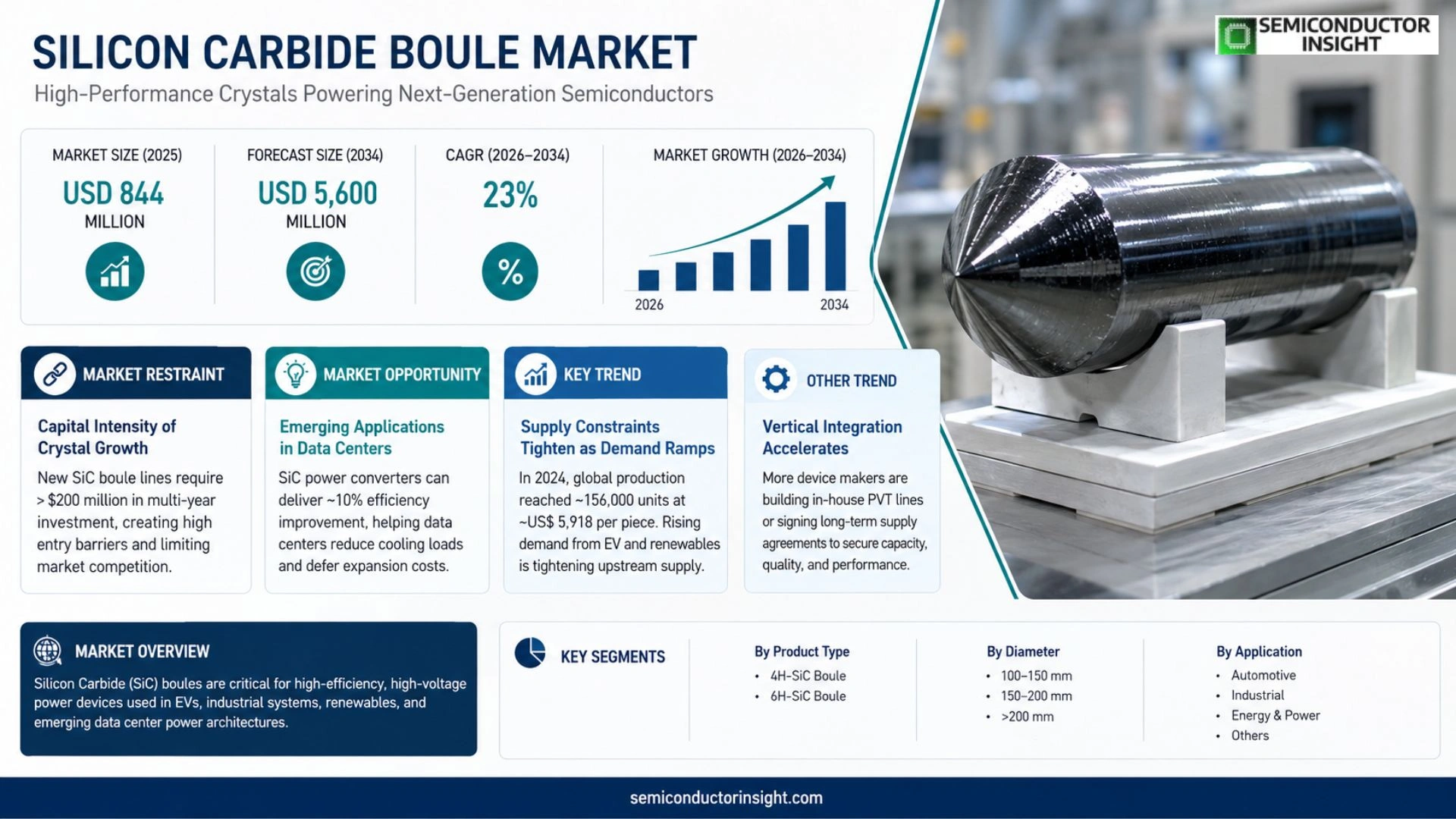
Global Silicon Carbide Boule market measured USD 844 million in 2025; applying the observed expansion trend yields an estimated valuation of roughly USD 5,600 million by 2034, corresponding to an approximate compound annual growth rate of 23 percent.
A silicon carbide boule is a cylindrical single‑crystal ingot produced by high‑temperature physical vapor transport on a seed crystal; typical polytypes such as 4H‑SiC and 6H‑SiC are doped either conductively or semi‑insulating, then oriented, ground, sliced into wafers and polished into substrates used for power‑electronics and RF devices.
The upward trajectory reflects accelerating electrification initiatives,automotive traction systems, renewable‑energy converters and data‑center power modules all demand higher efficiency and high‑temperature reliability,while supply constraints arise from long growth cycles and narrow process windows; consequently manufacturers are increasing vertical integration or securing multi‑supplier agreements to assure uniformity, traceability and steady delivery.
MARKET DRIVERS
Rising Demand for High‑Power Electronics
The acceleration of electric‑vehicle adoption and the shift toward renewable‑energy converters have heightened the need for devices that can tolerate higher voltages and temperatures. Silicon Carbide Boule Market players are benefitting from OEM specifications that now favour SiC substrates for their superior efficiency, which translates into lower system‑level cooling costs and extended device lifespans.
Cost Reductions via Process Innovation
Advances in vapor‑phase crystal growth and automated wafer handling have trimmed material waste, pushing yields toward double‑digit improvements. Manufacturers that have integrated real‑time defect detection are seeing per‑boule costs fall by up to 15 %, creating a price‑competitive environment for downstream assemblers.
➤ “Yield gains are the most tangible lever for margin expansion in this segment,”
These dynamics collectively incentivize capital infusion into larger‑diameter furnaces, setting the stage for a broader supply base that can support next‑generation power modules.
MARKET CHALLENGES
Supply‑Chain Constraints
Despite steady demand, the limited number of high‑temperature crystal growers constrains availability. Raw‑material sourcing for high‑purity silicon and carbon compounds remains fragmented, leading to longer lead times and price volatility for end‑users.
Other Challenges
Technical Yield Variability
Yield fluctuations across furnace batches create forecasting uncertainty for OEMs, prompting many to maintain safety inventories that inflate overall system costs.
MARKET RESTRAINTS
Capital Intensity of Crystal Growth
Building and certifying a new SiC boule line demands multi‑year capital commitments exceeding $200 million. The long amortization horizon deters smaller players from entry, consolidating market power among a handful of incumbents and limiting price elasticity.
MARKET OPPORTUNITIES
Emerging Applications in Data Centers
Data‑center operators are experimenting with SiC‑based power converters to reduce cooling footprints and improve PUE (Power Usage Effectiveness). Early pilot projects indicate that a 10 % efficiency uplift can defer facility expansion costs, signaling a niche yet high‑value avenue for suppliers to capture additional revenue.
Silicon Carbide Boule Market Trends
Supply Constraints Tighten as Demand Ramps
In 2024 the global production of Silicon Carbide Boule reached roughly 156 000 units, with an average transaction price close to US$ 5,918 per piece. The modest production base, combined with a profit margin spectrum of 20 %‑40 %, reflects the technical intricacy of physical vapor transport growth. As automotive manufacturers and renewable‑energy converters move from prototype validation to volume manufacturing, they impose stricter benchmarks on crystal uniformity, traceability, and on‑time delivery. The long growth cycles and narrow thermal windows inherent to the process mean that any surge in downstream orders translates quickly into tighter upstream supply conditions, pressuring manufacturers to secure raw‑material purity and maintain stable furnace availability.
Other Trends
Vertical Integration Accelerates
Power‑device specialists are increasingly internalizing crystal growth rather than relying solely on external suppliers. Some firms adopt a build‑or‑buy model, establishing dedicated PVT lines to lock in capacity and safeguard proprietary doping profiles. Others negotiate multi‑year, multi‑source agreements that blend long‑term volume reservations with performance guarantees. This shift reduces qualification risk for downstream fabs and creates a feedback loop where growers gain direct insight into device‑level defect tolerances, prompting refinements in feedstock particle‑size control and thermal‑field engineering.
Yield Optimization Becomes Competitive Edge
The economic viability of each boule hinges on defect density and impurity incorporation, which cascade into wafer yield and reliability figures for power and RF modules. Manufacturers that can consistently deliver low‑defect, electrically stable crystals command premium pricing and enjoy higher gross margins. Investment patterns reveal a focus on advanced metrology, real‑time defect mapping, and high‑purity SiC powder production. Companies that align these capabilities with scalable slicing and polishing lines are better positioned to capture the share of a market energized by high‑efficiency traction inverters, grid‑level converters, and data‑center power modules.
COMPETITIVE LANDSCAPE
Key Industry Players
Silicon Carbide Boule Market – Competitive Landscape Overview
Wolfspeed, the former Cree Business Unit, remains the benchmark for size‑scale and wafer quality in the silicon‑carbide boule arena. Its vertically integrated model,covering high‑purity SiC powder synthesis, PVT crystal growth, and downstream wafer processing,enables tight control of defect density and consistent electrical characteristics, which translates into higher device yields for automotive and power‑electronics customers. The company’s capacity expansion programmes, backed by sizable capital investment, have pushed its annual output well above 30 % of the global supply, positioning it as the de‑facto reference supplier for premium 4H‑SiC substrates. Market structure therefore clusters around a handful of large, technology‑intensive firms that can absorb the long‑lead‑time and high‑cost nature of crystal growth, while smaller outfits compete on niche polytype mixes or cost‑focused product lines.
Beyond the dominant tier, a dense set of Asian manufacturers has carved out defensible positions by targeting specific segments such as 6‑inch wafers, semi‑insulating substrates, or low‑defect, high‑doping‑uniform boules. Companies like SiCrystal, SK Siltron and Resonac leverage regional supply‑chain advantages and government‑backed funding to scale capacity quickly, albeit with greater variability in yield. Others, including TankeBlue, Ningbo Alpha Semiconductor, and Sanan Semiconductor, pursue strategic partnerships with downstream device makers to secure long‑term purchase agreements, thereby mitigating the inherent volatility of PVT production cycles. This diversification of business models,ranging from pure‑play crystal growers to vertically integrated semiconductor groups,creates a competitive environment where technical differentiation, reliability of delivery, and flexibility of pricing are decisive factors for customer selection.
List of Key Silicon Carbide Boule Companies Profiled
- Wolfspeed
- onsemi
- STMicroelectronics
- SiCrystal
- SK Siltron
- Resonac
- TankeBlue
- Ningbo Alpha Semiconductor
- Zhejiang Tony Electronic
- Hebei Synlight Semiconductor
- Shanxi Semisic Crystal
- IVSemitec
- Sanan Semiconductor
- Zhejiang CrystalYond Semiconductor
- Hypersics
Segment Analysis:
| Segment Category | Sub-Segments | Key Insights |
| By Type |
|
N‑Type
|
| By Application |
|
6‑Inch Wafer
|
| By End User |
|
Automotive Electrification
|
| By Conductivity |
|
Conductive Type
|
| By Polytype Classification |
|
4H‑SiC
|
Regional Analysis: Silicon Carbide Boule Market
Foundries across Taiwan, South Korea, and Mainland China have scaled furnace capacities, leveraging high‑purity silicon sources to meet rising demand for power modules. Their ability to integrate vertical steps,from crystal growth to wafer polishing,creates a competitive edge that attracts Tier‑1 device makers seeking reliable supply.
Joint ventures between university labs and semiconductor firms accelerate defect‑reduction techniques, pushing wafer yields upward. Collaborative patents in substrate engineering underline a strategic shift toward proprietary processes that differentiate product performance.
Regional logistics networks, bolstered by dedicated container lanes, mitigate disruptions that have plagued other semiconductor inputs. Close coordination with raw‑material miners ensures a steadier flow of high‑grade silicon carbide powders, a critical input for boule growth.
Automakers expanding electric‑vehicle line‑ups and data‑center operators upgrading power‑conversion hardware are driving a surge in orders for high‑efficiency SiC devices, reinforcing the region’s upstream demand.
North America
North America retains a strong position in Silicon Carbide Boule Market through its concentration of design‑intensive firms and a mature automotive sector that adopts advanced power solutions early. While domestic crystal growth capacity lags behind Asia‑Pacific, strategic partnerships with overseas manufacturers enable U.S. device companies to secure premium-quality boules. Policy frameworks encouraging energy efficiency amplify interest in SiC‑based converters, prompting tier‑1 OEMs to embed these components in next‑generation platforms. The region’s emphasis on intellectual property protection also encourages investment in proprietary process enhancements, which could gradually shift more of the value chain stateside.
Europe
European stakeholders approach Silicon Carbide Boule Market from a sustainability‑driven perspective, integrating SiC technologies into renewable energy grids and high‑speed rail systems. Countries such as Germany and France are channeling public‑private funds toward research consortia that explore defect‑free crystal growth. Although local production remains modest, the continent’s stringent quality standards push suppliers toward higher reliability, influencing global pricing dynamics. Moreover, regulatory pressure to reduce carbon footprints in transportation accelerates automotive manufacturers’ transition to SiC power modules, creating a steady pipeline of demand for premium boules.
South America
South America’s involvement in Silicon Carbide Boule Market is emerging, driven primarily by expanding renewable‑energy projects in Brazil and Chile. The region’s growing appetite for efficient inverters and grid‑level converters positions it as a prospective consumer of SiC devices. Local investors are beginning to fund pilot fab facilities that require imported boules, which in turn stimulates ancillary services such as logistics and testing. While the supply base is still nascent, the strategic focus on clean‑energy infrastructure suggests a gradual increase in procurement activity over the next decade.
Middle East & Africa
The Middle East & Africa landscape for Silicon Carbide Boule Market activity centers on large‑scale solar installations and oil‑field power optimization projects. Nations like the United Arab Emirates and Saudi Arabia are allocating capital toward demonstration plants that trial SiC‑based converters, seeking to improve plant‑level efficiency. Though indigenous crystal growers are absent, the region’s high purchasing power and appetite for cutting‑edge power solutions attract global suppliers eager to showcase performance benchmarks. As these demonstration projects mature, they are likely to evolve into repeat orders, laying groundwork for a more sustained market presence.
Report Scope
This market research report provides a comprehensive analysis of the Silicon Carbide Boule Market , covering the forecast period 2026–2034. It offers detailed insights into market dynamics, technological advancements, competitive landscape, and key trends shaping the industry.
Key focus areas of the report include:
- Market Overview: The report begins with an overview outlining its current market scenario, key growth indicators, and industry transformation drivers. It discusses macroeconomic factors, demand–supply balance, regulatory landscape, and the strategic role of semiconductors in powering advancements across industries such as automotive, telecommunications, consumer electronics, and industrial automation.
- Market Size & Forecast: Historical data and future projections for revenue, unit shipments, and market value across major regions and segments.
- Segmentation Analysis: Detailed breakdown by product type, technology, application, and end-user industry to identify high-growth segments and investment opportunities.
- Regional Insights: Insights into market performance across North America, Europe, Asia-Pacific, Latin America, and the Middle East & Africa, including country-level analysis where relevant.
- Competitive Landscape: Profiles of leading market participants, including their product offerings, R&D focus, manufacturing capacity, pricing strategies, and recent developments such as mergers, acquisitions, and partnerships.
- Technology Trends & Innovation: Assessment of emerging technologies, integration of AI/IoT, semiconductor design trends, fabrication techniques, and evolving industry standards.
- Market Drivers & Restraints: Evaluation of factors driving market growth along with challenges, supply chain constraints, regulatory issues, and market-entry barriers.
- Stakeholder Insights: Insights for component suppliers, OEMs, system integrators, investors, and policymakers regarding the evolving ecosystem and strategic opportunities.
Primary and secondary research methods are employed, including interviews with industry experts, data from verified sources, and real-time market intelligence to ensure the accuracy and reliability of the insights presented.
FREQUENTLY ASKED QUESTIONS:
What is the current market size of Silicon Carbide Boule Market?
-> Silicon Carbide Boule market estimated valuation of roughly USD 5,600 million by 2034 growing at a CAGR of 23.3% during the forecast period.
Which key companies operate in Silicon Carbide Boule Market?
-> Key players include Wolfspeed, Coherent, SiCrystal, SK Siltron, Resonac, STMicroelectronics, onsemi, TankeBlue, SICC, Ningbo Alpha Semiconductor, Zhejiang Tony Electronic, Hebei Synlight Semiconductor, Shanxi Semisic Crystal, IVSemitec, Sanan Semiconductor, Zhejiang CrystalYond Semiconductor, Hypersics, GeChi Compound Semiconductor, Atecom Technology, KY Semiconductor, among others.
What are the key growth drivers?
-> Key growth drivers include electrification of automotive, energy‑infrastructure upgrades, renewable energy integration, industrial drives, data‑center power needs, and the requirement for low‑defect, high‑performance SiC boules.
Which region dominates the market?
-> Asia is the largest market region, driven by strong manufacturing presence in China, Japan and South Korea, while Europe and North America also hold significant shares.
What are the emerging trends?
-> Emerging trends include deeper vertical integration, long‑term multi‑supplier partnerships, build‑or‑buy crystal growth strategies, increased investment in defect‑mapping and metrology, and focus on scalable high‑yield manufacturing.
Get Sample Report PDF for Exclusive Insights
Report Sample Includes
- Table of Contents
- List of Tables & Figures
- Charts, Research Methodology, and more...
 Download Sample Report PDF