Universal Asynchronous Receiver-Transmitter (UART) ICs Market Insights
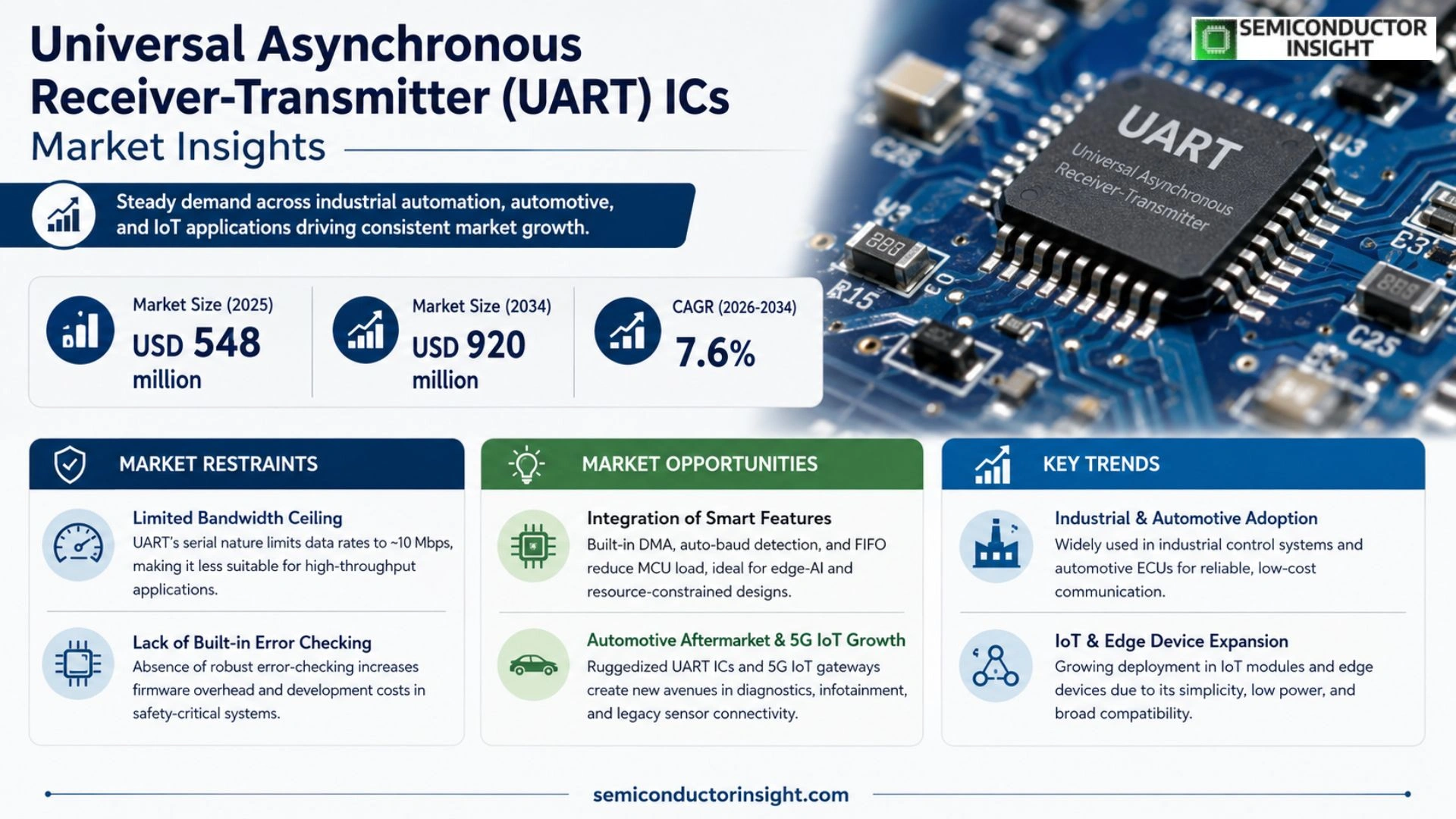
Global Universal Asynchronous Receiver-Transmitter (UART) ICs market is projected to grow from USD 548 million in 2025 to USD 920 million by 2034, exhibiting a CAGR of 7.6% during the forecast period.
Universal Asynchronous Receiver-Transmitter (UART) ICs are integrated circuits that provide asynchronous serial communication by converting parallel data streams into serial form and vice‑versa. A typical UART includes receive and transmit control logic, shift registers, a baud‑rate generator and FIFO buffers that frame data into start, payload, optional parity and stop bits without requiring a shared clock signal. These devices are packaged in standard formats such as DIP, SOIC and QFN and feature dedicated TX and RX pins for direct connection to host controllers. Proper implementation must address sampling timing, buffering depth, error detection and support a wide range of baud rates. UART ICs remain essential across embedded systems, industrial automation, automotive electronics, consumer devices and communications equipment because they deliver low‑cost, reliable serial links while allowing designers to isolate or extend ports when discrete solutions are preferred over on‑chip peripherals.
MARKET DRIVERS
Widespread Adoption in Embedded Systems
Universal Asynchronous Receiver-Transmitter (UART) ICs Market has been propelled by the surge in embedded‑device deployments across automotive, industrial automation, and consumer electronics. In 2023, global shipments of UART chips surpassed 1.2 billion units, reflecting an 8 % year‑over‑year increase driven largely by cost‑sensitive microcontroller designs that still rely on serial communication for sensor integration.
Shift Toward Low‑Power Connectivity
Manufacturers are increasingly prioritizing power‑efficiency, and modern UART IP blocks now feature sleep‑mode architectures that trim standby consumption to microamp levels. This evolution allows battery‑operated wearables and IoT gateways to extend operational life without sacrificing the simplicity UART offers for firmware updates and diagnostic logging.
➤ Design engineers value UART for its minimal pin count, enabling tighter board layouts and lower BOM costs.
Consequently, component distributors report a steady rise in demand for 2.54 mm pitch packages that fit legacy footprints while offering enhanced electro‑magnetic immunity. The combined effect of price pressure and power‑saving features cements UART’s role as the de‑facto serial interface in cost‑critical products.
MARKET CHALLENGES
Compatibility Constraints with Emerging Protocols
While UART remains entrenched, the emergence of high‑speed alternatives such as USB‑PD and Ethernet‑based diagnostics creates a compatibility dilemma for designers. Legacy equipment often cannot be retrofitted with newer interfaces without significant redesign, prompting hesitancy among OEMs to commit to new product cycles that would marginalize existing UART‑based platforms.
Other Challenges
Supply‑Chain Volatility
The semiconductor supply chain continues to experience fluctuations in fab capacity, leading to occasional lead‑time extensions for standard‑speed UART devices. Smaller fabless firms, which dominate the UART niche, are particularly exposed to wafer‑lot reallocation when demand spikes in adjacent analog markets.
MARKET RESTRAINTS
Limited Bandwidth Ceiling
UART’s inherent serial nature caps practical data rates at around 10 Mbps for most low‑cost implementations. Applications requiring high‑throughput streaming, such as autonomous‑vehicle sensor fusion, consequently bypass UART for faster serial standards, limiting market expansion in these high‑value segments.
Furthermore, the lack of built‑in error‑checking mechanisms compared with protocols like CAN or SPI necessitates additional firmware overhead, raising development costs for safety‑critical systems where data integrity is non‑negotiable.
These technical ceilings, combined with the growing expectation for multimodal connectivity, restrain the ability of Universal Asynchronous Receiver-Transmitter (UART) ICs Market to capture share from newer, higher‑speed interfaces.
MARKET OPPORTUNITIES
Integration of Smart Features
Vendors are embedding configurable UART controllers with built‑in DMA, auto‑baud detection, and programmable FIFO depths. These smart features reduce MCU CPU load, making UART attractive for edge‑AI modules where processing resources are at a premium.
Another promising avenue lies in the automotive aftermarket, where after‑market infotainment upgrades rely on UART for diagnostic back‑channel communication. Targeted marketing of ruggedized UART packages that meet automotive AEC‑Q100 standards could unlock a multi‑billion‑dollar segment.
Finally, the ongoing rollout of 5G‑enabled IoT gateways presents a niche for UART devices that act as low‑latency bridges between legacy sensors and high‑speed cellular modems. By positioning UART as the secure, low‑cost entry point into 5G ecosystems, manufacturers can sustain relevance even as data‑rate expectations evolve.
Universal Asynchronous Receiver-Transmitter (UART) ICs Market Trends
Industrial Automation and Automotive Reliance on UART Interfaces
Universal Asynchronous Receiver-Transmitter (UART) ICs Market is witnessing heightened demand from industrial control systems and automotive electronics. Manufacturers of factory‑floor equipment increasingly embed UART ports to link sensors, PLCs, and motor drives because the protocol offers deterministic timing without the need for a shared clock. In automotive body‑control modules and diagnostic gateways, UART provides a lightweight conduit for firmware updates and fault‑code extraction, reducing software complexity while meeting stringent functional‑safety standards. The rise of modular vehicle architectures, where multiple electronic control units must exchange configuration data, further cements UART’s role as the preferred low‑cost, low‑latency bridge. Consequently, suppliers are expanding multi‑port families that retain the classic asynchronous frame but add isolated transceivers to satisfy automotive isolation requirements.
Other Trends
Low‑Power and Multi‑Channel Enhancements
Within Universal Asynchronous Receiver-Transmitter (UART) ICs Market, a parallel trend emphasizes power‑aware designs and channel aggregation. Emerging device classes embed deep‑sleep modes and sub‑microamp current draws, enabling battery‑operated edge nodes to maintain serial connectivity without compromising runtime. At the same time, manufacturers introduce dual‑ and quad‑UART solutions that share a single baud‑rate generator while offering independent FIFO buffers. This architecture reduces board‑level component count and simplifies routing in compact IoT modules. The combined effect is a broader appeal to designers of wearables, remote sensors, and smart‑grid interfaces, where space constraints and energy budgets dominate component selection.
Supply‑Chain Resilience and Component Longevity
Supply‑chain considerations are reshaping Universal Asynchronous Receiver-Transmitter (UART) ICs Market as OEMs prioritize parts with proven, stable manufacturing processes. Because UART chips rely on mature CMOS and BiCMOS fabs, foundries can deliver consistent yields at predictable costs, a factor that becomes decisive amid fluctuating raw‑material prices. Leading vendors such as NXP Semiconductors and Texas Instruments have publicly committed to extended production life cycles for key UART families, reinforcing confidence among automotive Tier‑1s and industrial equipment makers who require long‑term availability for safety‑critical products. This focus on longevity also encourages the integration of enhanced electromagnetic‑compatibility features, ensuring that legacy deployments continue to meet evolving regulatory environments without necessitating a full redesign.
COMPETITIVE LANDSCAPE
Key Industry Players
Competitive dynamics shaping UART IC market in 2024‑2025
UART IC sector remains anchored by a handful of established silicon vendors whose broad product portfolios and long‑term support contracts create a de‑facto hierarchy. NXP Semiconductors, Texas Instruments, Renesas Electronics, Microchip Technology and Analog Devices dominate revenue share by leveraging deep automotive and industrial relationships, extensive mixed‑signal design libraries, and the ability to ship high‑volume families ranging from single‑port UARTs to multi‑channel, FIFO‑enabled variants. Their scale enables aggressive pricing for volume customers while preserving engineering resources for safety‑critical certifications, a factor that fosters customer lock‑in in sectors such as automotive body‑control modules and factory‑floor controllers. The market structure therefore exhibits a classic “core‑plus‑specialist” pattern: the core manufacturers address the bulk of demand across standard packages (DIP, SOIC, QFN) and maintain robust supply chains, whereas a secondary tier of firms concentrates on niche functionality, isolation, or low‑power enhancements.
Beyond the core, several niche players have carved out profitable slices by targeting specialized use‑cases. Diodes Incorporated and FTDI (Future Technology Devices International) focus on isolated UART solutions and USB‑to‑UART bridge chips that simplify board‑level design for medical and test‑equipment manufacturers. Silicon Labs and Maxim Integrated (now part of Analog Devices) differentiate with ultra‑low‑power UARTs optimized for battery‑operated IoT nodes, while ROHM Semiconductor and Prolific Technology deliver cost‑effective multi‑port families that cater to legacy equipment upgrades. These firms sustain relevance through rapid part‑number refresh cycles, targeted software drivers, and aggressive application‑specific marketing, which together mitigate the substitution pressure from highly integrated MCU‑based UARTs. Their agility also allows them to respond to emerging standards for electromagnetic compatibility and secure boot, reinforcing their appeal to original equipment manufacturers that prioritize long‑term serviceability.
List of Key UART ICs Companies Profiled
- NXP Semiconductors
- Texas Instruments
- Renesas Electronics
- Microchip Technology
- Analog Devices, Inc.
- Diodes Incorporated
- FTDI (Future Technology Devices International)
- Silicon Labs
- STMicroelectronics
- Infineon Technologies AG
- ROHM Semiconductor
- Prolific Technology Inc.
- ON Semiconductor
- Broadcom Inc.
- Vishay Intertechnology
Segment Analysis:
| Segment Category | Sub-Segments | Key Insights |
| By Type |
|
UART
|
| By Application |
|
Industrial Automation
|
| By End User |
|
Industrial equipment manufacturers
|
| By Functional Capability |
|
UART with FIFO
|
| By Package |
|
QFN
|
Regional Analysis: Universal Asynchronous Receiver-Transmitter (UART) ICs Market
North America
Engineering teams in the United States and Canada are embedding programmable baud‑rate generators and auto‑flow control within UART cores, reducing board‑level component counts. This trend reflects a strategic shift toward modular silicon that can be re‑configured post‑silicon, shortening time‑to‑market for niche applications.
Recent disruptions have prompted North American fabs to diversify wafer‑fab partners and to increase on‑shoring of critical passive components that complement UART ICs. The resulting buffer improves lead‑time predictability for OEMs reliant on tight integration schedules.
Compliance frameworks such as IEC 60730 for safety‑critical equipment reinforce the need for UART modules with built‑in fault detection. Manufacturers that proactively certify their devices gain a competitive edge in regulated sectors like medical devices and aerospace.
Industrial end‑users are favoring UART solutions that support extended temperature ranges and low‑EMI designs, enabling deployment in harsh environments without sacrificing data integrity. This preference nudges vendors toward ruggedized product lines.
Europe
European semiconductor clusters, especially in Germany and the United Kingdom, emphasize high‑precision UART implementations for railway signalling and energy‑grid monitoring. The regional push for interoperability standards leads to UART IP that can seamlessly interface with legacy field‑bus protocols, a requirement entrenched in long‑lived infrastructure projects. Moreover, sustainability initiatives encourage designs that minimize power draw, prompting suppliers to refine clock‑gating techniques within their UART blocks.
Asia-Pacific
In Asia‑Pacific, the confluence of rapid adoption of IoT gateways and mass‑market consumer electronics fuels demand for cost‑effective UART solutions. Manufacturers in China, Taiwan, and South Korea leverage economies of scale to offer integrated UART‑SPI combo chips, appealing to OEMs seeking to consolidate footprints. The region’s aggressive product‑development cycles also stimulate early‑stage collaborations between fabless firms and foundries to embed security‑oriented UART features, a response to heightened cybersecurity scrutiny.
South America
South American markets, led by Brazil, are witnessing a gradual transition from legacy serial interfaces to modern UART‑centric designs, especially in agritech equipment and renewable‑energy converters. Local players prioritize robust UART modules that can tolerate voltage fluctuations common in remote installations, thereby enhancing reliability in field deployments where maintenance windows are limited.
Middle East & Africa
The Middle East & Africa region displays a growing appetite for UART ICs within defense communications and oil‑field telemetry. Strategic partnerships between regional system integrators and global silicon vendors facilitate technology transfer, allowing localized adaptation of UART cores to meet stringent security protocols and rugged operational criteria.
Report Scope
This market research report provides a comprehensive analysis of the Universal Asynchronous Receiver-Transmitter (UART) ICs Market , covering the forecast period 2026–2034. It offers detailed insights into market dynamics, technological advancements, competitive landscape, and key trends shaping the industry.
Key focus areas of the report include:
- Market Overview: The report begins with an overview outlining its current market scenario, key growth indicators, and industry transformation drivers. It discusses macroeconomic factors, demand–supply balance, regulatory landscape, and the strategic role of semiconductors in powering advancements across industries such as automotive, telecommunications, consumer electronics, and industrial automation.
- Market Size & Forecast: Historical data and future projections for revenue, unit shipments, and market value across major regions and segments.
- Segmentation Analysis: Detailed breakdown by product type, technology, application, and end-user industry to identify high-growth segments and investment opportunities.
- Regional Insights: Insights into market performance across North America, Europe, Asia-Pacific, Latin America, and the Middle East & Africa, including country-level analysis where relevant.
- Competitive Landscape: Profiles of leading market participants, including their product offerings, R&D focus, manufacturing capacity, pricing strategies, and recent developments such as mergers, acquisitions, and partnerships.
- Technology Trends & Innovation: Assessment of emerging technologies, integration of AI/IoT, semiconductor design trends, fabrication techniques, and evolving industry standards.
- Market Drivers & Restraints: Evaluation of factors driving market growth along with challenges, supply chain constraints, regulatory issues, and market-entry barriers.
- Stakeholder Insights: Insights for component suppliers, OEMs, system integrators, investors, and policymakers regarding the evolving ecosystem and strategic opportunities.
Primary and secondary research methods are employed, including interviews with industry experts, data from verified sources, and real-time market intelligence to ensure the accuracy and reliability of the insights presented.
FREQUENTLY ASKED QUESTIONS:
What is the current market size of Universal Asynchronous Receiver-Transmitter (UART) ICs Market?
-> Universal Asynchronous Receiver-Transmitter (UART) ICs Market was valued at USD 548 million in 2025 and is expected to reach USD 920 million by 2032.
What is the projected CAGR for UART ICs market?
-> The market is projected to grow at a compound annual growth rate (CAGR) of 7.6% during the forecast period.
Which key companies operate in Universal Asynchronous Receiver-Transmitter (UART) ICs Market?
-> Key players include NXP Semiconductors, Texas Instruments, Renesas Electronics, Microchip Technology, Diodes Incorporated, FTDI, Analog Devices, and Silicon Labs, among others.
What are the primary growth drivers for UART ICs?
-> Growth is driven by increasing adoption in industrial automation, automotive electronics, IoT edge devices, and the need for reliable, low‑cost serial communication in digitalization initiatives.
Which region dominates UART ICs market?
-> Asia‑Pacific is the dominant region, with China and other APAC economies showing the highest demand across automotive, industrial and consumer applications.
What emerging trends are shaping UART IC market?
-> Emerging trends include integration of low‑power designs, enhanced electromagnetic compatibility, multi‑channel architectures, and the incorporation of security features for critical infrastructure.
Get Sample Report PDF for Exclusive Insights
Report Sample Includes
- Table of Contents
- List of Tables & Figures
- Charts, Research Methodology, and more...
 Download Sample Report PDF