High-side Switch Controller Market Insights
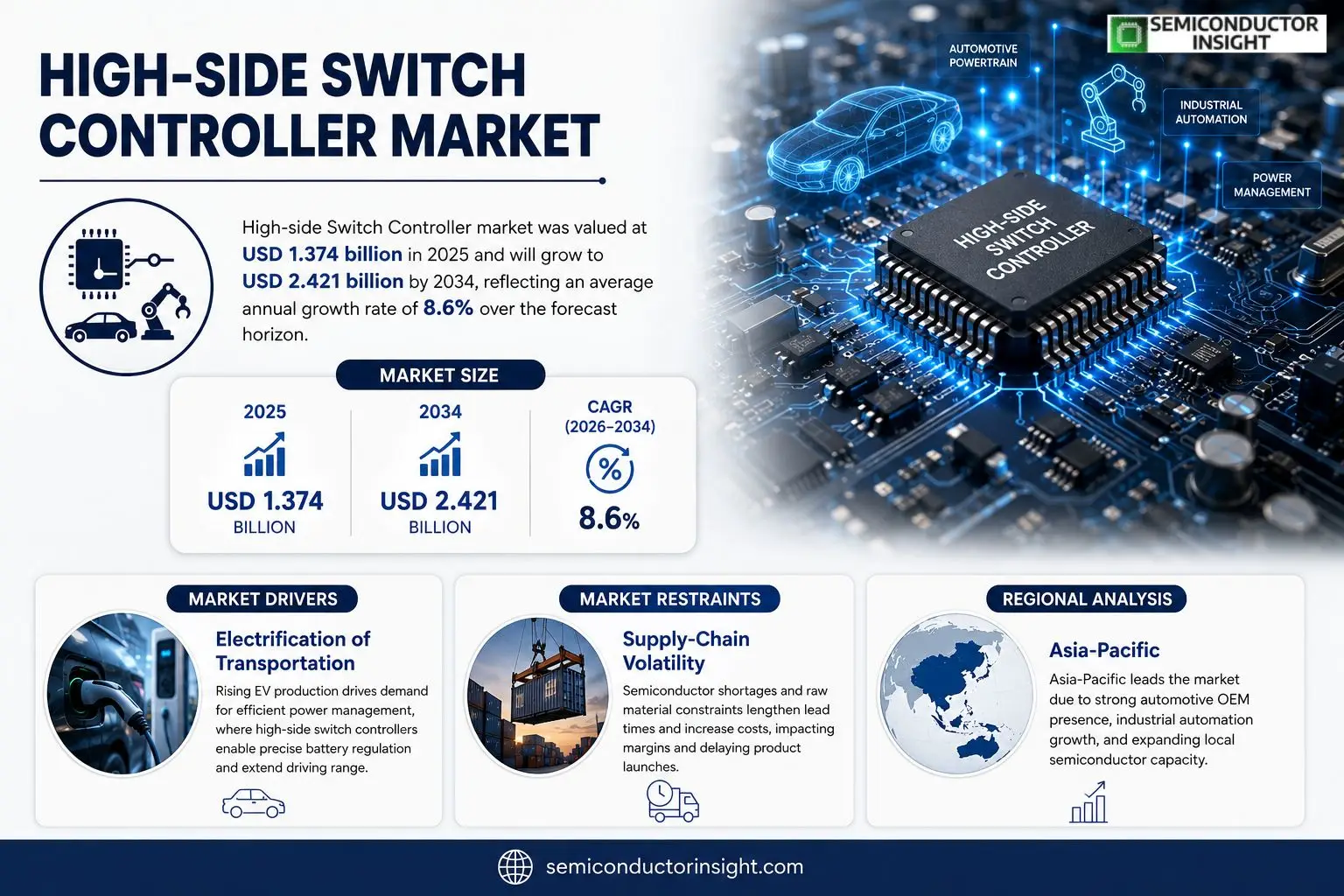
High-side Switch Controller market was valued at USD 1.374 billion in 2025 and will grow to USD 2.421 billion by 2034, reflecting an average annual growth rate of 8.6 percent over the forecast horizon.
High‑side Switch Controller is a control‑IC that manages high‑side load power in automotive and industrial automation systems by combining switching control, protection functions and basic diagnostics. In 2025 production reached roughly 295 million units with a average price of USD 5.1 per unit; capacity utilization stood at about 68 percent while the gross margin averaged 40 percent, underscoring the importance of single‑chip integration and robust fault‑handling features for maintaining profitability.
MARKET DRIVERS
Electrification of Transportation
The surge in electric vehicle (EV) production has compelled manufacturers to adopt more efficient power‑management topologies. High-side switch controllers enable precise regulation of battery banks, reducing losses and extending driving rangeattributes that OEMs regard as decisive for competitive positioning. As fleets transition toward zero‑emission mandates, the demand for these controllers is rising in parallel with vehicle complexity.
Industrial Automation & IoT Integration
Smart factories are embedding sensor‑driven actuation across conveyor belts, robotic arms, and safety interlocks. High-side switch controllers provide the isolation and rapid response needed to protect delicate control circuits while supporting real‑time data exchange. The convergence of edge computing and predictive maintenance amplifies the value of reliable switching solutions, prompting capital allocation toward next‑generation devices.
➤ Manufacturers increasingly favor silicon‑carbide (SiC) and gallium‑nitride (GaN) options for their superior thermal performance, creating a niche yet rapidly expanding segment within the broader market.
Regulatory pressure around energy efficiency, exemplified by stricter IEC standards, forces component suppliers to offer lower conduction losses and tighter voltage tolerance. Companies that embed these attributes into high-side switch controllers gain a clear market advantage, as end‑users look to meet compliance without redesigning entire systems.
MARKET CHALLENGES
Supply‑Chain Volatility
semiconductor shortages have elongated lead times for critical switching substrates. While demand ascends, manufacturers grapple with inventory buffers that erode profit margins. The uncertainty surrounding raw‑material availabilityparticularly for wide‑bandgap materialscomplicates forecasting and hampers timely product launches.
Other Challenges
Design Complexity
Engineers must balance thermal dissipation, electromagnetic interference, and fault tolerance within increasingly compact footprints. The need for multidisciplinary expertise raises development costs and extends time‑to‑market, especially for niche applications such as aerospace or medical devices.Compliance testing regimes differ across regions, forcing vendors to maintain multiple certification pipelines. This fragmentation inflates overhead and can deter smaller players from entering the arena, consolidating market power among established suppliers.
MARKET RESTRAINTS
Cost Sensitivity in Mass‑Market Segments
High‑end silicon‑carbide and gallium‑nitride devices command premiums that many volume‑driven manufacturers cannot absorb. When product pricing competes with mature silicon alternatives, procurement decisions often tip toward the lower‑cost option, dampening overall market acceleration.The learning curve associated with new device architectures imposes training expenses on design teams. Companies hesitant to invest in upskilling may delay adoption, limiting the penetration of advanced high-side switch controllers in legacy product lines.Regulatory hurdles, while fostering safety, also introduce time‑consuming validation steps. For firms targeting rapid market entry, the procedural overhead can act as a deterrent, especially in regions with overlapping standards.
MARKET OPPORTUNITIES
Growth in Renewable Energy Inverters
As solar and wind farms scale, inverter manufacturers seek high-side switch controllers capable of handling higher voltages and variable frequency operation. The ability to manage grid‑code compliance while minimizing conversion loss positions these controllers as critical enablers for clean‑energy infrastructure.Emerging applications in autonomous robotics demand fault‑tolerant power distribution networks. Controllers that integrate diagnostic feedback and self‑recovery mechanisms can differentiate suppliers in a marketplace increasingly focused on reliability and uptime.Strategic collaborations between semiconductor fabs and system integrators are accelerating the rollout of modular driver families. Such alliances offer a streamlined path to customize solutions for niche markets, creating a fertile ground for revenue diversification within High-side Switch Controller Market.
High-side Switch Controller Market Trends
Integration and System‑Level Functionality
High-side Switch Controller Market is moving from isolated load‑switch products toward chips that embed protection, diagnostics and thermal management on a single die. In 2025 manufacturers delivered roughly 295 million units at an average price of US $5.1, while capacity utilization lingered near 68 %. Those figures illustrate that profit marginsaround 40 %now hinge on the ability to shrink external components and wiring complexity. Customers in automotive and industrial automation are rewarding suppliers that can offer predictable fault visibility and seamless hand‑off to vehicle‑wide control units, because such capabilities reduce validation effort and field‑failure expenses. Consequently, platform‑level design wins have become the primary lever for sustaining earnings as unit‑price pressure intensifies.
Other Trends
Supply Chain Pressures and Margin Management
Upstream inputs such as silicon wafers, photoresists and epoxy molding compounds remain sourced from a limited set of vendors, including Shanghai Silicon Industry Group and Shin‑Etsu Chemical. The concentration of these materials inflates exposure to price swings, prompting manufacturers to pursue tighter inventory control and longer‑term supply contracts. Mid‑stream activitiessystem architecture definition, current‑sensing integration and tapeout planninghave grown in strategic importance because they directly influence reliability metrics and thermal performance. Firms that align their verification roadmaps with downstream automotive OEM schedules, for instance BYD or Toyota, can lock in volume commitments that offset the margin erosion caused by competitive pricing. The net effect is a market where operational efficiency, rather than sheer shipment volume, determines profitability.
Application‑Driven Reliability Demands
Automotive platforms now feature dozens of controllable loads per vehicle, while industrial automation lines adopt modular designs that call for frequent re‑configuration. This escalation forces High-side Switch Controller Market to prioritize failure‑proof operation; even a brief interruption can cascade into costly downtime. Suppliers that embed advanced fault‑logging and self‑test routines into the controller are seeing stronger adoption in premium vehicle programs, where warranty risk is a decisive cost factor. Meanwhile, industrial customers value thermal stability that survives harsh environments, prompting a shift toward silicon that can sustain higher junction temperatures without compromising protection accuracy. The overall trend points to a competitive landscape where differentiation is tied to the depth of integration and the robustness of on‑chip safety features rather than headline pricing.
COMPETITIVE LANDSCAPEKey Industry Players
High-side Switch Controller Market – Competitive Overview
The dominance hierarchy in the high‑side switch controller segment is shaped by a handful of large‑scale semiconductor houses that leverage deep automotive and industrial portfolios. Texas Instruments, with its extensive analogue‑centric line‑up, captures the bulk of volume‑driven platforms, exploiting economies of scale to keep per‑unit cost low while extending protection and diagnostic features across multiple vehicle families. Infineon and STMicroelectronics occupy a parallel tier, each combining robust silicon‑on‑silicon integration with region‑specific compliance expertise, which grants them preferential access to OEM design wins in Europe and Asia. Their ability to bundle high‑side controllers with complementary power‑management ICs creates a “system‑on‑chip” argument that resonates with tier‑one suppliers seeking to reduce board count and validation effort. This concentration of market share forces midsize players to differentiate through niche voltage ranges, ultra‑low‑noise architectures, or accelerated qualification cycles for emerging electric‑drive applications.Beyond the top tier, a constellation of specialized firms fuels incremental innovation and addresses application‑specific gaps. NXP Semiconductors and Renesas Electronics focus on automotive‑grade controllers tuned for 48 V architectures, positioning themselves as enablers of next‑generation chassis‑level electrification. Rohm Semiconductor and Diodes Incorporated emphasize high‑current, dual‑channel devices that cater to industrial automation lines requiring tight thermal management. Japanese heavyweight Fuji Electric and Toshiba maintain a foothold in legacy equipment refurbishments, while onsemi and Analog Devices pursue niche markets such as renewable‑energy inverter modules where reliability under harsh thermal cycling is paramount. Emerging Chinese vendors, notably Shanghai Silicon Industry Group and Nanda Optoelectronics, are beginning to offer cost‑competitive silicon wafers and packaging services, hinting at a gradual reshaping of the upstream supply chain that could pressure established margins.
List of Key High-side Switch Controller Companies Profiled
- Texas Instruments
- Infineon Technologies
- STMicroelectronics
- NXP Semiconductors
- Renesas Electronics
- Rohm Semiconductor
- Diodes Incorporated
- Fuji Electric
- Toshiba
- onsemi
- Analog Devices
- Microchip Technology
- Shanghai Silicon Industry Group
- Nanda Optoelectronics
- Broadcom Inc.
Segment Analysis:
| Segment Category | Sub-Segments | Key Insights |
| By Type |
|
12V Controllers are widely adopted in automotive platforms where low‑voltage distribution is critical. – They provide robust protection against over‑current and short‑circuit events, enhancing overall vehicle reliability. – Integrated diagnostic features simplify validation, reducing development effort for OEMs. – Compatibility with standard PWM interfaces facilitates seamless integration with existing power‑train control units. |
| By Application |
|
Automotive Powertrain segment drives innovation, demanding higher reliability and fault visibility. – Controllers are expected to coordinate tightly with vehicle‑level control units, enabling predictive fault handling. – Thermal management becomes a differentiator as power densities increase in electric drivetrains. – System‑level integration reduces wiring complexity, supporting modular vehicle architectures. |
| By End User |
|
OEMs prioritize long‑term part availability and proven reliability. – Preference for controllers that offer extensive diagnostic coverage to minimize field failures. – Emphasis on scalable families that can be reused across multiple vehicle platforms. – Strong relationship with tier‑1 suppliers drives co‑development of application‑specific features. |
| By Integration Level |
|
Integrated Switch‑Protection‑Diagnostic is emerging as the preferred architecture. – Reduces external component count, simplifying PCB layout and improving reliability. – Enables faster validation cycles thanks to built‑in self‑test capabilities. – Aligns with supplier strategies to deliver platform‑level solutions that lower overall system cost. |
| By Functionality |
|
Predictive Health Monitoring is gaining traction as systems become more connected. – Allows early detection of degradation, supporting proactive maintenance strategies. – Enhances overall system uptime, which is a critical metric for both automotive and industrial customers. – Provides a pathway for higher‑value services such as remote diagnostics and over‑the‑air updates. |
Regional Analysis: High-side Switch Controller Market
North America
Vehicle manufacturers are redesigning power‑train topologies to embed high‑side switches directly within inverter modules, reducing interconnect losses and improving fault isolation. The move aligns with the push toward electrified light‑duty and commercial fleets, where tighter packaging and higher efficiency translate into extended range and lower total‑cost‑of‑ownership. Suppliers that can certify automotive‑grade reliability while offering compact footprints are gaining design‑win status.
Factories upgrading to collaborative robots and high‑speed assembly lines demand power stages that can handle rapid load transients without overheating. High-side switch controllers, with their inherent ability to protect downstream devices, are becoming standard in motor‑drive racks and programmable logic controller (PLC) ecosystems, especially where predictive‑maintenance algorithms require precise current monitoring.
Federal energy‑efficiency standards now reference inverter loss thresholds that indirectly pressure designers to adopt low‑on‑resistance high‑side switches. Compliance audits focus on system‑level performance, compelling OEMs to select components that demonstrably reduce conduction and switching losses while maintaining robust protection features.
Silicon‑carbide (SiC) and gallium‑nitride (GaN) device integration is reshaping the high‑side switch market, offering superior thermal conductivity and faster switching speeds. Early adopters are experimenting with hybrid silicon‑SiC architectures that balance cost against performance, setting a new baseline for future product generations.
Europe
European manufacturers are capitalising on stringent emissions legislation to accelerate the incorporation of high‑side switch controllers into electric‑drive platforms. The region’s strong emphasis on sustainability drives collaborative projects between automotive consortia and semiconductor firms, aiming to standardise fault‑tolerant designs that simplify certification across multiple markets. Additionally, the rise of Industry 4.0 initiatives in Germany and France fuels demand for robust power modules that can survive harsh industrial environments while supporting real‑time diagnostics.
Asia‑Pacific
In Asia‑Pacific, rapid electrification of two‑wheelers and burgeoning renewable‑energy installations are expanding the addressable market for high‑side switches. Chinese and Indian OEMs, pressured by aggressive government incentives, are integrating these controllers into battery‑management systems to meet both cost and efficiency targets. Meanwhile, a surge in local semiconductor capacity is shortening supply chains, allowing regional players to iterate design cycles faster than their Western counterparts.
South America
South American adoption is anchored by the growth of mining equipment and agricultural machinery that rely on high‑power motor drives. Operators are seeking controllers that can endure extreme temperature fluctuations and dust exposure without frequent maintenance. The region’s emerging focus on grid‑scale storage also creates a niche for high‑side switches that manage bidirectional power flow with tight fault‑handling requirements.
Middle East & Africa
The Middle East & Africa is witnessing a nascent but accelerating interest in high‑side switch technology, primarily driven by large‑scale solar‑farm projects and oil‑field automation. Utilities in the Gulf Cooperation Council are incorporating these components to enhance inverter reliability under high‑ambient‑temperature conditions. In Africa, pilot smart‑grid deployments are testing the resilience of high‑side switches as part of micro‑grid controllers, laying groundwork for broader rollout as electrification initiatives mature.
Report Scope
This market research report provides a comprehensive analysis of the High-side Switch Controller Market , covering the forecast period 2026–2034. It offers detailed insights into market dynamics, technological advancements, competitive landscape, and key trends shaping the industry.
Key focus areas of the report include:
- Market Overview: The report begins with an overview outlining its current market scenario, key growth indicators, and industry transformation drivers. It discusses macroeconomic factors, demand–supply balance, regulatory landscape, and the strategic role of semiconductors in powering advancements across industries such as automotive, telecommunications, consumer electronics, and industrial automation.
- Market Size & Forecast: Historical data and future projections for revenue, unit shipments, and market value across major regions and segments.
- Segmentation Analysis: Detailed breakdown by product type, technology, application, and end-user industry to identify high-growth segments and investment opportunities.
- Regional Insights: Insights into market performance across North America, Europe, Asia-Pacific, Latin America, and the Middle East & Africa, including country-level analysis where relevant.
- Competitive Landscape: Profiles of leading market participants, including their product offerings, R&D focus, manufacturing capacity, pricing strategies, and recent developments such as mergers, acquisitions, and partnerships.
- Technology Trends & Innovation: Assessment of emerging technologies, integration of AI/IoT, semiconductor design trends, fabrication techniques, and evolving industry standards.
- Market Drivers & Restraints: Evaluation of factors driving market growth along with challenges, supply chain constraints, regulatory issues, and market-entry barriers.
- Stakeholder Insights: Insights for component suppliers, OEMs, system integrators, investors, and policymakers regarding the evolving ecosystem and strategic opportunities.
Primary and secondary research methods are employed, including interviews with industry experts, data from verified sources, and real-time market intelligence to ensure the accuracy and reliability of the insights presented.
FREQUENTLY ASKED QUESTIONS:
What is the current market size of High-side Switch Controller Market?
-> High-side Switch Controller Market was valued at USD 1374 million in 2025 and is expected to reach USD 2421 million by 2034.
Which key companies operate in High-side Switch Controller Market?
-> Key players include STMicroelectronics, Infineon, Diodes Incorporated, ROHM, Renesas, Fuji Electric, Texas Instruments, Microchip, onsemi, Toshiba, among others.
What are the key growth drivers?
-> Key growth drivers include rising demand for integrated power management in automotive and industrial automation, need for higher reliability and fault visibility, pressure to reduce system cost through single‑chip integration, and expanding number of controlled loads in electric vehicles and factory equipment.
Which region dominates the market?
-> Asia-Pacific dominates High-side Switch Controller Market, driven by major automotive OEMs and industrial automation manufacturers located in China, Japan, South Korea and India.
What are the emerging trends?
-> Emerging trends include shift toward system‑oriented power management, enhanced protection and diagnostic functions, tighter coordination with vehicle control units, and incorporation of AI‑enabled monitoring for predictive reliability.
Get Sample Report PDF for Exclusive Insights
Report Sample Includes
- Table of Contents
- List of Tables & Figures
- Charts, Research Methodology, and more...
 Download Sample Report PDF