Robotic Connectors Market Insights
Global Robotic Connectors market size was valued at USD 383 million in 2025. The market is forecasted to increase to USD 1,186 million by 2034, indicating an implied CAGR of roughly 13.4 % over the period.
Robotic connectors are interconnect components used in industrial, collaborative and service robots for reliable transmission of power, signals, high‑speed data and,when required,pneumatic or fluid media across moving joints. They are engineered to endure vibration, bending stresses, electromagnetic interference, oil/coolant exposure and wash‑down conditions while maintaining low insertion loss.
The surge in robot deployments across manufacturing floors, logistics centers and medical automation creates strong demand for compact connectors that combine power‑and‑data functions into hybrid interfaces. Because OEMs prioritize high mating‑cycle durability and easy maintenance, suppliers are focusing on designs that offer both EMC robustness and sealed performance under harsh factory environments.
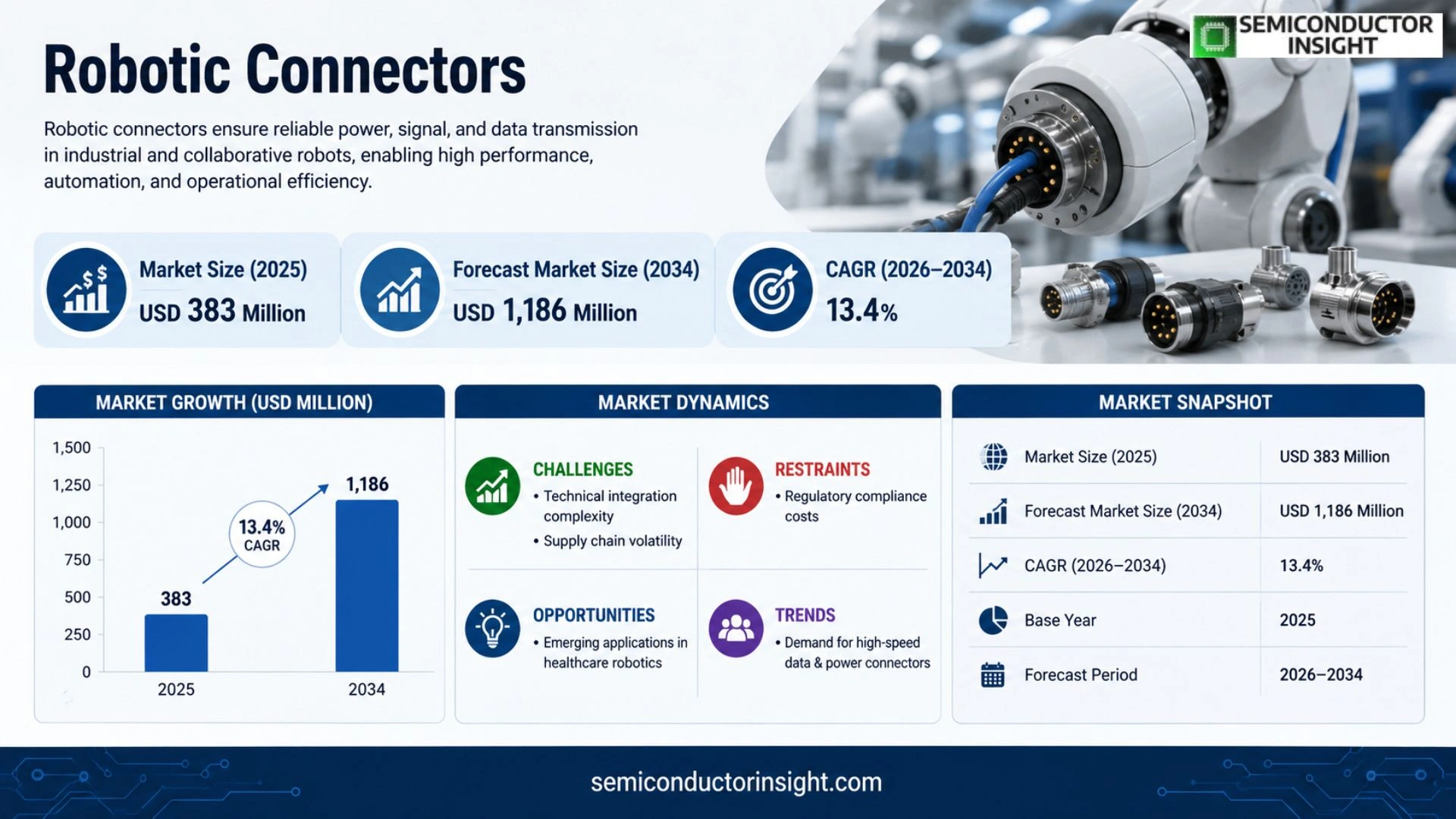
MARKET DRIVERS
Increasing Automation in Manufacturing
The Robotic Connectors Market is gaining traction as manufacturers accelerate the deployment of collaborative robots on production lines. In 2023, worldwide installation of cobots rose 22 % year‑over‑year, compelling equipment vendors to source connectors that can sustain higher data throughput while occupying minimal panel space. This pressure is prompting OEMs to redesign housings around modular connector families, thereby unlocking faster change‑over cycles and lower downtime.
Advancements in Miniaturization
At the same time, the push for smaller, lighter robotic end‑effectors has intensified the need for ultra‑compact interconnect solutions. Recent engineering of 0.5 mm pitch contacts enables dense signal routing without compromising mechanical robustness, a development that directly fuels higher payload capabilities in next‑generation service robots. Companies that master these miniaturized designs are positioning themselves as preferred suppliers in a market projected to exceed USD 2 billion by 2030.
➤ “Connector density is becoming the silent catalyst behind the rise of agile manufacturing cells,” notes a senior analyst at a leading research firm.
Strategic investments in additive manufacturing for connector housings are also reshaping cost structures. By eliminating traditional tooling, manufacturers can iterate designs rapidly, respond to niche customer specifications, and ultimately reduce bill‑of‑materials expenses,an advantage that reverberates throughout the Robotic Connectors Market value chain.
MARKET CHALLENGES
Technical Integration Complexity
Integrating high‑speed data links with power delivery in a single connector package remains a formidable engineering hurdle. Many system integrators report incompatibility between legacy control modules and newly introduced Ethernet‑based robot controllers, forcing costly redesigns of wiring harnesses. This friction slows adoption rates, especially among mid‑size manufacturers operating on tight capital budgets.
Other Challenges
Supply Chain Volatility
The reliance on specialty alloys such as beryllium copper and proprietary polymer blends has exposed the Robotic Connectors Market to raw‑material price spikes. Recent disruptions in Asian metal smelting capacities have lengthened lead times by 30 % for critical connector components, pressuring suppliers to hold higher inventory levels or negotiate premium contracts.
MARKET RESTRAINTS
Regulatory Compliance Costs
Stringent electromagnetic compatibility (EMC) and safety certifications required for industrial robots raise the cost baseline for connector manufacturers. Achieving CE, UL, and ISO 13849 approvals entails extensive testing regimes, which small‑to‑medium suppliers often struggle to fund. Consequently, market consolidation accelerates as larger players absorb niche firms that cannot meet compliance budgets.
MARKET OPPORTUNITIES
Emerging Applications in Healthcare Robotics
Robotic systems designed for minimally invasive surgery and patient‑assisted rehabilitation demand connectors that combine sterility, bio‑compatibility, and ultra‑reliable signal integrity. Early adopters are already trialing hermetically sealed, single‑use connector modules that meet Class II medical device standards. The niche yet high‑margin segment offers a clear pathway for differentiation, encouraging Robotic Connectors Market participants to develop dedicated product lines that address strict hygiene and traceability requirements.
Robotic Connectors Market Trends
Hybrid Power‑Data Interfaces Drive Buyer Preferences
The push toward unified power‑and‑signal pathways is reshaping design priorities across robot manufacturers. Engineers now favor connectors that can sustain high current while simultaneously handling Ethernet‑grade data streams, because such hybrids cut cable count, simplify routing, and reduce overall system mass. The trend is especially pronounced in collaborative arms where workspace constraints demand compact solutions. Suppliers that integrate Ni/Au plating with robust polymer shells are gaining traction, as they can guarantee signal integrity under vibration and EMI stress. This convergence encourages OEMs to specify a single interface for base‑to‑wrist articulation, thereby shortening assembly cycles and lowering total cost of ownership for end users.
Other Trends
Supply‑Chain Consolidation Among Core Material Providers
Upstream players delivering copper‑alloy contacts, high‑performance elastomer seals, and high‑flex shielded cables are becoming increasingly clustered around a handful of global specialists. The rationale stems from the need to guarantee consistent tolerances and to meet stricter environmental certifications demanded by automotive‑grade robot deployments. As a result, smaller niche manufacturers are either being acquired or forced to align with larger consortiums that can provide volume discounts and traceability across the entire production line. This consolidation translates into more predictable lead times for robot builders, but it also raises entry barriers for new connector designers lacking deep supply‑chain relationships.
Application Diversification Fuels New Functional Requirements
Beyond traditional industrial robots, Robotic Connectors Market is responding to growth in collaborative, medical, and autonomous mobile robot segments. Medical devices, for instance, impose stricter sterilization protocols and demand connectors that can withstand repeated washdown cycles without degradation of sealing performance. Autonomous mobile robots require ruggedized housings for outdoor dust and moisture exposure, prompting manufacturers to introduce IP‑rated variants with reinforced locking mechanisms. Meanwhile, collaborative platforms prioritize quick‑change docking features that enable rapid tool swaps on the factory floor. These divergent use cases compel suppliers to expand their product portfolios, offering modular families that can be fine‑tuned for specific environment and compliance criteria, thereby opening niche revenue streams while reinforcing the overall robustness of the ecosystem.
COMPETITIVE LANDSCAPE
Key Industry Players
Robotic Connectors Competitive Landscape Overview
TE Connectivity dominates the upper tier of the market, leveraging a broad portfolio that spans threaded, bayonet and push‑pull mating mechanisms. Its extensive engineering polymer and copper‑alloy contacts enable high‑cycle durability, a critical requirement for robot joints that experience continuous motion and exposure to coolant or oil. By integrating hybrid power‑and‑data modules, TE has cemented relationships with leading robot OEMs such as FANUC and ABB, allowing the company to capture a sizable share of the $921 million forecast for 2032. Hirose Electric follows closely, differentiating itself through miniature round connectors that address space‑constrained wrist applications. Hirose’s aggressive patent filing strategy around high‑frequency shielding has created a defensible niche in collaborative robot platforms where electromagnetic compatibility is paramount. HARTING, another heavyweight, supplies robust rectangular interfaces that serve heavy‑duty industrial arms. Its modular cable‑assembly approach reduces installation time for line builders, translating into repeat business from system integrators across North America and Europe. Collectively, these three firms shape the competitive hierarchy, setting pricing benchmarks and influencing technology standards across the value chain.
Beyond the tier‑one contenders, a constellation of specialist manufacturers enriches the market’s depth. Amphenol and Molex focus on high‑density board‑level solutions that enable embedded sensor networks within robotic end‑effectors. Phoenix Contact and Belden have entered the arena with hybrid connector‑cable assemblies that bundle power, signal and pneumatic lines, appealing to manufacturers seeking “plug‑and‑play” installations. Weidmueller and Samtec supply custom‑engineered bayonet connectors for aerospace‑grade robots, where vibration tolerance is non‑negotiable. Smaller yet technically agile firms such as Beisit Electric, Binder and LEMO cater to niche medical‑robot applications, emphasizing sterilizable materials and low‑profile form factors. Asian players,including Shenzhen Taihua Electronics, Nextronics Engineering, WCON and JCTC,are gaining market visibility by offering cost‑effective alternatives that comply with IEC standards, thereby expanding the supplier base for fast‑growing AMR and AGV segments. This layered ecosystem ensures that end users can select solutions aligned with performance, regulatory and budgetary constraints.
List of Key Robotic Connectors Companies Profiled
- TE Connectivity
- Hirose Electric
- HARTING
- Amphenol
- Phoenix Contact
- Belden
- Molex
- Weidmueller
- Samtec
- Beisit Electric
- Binder
- LEMO
- Shenzhen Taihua Electronics Co., Ltd
- Nextronics Engineering Corp
- WCON
- JCTC
Segment Analysis:
| Segment Category | Sub-Segments | Key Insights |
| By Type |
|
Round Connectors are favored for their compact circular geometry, enabling seamless integration in high‑density robot joints; they deliver robust EMI shielding and accommodate repeated mating cycles with minimal wear; designers appreciate the ease of alignment which reduces assembly time and enhances maintainability across diverse robotic platforms. |
| By Application |
|
Industrial Robots demand highly reliable power‑and‑data hybrids to sustain continuous operation on factory floors; connectors must resist vibration, oil, coolant and frequent re‑configurations, prompting a focus on durable contact alloys and advanced sealing; the need for quick‑change end‑effectors further drives modular connector architectures. |
| By End User |
|
Robot OEMs prioritize connectors that combine compact form‑factor with high‑cycle durability, enabling streamlined product launches; they value supplier ecosystems that provide customized plating and polymer solutions to meet specific EMC and environmental standards; close collaboration with integrators ensures seamless adoption across diverse robot families. |
| By Mating Mechanism |
|
Push‑Pull mechanisms dominate fast‑swap robotic end‑effectors due to their intuitive engagement and minimal torque requirements; they support high‑frequency mating cycles while preserving contact integrity; designers appreciate the reduced risk of cross‑threading, which accelerates maintenance in production settings. |
| By Function |
|
Hybrid Power‑and‑Signal Connectors are emerging as the preferred choice for next‑generation robots, merging high‑current pathways with high‑speed data lanes; they simplify cable management, improve reliability in harsh environments, and enable compact wrist designs that support advanced sensing and actuation capabilities. |
Regional Analysis: Robotic Connectors Market
North America
Silicon Valley and Detroit’s mobility corridor act as incubators for connector innovations, blending expertise in high‑performance materials with software‑enabled monitoring. Start‑ups leverage venture capital to explore magnetic‑lock and self‑aligning concepts that cut assembly time, while established players iterate on these ideas to meet automotive safety certifications.
Proximity to major component foundries and a mature logistics infrastructure enable rapid scaling of connector inventories. The ability to source copper alloys and high‑temperature plastics locally reduces lead times, allowing manufacturers to respond swiftly to short‑run production schedules demanded by customized robot deployments.
Stringent UL and CSA certifications shape connector design choices, pushing firms toward robust sealing solutions that meet stringent ingress protection levels. Compliance requirements act as a catalyst for standardization, encouraging the adoption of universal locking mechanisms across disparate robotic platforms.
End‑users, from tier‑one automotive assemblers to boutique electronics firms, prioritize connectors that combine high current capacity with diagnostic feedback. The trend toward predictive maintenance drives demand for smart connectors that report temperature, vibration, and connection integrity to centralized control systems.
Europe
European manufacturers leverage the continent’s strong emphasis on sustainability to differentiate connector offerings. Companies embed recyclable composites and design for disassembly, aligning with EU directives on circular economy. The presence of leading automation clusters in Germany and Sweden encourages collaborative standard‑setting, which translates into interoperable connector families across diverse robotic applications. Market participants must navigate a patchwork of national safety codes while capitalizing on the region’s appetite for high‑precision, low‑latency interconnects in aerospace and pharmaceutical production.
Asia‑Pacific
Asia‑Pacific emerges as a rapid growth engine for Robotic Connectors Market, driven by expanding electronics manufacturing hubs in China, South Korea, and Taiwan. Cost‑sensitive OEMs in the region seek connectors that balance affordability with the ability to withstand high‑temperature soldering processes. Simultaneously, rising automation in Southeast Asian automotive plants fuels demand for rugged, vibration‑resistant designs. Suppliers that can localize production and tailor connector footprints to compact robotic arms gain a competitive edge.
South America
In South America, the market is shaped by a gradual shift from labor‑intensive assembly lines to robot‑assisted cells, particularly in Brazil’s automotive sector. Limited local component sourcing compels firms to import high‑spec connectors, creating opportunities for distributors who can provide value‑added services such as on‑site testing and certification assistance. The region’s regulatory environment, while less stringent than North America, increasingly adopts international safety standards, nudging manufacturers toward globally accepted connector solutions.
Middle East & Africa
The Middle East & Africa region showcases a niche yet promising landscape, where oil‑and‑gas and renewable‑energy projects rely on rugged connectors capable of withstanding extreme environmental conditions. Investment in smart‑factory initiatives in UAE and Saudi Arabia is prompting a modest rise in demand for connectors with built‑in condition‑monitoring. African markets, still early in automation adoption, emphasize low‑cost, durable designs that can survive erratic power quality, positioning the region as a frontier for ruggedized connector technologies.
Report Scope
This market research report provides a comprehensive analysis of the Robotic Connectors Market , covering the forecast period 2026–2034. It offers detailed insights into market dynamics, technological advancements, competitive landscape, and key trends shaping the industry.
Key focus areas of the report include:
- Market Overview: The report begins with an overview outlining its current market scenario, key growth indicators, and industry transformation drivers. It discusses macroeconomic factors, demand–supply balance, regulatory landscape, and the strategic role of semiconductors in powering advancements across industries such as automotive, telecommunications, consumer electronics, and industrial automation.
- Market Size & Forecast: Historical data and future projections for revenue, unit shipments, and market value across major regions and segments.
- Segmentation Analysis: Detailed breakdown by product type, technology, application, and end-user industry to identify high-growth segments and investment opportunities.
- Regional Insights: Insights into market performance across North America, Europe, Asia-Pacific, Latin America, and the Middle East & Africa, including country-level analysis where relevant.
- Competitive Landscape: Profiles of leading market participants, including their product offerings, R&D focus, manufacturing capacity, pricing strategies, and recent developments such as mergers, acquisitions, and partnerships.
- Technology Trends & Innovation: Assessment of emerging technologies, integration of AI/IoT, semiconductor design trends, fabrication techniques, and evolving industry standards.
- Market Drivers & Restraints: Evaluation of factors driving market growth along with challenges, supply chain constraints, regulatory issues, and market-entry barriers.
- Stakeholder Insights: Insights for component suppliers, OEMs, system integrators, investors, and policymakers regarding the evolving ecosystem and strategic opportunities.
Primary and secondary research methods are employed, including interviews with industry experts, data from verified sources, and real-time market intelligence to ensure the accuracy and reliability of the insights presented.
FREQUENTLY ASKED QUESTIONS:
What is the current market size of Robotic Connectors Market?
-> Robotic Connectors market size is forecasted to increase to USD 1,186 million by 2034, indicating an implied CAGR of roughly 13.4 %
Which key companies operate in Robotic Connectors Market?
-> Key players include TE Connectivity, Hirose Electric, HARTING, Amphenol, IRISO, Phoenix Contact, Belden, Molex, Weidumller, Samtec, Beisit Electric, Binder, LEMO, Shenzhen Taihua Electronics Co., Ltd, Nextronics Engineering Corp, WCON, JCTC.
What are the key growth drivers?
-> Key growth drivers include rapid adoption of industrial and collaborative robots, demand for hybrid power‑and‑data interfaces, need for compact and high‑durability connectors, and the push toward integrated cable assemblies in harsh factory environments.
Which region dominates the market?
-> Asia‑Pacific dominates Robotic Connectors market, driven by strong manufacturing bases in China, Japan, and South Korea, with Europe and North America also showing significant demand.
What are the emerging trends?
-> Emerging trends include development of high‑flex shielded cable systems, integration of pneumatic/fluid channels with power‑data connectors, and the rise of quick‑change docking solutions for collaborative robots.

Get Sample Report PDF for Exclusive Insights
Report Sample Includes
- Table of Contents
- List of Tables & Figures
- Charts, Research Methodology, and more...
 Download Sample Report PDF