SiC MOSFET Gate Drivers ICs Market Insights
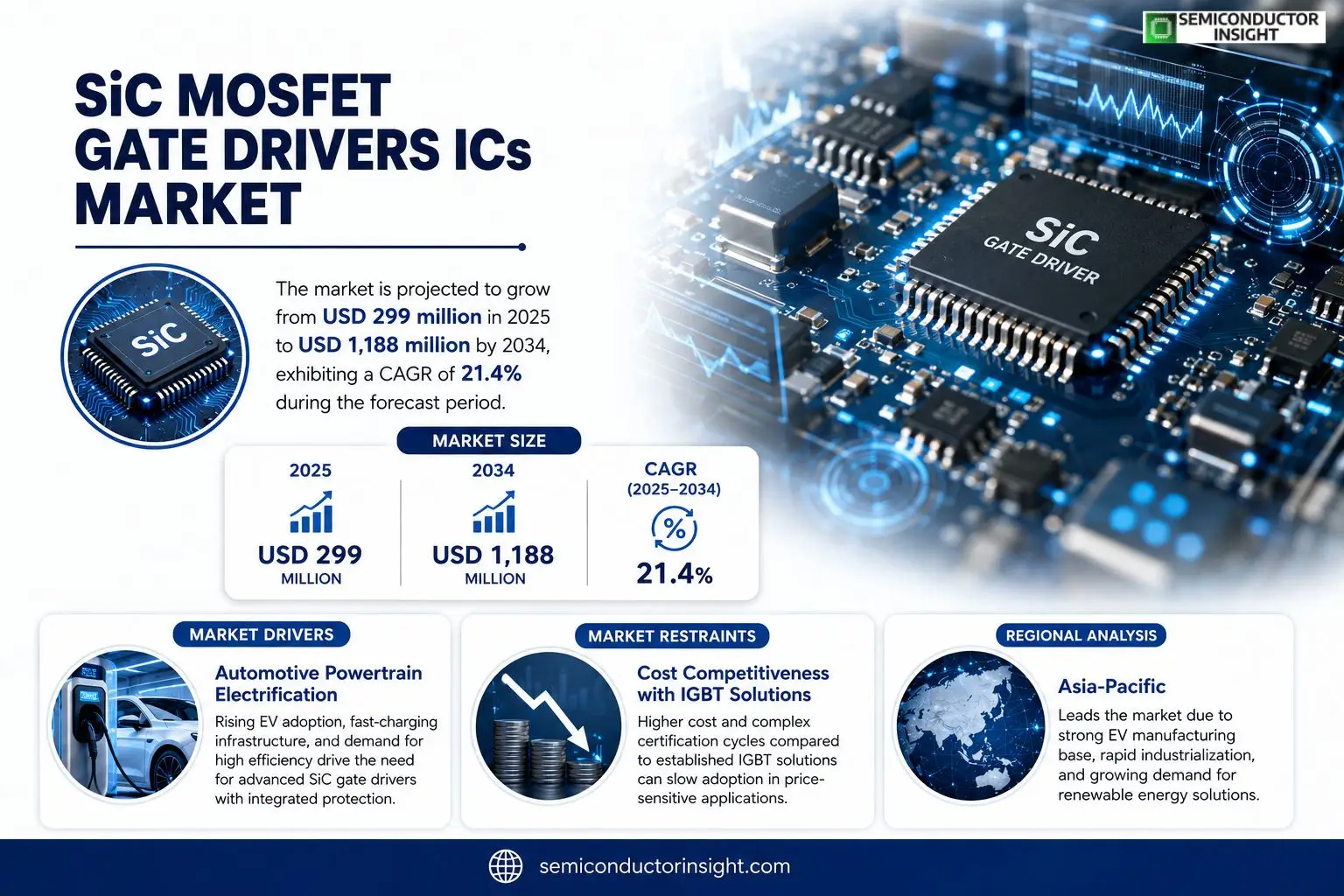
SiC MOSFET Gate Drivers ICs market size was valued at USD 299 million in 2025. The market is projected to grow from USD 299 million in 2025 to USD 1,188 million by 2034, exhibiting a CAGR of 21.4% during the forecast period.
A SiC MOSFET Gate Driver IC is an interface chip that receives a low‑power PWM control signal and supplies the required gate voltage and peak current to switch a silicon‑carbide MOSFET safely and efficiently. Because SiC devices switch with very fast dv/dt and di/dt, these drivers commonly integrate robustness features such as high CMTI, active Miller clamp, negative gate‑off capability and rapid protection functions.The market is experiencing rapid growth due to several factors, including rising adoption of SiC technology for higher‑efficiency power conversion, expanding electric‑vehicle traction systems and increasing demand for fast‑charging infrastructure. Advancements in isolated driver architectures and tighter integration with power modules are further enhancing system reliability while shortening validation cycles. Recent collaborationssuch as Infineon’s March 2024 partnership with major automotive OEMs on next‑generation isolated driversdemonstrate how leading players are strengthening their portfolios. Companies like Texas Instruments, STMicroelectronics, Power Integrations, onsemi, Microchip Technology, Littelfuse, Renesas Electronics, ROHM and InventChip Technology continue expanding offerings across automotive, photovoltaic and industrial applications.
MARKET DRIVERS
Automotive Powertrain Electrification
The shift toward 48 V and higher voltage architectures in passenger and commercial vehicles has created a demand for gate‑driver solutions that can cope with the fast switching speeds of silicon‑carbide (SiC) devices. SiC MOSFET Gate Drivers ICs Market suppliers that offer integrated protection and fault‑diagnostic features are seeing rapid uptake because OEMs value the ability to reduce inverter size while preserving reliability.
Industrial Inverter Modernization
Factories are replacing legacy IGBT‑based converters with SiC‑based topologies to meet energy‑efficiency mandates. Gate‑driver ICs that deliver low gate charge and precise timing enable these converters to achieve higher power density, directly influencing plant‑level capital expenditure decisions. SiC MOSFET Gate Drivers ICs Market participants that align product roadmaps with modular drive‑train standards are positioned to capitalize on this transition.
➤ “Designers who integrate adaptive dead‑time control into SiC gate drivers report up to 12 % reduction in total harmonic distortion, a metric that directly translates into lower acoustic noise for motor applications.”
Beyond product performance, the convergence of vehicle‑to‑grid (V2G) concepts and renewable‑energy integration is prompting system integrators to seek drivers with robust isolation and communication stacks. Companies that can certify compliance across automotive, rail and aerospace standards are likely to capture a disproportionate share of upcoming orders.
MARKET CHALLENGES
Thermal Management Constraints
SiC devices operate at higher junction temperatures, which places additional stress on driver ICs. If the driver cannot dissipate heat efficiently, the system may experience premature derating. Manufacturers must therefore invest in advanced packagingsuch as copper‑core substratesor accept higher bill‑of‑materials costs, a trade‑off that can deter price‑sensitive customers.
Other Challenges
Supply‑Chain Volatility
The semiconductor ecosystem continues to feel the aftershocks of recent geopolitical tension and raw‑material shortages. Limited wafer capacity for SiC translates into longer lead times for driver ICs, forcing OEMs to hold larger safety stocks and potentially slowing the rollout of new vehicle platforms.
MARKET RESTRAINTS
Cost Competitiveness with Established IGBT Solutions
Despite efficiency advantages, SiC gate drivers remain priced above mature IGBT‑based counterparts. For many mid‑range applications, the incremental capital outlay does not yet justify the energy savings, leading manufacturers to defer migration until total cost of ownership models demonstrate clear benefit.Certification cycles for automotive safety standards such as ISO 26262 extend product launch timelines. Companies that must re‑engineer driver architectures to satisfy higher ASIL levels encounter additional engineering overhead, which can suppress short‑term revenue growth.The learning curve associated with novel SiC driver topologies also hampers adoption. Design teams accustomed to conventional silicon drivers require specialized training, and the scarcity of seasoned application engineers can create bottlenecks during early‑stage design phases.
MARKET OPPORTUNITIES
Integration of Wide‑Bandgap Power Modules
Manufacturers that bundle SiC MOSFETs with co‑designed gate‑driver ICs can offer turnkey solutions that simplify board‑level design and accelerate time‑to‑market. This integration strategy appeals to original equipment manufacturers (OEMs) seeking to reduce component count and streamline validation processes.Emerging sectors such as electric aviation and high‑speed rail are beginning to specify SiC power electronics for their propulsion systems. Gate‑driver ICs engineered for ultra‑low EMI footprints and high‑frequency operation are poised to become essential enablers for these niche markets, representing a sizable upside for early entrants.Finally, the rollout of next‑generation communication protocols (e.g., Ethernet‑TSN) within industrial automation creates demand for driver ICs that embed deterministic latency features. Companies that embed such capabilities within their SiC driver portfolios will likely secure long‑term contracts tied to Industry 4.0 deployments.
SiC MOSFET Gate Drivers ICs Market Trends
Escalating Demand from High‑Power Automotive Applications
The surge in SiC adoption for traction inverters and fast‑charging systems is reshaping the driver‑IC landscape. OEMs now require gate drivers that can tolerate the extreme dv/dt and di/dt inherent to SiC devices while maintaining tight EMI limits. This requirement translates into higher average selling pricesapproximately US$2.8 per piece in 2025and pushes manufacturers to embed active Miller clamps, negative‑gate‑off capability, and fast short‑circuit protection directly into the silicon. The result is a tighter coupling between driver design and overall vehicle platform engineering, shortening validation cycles and delivering measurable reductions in system‑level loss.
Other Trends
Integration of Protection and Diagnostic Features
Beyond basic gate control, the market is witnessing a migration toward drivers that bundle protection, health‑monitoring, and compliance functions. Customers increasingly ask for on‑chip DESAT detection, coordinated UVLO/thermal shutdown, and real‑time fault reporting to satisfy functional‑safety standards. These capabilities reduce the bill of materials by eliminating external components and simplify board layout, which is critical in dense power modules used in data‑center UPS and renewable‑energy inverters. Suppliers that can certify these integrated solutions across automotive‑grade temperature ranges are gaining a distinct competitive edge.
Shift Toward Galvanically Isolated Architectures
Isolation has become a decisive factor as SiC power stages move into multi‑voltage topologies. Galvanically isolated drivers mitigate common‑mode noise and allow higher switching frequencies without compromising safety margins. The trend is reinforced by grid‑tied renewable installations where voltage excursions are more pronounced. Manufacturers that leverage mature isolation IP combined with robust creepage/clearance packaging are able to command premium marginsoften exceeding 50%while delivering the reliability required for long‑term field operation. This emphasis on isolation is prompting new qualification pathways and encouraging strategic partnerships between analog specialists and system‑level integrators.
COMPETITIVE LANDSCAPE
Key Industry Players
SiC MOSFET Gate‑Driver ICs – Competitive Overview
Among the incumbents, Infineon Technologies dominates the high‑voltage isolated driver segment thanks to its long‑standing analog‑isolation expertise and automotive‑grade supply chain. Its IXTP series integrates a negative‑gate turn‑off function and active Miller clamp, features that have become de‑facto requirements for traction‑inverter OEMs. The company’s ability to co‑optimize the driver silicon with its own SiC MOSFET portfolio gives it leverage in system‑level negotiations, compressing validation cycles for Tier‑1 suppliers. STMicroelectronics follows closely, leveraging a broad portfolio that spans both isolated and non‑isolated topologies. Recent silicon‑on‑insulator (SOI) process refinements have allowed ST to push CMTI ratings above 5 kV while retaining tight propagation‑delay matching, positioning it well for fast‑charging infrastructure where EMI control is paramount. Texas Instruments, with its “UCC” family, distinguishes itself through extensive reference designs and diagnostic‑centric firmware, enabling OEMs to embed fault‑logging and UVLO sequencing without additional external components. This software‑first approach has deepened customer stickiness in data‑center power modules where uptime is a competitive differentiator. Overall, the market structure reflects a tiered hierarchy: a handful of analog‑isolation powerhouses control the bulk of volume, while niche specialists capture value in ultra‑high‑current or ultra‑low‑noise niches.Beyond the four leaders, a second tier of manufacturers contributes diversification and innovation pressure. ON Semiconductor’s isolated drivers incorporate a proprietary bootstrap‑free architecture that reduces bill‑of‑materials cost for compact modules. Power Integrations focuses on non‑isolated, high‑frequency drivers optimized for photovoltaic inverters, where cost sensitivity drives aggressive price points. Microchip Technology and Renesas Electronics each provide mixed‑signal driver families that embed on‑chip temperature sensing, appealing to industrial drives that require tight thermal management. ROHM Semiconductor’s recent launch of a dual‑channel, 1.2 kV driver with built‑in DESAT protection illustrates how Japanese firms are targeting automotive‑grade reliability. Additional contenders such as NXP Semiconductors, Analog Devices, Vishay, and Fuji Electric broaden the competitive set, offering either specialized voltage classes or unique packaging solutions tailored to the expanding SiC ecosystem. The interplay among these players is less about headline specifications and more about the depth of application engineering, long‑term supply guarantees, and the richness of design‑win collateralfactors that shape OEM adoption curves across automotive, renewable‑energy and industrial verticals.
List of Key SiC MOSFET Gate Drivers ICs Companies Profiled
- Infineon Technologies
- STMicroelectronics
- Texas Instruments
- ON Semiconductor
- Power Integrations
- Microchip Technology
- Littelfuse
- Renesas Electronics
- ROHM Semiconductor
- NXP Semiconductors
- Analog Devices
- Vishay Intertechnology
- Fuji Electric
- InventChip Technology
Segment Analysis:
| Segment Category | Sub-Segments | Key Insights |
| By Type |
|
Galvanically Isolated Gate Driver
|
| By Application |
|
Automotive
|
| By End User |
|
OEM Tier‑1 Suppliers
|
| By Voltage Class |
|
Medium‑Voltage
|
| By Integration Level |
|
Integrated Driver + Protection
|
Regional Analysis: SiC MOSFET Gate Drivers ICs Market
North America
Partnerships between silicon carbide wafer producers and advanced‑packaging specialists enable driver ICs to meet the thermal demands of automotive power modules, fostering a design culture that prioritises compactness without sacrificing reliability.
Leading vehicle manufacturers have instituted co‑development agreements that grant semiconductor firms early insight into drivetrain architectures, accelerating alignment of driver specifications with next‑generation electric vehicle platforms.
Federal energy‑efficiency standards indirectly shape driver design priorities, encouraging solutions that optimize switching loss and enable higher overall system efficiency in power‑dense applications.
Companies diversify sourcing of silicon carbide substrates and introduce buffer stock policies, mitigating disruptions and ensuring continuous availability of high‑performance driver ICs for critical projects.
Europe
European manufacturers view the SiC MOSFET Gate Drivers ICs Market through the lens of stringent emissions legislation, prompting automotive suppliers to adopt drivers that can sustain higher voltage levels while minimizing loss. Germany’s engineering hubs blend traditional powertrain expertise with emerging silicon carbide competencies, creating a hybrid talent pool that drives iterative product improvement. Meanwhile, the United Kingdom’s focus on offshore wind integration has generated a demand for drivers that can operate reliably in fluctuating grid conditions, nudging vendors toward robust, low‑noise designs. Collaborative research programmes financed by the EU foster cross‑border technology sharing, ensuring that European firms stay abreast of innovation trends without relying on external patents.
Asia-Pacific
In the Asia‑Pacific arena, rapid electrification of two‑wheelers and a burgeoning electric bus fleet shape demand for SiC MOSFET Gate Drivers. China’s policy emphasis on carbon‑neutral manufacturing stimulates domestic semiconductor fabs to expand capacity for driver ICs that can endure harsh climatic conditions. Japan’s legacy in power electronics translates into a meticulous approach to driver reliability, influencing regional standards that stress long‑term endurance testing. Southeast Asian nations, while still scaling production, are investing in training programs that equip engineers with silicon carbide design skills, laying groundwork for future market participation.
South America
South America’s exposure to variable renewable‑energy sources, especially in Brazil and Chile, positions the SiC MOSFET Gate Drivers ICs Market as a critical enabler for grid‑level power conversion. Local utilities prioritize drivers that offer high thermal tolerance and low switching noise to maintain grid stability amidst intermittent solar and wind inputs. Although the region’s semiconductor manufacturing base remains modest, strategic partnerships with North American firms bring advanced driver technologies to regional integrators, fostering a nascent ecosystem that values technical support over sheer volume.
Middle East & Africa
The Middle East & Africa region leverages its intensive solar‑energy deployments to explore SiC driver applications in utility‑scale inverters. Harsh desert temperatures demand driver ICs with superior thermal management, prompting vendors to tailor packaging solutions for the environment. In Africa, emerging transportation electrification projects, though limited in scale, seek drivers that can reduce overall system weight, aligning with cost‑sensitive market dynamics. Cross‑regional collaborations, often facilitated by governmental incentives, enable local firms to access design expertise, gradually building competence in silicon carbide driver integration.
Report Scope
This market research report provides a comprehensive analysis of the SiC MOSFET Gate Drivers ICs Market , covering the forecast period 2026–2034. It offers detailed insights into market dynamics, technological advancements, competitive landscape, and key trends shaping the industry.
Key focus areas of the report include:
- Market Overview: The report begins with an overview outlining its current market scenario, key growth indicators, and industry transformation drivers. It discusses macroeconomic factors, demand–supply balance, regulatory landscape, and the strategic role of semiconductors in powering advancements across industries such as automotive, telecommunications, consumer electronics, and industrial automation.
- Market Size & Forecast: Historical data and future projections for revenue, unit shipments, and market value across major regions and segments.
- Segmentation Analysis: Detailed breakdown by product type, technology, application, and end-user industry to identify high-growth segments and investment opportunities.
- Regional Insights: Insights into market performance across North America, Europe, Asia-Pacific, Latin America, and the Middle East & Africa, including country-level analysis where relevant.
- Competitive Landscape: Profiles of leading market participants, including their product offerings, R&D focus, manufacturing capacity, pricing strategies, and recent developments such as mergers, acquisitions, and partnerships.
- Technology Trends & Innovation: Assessment of emerging technologies, integration of AI/IoT, semiconductor design trends, fabrication techniques, and evolving industry standards.
- Market Drivers & Restraints: Evaluation of factors driving market growth along with challenges, supply chain constraints, regulatory issues, and market-entry barriers.
- Stakeholder Insights: Insights for component suppliers, OEMs, system integrators, investors, and policymakers regarding the evolving ecosystem and strategic opportunities.
Primary and secondary research methods are employed, including interviews with industry experts, data from verified sources, and real-time market intelligence to ensure the accuracy and reliability of the insights presented.
FREQUENTLY ASKED QUESTIONS:
What is the current market size of SiC MOSFET Gate Drivers ICs Market?
-> SiC MOSFET Gate Drivers ICs Market was valued at USD 299 million in 2025 and is expected to reach USD 1188 million by 2034, growing at a CAGR of 21.4% over the forecast period.
Which key companies operate in SiC MOSFET Gate Drivers ICs Market?
-> Key players include Infineon, STMicroelectronics, Power Integrations, Texas Instruments, onsemi, Microchip Technology, Littelfuse, Renesas Electronics, ROHM, InventChip Technology, among others.
What are the key growth drivers?
-> Key growth drivers include rising adoption of SiC for higher efficiency and power density, increasing demand for high‑frequency switching in electric vehicle traction, fast‑charging infrastructure, grid‑tied renewable inverters, and the need for integrated protection and diagnostics to reduce validation time and improve functional safety.
Which region dominates the market?
-> Asia-Pacific leads the market due to strong automotive electrification programs, rapid expansion of data‑center power infrastructure, and significant industrial drive‑train applications, while Europe and North America also show robust growth.
What are the emerging trends?
-> Emerging trends include integration of advanced protection features (active Miller clamp, DESAT, UVLO), higher common‑mode transient immunity (CMTI), multi‑channel isolated driver architectures, and co‑optimized driver‑module solutions for traction and fast‑charging platforms.
Get Sample Report PDF for Exclusive Insights
Report Sample Includes
- Table of Contents
- List of Tables & Figures
- Charts, Research Methodology, and more...
 Download Sample Report PDF