IGBT for Charging Pile Market Insights
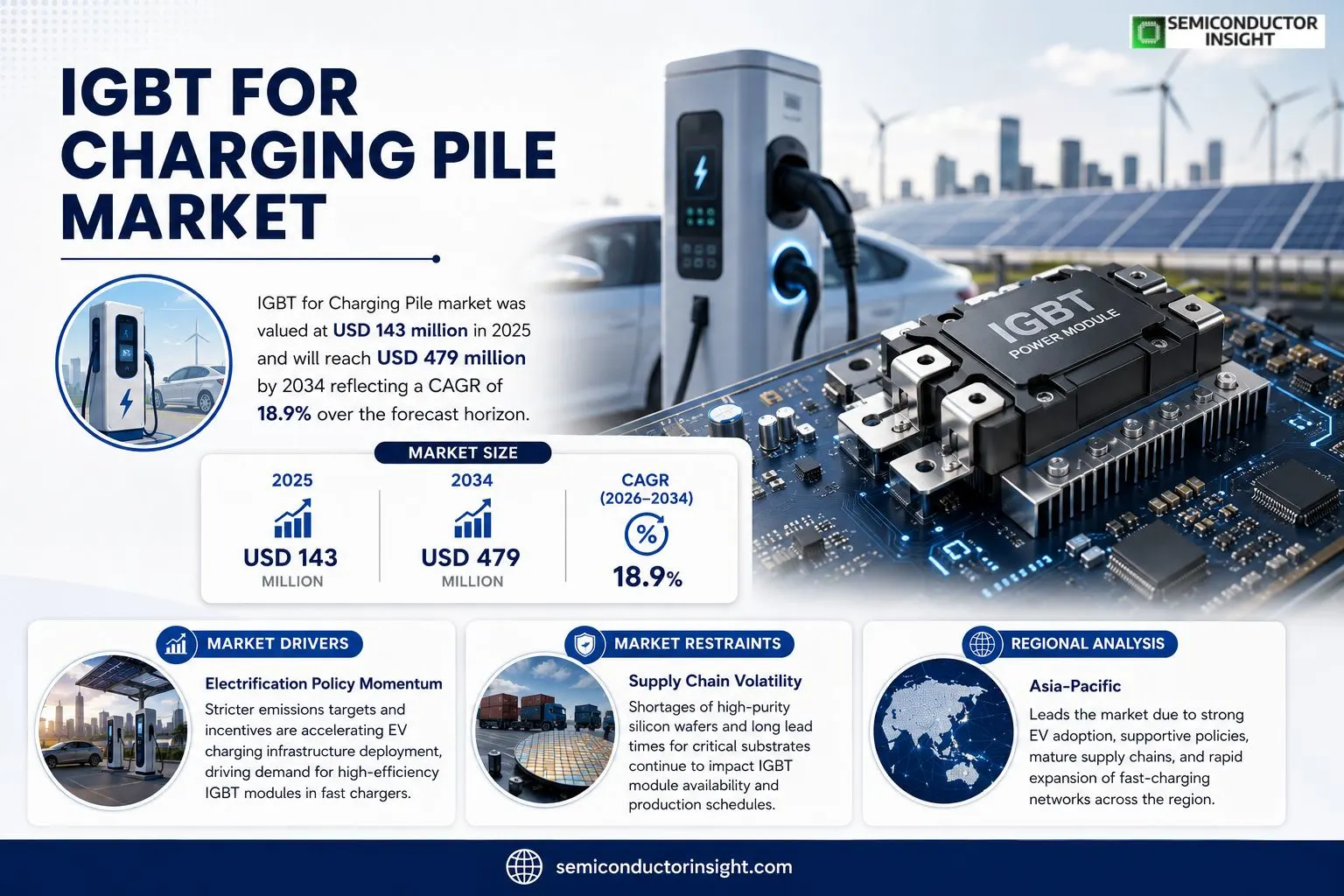
IGBT for Charging Pile market was valued at USD 143 million in 2025 and will reach USD 479 million by 2034 reflecting a CAGR of 18.9% over the forecast horizon.
IGBT for charging pile refers to insulated‑gate bipolar transistors that serve as the primary power‑switching devices in electric‑vehicle charging equipment, especially DC fast chargers and high‑power modules. An IGBT combines a MOSFET‑type gate drive with bipolar high‑current capability, making it suitable for medium‑to‑high power conversion.The market expands because ongoing deployment of EV charging infrastructure drives demand for robust power semiconductors, while advances such as trench‑gate field‑stop structures improve efficiency and thermal performance. Leading suppliersincluding Infineon, STMicroelectronics, onsemi, Mitsubishi Electric and Toshibaare focusing on scaling production capacity and enhancing device reliability to meet automotive‑grade specifications.
MARKET DRIVERS
Electrification Policy Momentum
Governments across Europe and Asia have instituted stricter emissions targets, prompting utilities and infrastructure owners to accelerate deployment of fast‑charging stations. This regulatory push compels manufacturers to adopt high‑efficiency IGBT modules, which can reduce conversion losses by up to 15 % compared with older silicon devices. The resulting cost‑of‑ownership advantage fuels a noticeable uptick in procurement orders.
Advances in Wide‑Bandgap Semiconductors
Recent breakthroughs in silicon‑carbide (SiC) and gallium‑nitride (GaN) packaging have lowered the price barrier for integrating IGBT for Charging Pile Market solutions into 150 kW and higher chargers. Manufacturers can now offer compact power modules that sustain higher switching frequencies, enabling chargers to occupy smaller footprints on constrained urban sites.
➤ Operators that prioritize energy‑dense IGBT designs are reporting a 20 % reduction in cooling infrastructure expenditure.
Beyond hardware, the rise of fleet electrification programs creates a predictable demand pipeline. Fleet managers favor stations equipped with reliable IGBT converters because they deliver stable voltage profiles, which in turn extend battery life for commercial vehicles. This alignment of operational need and technology performance strengthens market momentum.
MARKET CHALLENGES
Supply Chain Volatility
shortages of high‑purity silicon wafers have intermittently constrained the output of IGBT modules. While manufacturers have diversified sourcing, lead times for critical substrates remain above six months, complicating just‑in‑time production schedules for charging‑pile OEMs.
Other Challenges
Thermal Management Complexity
Higher power densities demand sophisticated cooling solutions. Integrators must balance cost against performance, often resorting to liquid‑cooling loops that increase system complexity and maintenance overhead.
MARKET RESTRAINTS
Capital Intensity of Upgrades
Retrofitting existing charging stations with next‑generation IGBT converters entails significant capital outlay. Asset owners evaluate return‑on‑investment against alternative upgrades, such as expanding station count, which can defer adoption of the latest semiconductor technology.
MARKET OPPORTUNITIES
Integration with Renewable Energy Sources
As utilities pair fast‑charging hubs with on‑site solar or wind generation, IGBT for Charging Pile Market players can deliver bi‑directional converters that support grid‑interactive functions. Such capability not only smooths peak‑load spikes but also opens revenue streams through ancillary services, positioning IGBT manufacturers as strategic partners in the energy transition.
IGBT for Charging Pile Market Trends
Efficiency‑Centric Architecture Dominates Design Choices
Manufacturers are increasingly configuring charging stations around high‑efficiency front‑end rectifiers and compact DC‑DC modules. By extracting more power per unit area, the thermal envelope shrinks, allowing designers to adopt lighter heat‑sink solutions and reduce overall system cost. The modular “power subunit stacking” approach, now a de‑facto standard, enables reuse of validated IGBT blocks across multiple power classes, shortens development cycles, and improves procurement leverage. Consequently, equipment suppliers are prioritising IGBT devices that deliver low on‑resistance and fast switching while maintaining robust voltage tolerance.
Other Trends
Supply‑Chain Consolidation and Service Orientation
The competitive landscape is shifting as semiconductor firms and emerging domestic players intensify rivalry. Buyers are no longer fixated on headline unit price; instead, they evaluate delivery reliability, lot‑to‑lot quality consistency, and the total cost of ownership over the product lifecycle. This service‑centric mindset pushes vendors to tighten inventory buffers, certify multiple qualification grades, and offer extended warranty clauses, thereby stabilising the flow of IGBT components to fast‑charging projects.
Technology Diversification Across Voltage Classes
Parallel to efficiency drives, the market is witnessing a migration toward advanced cell structures such as trench‑gate field‑stop (TGFS) and optimized planar designs. Higher‑voltage classes (1200 V and 1700 V) are gaining acceptance in premium fast‑charging deployments, where power density and EMI control become critical. Meanwhile, mainstream 600/650 V devices retain a strong foothold because of their mature supply base and predictable failure modes. This bifurcation compels OEMs to manage a mixed portfolio, balancing cost‑sensitive volume production with niche high‑performance offerings.
COMPETITIVE LANDSCAPE
Key Industry Players
Competitive Overview of IGBT Suppliers for EV Charging Piles
The IGBT segment for charging piles is dominated by a handful of multinational silicon specialists whose production footprints span Europe, Japan and the United States. Infineon, STMicroelectronics and Mitsubishi Electric command the bulk of the 37 million units sold in 2025, leveraging mature trench‑gate field‑stop (TGFS) designs that balance efficiency and cost. Their ability to sustain gross margins of 30‑50 % derives from deep wafer‑fab capacity, long‑term OEM contracts, and a reputation for reliable thermal performance under the high‑stress regimes of DC fast chargers. These firms also benefit from a diversified product portfolio that includes both industrial‑grade and automotive‑grade devices, allowing them to capture demand across residential, public and fleet‑charging applications while pricing pressure remains moderate.Chinese and other regional players have closed the gap by expanding epitaxial wafer lines and offering competitive pricing on 600 V and 1200 V modules. Companies such as PANJIT, Nell Power Semiconductor, GOODWORK Semiconductor and CRRC Times Semiconductor focus on the high‑volume, cost‑sensitive tier of the market, where scale and delivery reliability outweigh headline unit price. Their strategies emphasize modular “power subunit stacking” architectures that simplify system integration and accelerate time‑to‑market for fast‑charging networks. Meanwhile, niche innovators like Dynex Semiconductor and Littelfuse differentiate through advanced gate‑driver solutions and ruggedized packaging, targeting premium stations that demand higher power density and tighter EMI control. This layered competitive structure forces all participants to balance margin preservation with rapid technology refresh cycles.
List of Key IGBT for Charging Pile Companies Profiled
- Infineon Technologies AG
- STMicroelectronics
- onsemi
- Mitsubishi Electric Corporation
- Fuji Electric Co., Ltd.
- Toshiba Corporation
- Hitachi Energy
- Littelfuse, Inc.
- Dynex Semiconductor Ltd.
- PANJIT (Shanghai) Semiconductor Co., Ltd.
- Nell Power Semiconductor
- GOODWORK Semiconductor
- StarPower Semiconductor
- CRCR Times Semiconductor
- China Resources Microelectronics
- Marching Power
- CoolSemi (Shenzhen) Ltd.
- Oriental Semiconductor
- Suzhou Convert Semiconductor
- Lonten Semiconductor
Segment Analysis:
| Segment Category | Sub-Segments | Key Insights |
| By Type |
|
600/650V Class
|
| By Application |
|
Outdoor Fast Charging Pile
|
| By End User |
|
Charging Service Providers
|
| By Device Cell Structure |
|
Trench‑Gate Field‑Stop (TGFS) IGBT
|
| By Qualification Grade |
|
Automotive Grade
|
Regional Analysis: IGBT for Charging Pile Market
Asia-Pacific
Governments across the region have introduced tiered subsidies for high‑power chargers, explicitly referencing IGBT efficiency standards. These measures lower capital outlay for operators, while certification programmes push suppliers toward tighter performance tolerances.
A dense network of silicon wafer fabricators and assembly plants shortens the procurement cycle for IGBT modules, enabling rapid scaling of charging stations in emerging megacities.
Local OEMs prioritize IGBT‑centric architectures to meet rising demand for ultra‑fast charging, integrating advanced gate‑drive techniques that improve thermal management and reliability.
A blend of legacy semiconductor firms and agile startups fuels intense competition, driving incremental improvements in switch speed, voltage rating, and cost efficiency.
North America
North America’s IGBT for Charging Pile Market is shaped by a mature grid infrastructure and a strong emphasis on interoperability standards. Federal programs promote the rollout of Level 3 chargers in highway corridors, which compels manufacturers to adopt IGBT solutions that can sustain high duty cycles. The region’s focus on sustainability reporting pushes fleet operators to choose chargers with superior energy‑conversion efficiency, reinforcing demand for next‑generation IGBT devices. While domestic production remains limited, strategic partnerships with Asian suppliers ensure a steady flow of components, allowing U.S. and Canadian firms to remain competitive.
Europe
Europe’s approach blends regulatory rigor with ambitious decarbonisation targets. The European Union’s Common Charging Infrastructure Directive mandates minimum efficiency thresholds, directly influencing the specification of IGBT modules in public stations. Countries such as Germany and the Netherlands lead pilot projects that embed IGBT‑based converters within smart‑grid frameworks, enabling real‑time load shifting. Industry consortia are actively harmonising testing protocols, which reduces market entry barriers for new IGBT designs and encourages incremental innovation across the supply chain.
South America
In South America, market growth is anchored by government‑backed initiatives to expand charging networks in Brazil and Chile. Limited grid capacity in several locales makes the high efficiency of IGBT converters particularly valuable, as it mitigates the need for extensive auxiliary cooling equipment. Local assemblers are beginning to license IGBT technology, fostering a nascent domestic ecosystem that could reduce reliance on imports over the next decade. Stakeholders are closely monitoring policy shifts that may unlock additional funding for EV infrastructure, which would further elevate the role of IGBT components.
Middle East & Africa
The Middle East & Africa region exhibits a patchwork of development patterns. Wealthier Gulf states invest heavily in flagship charging hubs for high‑speed corridors, selecting IGBT‑based solutions to meet stringent performance criteria under extreme temperatures. Conversely, many African markets are still in the pilot phase, where the modular nature of IGBT converters offers a cost‑effective path to scale. Cross‑border collaborations with Asian manufacturers are gradually building local expertise, positioning the region to adopt more sophisticated charging architectures as EV adoption accelerates.
Report Scope
This market research report provides a comprehensive analysis of the IGBT for Charging Pile Market , covering the forecast period 2026–2034. It offers detailed insights into market dynamics, technological advancements, competitive landscape, and key trends shaping the industry.
Key focus areas of the report include:
- Market Overview: The report begins with an overview outlining its current market scenario, key growth indicators, and industry transformation drivers. It discusses macroeconomic factors, demand–supply balance, regulatory landscape, and the strategic role of semiconductors in powering advancements across industries such as automotive, telecommunications, consumer electronics, and industrial automation.
- Market Size & Forecast: Historical data and future projections for revenue, unit shipments, and market value across major regions and segments.
- Segmentation Analysis: Detailed breakdown by product type, technology, application, and end-user industry to identify high-growth segments and investment opportunities.
- Regional Insights: Insights into market performance across North America, Europe, Asia-Pacific, Latin America, and the Middle East & Africa, including country-level analysis where relevant.
- Competitive Landscape: Profiles of leading market participants, including their product offerings, R&D focus, manufacturing capacity, pricing strategies, and recent developments such as mergers, acquisitions, and partnerships.
- Technology Trends & Innovation: Assessment of emerging technologies, integration of AI/IoT, semiconductor design trends, fabrication techniques, and evolving industry standards.
- Market Drivers & Restraints: Evaluation of factors driving market growth along with challenges, supply chain constraints, regulatory issues, and market-entry barriers.
- Stakeholder Insights: Insights for component suppliers, OEMs, system integrators, investors, and policymakers regarding the evolving ecosystem and strategic opportunities.
Primary and secondary research methods are employed, including interviews with industry experts, data from verified sources, and real-time market intelligence to ensure the accuracy and reliability of the insights presented.
FREQUENTLY ASKED QUESTIONS:
What is the current market size of IGBT for Charging Pile Market?
-> IGBT for Charging Pile Market was valued at USD 143 million in 2025 and is expected to reach USD 479 million by 2032.
Which key companies operate in IGBT for Charging Pile Market?
-> Key players include Infineon, STMicroelectronics, onsemi, Mitsubishi Electric, Fuji Electric, Toshiba, Hitachi Energy, Littelfuse, Dynex Semiconductor, PANJIT, Nell Power Semiconductor, GOODWORK Semiconductor, StarPower Semiconductor, CRRC Times Semiconductor, China Resources Microelectronics, Marching Power, CoolSemi, Oriental Semiconductor, Suzhou Convert Semiconductor, Lonten Semiconductor.
What are the key growth drivers?
-> Key growth drivers include rapid expansion of EV charging infrastructure, increasing EV adoption, demand for higher efficiency and reliability in power conversion, modular power‑subunit stacking, and cost‑effective semiconductor solutions.
Which region dominates the market?
-> Asia-Pacific holds the largest share of the IGBT for Charging Pile market, driven by high EV penetration and aggressive charging network deployment, while Europe remains a significant growth region.
What are the emerging trends?
-> Emerging trends include adoption of trench‑gate field‑stop (TGFS) IGBT structures, integration of advanced gate‑driver technologies, push toward higher power‑density modules, and increasing substitution of IGBTs with newer wide‑bandgap devices in premium high‑power applications.

Get Sample Report PDF for Exclusive Insights
Report Sample Includes
- Table of Contents
- List of Tables & Figures
- Charts, Research Methodology, and more...
 Download Sample Report PDF