Silicon Carbide MOSFET Chips Market Insights
Silicon Carbide MOSFET Chips market was valued at USD 3,663 million in 2025 and is expected to climb to USD 21,698 million by 2034, delivering an approximate compound annual growth rate of 29 percent throughout the forecast horizon.
Silicon Carbide MOSFET chips refer to unpackaged SiC power‑MOSFET diesbare die or chipcut from a SiC wafer and comprising the full vertical device architecture (cell array, gate oxide, JFET region, drift layer, etc.). Compared with conventional packaged parts, these chips enable direct die‑attach and custom module integration, which reduces parasitic inductance and raises power density for high‑performance converters.The market gains momentum because automotive electrification demands higher efficiency chargers, renewable‑energy converters require robust high‑temperature devices, and data‑center power supplies seek smaller form factors with lower losses. Moreover, advances in epitaxial growth and high‑temperature activation annealing improve wafer yields, while vertical integration by leading suppliers stabilises pricing amid expanding capacity. As customers prioritize reliability and consistent performance across automotive‑grade modules, manufacturers that combine superior substrate quality with innovative packaging are well positioned to capture emerging opportunities.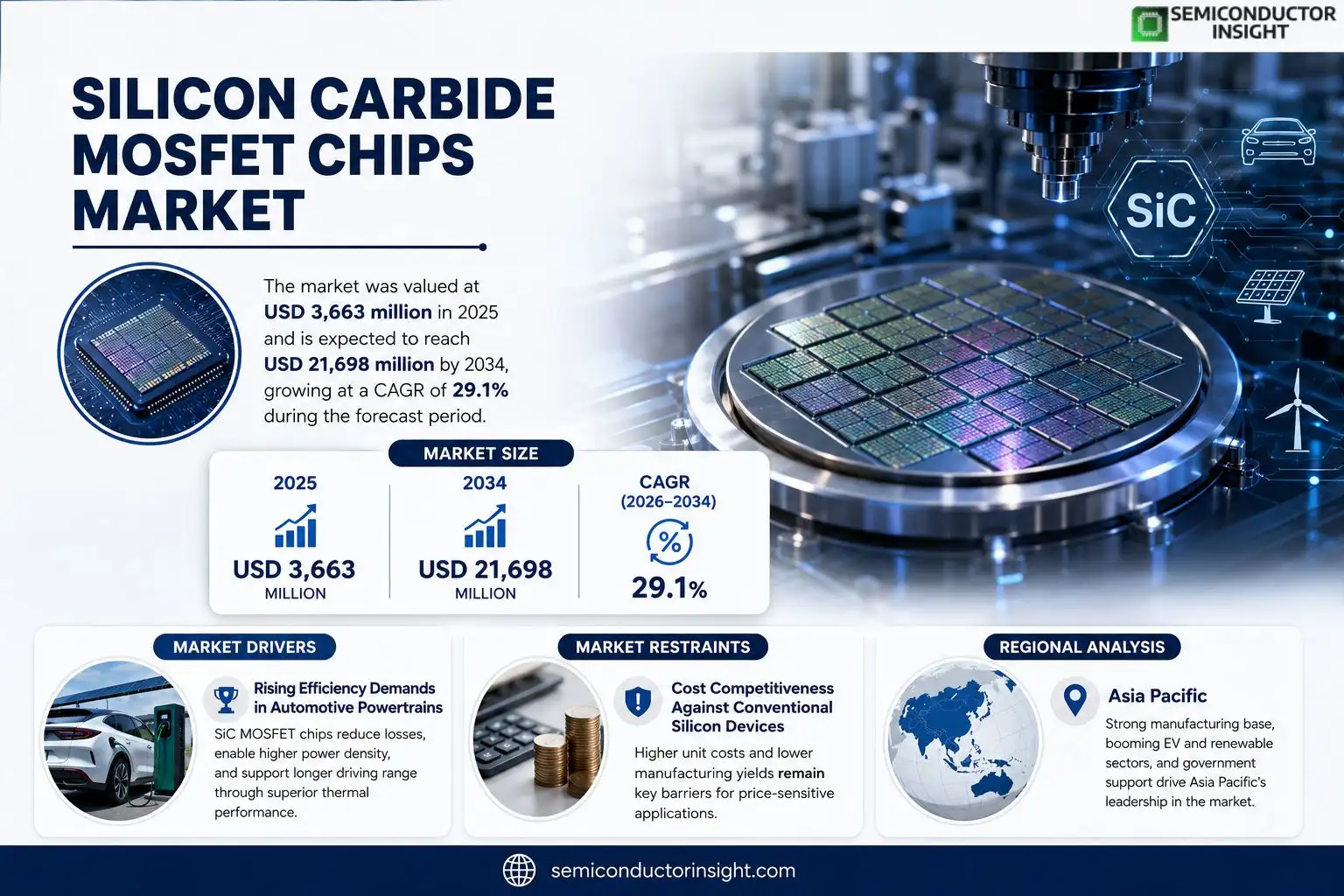
MARKET DRIVERS
Rising Efficiency Demands in Automotive Powertrains
Automakers are redesigning electric‑vehicle power modules to cut losses, and the thermal advantage of silicon carbide devices offers a clear path. Lower on‑board resistance translates into smaller cooling systems, which frees up chassis space and reduces vehicle weight. As manufacturers chase longer driving ranges, Silicon Carbide MOSFET Chips Market benefits from each incremental efficiency gain.
Expansion of Renewable Energy Inverter Platforms
Grid‑scale solar and wind installations increasingly rely on inverters that must handle high voltage while maintaining tight control. Silicon carbide switches sustain higher switching frequencies, enabling compact inverter architectures and improved power density. The 2023 shipment data shows a 14% rise in inverter‑grade SiC MOSFET volumes, underscoring the technology’s relevance to clean‑energy projects.
➤ Industry observers note that the convergence of automotive electrification and renewable‑energy integration is reshaping component sourcing strategies, making silicon carbide a preferred choice for next‑generation designs.
Beyond the two headline areas, data‑center power supplies are also turning to SiC for tighter regulation and lower operational costs. The combined effect of these sectors is creating a multi‑pronged demand curve that strengthens the market’s foundation.
MARKET CHALLENGES
Cost Competitiveness Against Conventional Silicon Devices
While performance metrics are compelling, the higher unit price of SiC MOSFETs remains a barrier for price‑sensitive applications. OEMs weighing total cost of ownership often encounter initial capital outlays that exceed the budgets allocated for legacy silicon solutions, slowing broader adoption.
Other Challenges
Manufacturing Yield Constraints
Silicon carbide wafers are intrinsically harder to process, leading to lower yields during the epitaxial growth stage. Reduced yield percentages elevate production costs and can create supply bottlenecks, especially when demand spikes in a short window.
MARKET RESTRAINTS
Limited Availability of Qualified Foundries
The niche nature of silicon carbide processing confines manufacturing to a handful of specialized foundries. This concentration restricts capacity expansion and introduces lead‑time volatility for customers that require predictable delivery schedules. As a result, some system integrators opt for more readily available silicon alternatives despite the efficiency trade‑offs.
MARKET OPPORTUNITIES
Emerging High‑Voltage Railway Traction Systems
Rail networks upgrading to high‑speed, electric traction are evaluating SiC MOSFETs for their ability to handle voltages above 3 kV while maintaining compact form factors. Early pilots in Europe and Asia demonstrate that replacing silicon IGBTs with SiC devices can cut energy losses by up to 18%, presenting a lucrative niche for manufacturers willing to tailor devices to railway specifications.
Advanced Driver‑Assistance Systems (ADAS) Integration
ADAS modules demand rapid response times and high reliability under variable thermal conditions. Silicon carbide’s inherent robustness makes it an attractive candidate for power‑train control units within these safety‑critical systems. Forecasts indicate that dedicated ADAS power modules could account for a meaningful share of new SiC MOSFET orders within the next five years.
Silicon Carbide MOSFET Chips Market Trends
Shift Toward Higher Power Density in Automotive Chargers
The adoption of SiC die‑attach solutions is redefining charger architecture for electric‑vehicle platforms. By eliminating the parasitic inductance of conventional packaged devices, manufacturers can raise switching frequencies, which directly trims magnetic size and eases thermal design. In 2025, average unit pricing settled near US$ 12, while sales of roughly 334 million pieces reflected a market that is already rewarding designs that squeeze more watts per cubic centimeter. This dynamic forces OEMs to favor suppliers that can guarantee consistent epitaxial quality and tight control over ion‑implant activation, because a single variation in drift‑layer resistivity can cascade into larger heatsink budgets. The commercial impact is clear: firms that combine vertical integration with proven yield learning are able to lock in price stability, allowing vehicle integrators to meet tighter efficiency mandates without inflating bill‑of‑materials.
Other Trends
Supply‑Chain Consolidation and Yield Management
Upstream, the limited number of 4H‑SiC substrate producers has spurred strategic partnerships aimed at smoothing capacity bottlenecks. Companies that have invested in high‑temperature anneal lines report margin expansions ranging from 25 % to 50 %, a sign that yield improvements are translating into tangible financial upside. Downstream, OSAT players are standardizing low‑inductance interconnect stacks, which reduces variability in module performance and shortens qualification cycles for automotive customers. As these relationships mature, Silicon Carbide MOSFET Chips Market experiences a modest compression in pricing pressure, yet the premium attached to verified reliability continues to sustain healthy gross margins for incumbents.
Emerging Opportunities in Grid‑Scale Energy Storage
Beyond mobility, high‑voltage SiC chips are gaining traction in stationary power conversion where inverter efficiency directly influences the levelized cost of stored energy. The ability to operate at temperatures above 200 °C permits designers to eliminate bulky cooling plates, thereby lowering installation footprints for utility‑scale battery farms. Anticipated tightening of grid‑code efficiency standards means that converters built around SiC dies will command preference, especially in regions pursuing aggressive renewable integration. This trend is prompting several semiconductor vendors to extend their product portfolios toward 1700 V class devices, positioning the sector to capture incremental demand from both new build projects and retrofit programs across power infrastructure.
COMPETITIVE LANDSCAPE
Key Industry Players
Silicon Carbide MOSFET Chips Market: Competitive Dynamics and Player Positioning
Infineon, Wolfspeed and ROHM dominate the silicon‑carbide MOSFET die segment, each leveraging vertically integrated supply chains that span substrate procurement, epitaxial growth and high‑temperature activation. Their ability to sustain yield improvements while offering a broad voltage range (650 V–1700 V) gives them pricing leverage and secures long‑term contracts with automotive OEMs and charging‑infrastructure vendors. Onsemi and STMicroelectronics complement the leadership tier by focusing on high‑volume automotive power modules, where their established relationships with Tier‑1 suppliers translate into repeat orders for SiC chips that power next‑generation electric‑vehicle chargers.Beyond the dominant trio, a constellation of specialized firms adds depth to the competitive picture. Navitas Semiconductor concentrates on high‑frequency, low‑inductance designs that appeal to data‑center power converters, while Mitsubishi Electric and Toshiba exploit legacy power‑electronics expertise to enter niche industrial markets. Microchip and Bosch pursue ecosystem strategies, bundling SiC dies with reference designs that accelerate customer adoption. Shenzhen BASiC Semiconductor, emerging from the Chinese foundry ecosystem, offers cost‑competitive wafers that attract regional OEMs seeking supply‑chain diversification. These players differentiate through unique process patents, localized manufacturing footprints or aggressive after‑sales support, thereby shaping a market where performance, reliability and delivery certainty compete on equal footing.
List of Key Silicon Carbide MOSFET Chips Companies Profiled
- Infineon Technologies AG
- Wolfspeed, Inc.
- ROHM Semiconductor
- ON Semiconductor
- STMicroelectronics
- Mitsubishi Electric Corporation
- Toshiba Corporation
- Navitas Semiconductor
- Microchip Technology Inc.
- Bosch Automotive Electronics
- Shenzhen BASiC Semiconductor
- AMPER Semiconductor
Segment Analysis:
| Segment Category | Sub-Segments | Key Insights |
| By Type |
|
High‑Voltage Class drives market momentum because it enables compact power‑dense designs.
|
| By Application |
|
Automotive & EV Charging remains the foremost growth engine.
|
| By End User |
|
Vehicle OEMs prioritize supply‑chain reliability and long‑term qualification.
|
| By Voltage Class |
|
Mid‑Voltage Segment is gaining traction as system designers balance performance and cost.
|
| By Gate Architecture |
|
Trench‑gate Architecture is prized for its low on‑resistance and fast switching capability.
|
Regional Analysis: Silicon Carbide MOSFET Chips Market
North America
The regional logistics framework links silicon carbide wafer suppliers in Arizona with assembly plants in Michigan, shortening lead times and reducing inventory buffers. This proximity enables manufacturers to iterate designs rapidly, a critical factor when engineering devices for high‑frequency applications where tolerances are tight.
Federal tax credits for energy‑efficient equipment have been extended to cover SiC‑based power modules, encouraging OEMs to specify these components in new vehicle platforms. State‑level programs further augment adoption by subsidising pilot projects in heavy‑duty fleets.
Beyond automotive, aerospace manufacturers are experimenting with SiC MOSFETs for electric propulsion systems, while data‑center operators explore their low‑loss characteristics to improve power‑delivery efficiency in high‑density racks.
Leading firms leverage vertically integrated production to capture margin advantage, whereas emerging players focus on niche applications such as high‑temperature sensor interfaces, carving out specialized market segments.
Europe
European manufacturers are capitalising on stringent emissions directives that compel automotive suppliers to adopt power‑efficient components. Countries such as Germany and France have cultivated clusters where SiC device designers collaborate closely with vehicle manufacturers, fostering co‑development cycles that shorten time‑to‑market. The region’s emphasis on circular‑economy principles also drives interest in the longer lifespan of SiC MOSFETs, positioning them as a sustainable alternative to silicon equivalents. While the overall market size lags behind North America, the depth of engineering expertise and the presence of Tier‑1 automotive partners ensure a steady pipeline of high‑margin contracts.
Asia‑Pacific
Asia‑Pacific stands out for its manufacturing scalability and cost‑effective production capacity. China’s extensive semiconductor foundries are rapidly upgrading to accommodate wide‑bandgap processes, attracted by the domestic demand for electric buses and two‑wheelers. Japan’s legacy in power electronics continues to feed advanced SiC designs for industrial drives, and South Korea’s investment in next‑generation fabs adds a layer of technical sophistication. The region’s growth is propelled by a confluence of government subsidies, a broad base of OEMs, and an emerging ecosystem of component distributors eager to meet the surging demand for efficient power conversion.
South America
In South America, market momentum is linked to renewable‑energy projects, particularly in Brazil and Chile, where utility operators are retrofitting substations with SiC‑enabled converters to improve grid stability. The relatively modest automotive footprint limits immediate volume, yet the region’s focus on expanding solar‑farm capacity creates a niche for high‑temperature, low‑loss devices. Local partnerships between semiconductor firms and energy service companies are beginning to shape a value chain that can sustain modest but consistent growth.
Middle East & Africa
The Middle East & Africa region is characterised by concentrated demand in oil‑rich economies that are diversifying toward clean‑energy infrastructure. United Arab Emirates and Saudi Arabia have announced initiatives to integrate SiC MOSFETs into offshore wind turbines and hydrogen‑electrolysis plants, citing the technology’s superior thermal performance. African markets, while still nascent, are exploring SiC solutions for off‑grid solar micro‑grids, where efficiency directly translates to reduced battery turnover. The strategic importance of these projects lies less in immediate sales volume and more in establishing early references that could catalyse broader regional adoption.
Report Scope
This market research report provides a comprehensive analysis of the Silicon Carbide MOSFET Chips Market , covering the forecast period 2026–2034. It offers detailed insights into market dynamics, technological advancements, competitive landscape, and key trends shaping the industry.
Key focus areas of the report include:
- Market Overview: The report begins with an overview outlining its current market scenario, key growth indicators, and industry transformation drivers. It discusses macroeconomic factors, demand–supply balance, regulatory landscape, and the strategic role of semiconductors in powering advancements across industries such as automotive, telecommunications, consumer electronics, and industrial automation.
- Market Size & Forecast: Historical data and future projections for revenue, unit shipments, and market value across major regions and segments.
- Segmentation Analysis: Detailed breakdown by product type, technology, application, and end-user industry to identify high-growth segments and investment opportunities.
- Regional Insights: Insights into market performance across North America, Europe, Asia-Pacific, Latin America, and the Middle East & Africa, including country-level analysis where relevant.
- Competitive Landscape: Profiles of leading market participants, including their product offerings, R&D focus, manufacturing capacity, pricing strategies, and recent developments such as mergers, acquisitions, and partnerships.
- Technology Trends & Innovation: Assessment of emerging technologies, integration of AI/IoT, semiconductor design trends, fabrication techniques, and evolving industry standards.
- Market Drivers & Restraints: Evaluation of factors driving market growth along with challenges, supply chain constraints, regulatory issues, and market-entry barriers.
- Stakeholder Insights: Insights for component suppliers, OEMs, system integrators, investors, and policymakers regarding the evolving ecosystem and strategic opportunities.
Primary and secondary research methods are employed, including interviews with industry experts, data from verified sources, and real-time market intelligence to ensure the accuracy and reliability of the insights presented.
FREQUENTLY ASKED QUESTIONS:
What is the current market size of Silicon Carbide MOSFET Chips Market?
-> Silicon Carbide MOSFET Chips Market was valued at USD 3663 million in 2025 and is expected to reach USD 21698 million by 2034, growing at a CAGR of 29.1% during the forecast period.
Which key companies operate in Silicon Carbide MOSFET Chips Market?
-> Key players include Infineon, Wolfspeed, ROHM, Onsemi, Bosch, STMicroelectronics, Mitsubishi Electric, Toshiba, Microchip, Navitas Semiconductor, Shenzhen BASiC Semiconductor, among others.
What are the key growth drivers?
-> Key growth drivers include increasing demand for high‑efficiency charging infrastructure, higher‑power charger platforms, grid‑side energy storage, renewable energy integration, and data‑center power conversion needs.
Which region dominates the market?
-> Asia is the dominant region, driven by strong manufacturing bases and rapidly expanding automotive and renewable sectors.
What are the emerging trends?
-> Emerging trends include advances in vertical integration and packaging innovation, broader adoption in electric‑vehicle fast chargers, and expanding use in grid‑level power conversion applications.
Get Sample Report PDF for Exclusive Insights
Report Sample Includes
- Table of Contents
- List of Tables & Figures
- Charts, Research Methodology, and more...
 Download Sample Report PDF