Automotive Grade High Side Switches Market Insights
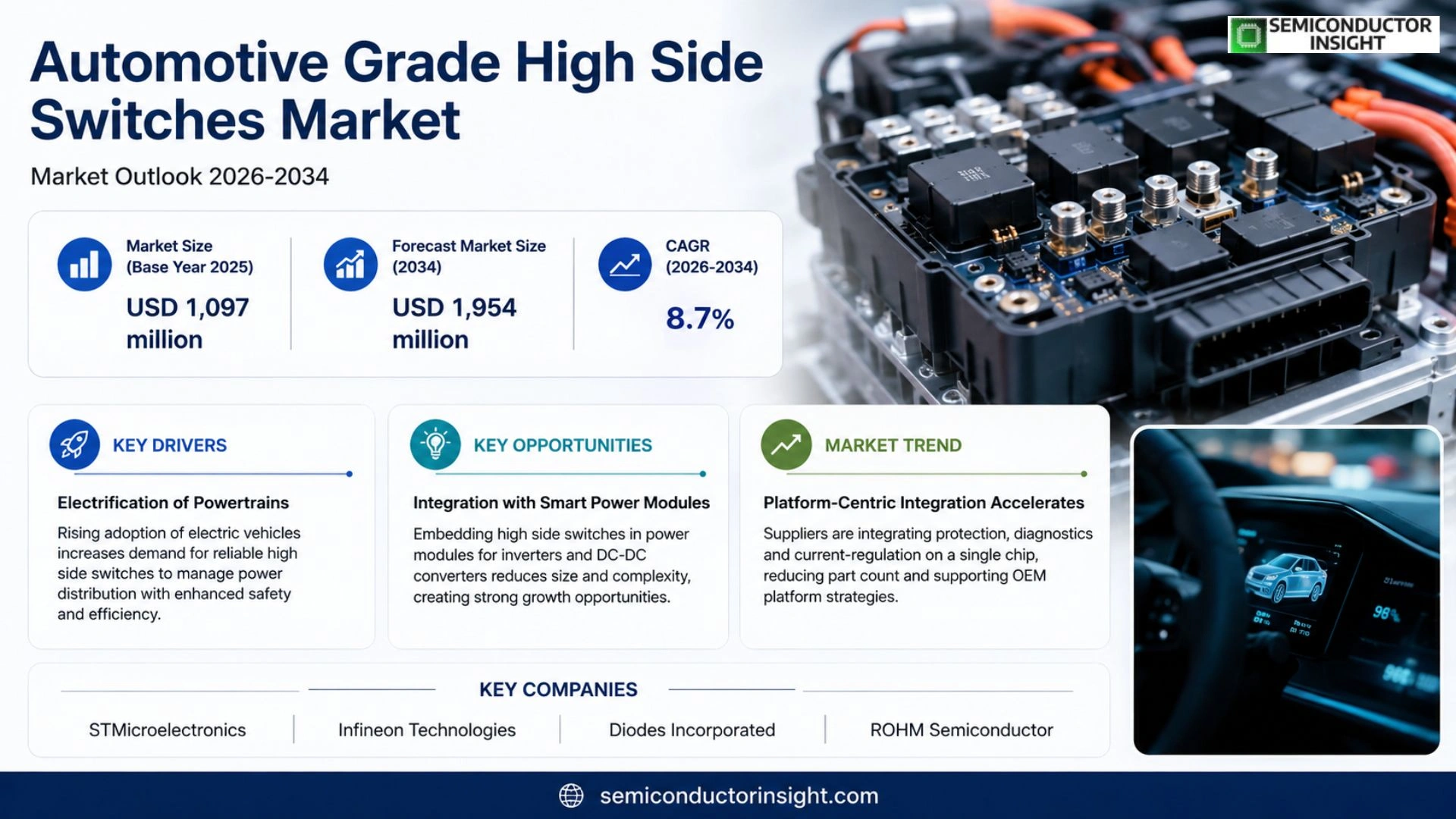
Global Automotive Grade High Side Switches market is projected to grow from USD 1,097 million in 2025 to USD 1,954 million by 2034, exhibiting a CAGR of 8.7% during the forecast period.
Automotive Grade High Side Switches are dedicated control ICs designed for high‑side load management in vehicle electrical architectures. They integrate switching control, protection and diagnostic functions, enabling safe and efficient power distribution across body electronics and power‑related systems.
The market expands because vehicle electrification raises the number of electronically controlled loads, while platform‑based designs push integration levels and reduce component count. Leading suppliers such as STMicroelectronics, Infineon and ROHM are accelerating product roadmaps, and recent collaborations on next‑generation protection modules have reinforced demand across passenger‑car and commercial‑vehicle segments.
MARKET DRIVERS
Electrification of Powertrains
The shift from internal‑combustion engines to electric drivetrains forces vehicle manufacturers to redesign their power distribution architecture. High side switches built to automotive‑grade specifications become indispensable for managing battery‑to‑load pathways, delivering precise control while meeting stringent safety standards. As a result, the Automotive Grade High Side Switches Market experiences a noticeable uplift in component orders from tier‑one suppliers.
Advanced Driver‑Assistance Systems (ADAS)
ADAS modules rely on fast, reliable switching to protect sensors, lidar units and communication buses. The need for compact, low‑loss devices that can survive harsh thermal cycles drives OEMs to specify newer generations of high side switches. This trend not only expands the Bill of Materials but also pushes vendors to innovate around integration density.
➤ “Every additional kW of electric propulsion requires a proportional increase in protected high‑side switching capacity.”
Regulatory pressure on crash safety and electromagnetic compatibility further compels engineers to adopt components with certified automotive grades. The combined effect of performance demands and compliance requirements creates a robust catalyst for market expansion.
MARKET CHALLENGES
Cost Sensitivity in Volume Production
While technology advances rapidly, manufacturers must keep unit costs under tight control to preserve profit margins on mass‑produced models. High side switch designs that incorporate silicon‑carbide or gallium‑nitride offer superior efficiency but often carry premium price tags, forcing buyers to balance performance against budget constraints.
Other Challenges
Supply Chain Volatility
Global semiconductor shortages, coupled with regional trade disruptions, have introduced lead‑time uncertainty for critical switching components. OEMs are increasingly scrutinizing supplier footprints, favoring partners that can guarantee stable delivery schedules.
MARKET RESTRAINTS
Stringent Reliability Testing
Automotive qualification programs such as AEC‑Q100 and ISO‑26262 demand extensive endurance testing. The need to pass these hurdles adds development cycles and validation costs, which can deter smaller entrants and slow the rollout of next‑generation high side switches.
MARKET OPPORTUNITIES
Integration with Smart Power Modules
Emerging architectures that embed high side switches directly within power modules for inverters and DC‑DC converters promise a reduction in board space and wiring complexity. Companies that can deliver fully integrated, automotive‑grade solutions stand to capture a sizable share of the Automotive Grade High Side Switches Market as OEMs pursue lighter, more modular designs.
Automotive Grade High Side Switches Market Trends
Platform‑Centric Integration Accelerates
Automakers are tightening tolerances on wiring architecture as vehicle electrification introduces dozens of new loads. Suppliers that can collapse protection, diagnostics and current‑regulation functions onto a single die are gaining a decisive edge. The move toward platform‑based designs reduces part count, simplifies board layout and trims validation cycles, translating directly into lower per‑vehicle cost. Margins have become closely linked to the ability to deliver a high‑density switch that still meets the 40 % gross‑margin benchmark observed in recent production runs. Companies that align their road‑maps with OEM platform cycles,reusing the same controller across multiple models,are positioned to capture the bulk of volume growth while preserving profitability.
Other Trends
Supply Chain Consolidation
The upstream ecosystem is coalescing around a handful of wafer and molding providers such as Shanghai Silicon Industry and Shin‑Etsu Chemical. As capacity utilization hovers near 70 %, manufacturers are negotiating longer‑term contracts to lock in raw‑material pricing and improve yield predictability. This consolidation reduces exposure to price volatility but also raises entry barriers for new entrants, reinforcing the advantage of established players with deep supplier relationships. The downstream effect is a smoother flow of qualified silicon to the assembly lines of major Chinese OEMs, which in turn supports stable production volumes for the high‑side switch segment.
Intelligent Load Management Becomes Standard
Vehicle architectures now embed sophisticated diagnostic and fault‑logging capabilities directly within the switch controller. This shift enables centralized monitoring of body‑electronic subsystems, lessening the diagnostic burden on service technicians and improving warranty outcomes for manufacturers. The added intelligence also supports adaptive current limiting, which protects downstream components as power‑draw patterns become more erratic with the rise of electric auxiliary systems. By embedding these functions, suppliers not only differentiate their product portfolio but also deliver measurable system‑level savings, a factor that is increasingly decisive in high‑volume platform negotiations.
COMPETITIVE LANDSCAPE
Key Industry Players
Automotive Grade High Side Switches: Competitive Overview
The segment is dominated by a handful of large silicon houses that have leveraged deep automotive qualification programmes and system‑level integration expertise. STMicroelectronics and Infineon command a sizable share thanks to their extensive power‑management portfolios, which combine high‑side control, protection, and diagnostic capabilities in a single die. Their ability to embed these functions across multiple vehicle platforms reduces part counts for OEMs and sustains healthy gross margins despite price pressure on high‑volume models. Texas Instruments and NXP Semiconductors also feature prominently; both firms have accelerated the migration toward dual‑channel architectures that simplify wiring harnesses and improve fault isolation. The competitive thrust revolves around platform‑centric design, where each new vehicle program re‑uses a validated controller family, thereby lowering validation costs and accelerating time‑to‑market. This approach is reshaping bargaining dynamics, as OEMs increasingly demand long‑term supply guarantees and collaborative road‑mapping.
Beyond the tier‑one giants, a cadre of specialized manufacturers is carving out niches through differentiated product mixes or regional focus. ROHM, Renesas, and Diodes Incorporated excel in offering 12 V and 24 V families tuned for body‑electronics and comfort‑system applications, where thermal robustness is a decisive factor. Smaller Asian players such as Fujitsu, Vishay and Cypress (now part of Infineon) are gaining traction in the commercial‑vehicle niche by tailoring packages for harsh environments and offering aggressive pricing tied to local foundry capacity. Chinese firms, notably Shanghai Silicon Industry and Nanda Optoelectronics, have scaled production rapidly, leveraging domestic auto programmes to achieve economies of scale. Their ascent adds competitive pressure on pricing while expanding the supplier base for OEMs seeking alternative sources. The net effect is a market where scale, integration depth, and regional manufacturing agility together dictate competitive positioning.
List of Key Automotive Grade High Side Switches Companies Profiled
- STMicroelectronics
- Infineon Technologies
- Diodes Incorporated
- ROHM Semiconductor
- Renesas Electronics
- Fuji Electric
- Texas Instruments
- Microchip Technology
- onsemi
- Toshiba Electronic Devices & Power Solutions
- NXP Semiconductors
- Vishay Intertechnology
- Analog Devices
- Maxim Integrated
- Shanghai Silicon Industry
Segment Analysis:
| Segment Category | Sub-Segments | Key Insights |
| By Type |
|
12V Controller
|
| By Application |
|
Body Electronics
|
| By End User |
|
Passenger Cars
|
| By Integration Level |
|
Integrated Power Management ICs
|
| By Functional Focus |
|
Diagnostic Integration
|
Regional Analysis: Automotive Grade High Side Switches Market
North America
Recent disruptions have prompted manufacturers to co‑locate silicon fabs with assembly plants, shortening lead times for high‑side switches. This strategic shift reduces inventory risk and enables faster response to design iterations, a clear advantage for OEMs chasing short model cycles.
The migration toward 48‑V and higher voltage platforms demands switches that can handle larger fault currents without compromising thermal performance, nudging suppliers to expand their silicon‑carbide portfolios.
OEM design teams are consolidating multiple protection functions into single high‑side switch devices, which trims board space and simplifies validation, a move that resonates strongly with cost‑focused engineering groups.
Stringent safety standards around short‑circuit protection encourage adoption of devices with integrated diagnostics, prompting suppliers to embed self‑test capabilities directly into the switch architecture.
Europe
European manufacturers benefit from a tightly knit network of automotive clusters in Germany, France, and Italy, where high‑side switch specifications are often harmonized across multiple brands. The region’s emphasis on sustainability drives designers to prioritize components that minimize standby losses, reinforcing demand for efficient silicon carbide options. Collaborative research initiatives between universities and OEMs further accelerate the integration of advanced switch topologies into next‑generation EV platforms.
Asia‑Pacific
The Asia‑Pacific landscape is characterised by rapid model turnover and aggressive pricing pressures, especially in China, Japan, and South Korea. Original equipment manufacturers leverage high‑side switches to achieve compact power‑train layouts that fit smaller vehicle footprints. Local semiconductor firms are scaling up production capacities, aiming to meet the volume requirements of mass‑market electric models while offering competitive pricing structures.
South America
In Brazil and Argentina, the market is shaped by a growing interest in hybrid drivetrains as governments introduce incentives for reduced emissions. Suppliers focus on ruggedized switch designs that can withstand higher ambient temperatures and diverse road conditions. The region’s manufacturers are beginning to align with global standards, creating a pathway for broader component adoption.
Middle East & Africa
The Middle East & Africa region showcases a blend of luxury vehicle demand and nascent electric vehicle projects. High‑side switches are valued for their ability to provide reliable protection in high‑temperature environments prevalent across the Gulf states. Emerging auto‑assembly hubs in South Africa are establishing partnerships with global silicon vendors, laying the groundwork for a more integrated supply chain.
Report Scope
This market research report provides a comprehensive analysis of the Automotive Grade High Side Switches Market , covering the forecast period 2026–2034. It offers detailed insights into market dynamics, technological advancements, competitive landscape, and key trends shaping the industry.
Key focus areas of the report include:
- Market Overview: The report begins with an overview outlining its current market scenario, key growth indicators, and industry transformation drivers. It discusses macroeconomic factors, demand–supply balance, regulatory landscape, and the strategic role of semiconductors in powering advancements across industries such as automotive, telecommunications, consumer electronics, and industrial automation.
- Market Size & Forecast: Historical data and future projections for revenue, unit shipments, and market value across major regions and segments.
- Segmentation Analysis: Detailed breakdown by product type, technology, application, and end-user industry to identify high-growth segments and investment opportunities.
- Regional Insights: Insights into market performance across North America, Europe, Asia-Pacific, Latin America, and the Middle East & Africa, including country-level analysis where relevant.
- Competitive Landscape: Profiles of leading market participants, including their product offerings, R&D focus, manufacturing capacity, pricing strategies, and recent developments such as mergers, acquisitions, and partnerships.
- Technology Trends & Innovation: Assessment of emerging technologies, integration of AI/IoT, semiconductor design trends, fabrication techniques, and evolving industry standards.
- Market Drivers & Restraints: Evaluation of factors driving market growth along with challenges, supply chain constraints, regulatory issues, and market-entry barriers.
- Stakeholder Insights: Insights for component suppliers, OEMs, system integrators, investors, and policymakers regarding the evolving ecosystem and strategic opportunities.
Primary and secondary research methods are employed, including interviews with industry experts, data from verified sources, and real-time market intelligence to ensure the accuracy and reliability of the insights presented.
FREQUENTLY ASKED QUESTIONS:
What is the current market size of Automotive Grade High Side Switches Market?
-> Automotive Grade High Side Switches market is projected to grow from USD 1,954 million by 2034, exhibiting a CAGR of 8.7% during the forecast period.
Which key companies operate in Automotive Grade High Side Switches Market?
-> Key players include STMicroelectronics, Infineon, Diodes Incorporated, ROHM, Renesas, Fuji Electric, Texas Instruments, Microchip, onsemi, Toshiba, among others.
What are the key growth drivers?
-> Key growth drivers include increasing vehicle electrical architecture complexity, rising number of electronically controlled loads, demand for integrated protection and diagnostic functions, and the shift toward platform‑based design that reduces system cost and component count.
Which region dominates the market?
-> Asia dominates the Automotive Grade High Side Switches market, driven by high production volumes of passenger and commercial vehicles, while Europe remains a strong secondary market.
What are the emerging trends?
-> Emerging trends include higher single‑chip integration, AI‑enabled diagnostic analytics, migration to 24 V vehicle architectures, and the development of robust, high‑temperature silicon carbide (SiC) switch solutions.
Get Sample Report PDF for Exclusive Insights
Report Sample Includes
- Table of Contents
- List of Tables & Figures
- Charts, Research Methodology, and more...
 Download Sample Report PDF