SiC MOSFET for Charging Pile Market Insights
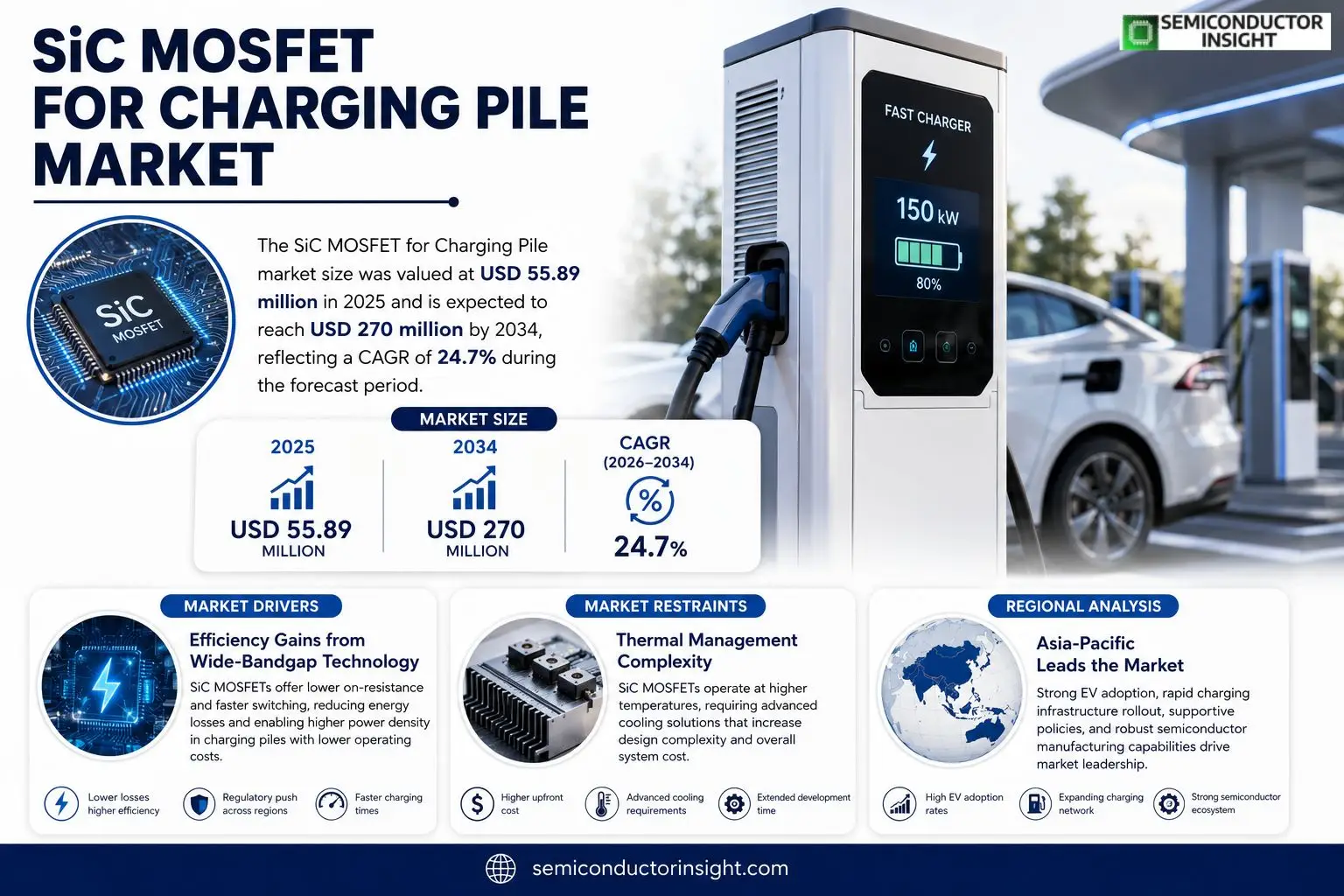
SiC MOSFET for Charging Pile market size was valued at USD 55.89 million in 2025 and is expected to reach USD 270 million by 2034, reflecting an implied CAGR of roughly 24.7 % over the period.
A SiC MOSFET for a charging pile is a silicon‑carbide power transistor that operates as a high‑voltage, fast‑switching, voltage‑controlled switch within EV charging equipment (both AC/DC front‑end and DC/DC conversion stages). Compared with conventional silicon devices, it enables higher switching frequencies with lower loss, thereby improving overall efficiency and power density of high‑performance charging stations.The upward trend stems from operators shifting focus toward energy‑cost optimisation, tighter thermal management and higher uptime requirements. Because SiC devices reduce magnetics size and cooling demand, system designers can achieve smaller enclosures and lower Total Cost of Ownership, factors that are increasingly influencing procurement decisions across residential and commercial charging networks.
MARKET DRIVERS
Efficiency Gains from Wide‑Bandgap Technology
The adoption of SiC MOSFET for Charging Pile Market is being propelled by its markedly lower on‑resistance, which translates into appreciable reductions in conversion losses. Operators of electric‑vehicle charging stations can therefore deliver higher power density while consuming less electricity, directly impacting operating margins. This efficiency edge becomes especially compelling in jurisdictions where energy tariffs are on an upward trajectory.
Regulatory Momentum Accelerating Adoption
Governments across Europe and Asia have introduced stricter efficiency standards for public charging infrastructure. Compliance often necessitates the integration of silicon‑carbide devices, positioning SiC MOSFET as a de‑facto requirement rather than an optional upgrade. The regulatory temperature creates a clear incentive for manufacturers to redesign power modules around this technology.
➤ “Switching to SiC MOSFET unlocks a 30 % reduction in thermal management costs for high‑power chargers.”
Beyond policy, the competitive landscape is reshaping as OEMs strive to differentiate their charging solutions through faster charge times. SiC MOSFET enables higher switching frequencies without compromising reliability, allowing chargers to reach peak outputs in shorter intervals. The resultant performance boost is a compelling selling point for fleet operators seeking rapid turnaround.
MARKET CHALLENGES
Cost Sensitivity in Emerging Markets
While the technical merits of SiC MOSFET for Charging Pile Market are well documented, price remains a stumbling block in regions where capital expenditure thresholds are tight. The upfront premium over traditional silicon devices can deter investment, even when life‑cycle savings are evident.
Other Challenges
Supply Chain Constraints
The semiconductor ecosystem is still adjusting to the volume demand for wide‑bandgap components. Limited wafer‑fab capacity and the necessity for high‑purity substrates occasionally result in lead times that outpace project schedules, compelling developers to seek alternative component strategies.
MARKET RESTRAINTS
Thermal Management Complexity
SiC MOSFET devices operate at higher junction temperatures, which obliges system designers to incorporate advanced cooling techniques. The added engineering effort can inflate development costs and extend time‑to‑market, especially for smaller players lacking in‑house thermal expertise.
MARKET OPPORTUNITIES
Integration with Smart‑Grid Platforms
The convergence of high‑efficiency power conversion and digital energy management presents a fertile ground for growth. By embedding SiC MOSFET for Charging Pile Market within interoperable smart‑grid architectures, utilities can orchestrate load balancing, demand response, and ancillary services, thereby extracting new revenue streams from existing infrastructure.
SiC MOSFET for Charging Pile Market Trends
Efficiency‑Driven Architecture Adoption
The charging‑infrastructure sector is shifting from a pure deployment mindset to one that prioritises energy‑cost reduction and uptime. Operators now favor modular, liquid‑cooled designs that can sustain higher power densities without excessive cooling hardware. SiC MOSFETs, with their ability to operate at higher switching frequencies and lower losses, become a decisive element in this transition. By enabling reduced magnetics and slimmer enclosures, they directly improve the thermal margin of a charging pile, allowing stations to deliver more kilowatts per square metre of footprint. This efficiency gain not only lowers operating expenses but also creates a competitive edge for service providers who can promise faster charging sessions and higher availability. The ripple effect is visible in procurement specifications, where OEMs increasingly require SiC devices for new build projects rather than relegating them to niche, high‑power applications.
Other Trends
Supply‑Chain Maturation and Cost Evolution
In 2025 sales reached roughly 5.1 million units at an average price of US$ 12 per piece, delivering gross margins between 40 % and 60 % for leading manufacturers. As wafer‑scale production stabilises and epitaxial growth yields improve, the cost differential with conventional silicon devices narrows. Concurrently, reference designs and platform‑grade modules are entering the market, reducing engineering overhead for integrators. The combined effect is a gradual erosion of the price premium that once confined SiG MOSFETs to premium‑only projects. Companies that can secure reliable substrate supplies while streamlining testing protocols are positioned to capture a broader share of the mid‑range charging‑pile segment.
Grid‑Compliance and Power‑Factor Optimization
Regulatory pressure on harmonic distortion, power‑factor correction, and electromagnetic interference is tightening across major grids. Modern PFC front‑ends, often built as totem‑pole configurations, depend on fast‑switching devices to meet these criteria without inflating component count. SiC MOSFETs furnish the necessary speed and voltage rating to implement compact LLC and CLLC converters that satisfy stringent grid codes while keeping overall system loss low. For operators, the ability to run converters at higher frequencies translates into smaller magnetic cores, lighter weight, and lower material costfactors that improve the total cost of ownership across residential and commercial sites. As the ecosystem of validation tools matures, the engineering barrier diminishes, accelerating adoption across the broader SiC MOSFET for Charging Pile Market.
COMPETITIVE LANDSCAPE
Key Industry Players
SiC MOSFET Landscape in the Charging Pile Sector
Infineon stands out as the market anchor, leveraging its deep silicon‑carbide wafer portfolio and extensive automotive power‑device legacy. The firm’s ability to source high‑quality 4‑inch and 6‑inch SiC substrates underpins a production line that comfortably handles the 5.1 million pieces shipped in 2025. By integrating epitaxial growth, ion‑implantation, and advanced gate‑oxide engineering within a single fab, Infineon sustains gross margins near the upper end of the 40‑60 % range. Its strategic positioning in both discrete MOSFETs and bare‑die modules allows OEMs to source a full spectrum of voltage classesfrom 650 V to 2000 Vwithout switching suppliers. The company’s aggressive pricing cadence and robust design‑win pipeline for high‑power, liquid‑cooled charging stations have reinforced its dominance in the top‑five revenue share for 2025.Beyond the headline names, a cohort of specialists is reshaping the value chain. Wolfspeed’s focus on high‑frequency LLC converters has yielded a suite of 1200 V devices that appeal to European operators seeking tighter footprint solutions. ROHM and onsemi each command strong footholds in the Asian market through partnerships with regional charger manufacturers, delivering cost‑effective 750 V parts that balance performance with volume pricing. Emerging players such as GOODWORK Semiconductor, BYD Semiconductor, and China Resources Microelectronics are rapidly scaling capacity, often by licensing mature process IP from the established leaders. Chinese firmsBASiC Semiconductor, Novus Semiconductors, Suzhou Convert Semiconductor, Sanan IC, Shenzhen SlkorMicro Semicon, and CoolSemiare expanding their product catalogs across the 650‑2000 V spectrum, emphasizing automotive‑grade qualification to tap the growing EV‑fleet replacement cycle. Their collective push introduces competitive pressure that compresses pricing and accelerates innovation in gate‑drive architectures, ultimately expanding the addressable market for high‑efficiency charging piles.
List of Key SiC MOSFET for Charging Pile Companies Profiled
- Infineon
- Wolfspeed
- ROHM
- STMicroelectronics
- onsemi
- GOODWORK Semiconductor
- BYD Semiconductor
- China Resources Microelectronics
- BASiC Semiconductor
- Novus Semiconductors
- Suzhou Convert Semiconductor
- Sanan IC
- Shenzhen SlkorMicro Semicon
- CoolSemi
Segment Analysis:
| Segment Category | Sub-Segments | Key Insights |
| By Type |
|
Discrete SiC MOSFET drives adoption because:
|
| By Application |
|
Public fast charging is pivotal as it:
|
| By End User |
|
Charging station operators prioritize SiC because:
|
| By Voltage Rating |
|
1200 V class dominates because:
|
| By Qualification Grade |
|
Automotive Grade is critical because:
|
Regional Analysis: SiC MOSFET for Charging Pile Market
Europe
The European Union’s tightening emissions standards have forced charging network operators to reconsider legacy silicon devices. By incentivizing the deployment of high‑efficiency power electronics, the regulatory environment indirectly fuels demand for SiC MOSFETs, especially in jurisdictions that require rapid charging capabilities without compromising grid stability.
Established silicon‑carbide wafer producers in Germany and the Netherlands provide Europe with a relatively insulated supply base. This local availability shortens lead times and reduces exposure to geopolitical shocks, allowing OEMs to integrate SiC MOSFETs with confidence across their product portfolios.
Leading European vehicle manufacturers are allocating R&D resources toward power‑train architectures that rely heavily on SiC components. Their commitment signals a longer‑term shift in design philosophy, encouraging downstream vendors to align their roadmaps with silicon‑carbide specifications.
Beyond passenger‑car fast chargers, European utilities are experimenting with SiC‑enabled bidirectional stations for grid‑support services. This exploratory activity broadens the addressable market, setting the stage for diverse deployment scenarios that capitalize on the technology’s thermal and switching advantages.
North America
In North America, the commercial appeal of SiC MOSFETs stems from the region’s emphasis on high‑power fast‑charging networks along interstate corridors. Private investment funds are channeling capital into stations that demand compact, low‑loss converters, a profile that matches silicon‑carbide’s strengths. While federal incentives tender support, the market momentum is chiefly driven by operator economics: reduced energy consumption translates into lower operational expenses, prompting early adopters to prioritize SiC‑based designs. Collaboration between semiconductor firms and U.S. charging equipment manufacturers has yielded a series of pilots that showcase the technology’s reliability under variable grid conditions. The cumulative effect is a growing confidence that SiC MOSFETs will become a standard component in next‑generation charging infrastructure across the continent.
Asia‑Pacific
Asia‑Pacific’s expansive urbanization and aggressive electrification targets create fertile ground for SiC MOSFET integration. Governments in several economies are issuing procurement mandates that favor high‑efficiency chargers, implicitly encouraging silicon‑carbide adoption. At the same time, a dense network of original equipment manufacturers with deep expertise in power electronics accelerates the translation of laboratory breakthroughs into market‑ready modules. Local supply chains benefit from proximity to raw material sources, which trims logistical complexities and supports cost‑effective scaling. The region’s venture capital ecosystem also nurtures start‑ups focused on innovative charger topologies that lean heavily on SiC MOSFET capabilities, reinforcing a virtuous cycle of technology diffusion.
South America
South America exhibits a cautious yet progressive stance toward SiC MOSFET deployment. National electrification agendas place a premium on reducing grid losses, and SiC’s superior efficiency aligns neatly with these objectives. Nonetheless, the region’s fragmented charging network infrastructure demands a careful rollout strategy, where early projects target high‑traffic metropolitan zones to demonstrate value. Partnerships between regional utilities and international semiconductor firms are beginning to surface, offering knowledge transfer that mitigates technical risk. As proof‑of‑concept installations validate performance claims, market participants anticipate a gradual shift toward broader adoption, especially in corridors where high‑density charging can unlock new mobility services.
Middle East & Africa
The Middle East & Africa region presents a distinctive blend of climate‑driven opportunity and nascent market development. Extreme ambient temperatures make the thermal resilience of SiC MOSFETs particularly attractive for charging stations deployed in desert environments. Strategic initiatives in the Gulf, backed by sovereign wealth funds, are earmarking capital for ultra‑fast chargers that can operate reliably under harsh conditions. In sub‑Saharan markets, emerging renewable‑energy projects intersect with electrified transport plans, prompting pilots that evaluate silicon‑carbide solutions for off‑grid charging hubs. While the overall market size remains modest, these focused experiments are laying the groundwork for scalable adoption as infrastructure investments mature.
Report Scope
This market research report provides a comprehensive analysis of the SiC MOSFET for Charging Pile Market , covering the forecast period 2026–2034. It offers detailed insights into market dynamics, technological advancements, competitive landscape, and key trends shaping the industry.
Key focus areas of the report include:
- Market Overview: The report begins with an overview outlining its current market scenario, key growth indicators, and industry transformation drivers. It discusses macroeconomic factors, demand–supply balance, regulatory landscape, and the strategic role of semiconductors in powering advancements across industries such as automotive, telecommunications, consumer electronics, and industrial automation.
- Market Size & Forecast: Historical data and future projections for revenue, unit shipments, and market value across major regions and segments.
- Segmentation Analysis: Detailed breakdown by product type, technology, application, and end-user industry to identify high-growth segments and investment opportunities.
- Regional Insights: Insights into market performance across North America, Europe, Asia-Pacific, Latin America, and the Middle East & Africa, including country-level analysis where relevant.
- Competitive Landscape: Profiles of leading market participants, including their product offerings, R&D focus, manufacturing capacity, pricing strategies, and recent developments such as mergers, acquisitions, and partnerships.
- Technology Trends & Innovation: Assessment of emerging technologies, integration of AI/IoT, semiconductor design trends, fabrication techniques, and evolving industry standards.
- Market Drivers & Restraints: Evaluation of factors driving market growth along with challenges, supply chain constraints, regulatory issues, and market-entry barriers.
- Stakeholder Insights: Insights for component suppliers, OEMs, system integrators, investors, and policymakers regarding the evolving ecosystem and strategic opportunities.
Primary and secondary research methods are employed, including interviews with industry experts, data from verified sources, and real-time market intelligence to ensure the accuracy and reliability of the insights presented.
FREQUENTLY ASKED QUESTIONS:
What is the current market size of SiC MOSFET for Charging Pile Market?
-> SiC MOSFET for Charging Pile Market was valued at USD 55.89 million in 2025 and is expected to reach USD 270 million by 2034 with a CAGR of 24.7% during the forecast period.
Which key companies operate in SiC MOSFET for Charging Pile Market?
-> Key players include Infineon, Wolfspeed, ROHM, STMicroelectronics, onsemi, GOODWORK Semiconductor, BYD Semiconductor, China Resources Microelectronics, BASiC Semiconductor, Novus Semiconductors, Suzhou Convert Semiconductor, Sanan IC, Shenzhen SlkorMicro Semicon, and CoolSemi, among others.
What are the key growth drivers?
-> Key growth drivers include the shift toward efficiency‑and‑uptime‑driven charging infrastructure, higher switching frequency with lower loss, demand for higher power density, stricter grid harmonics and power‑factor requirements, and the maturing SiC supply chain that lowers total cost of ownership.
Which region dominates the market?
-> Asia-Pacific leads the market due to rapid EV adoption, extensive charging‑station roll‑out, and strong semiconductor manufacturing capabilities, while Europe remains a significant contributor.
What are the emerging trends?
-> Emerging trends include integration of SiC MOSFETs in modular, liquid‑cooled charging architectures, increased availability of platform‑grade reference designs, and continued cost‑reduction initiatives that expand SiC adoption beyond high‑power tiers.

Get Sample Report PDF for Exclusive Insights
Report Sample Includes
- Table of Contents
- List of Tables & Figures
- Charts, Research Methodology, and more...
 Download Sample Report PDF