Automotive High-side Switch Controller Market Insights
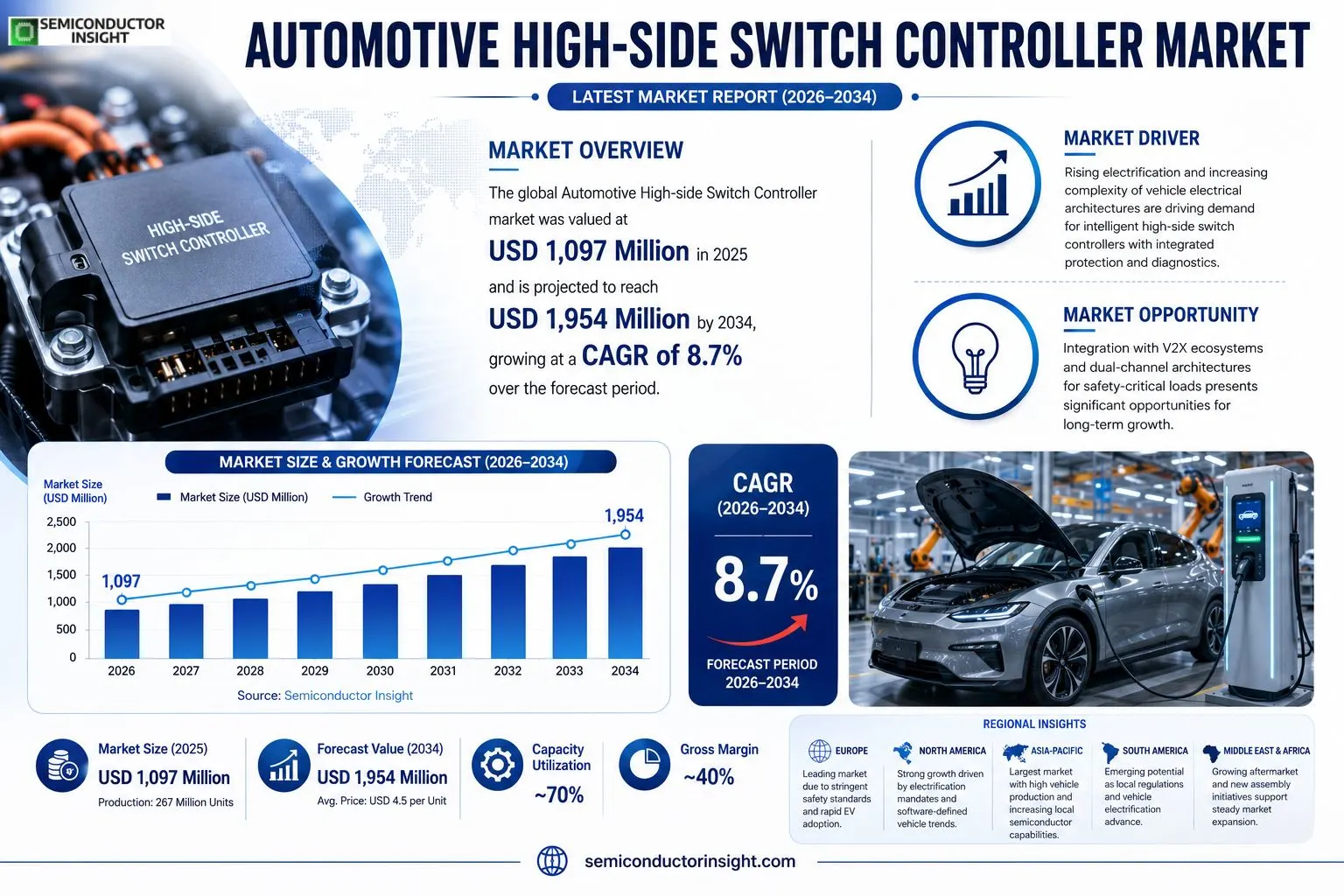
Automotive High-side Switch Controller market size was valued at USD 1,097 million in 2025. The market will reach USD 1,954 million by 2034, reflecting a CAGR of 8.7 % over the forecast period.
Automotive High-side Switch Controller is an automotive‑grade control IC designed to manage high‑side power loads by integrating switching control, protection, and diagnostic functions, enabling safe, efficient, and reliable power distribution across vehicle electrical systems. In 2025 production was about 267 million units with an average price of USD 4.5 per unit; capacity utilization stood at roughly 70 % and gross margin around 40 %.The market’s expansion stems from the growing complexity of vehicle electrical architectures in passenger and commercial vehicles, as more body functions and safety features demand centralized load control. While cost pressure remains on high‑volume platforms, value shifts toward controllers that combine protection, diagnostics, and current management, helping OEMs lower system risk and validation effort. Suppliers that embed these controllers deeply into long‑life vehicle platforms and support multi‑model reuse are better positioned to sustain margins as competition intensifies.
MARKET DRIVERS
Electrification of Powertrains
The shift toward electric and hybrid drivetrains has pressured OEMs to adopt more sophisticated power‑distribution architectures. Automotive High-side Switch Controller Market participants are benefitting from this transition because high‑side switches provide the isolation and rapid response needed to protect battery packs and regulate auxiliary loads. As vehicle ranges extend, manufacturers must ensure that every watt of energy is efficiently managed, turning high‑side control solutions into a prerequisite rather than an option.
Stringent Safety and Reliability Standards
Regulatory bodies across North America, Europe, and Asia have tightened crash‑worthiness and fault‑tolerance criteria for electric vehicles. This environment forces suppliers to embed fault‑current limiting and fail‑safe mechanisms directly into switch controllers. Automotive High-side Switch Controller Market is responding with designs that incorporate self‑diagnostic features and redundancy, thereby unlocking new revenue streams tied to compliance testing and certification services.
➤ “High‑side switch reliability now correlates directly with warranty claims; a 0.5 % reduction in failure rate can save manufacturers up to $30 million annually.”
These dynamics push tier‑1 distributors to pursue higher‑margin contracts, as original equipment manufacturers seek long‑term partnerships that guarantee both performance and post‑sale support. The cumulative effect is a notable uplift in order volumes for suppliers positioned at the intersection of electrification and safety compliance.
MARKET CHALLENGES
Thermal Management Constraints
High‑side switches operating amidst dense power electronics generate considerable heat. Engineers must balance thermal dissipation against packaging size, especially in compact vehicle platforms. Inadequate cooling not only shortens component life but also forces designers to oversize heat sinks, eroding the cost advantage of advanced semiconductor technologies. This challenge limits the pace at which new architectures can be rolled out without incurring additional engineering overhead.
Other Challenges
Supply Chain Volatility
semiconductor shortages have amplified lead times for silicon‑carbide (SiC) and gallium‑nitride (GaN) devices, which are increasingly preferred for high‑side applications. Manufacturers face the dilemma of either locking in higher‑priced inventories or delaying product launches, both of which strain margins in Automotive High-side Switch Controller Market.
MARKET RESTRAINTS
High Component Cost
The adoption of wide‑bandgap semiconductors drives up the bill of materials for high‑side switch assemblies. While performance gains are undeniable, many automotive programs operate under stringent cost targets, making it difficult to justify premium pricing. Consequently, cost‑sensitive segments such as entry‑level electric vehicles tend to opt for legacy silicon solutions, tempering overall market expansion.
MARKET OPPORTUNITIES
Integration with Vehicle‑to‑Everything (V2X) Ecosystems
Emerging V2X communication protocols require rapid, reliable power switching to support high‑frequency data bursts and over‑the‑air updates. High‑side switch controllers that embed low‑latency isolation and programmable protection can become the backbone of these next‑generation networks. Early movers that align product roadmaps with V2X specifications stand to capture a sizeable share of future vehicle architectures, opening new avenues for revenue beyond traditional powertrain applications.
Automotive High-side Switch Controller Market Trends
Higher Functional Integration Reduces System Cost
In 2025 the typical automotive high-side switch controller sold for roughly US$4.5 per unit while factories operated at about 70 % capacity utilization. The prevailing gross margin of 40 % reflects a delicate balance: manufacturers profit when they can embed protection, diagnostics and current‑management functions into a single silicon die, thereby cutting the bill of external components. Vehicle programs that adopt such integrated devices see fewer wiring loops, shorter validation timelines, and a lower probability of field failures. Consequently, OEMs are pressuring silicon vendors to deliver boards that combine multiple safety mechanisms without inflating bill‑of‑materials, a shift that is reshaping design specifications across the supply chain.
Other Trends
Supply‑Chain Stability Gains Importance
The upstream segment—silicon wafers, photoresists, leadframes and epoxy molding compounds—remains dominated by a handful of established suppliers such as Shin‑Etsu Chemical and Amkor Technology. Their consistent quality has become a strategic asset as automakers accelerate platform reuse across model generations. Any disruption in wafer throughput directly translates into capacity shortfalls for the mid‑stream design teams, which in turn hampers the ability to meet aggressive production schedules for both passenger and commercial vehicles. Firms that secure long‑term contracts with these material providers are thereby able to lock in predictable lead times and protect margin levels.
Shift Toward Dual‑Channel Architectures for Safety‑Critical Loads
Dual‑channel high-side switch controllers are gaining traction in applications that demand redundant power paths, such as advanced driver‑assistance systems and high‑voltage heating elements. By offering parallel control loops, these devices improve fault tolerance and simplify diagnostic reporting to the vehicle’s central controller. The move enhances overall vehicle reliability while allowing OEMs to meet stricter safety standards without adding separate protection hardware. Suppliers that can ship dual‑channel solutions with integrated SPI or PWM interfaces are positioned to capture a larger share of the growing safety‑critical market segment.
COMPETITIVE LANDSCAPE
Key Industry Players
Automotive High‑Side Switch Controller – Competitive Overview
Infineon Technologies commands the upper tier of the automotive high‑side switch controller arena, leveraging its deep automotive‑grade silicon portfolio and extensive validation infrastructure. The company’s ability to co‑develop modules that embed protection, diagnostics and current‑regulation functions has entrenched it in several OEM platforms, translating into roughly a quarter of shipments in 2025. The market structure reflects a classic oligopoly: a handful of integrated‑device powerhouses account for the majority of revenue, while a broader fringe of specialist firms pursue niche voltages or interface standards. Capacity utilization hovering near 70 % indicates that manufacturers are operating close to optimal throughput, but also that incremental demand must be met through incremental fab expansion or process refreshes. The concentration of design‑win opportunities in high‑volume vehicle programs means that players with proven automotive qualification pathways and robust application‑support teams retain decisive leverage over pricing negotiations and roadmap influence.
Beyond the tier‑one giants, a diverse set of mid‑size and boutique suppliers shapes the competitive fabric. STMicroelectronics and Renesas Electronics have pushed multi‑channel families that appeal to electric‑vehicle architectures, emphasizing low‑RDS(on) and integrated SPI diagnostics. ROHM’s recent focus on 24 V platforms aligns with commercial‑vehicle power‑train trends, while Diodes Incorporated leverages its analog heritage to offer cost‑effective single‑channel parts for body‑control modules. Texas Instruments differentiates through its extensive design‑in resources and a broad ecosystem of reference designs, allowing quicker validation for tier‑2 OEMs. Microchip Technology and ON Semiconductor pursue aggressive pricing strategies coupled with extended‑temperature offerings to capture emerging markets in Asia. Toshiba and Fuji Electric retain a foothold in legacy platforms where long‑term reliability is paramount. NXP Semiconductors and Maxim Integrated (now part of Analog Devices) target gateway‑controller integration, betting on system‑on‑chip convergence to shrink bill‑of‑materials. These differentiated portfolios force original‑equipment manufacturers to orchestrate a multi‑supplier strategy, raising validation complexity but also opening avenues for cost optimization through selective part‑sharing. As vehicle electrification intensifies, the pressure to integrate higher‑voltage control while retaining compact footprints drives many of the niche players to pursue SiC‑based gate drivers, a trend that could reshape the competitive hierarchy in the next five years.
List of Key Automotive High-side Switch Controller Companies Profiled
- Infineon Technologies
- Texas Instruments
- STMicroelectronics
- ROHM Semiconductor
- Renesas Electronics
- Diodes Incorporated
- Microchip Technology
- ON Semiconductor
- Toshiba
- Fuji Electric
- NXP Semiconductors
- Maxim Integrated
Segment Analysis:
| Segment Category | Sub-Segments | Key Insights |
| By Type |
|
12V Controller
|
| By Application |
|
Passenger Cars
|
| By End User |
|
OEMs
|
| By Architecture |
|
Centralized
|
| By Function |
|
Protection
|
Regional Analysis: Automotive High-side Switch Controller Market
The EU’s upcoming safety directive emphasizes fail‑safe operation for power electronics, nudging manufacturers toward controllers with enhanced diagnostic capabilities. Compliance costs are rising, yet firms that embed compliance into the chip architecture can differentiate themselves without incurring substantial aftermarket expenses.
Recent material shortages have spurred European players to diversify sources of silicon wafers and packaging services. Partnerships with local foundries are being cemented to mitigate geopolitical risk, ensuring a steadier pipeline for high‑side switch components.
Integration of wide‑bandgap semiconductors is gaining favor in premium models, delivering lower on‑resistance and superior thermal performance. Early adopters leverage these traits to meet aggressive efficiency targets in EV and hybrid architectures.
Tier‑1 suppliers with strong R&D budgets are consolidating niche startups to broaden their portfolio, creating a layered competitive environment where size and innovation intersect.
North America
The United States market reflects a blend of aggressive electrification mandates and a culture of rapid prototyping. Automakers favor high‑side switch controllers that support over‑the‑air updates, aligning with broader software‑defined vehicle strategies. Investment in domestic fab capacity is reshaping supply dynamics, allowing quicker response to design changes. Meanwhile, a fragmented supplier landscape encourages collaborative development models, where smaller firms can access advanced design tools through consortia, accelerating time‑to‑market for novel controller architectures.
Asia‑Pacific
Growth in China, Japan, and South Korea is propelled by expansive rollout of battery‑electric vehicles and a surge in localized semiconductor production. Manufacturers are emphasizing cost‑efficient designs that still meet stringent safety benchmarks, balancing volume pricing with performance. Regional policy incentives accelerate adoption of wide‑bandgap technologies, yet the market remains sensitive to raw‑material price swings, prompting firms to adopt flexible sourcing strategies that hedge against volatility.
South America
Brazil and Argentina lead the regional conversation, where market maturity lags behind other continents but presents untapped potential. Automotive manufacturers are gradually incorporating high‑side switch controllers into new vehicle platforms as local regulations tighten emissions limits. The primary challenge lies in aligning imported component specifications with locally assembled vehicles, a gap that forward‑looking suppliers are addressing through joint engineering workshops with OEMs.
Middle East & Africa
The region’s automotive sector is characterized by a steady influx of imported vehicles, creating a niche for aftermarket retrofits that improve power‑train efficiency. Suppliers focusing on robust, temperature‑tolerant controllers find a receptive audience, given the harsh climatic conditions. Emerging partnerships between regional distributors and Asian manufacturers are facilitating technology transfer, laying groundwork for gradual market expansion as local automotive assembly capacities increase.
Report Scope
This market research report provides a comprehensive analysis of the Automotive High-side Switch Controller Market , covering the forecast period 2026–2034. It offers detailed insights into market dynamics, technological advancements, competitive landscape, and key trends shaping the industry.
Key focus areas of the report include:
-
Market Overview: The report begins with an overview outlining its current market scenario, key growth indicators, and industry transformation drivers. It discusses macroeconomic factors, demand–supply balance, regulatory landscape, and the strategic role of semiconductors in powering advancements across industries such as automotive, telecommunications, consumer electronics, and industrial automation.
- Market Size & Forecast: Historical data and future projections for revenue, unit shipments, and market value across major regions and segments.
- Segmentation Analysis: Detailed breakdown by product type, technology, application, and end-user industry to identify high-growth segments and investment opportunities.
- Regional Insights: Insights into market performance across North America, Europe, Asia-Pacific, Latin America, and the Middle East & Africa, including country-level analysis where relevant.
- Competitive Landscape: Profiles of leading market participants, including their product offerings, R&D focus, manufacturing capacity, pricing strategies, and recent developments such as mergers, acquisitions, and partnerships.
- Technology Trends & Innovation: Assessment of emerging technologies, integration of AI/IoT, semiconductor design trends, fabrication techniques, and evolving industry standards.
- Market Drivers & Restraints: Evaluation of factors driving market growth along with challenges, supply chain constraints, regulatory issues, and market-entry barriers.
- Stakeholder Insights: Insights for component suppliers, OEMs, system integrators, investors, and policymakers regarding the evolving ecosystem and strategic opportunities.
Primary and secondary research methods are employed, including interviews with industry experts, data from verified sources, and real-time market intelligence to ensure the accuracy and reliability of the insights presented.
FREQUENTLY ASKED QUESTIONS:
What is the current market size of Automotive High-side Switch Controller Market?
-> Automotive High-side Switch Controller Market was valued at USD 1,097 million in 2025 and is expected to reach USD 1,954 million by 2034, growing at a CAGR of 8.7%.
Which key companies operate in Automotive High-side Switch Controller Market?
-> Key players include STMicroelectronics, Infineon, Diodes Incorporated, ROHM, Renesas, Fuji Electric, Texas Instruments, Microchip, onsemi, Toshiba.
What are the key growth drivers?
-> Key growth drivers include increasing vehicle electrical architecture complexity, rising number of electronically controlled loads, demand for integrated protection, diagnostics and current management, and platform‑scale deployment that reduces system cost and validation effort.
Which region dominates the market?
-> Asia is the leading region, driven by high automotive production volumes and rapid adoption of advanced electronic systems.
What are the emerging trends?
-> Emerging trends include greater functional integration of high‑side controllers, deeper embedding into long‑life vehicle platforms, and enhanced application support that shortens validation cycles and improves reliability.
Get Sample Report PDF for Exclusive Insights
Report Sample Includes
- Table of Contents
- List of Tables & Figures
- Charts, Research Methodology, and more...
 Download Sample Report PDF