Silicon Carbide Ingot Market Insights
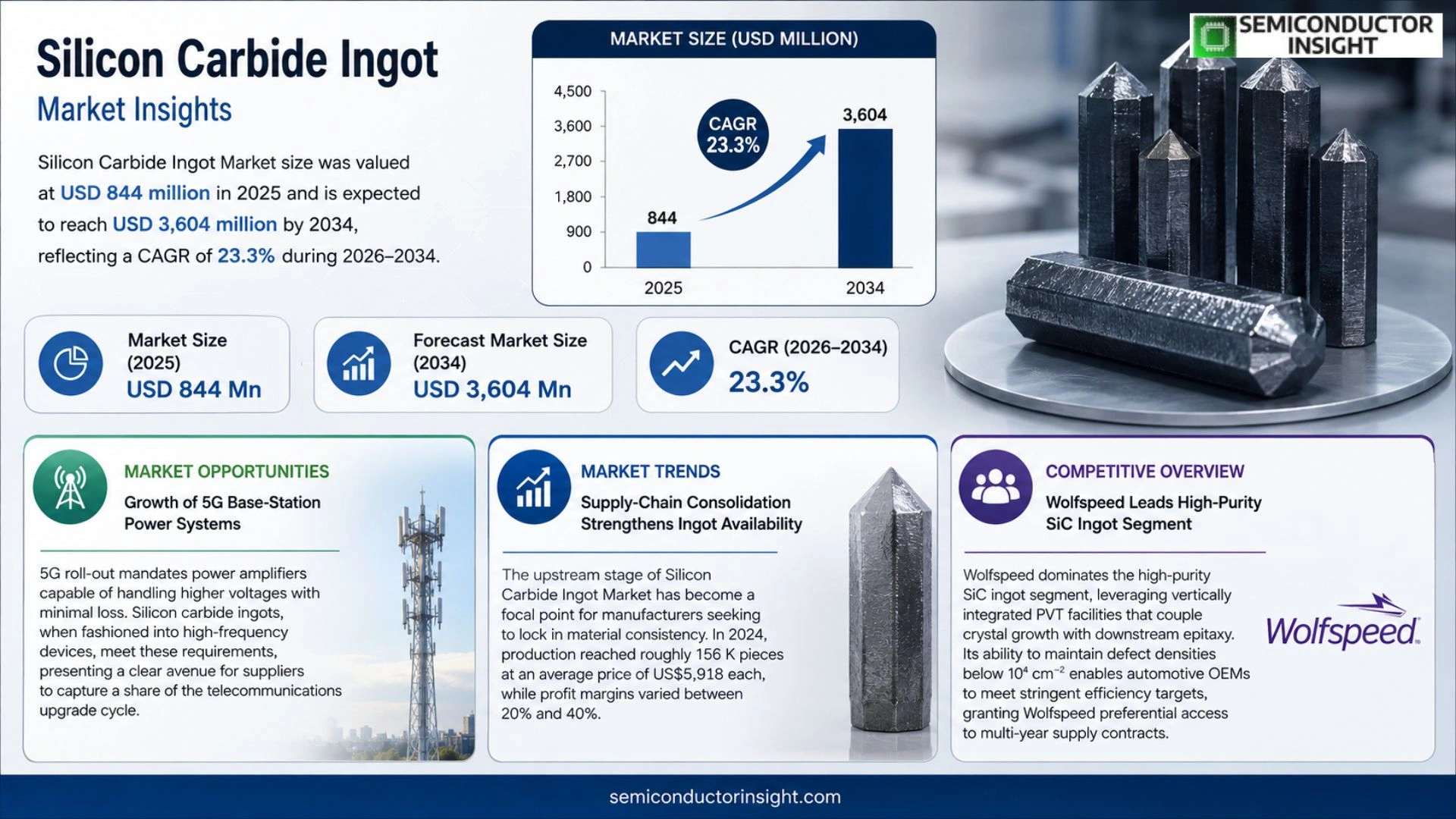
Silicon Carbide Ingot Market size was valued at USD 844 million in 2025 and is expected to reach USD 3,604 million by 2034, reflecting a compound annual growth rate of 23.3 % over the forecast horizon.
A silicon carbide ingot is a bulk single‑crystal SiC body grown in a high‑temperature furnace, most commonly through physical vapor transport (PVT) or sublimation‑recrystallization. The process depends on ultra‑pure SiC feedstock, seed crystals and tightly regulated dopant gases; the resulting crystal forms the upstream substrate that is later sliced into wafers, polished and used for epitaxial layer growth supporting power devices.
Growth is fueled by expanding demand for high‑efficiency power conversion in electric‑vehicle drivetrains, renewable‑energy inverters and industrial motor drives, where low‑loss SiC devices enable higher power density and reduced cooling needs.
MARKET DRIVERS
Rising Demand for High‑Efficiency Power Devices
Silicon Carbide Ingot Market is gaining traction as automotive manufacturers migrate to wide‑bandgap semiconductors for electric‑vehicle platforms. Engineers cite the material’s superior thermal conductivity and breakdown voltage, which translate into smaller, lighter power modules,a decisive factor for vehicle range and packaging constraints.
Advances in Crystal‑Growth Technologies
Recent refinements in physical vapor transport and chemical vapor deposition have lowered defect densities while boosting wafer yields. These process improvements reduce per‑unit cost, allowing tier‑1 suppliers to offer competitive pricing without sacrificing performance, thereby accelerating adoption across aerospace and renewable‑energy sectors.
➤ “The convergence of cost‑effective production and stringent efficiency targets is reshaping the competitive landscape for silicon carbide ingots.”
Collectively, stronger end‑user specifications and a maturing supply base create a virtuous cycle: higher volumes fund further R&D, which in turn drives additional volume,a dynamic that underpins the near‑term momentum of the silicon carbide ingot industry.
MARKET CHALLENGES
Supply‑Chain Constraints and Material Scarcity
Despite robust demand, the industry grapples with limited access to ultra‑high‑purity silicon and carbon sources. Small batches of premium hexagonal crystals command premium prices, pressuring manufacturers that operate on thin margins and leading to schedule volatility for downstream device assemblers.
Other Challenges
Regulatory Hurdles
Environmental legislation in key producing regions imposes stricter emissions caps on furnace operations. Companies must invest in abatement technologies, which raises capital outlays and can delay plant expansions, especially for firms reliant on legacy equipment.
MARKET RESTRAINTS
Capital Intensity of New Production Facilities
Establishing a modern silicon carbide ingot line requires multi‑hundred‑million‑dollar investments in high‑temperature reactors, clean‑room environments, and precision metrology. The financial threshold restricts entry to well‑capitalised players, limiting competitive pressure and slowing the diffusion of price‑reduction benefits.
Furthermore, the long lead times associated with equipment procurement and commissioning mean that capacity additions cannot keep pace with sudden spikes in automotive or telecom orders, creating a lingering bottleneck that dampens overall market expansion.
MARKET OPPORTUNITIES
Growth of 5G Base‑Station Power Systems
5G roll‑out mandates power amplifiers capable of handling higher voltages with minimal loss. Silicon carbide ingots, when fashioned into high‑frequency devices, meet these requirements, presenting a clear avenue for suppliers to capture a share of the telecommunications upgrade cycle.
Emerging economies are initiating large‑scale smart‑grid projects that prioritize efficiency and resilience. The superior switching characteristics of silicon carbide components make them attractive for grid‑level converters, positioning the silicon carbide ingot segment to supply critical infrastructure worldwide.
Silicon Carbide Ingot Market Trends
Supply‑Chain Consolidation Strengthens Ingot Availability
The upstream stage of Silicon Carbide Ingot Market has become a focal point for manufacturers seeking to lock in material consistency. In 2024, production reached roughly 156 K pieces at an average price of US$5,918 each, while profit margins varied between 20 % and 40 %. Companies that have integrated feedstock purification, PVT furnace operation, and metrology under a single roof report yield improvements of 5‑7 % relative to peers that rely on fragmented supply networks. This shift is motivated by the long thermal cycles inherent to PVT growth; any impurity or defect introduced early propagates through wafering and epitaxy, eroding device yields downstream. By securing end‑to‑end control, suppliers can promise tighter defect density specifications, a requirement that OEMs cite when selecting power‑electronics partners for EV drivetrains and renewable‑energy inverters.
Other Trends
Demand for Low‑Defect, High‑Uniformity Ingots
Customers in the automotive and industrial sectors increasingly scrutinize ingot uniformity because it directly influences the breakdown voltage and switching efficiency of SiC devices. Recent surveys indicate that buyers are willing to pay a premium of up to 12 % for ingots that demonstrate less than 0.5 % thickness variation across a 6‑inch boule. This premium aligns with the broader move toward lighter, higher‑density power converters, where every millimeter of silicon matters. Manufacturers that can reliably produce such ingots are positioning themselves as preferred suppliers, which in turn raises the barrier to entry for new entrants lacking sophisticated thermal‑field engineering capabilities.
Strategic Partnerships Mitigate Capacity Constraints
As demand outpaces the incremental capacity that new PVT lines can deliver,given capital expenditures exceeding US$150 million per furnace,players are forging long‑term contracts with upstream powder producers and downstream wafer fabricators. These alliances reduce the risk of material shortages and enable joint R&D initiatives focused on dopant control and in‑situ diagnostics. The net effect is a market environment where supply elasticity improves, but pricing power tilts toward firms that hold integrated portfolios.
Pricing Pressure and Margin Management
Despite strong demand, Silicon Carbide Ingot Market faces downward pressure on average selling prices as volume scaling drives cost efficiencies in crucible materials and gas purification. Between 2023 and 2024, the average price slipped by about 3 %, while manufacturers who optimized their feedstock utilization achieved margin expansion up to 8 %. The competitive dynamic forces companies to balance aggressive capital investment in larger furnaces with disciplined cost‑of‑goods‑sold management. Firms that succeed in this balancing act are likely to capture a larger share of the projected US$3.6 billion market value by 2032.
COMPETITIVE LANDSCAPE
Key Industry Players
Silicon Carbide Ingot Market Competitive Overview
Wolfspeed dominates the high‑purity SiC ingot segment, leveraging vertically integrated PVT facilities that couple crystal growth with downstream epitaxy. Its ability to maintain defect densities below 10⁴ cm⁻² enables automotive OEMs to meet stringent efficiency targets, granting Wolfspeed preferential access to multi‑year supply contracts. The firm’s scale also supports a broad product portfolio covering 4‑inch to 8‑inch diameters, reinforcing its price‑setting power across the value chain. Competitors with comparable scale, such as STMicroelectronics and onsemi, have pursued joint ventures or capacity expansions to narrow the gap, but Wolfspeed’s entrenched customer relationships and robust margin profile keep it at the apex of market structure.
Beyond the tier‑one leaders, a diverse cohort of niche players adds depth to the ecosystem. Companies like Coherent, SiCrystal, and SK Siltron specialize in customized dopant profiles or specialty polytypes (4H‑SiC, 6H‑SiC) that serve niche power‑device makers. Regional manufacturers,including Ningbo Alpha Semiconductor, Zhejiang Tony Electronic, and Hebei Synlight Semiconductor,focus on cost‑competitive bulk ingots for emerging Asian markets, often partnering with local wafer fabs to secure demand. The collective emphasis on yield improvement, feedstock purity, and long‑term delivery reliability creates a competitive environment where technical differentiation and strategic alliances drive market share gains.
List of Key Silicon Carbide Ingot Companies Profiled
- Wolfspeed
- Coherent
- SiCrystal
- TankeBlue
- SICC
- SK Siltron
- Ningbo Alpha Semiconductor
- Resonac
- Zhejiang Tony Electronic
- STMicroelectronics
- onsemi
- Hebei Synlight Semiconductor
- Shanxi Semiconductor
- IVSemitec
- Sanan Semiconductor
Segment Analysis:
| Segment Category | Sub-Segments | Key Insights |
| By Type |
|
Leading Segment: N-Type
|
| By Application |
|
Leading Segment: EV Powertrains
|
| By End User |
|
Leading Segment: Automotive OEMs
|
| By Product Type |
|
Leading Segment: Single‑Crystal Ingots
|
| By Polytype Classification |
|
Leading Segment: 4H‑SiC
|
Regional Analysis: Silicon Carbide Ingot Market
Regional manufacturers have re‑engineered sourcing strategies, integrating domestic graphite and silicon suppliers to lessen exposure to geopolitical disruptions. This forward integration reduces bottlenecks, allowing buyers to retrieve ingots with predictable schedules, a factor that is increasingly decisive for OEMs targeting rapid product cycles.
Fiscal credits and targeted R&D grants are commonplace across the basin, especially in China’s “Made in 2025” agenda and Japan’s semiconductor revitalization plan. These levers lower capital intensity for new crystal‑growth facilities, accelerating market entry for emerging players.
Clusters around Shenzhen, Tokyo, and Seoul combine universities, venture capital, and large‑scale fabs. The synergistic environment nurtures advances in epitaxial techniques, which translate into higher yield ingot batches and, ultimately, more reliable downstream components.
The region’s ability to produce cost‑effective ingots has turned it into a net exporter to Europe and North America. Shipping corridors are now optimized for temperature‑controlled containers, ensuring material purity remains intact during long hauls.
North America
In North America, Silicon Carbide Ingot Market is shaped by a blend of legacy equipment makers and a surge of venture‑backed start‑ups focused on electric‑vehicle powertrains. The United States leverages a mature intellectual‑property framework, which encourages firms to invest in proprietary crystal‑growth methods rather than relying on licensed technologies. While labor costs are higher, the emphasis on quality assurance and compliance with stringent safety standards creates a premium tier that attracts high‑value contracts from aerospace and defense customers. Canada’s contribution, though modest in volume, centers on niche applications such as high‑power renewable‑energy converters, where material performance outweighs price considerations.
Europe
European stakeholders view silicon carbide as a strategic material for the continent’s green‑energy transition. Germany and the Nordic region have prioritized domestic production to reduce reliance on external supplies, aligning with broader industrial‑policy goals. The market here is characterized by a preference for traceable supply chains and certifications that meet automotive safety mandates. Collaborative research programmes, funded by the EU, aim to improve crystal uniformity, which in turn enables manufacturers of rail and industrial motor drives to meet efficiency targets set by upcoming regulations.
South America
South America remains a peripheral player, yet Brazil’s growing semiconductor assembly sector is beginning to explore silicon carbide as a differentiator for power‑electronics destined for the region’s expanding renewable‑energy farms. The market’s modest size is offset by a willingness among local firms to partner with Asian growers, importing ingots while developing assembly expertise. Regulatory frameworks are still evolving, but there is a clear appetite for materials that can withstand the continent’s high‑temperature climate.
Middle East & Africa
In the Middle East and Africa, Silicon Carbide Ingot Market is still nascent, constrained by limited manufacturing infrastructure. However, the Gulf Cooperation Council’s investment in carbon‑neutral initiatives has sparked interest in high‑efficiency power conversion solutions, prompting a handful of joint‑venture agreements with Asian suppliers. African nations, particularly South Africa, are assessing the material for mining‑equipment electrification, where rugged performance can translate into operational cost savings.
Report Scope
This market research report provides a comprehensive analysis of the Silicon Carbide Ingot Market , covering the forecast period 2026–2034. It offers detailed insights into market dynamics, technological advancements, competitive landscape, and key trends shaping the industry.
Key focus areas of the report include:
- Market Overview: The report begins with an overview outlining its current market scenario, key growth indicators, and industry transformation drivers. It discusses macroeconomic factors, demand–supply balance, regulatory landscape, and the strategic role of semiconductors in powering advancements across industries such as automotive, telecommunications, consumer electronics, and industrial automation.
- Market Size & Forecast: Historical data and future projections for revenue, unit shipments, and market value across major regions and segments.
- Segmentation Analysis: Detailed breakdown by product type, technology, application, and end-user industry to identify high-growth segments and investment opportunities.
- Regional Insights: Insights into market performance across North America, Europe, Asia-Pacific, Latin America, and the Middle East & Africa, including country-level analysis where relevant.
- Competitive Landscape: Profiles of leading market participants, including their product offerings, R&D focus, manufacturing capacity, pricing strategies, and recent developments such as mergers, acquisitions, and partnerships.
- Technology Trends & Innovation: Assessment of emerging technologies, integration of AI/IoT, semiconductor design trends, fabrication techniques, and evolving industry standards.
- Market Drivers & Restraints: Evaluation of factors driving market growth along with challenges, supply chain constraints, regulatory issues, and market-entry barriers.
- Stakeholder Insights: Insights for component suppliers, OEMs, system integrators, investors, and policymakers regarding the evolving ecosystem and strategic opportunities.
Primary and secondary research methods are employed, including interviews with industry experts, data from verified sources, and real-time market intelligence to ensure the accuracy and reliability of the insights presented.
FREQUENTLY ASKED QUESTIONS:
What is the current market size of Silicon Carbide Ingot Market?
-> Silicon Carbide Ingot Market was valued at USD 844 million in 2025 and is projected to reach USD 3604 million by 2032, at a CAGR of 23.3% during the forecast period.
Which key companies operate in Silicon Carbide Ingot Market?
-> Key players include Wolfspeed, Coherent, SiCrystal, TankeBlue, SICC, SK Siltron, Ningbo Alpha Semiconductor, Resonac, Zhejiang Tony Electronic, STMicroelectronics, onsemi, Hebei Synlight Semiconductor, Shanxi Semisic Crystal, IVSemitec, Sanan Semiconductor, Zhejiang CrystalYond Semiconductor, Hypersics, GeChi Compound Semiconductor, Atecom Technology, KY Semiconductor.
What are the key growth drivers?
-> Key growth drivers include the rising demand for high‑efficiency power conversion in electric vehicles, charging infrastructure, renewable‑energy inverters, industrial drives, and energy‑storage systems, which require low‑defect SiC ingots with tightly controlled electrical properties.
Which region dominates the market?
-> The market is globally distributed, with strong activity across North America, Europe, and Asia‑Pacific, and no single region is explicitly identified as dominant in the reference data.
What are the emerging trends?
-> Emerging trends include greater emphasis on end‑to‑end supply‑chain integration, low‑defect ingot production, and coordinated efforts between crystal growth, epitaxy, and device fabrication to improve yield and reliability.
Get Sample Report PDF for Exclusive Insights
Report Sample Includes
- Table of Contents
- List of Tables & Figures
- Charts, Research Methodology, and more...
 Download Sample Report PDF