Low Temperature Co-fired Ceramic (LTCC) Market Insights
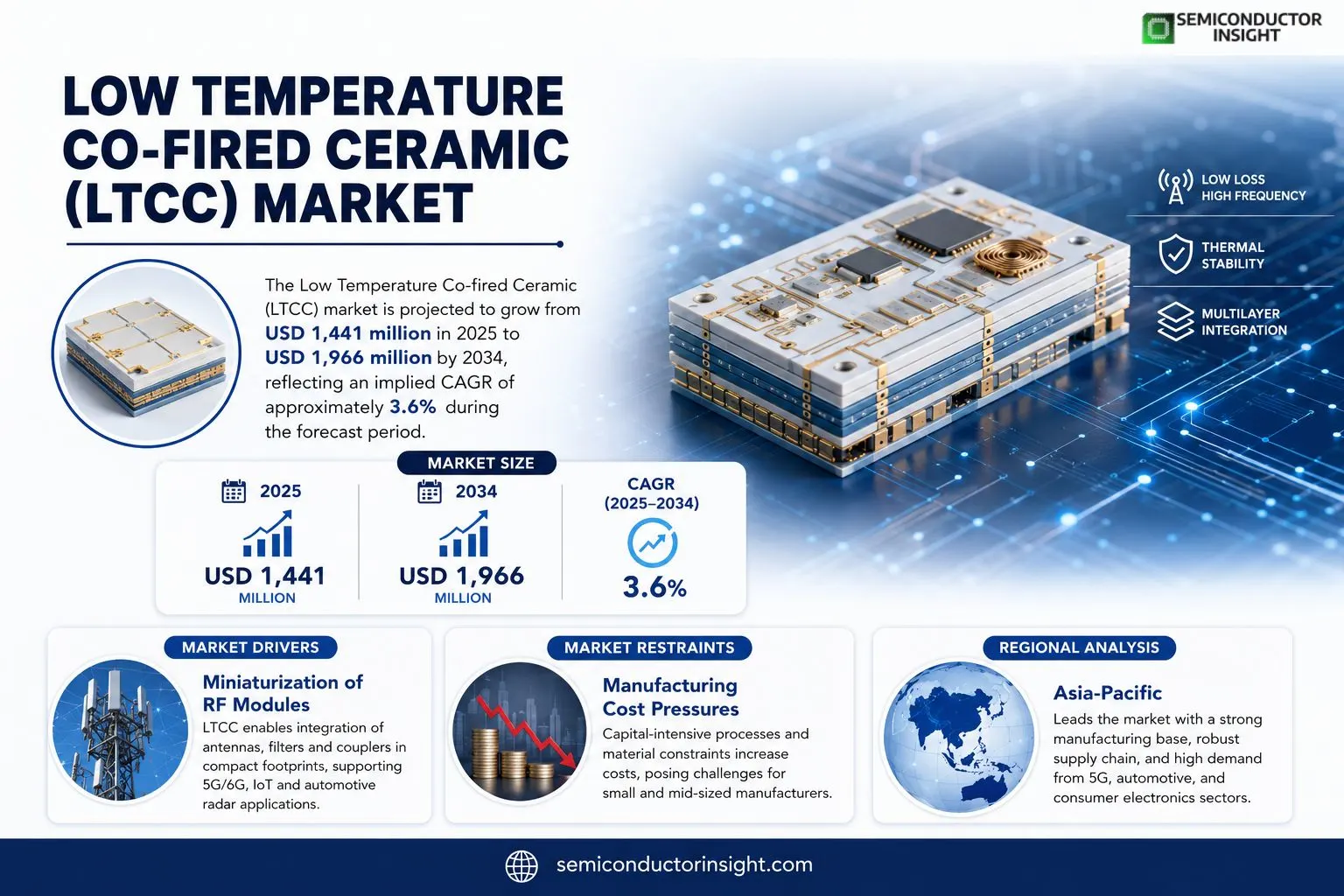
Low Temperature Co-fired Ceramic (LTCC) market size was valued at USD 1,441 million in 2025 and is forecasted to reach USD 1,966 million by 2034, reflecting an implied CAGR of roughly 3.6 % over the period.
LTCC refers to a multilayer glass‑ceramic substrate that is co‑fired with low‑resistance metal conductors at temperatures below 1,000 °C. By incorporating glass into alumina powders, manufacturers achieve a firing range of approximately 850‑900 °C, enabling fine‑line metallization and the integration of passive components such as LC filters, directional couplers and antennas within a compact module.The expansion of high‑frequency applicationsparticularly 5G/6G communications, automotive radar and IoT wearableshas heightened demand for low‑loss LTCC solutions. Ongoing R&D efforts focus on ultra‑low dielectric loss materials and hybrid LTCC‑organic packaging, while leading suppliers including Murata Manufacturing, Kyocera (AVX), TDK Corporation and Mini‑Circuits continue to broaden their portfolios through new product introductions and strategic collaborations.
MARKET DRIVERS
Miniaturization of RF Modules
The push for smaller, high‑performance RF components has placed the Low Temperature Co-fired Ceramic (LTCC) Market at the center of supply‑chain strategies. Manufacturers are leveraging LTCC’s multilayer architecture to integrate antennas, filters and baluns within a single footprint, thereby trimming board area and reducing interconnect loss. This technical advantage translates into faster time‑to‑market for smartphones and wearables, where space is at a premium.
Automotive Sensor Adoption
Automakers are expanding the electronic skin of vehicles to meet stricter safety mandates, and LTCC’s ability to survive harsh thermal cycles makes it a preferred substrate for radar, LiDAR and infotainment modules. The convergence of electric‑vehicle platforms and advanced driver‑assistance systems is compelling OEMs to source LTCC‑based modules, creating a steady flow of orders for specialised fabricators.
➤ “LTCC’s unique combination of high‑frequency performance and thermal robustness is reshaping component procurement across multiple high‑growth sectors.”
Beyond aerospace and defense, the telecommunications sector is capitalising on LTCC’s low loss tangent to construct dense, multi‑band pass‑ives for 5G base stations. As carriers densify networks, the demand for compact, high‑Q components drives a sustained pull on the LTCC ecosystem.
MARKET CHALLENGES
Manufacturing Cost Pressures
While LTCC delivers superior performance, the multilayer firing process remains capital intensive. Small‑to‑medium enterprises often face hurdles securing the necessary equipment, which can inflate unit costs relative to conventional PCB technologies. This price differential forces some buyers to revert to alternate substrates for low‑margin applications.
Other Challenges
Material Compatibility Issues
The co‑firing of conductors and dielectrics at modest temperatures limits the selection of high‑conductivity metals. Engineers must balance sheet resistance against process tolerances, occasionally compromising RF efficiency to stay within acceptable yield levels.
MARKET RESTRAINTS
Design Flexibility Constraints
LTCC’s rigid ceramic body restricts designers who need aggressive bend or flex characteristics. For applications such as flexible wearables, the inability to conform to curved surfaces limits substitution, nudging customers toward polymer‑based solutions despite LTCC’s electrical merits.The thickness of individual dielectric layers, typically 10‑30 µm, imposes a ceiling on the number of routable interconnects. When ultra‑high density routing is required, firms often resort to advanced packaging alternatives, thereby capping LTCC’s penetration in certain high‑complexity segments.Additionally, the learning curve associated with precise screen‑printing of fine lines can inflate development cycles. Companies lacking in‑house expertise may delay projects, opting for more straightforward technologies to meet aggressive launch windows.
MARKET OPPORTUNITIES
5G Infrastructure Expansion
The rollout of 5G networks demands miniature, high‑Q passives capable of handling millimetre‑wave frequencies. LTCC’s low dielectric loss and ability to embed multilayer resonators position it as a strategic component for small‑cell sites and distributed antenna systems. Suppliers that streamline production for these frequencies can capture a niche yet rapidly growing share of the telecom spend.Emerging use cases in Internet of Things (IoT) gateways also present fertile ground. As edge devices assimilate more sensors and communication modules, the balance between size, reliability and performance offered by LTCC becomes increasingly valuable, encouraging OEMs to reconsider legacy designs.Finally, collaborations between material scientists and equipment manufacturers are unlocking new low‑temperature glass‑frit formulations, which promise to broaden the palette of printable metals. This advancement could lower costs and open the LTCC platform to sectors previously deterred by price or processing constraints.
Low Temperature Co-fired Ceramic (LTCC) Market Trends
5G, 6G and High‑Frequency Integration
The rollout of 5G networks and the early planning for 6G have created a pronounced demand for components that combine low insertion loss with small footprint. LTCC technology, with its ability to embed fine‑line conductors within a glass‑ceramic matrix, satisfies these requirements better than traditional organic laminates. Manufacturers are increasingly embedding LC filters, directional couplers and antenna modules directly on LTCC substrates to reduce interconnect count and improve signal integrity. This integration cuts board‑level assembly steps, which translates into shorter time‑to‑market for smartphones and base‑station equipment. Moreover, the low dielectric loss of the glass‑ceramic stack supports operation into the millimeter‑wave band, a prerequisite for forthcoming high‑capacity backhaul solutions. Japanese and Korean manufacturers, which control roughly 80 % of revenue, are accelerating their R&D pipelines to offer LTCC substrates optimized for IoT wearables, where the combination of high reliability and miniaturization is paramount. Consequently, supply chains are seeing a shift toward shorter lead times, as component integrators favor single‑piece LTCC modules over discrete assemblies.
Other Trends
Automotive Radar and ADAS Expansion
Electrified vehicles are adopting advanced driver‑assistance systems that rely on 77 GHz radar sensors. LTCC modules can host power amplifiers and beam‑forming networks that withstand the thermal cycles of automotive environments while retaining tight tolerances on phase and amplitude. The material’s inherent thermal stability reduces the need for additional heat‑spreading hardware, which is valuable in constrained chassis designs. As OEMs push for higher‑resolution imaging, the multilayer capability of LTCC enables the stacking of passives and active devices in a single form factor, driving down weight and improving reliability. Beyond radar, the same LTCC platform supports high‑frequency transceivers for vehicle‑to‑everything communication, aligning with regulatory pushes toward spectrum sharing in the 76‑81 GHz band. The high Q factor of LTCC resonators also aids in meeting stringent emission limits without excessive filtering stages.
Sustainability and Hybrid Packaging Initiatives
Environmental regulations and cost pressures are prompting suppliers to explore greener sintering cycles and recyclable glass‑ceramic compositions. At the same time, the industry is experimenting with hybrid packages that combine LTCC cores with organic interposers, leveraging the low‑loss advantage of ceramics where it matters most while using cheaper organic layers for digital routing. Early adopters report a 10‑15 % reduction in overall module thickness and a measurable improvement in power efficiency for power‑amplifier blocks. In parallel, several tier‑one suppliers are qualifying new low‑temperature co‑firing processes that cut energy consumption by up to 20 %, addressing both ESG goals and operational cost. The convergence of these sustainability initiatives with performance gains positions LTCC as a strategic technology for next‑generation electronic architectures.
COMPETITIVE LANDSCAPE
Key Industry Players
LTCC Market Competitive Overview
Murata Manufacturing, Kyocera (AVX), and TDK Corporation together capture roughly eight‑tenths of worldwide LTCC revenue, a concentration that reflects their deep mastery of low‑loss glass‑ceramic formulations and the ability to co‑fire fine‑line metal patterns at sub‑1000 °C temperatures. These firms have built vertically integrated supply chains, extensive R&D budgets, and sales networks that enable them to dominate high‑performance RF modules for smartphones, satellite communications, and emerging 6G components. Their scale permits aggressive pricing on large‑volume orders, reinforcing barriers to entry for newcomers, while their joint patents on dielectric loss reduction create a defensive moat. Recent acquisitions of niche substrate specialists in Europe and China illustrate a strategy of widening material portfolios and securing regional production capacity, a move that reshapes competitive dynamics across North America, Europe, and Asia‑Pacific.Beyond the dominant trio, a second tier of manufacturers enriches the ecosystem with segment‑focused expertise. Mini‑Circuits and ACX Corp excel in bespoke LTCC filters and couplers, frequently supplying defense integrators that demand ultra‑low insertion loss and stringent reliability standards. Samsung Electro‑Mechanics, Yokowo, and KOA (Via Electronic) concentrate on high‑frequency substrate production for automotive radar and electric‑vehicle power modules, leveraging Korean and Japanese fab clusters to meet automotive qualification cycles. Meanwhile, Proterial, NEO Tech, Walsin Technology, Shenzhen Sunlord Electronics, and Microgate carve out market share in LED substrates, probe‑card ceramics, and IoT‑grade components, often tailoring glass‑ceramic compositions to meet stringent thermal‑budget constraints. Their agility positions them to capture growth pockets as automotive and industrial automation broaden LTCC adoption, and they may become acquisition targets for the larger players seeking to augment portfolio breadth and accelerate entry into emerging mmWave and terahertz segments.
List of Key Low Temperature Co-fired Ceramic (LTCC) Companies Profiled
- Murata Manufacturing
- Kyocera (AVX)
- TDK Corporation
- Mini‑Circuits
- Taiyo Yuden
- Samsung Electro‑Mechanics
- Yokowo
- KOA (Via Electronic)
- Proterial, Ltd
- NEO Tech
- Walsin Technology
- Shenzhen Sunlord Electronics
- Microgate
- ACX Corp
- IMST GmbH
Segment Analysis:
| Segment Category | Sub-Segments | Key Insights |
| By Type |
|
LTCC Components dominate the type spectrum because they enable integration of passive functions in a compact form factor.
|
| By Application |
|
Consumer Electronics & Communications drives demand for LTCC because of the relentless push for smaller, faster RF front‑ends.
|
| By End User |
|
Smartphone manufacturers are the primary end users, valuing LTCC for its ability to shrink RF front‑end footprints while preserving performance.
|
| By Technology |
|
Multi‑layer glass ceramic remains the core technology, delivering unparalleled dielectric consistency.
|
| By Trend |
|
Miniaturization is the prevailing market trend, pushing LTCC suppliers to refine printing and layering processes.
|
Regional Analysis: Low Temperature Co-fired Ceramic (LTCC) Market
Asia-Pacific
Tier‑1 ceramic material producers in the region have consolidated logistics networks that buffer against raw‑material shortages, ensuring uninterrupted furnace schedules. Collaborative forecasting between fab owners and paste suppliers reduces lead‑time variability, a critical advantage when series‑production windows tighten.
Close ties between foundries and device engineers spur rapid exploration of heterogeneous integration. Engineers experiment with multilayer LTCC stacks that embed antenna structures directly within the substrate, cutting system size and eliminating external matching networks.
Regional standards bodies harmonize testing protocols for high‑frequency loss and thermal stability, giving designers confidence that a single qualification can serve multiple national markets, thereby simplifying export strategies.
Emerging automotive electrification projects demand compact, thermally robust modules. LTCC’s ability to host power‑RF hybrids positions it as a preferred substrate for on‑board chargers and radar systems, opening new revenue streams for regional players.
North America
North America’s LTCC activity clusters around a handful of research universities and defense contractors that prize substrate reliability for aerospace telemetry. While the overall market slice is modest, the region excels in high‑performance niche applications such as secure communications and satellite payloads. Partnerships between silicon‑foundry specialists and ceramic specialists focus on achieving tighter tolerances for millimeter‑wave front‑ends, a priority for defense procurement officers who demand proven long‑term stability.
Europe
European firms leverage strict electromagnetic compatibility regulations to differentiate LTCC offerings that meet stringent automotive and medical device standards. The continent’s emphasis on sustainability drives manufacturers to adopt low‑emission firing cycles, appealing to OEMs seeking greener supply chains. Collaborative consortia across Germany, France and the UK pool expertise in multi‑layer interconnects, enabling compact sensor modules for industrial IoT deployments.
South America
In South America, growth is anchored by telecom operators upgrading to 5G infrastructure. Local assemblers favor LTCC because its dimensional stability reduces the need for frequent recalibration of base‑station components. Government‑backed technology parks provide shared furnace capacity, allowing smaller firms to prototype without massive capital outlays, thereby expanding the supplier base.
Middle East & Africa
The Middle East & Africa region is witnessing an incremental uptake of LTCC in defense and oil‑field monitoring solutions. Oil‑rig sensors benefit from LTCC’s resistance to corrosion and high‑temperature operation, extending service intervals. Similarly, defense projects in the Gulf leverage the material’s low dielectric loss for secure, high‑frequency links, prompting regional manufacturers to tailor thin‑film formulations to meet harsh climatic conditions.
Report Scope
This market research report provides a comprehensive analysis of the Low Temperature Co-fired Ceramic (LTCC) Market , covering the forecast period 2026–2034. It offers detailed insights into market dynamics, technological advancements, competitive landscape, and key trends shaping the industry.
Key focus areas of the report include:
- Market Overview: The report begins with an overview outlining its current market scenario, key growth indicators, and industry transformation drivers. It discusses macroeconomic factors, demand–supply balance, regulatory landscape, and the strategic role of semiconductors in powering advancements across industries such as automotive, telecommunications, consumer electronics, and industrial automation.
- Market Size & Forecast: Historical data and future projections for revenue, unit shipments, and market value across major regions and segments.
- Segmentation Analysis: Detailed breakdown by product type, technology, application, and end-user industry to identify high-growth segments and investment opportunities.
- Regional Insights: Insights into market performance across North America, Europe, Asia-Pacific, Latin America, and the Middle East & Africa, including country-level analysis where relevant.
- Competitive Landscape: Profiles of leading market participants, including their product offerings, R&D focus, manufacturing capacity, pricing strategies, and recent developments such as mergers, acquisitions, and partnerships.
- Technology Trends & Innovation: Assessment of emerging technologies, integration of AI/IoT, semiconductor design trends, fabrication techniques, and evolving industry standards.
- Market Drivers & Restraints: Evaluation of factors driving market growth along with challenges, supply chain constraints, regulatory issues, and market-entry barriers.
- Stakeholder Insights: Insights for component suppliers, OEMs, system integrators, investors, and policymakers regarding the evolving ecosystem and strategic opportunities.
Primary and secondary research methods are employed, including interviews with industry experts, data from verified sources, and real-time market intelligence to ensure the accuracy and reliability of the insights presented.
FREQUENTLY ASKED QUESTIONS:
What is the current market size of Low Temperature Co-fired Ceramic (LTCC) Market?
-> Low Temperature Co-fired Ceramic (LTCC) Market was valued at USD 1441 million in 2025 and is expected to reach USD 1820 million by 2032, growing at a CAGR of 3.5% during the forecast period.
Which key companies operate in Low Temperature Co-fired Ceramic (LTCC) Market?
-> Key players include Murata Manufacturing, Kyocera (AVX), TDK Corporation, Mini‑Circuits, Taiyo Yuden, Samsung Electro‑Mechanics, Yokowo, KOA (Via Electronic), and Proterial, Ltd, among others.
What are the key growth drivers?
-> Key growth drivers include the rollout of 5G and beyond, electrification of vehicles with advanced driver‑assistance systems, rapid IoT and wearable device proliferation, ongoing miniaturization of high‑frequency modules, and sustainability‑focused material innovations.
Which region dominates the market?
-> Asia‑Pacific, led by China, dominates the LTCC market, followed by North America.
What are the emerging trends?
-> Emerging trends include advanced printing and layering for further miniaturization, hybrid LTCC‑organic packaging solutions, expansion into mmWave and terahertz frequencies for 6G and next‑generation sensing, and eco‑friendly sintering processes to meet sustainability requirements.
Get Sample Report PDF for Exclusive Insights
Report Sample Includes
- Table of Contents
- List of Tables & Figures
- Charts, Research Methodology, and more...
 Download Sample Report PDF