MOSFET for Charging Pile Market Insights
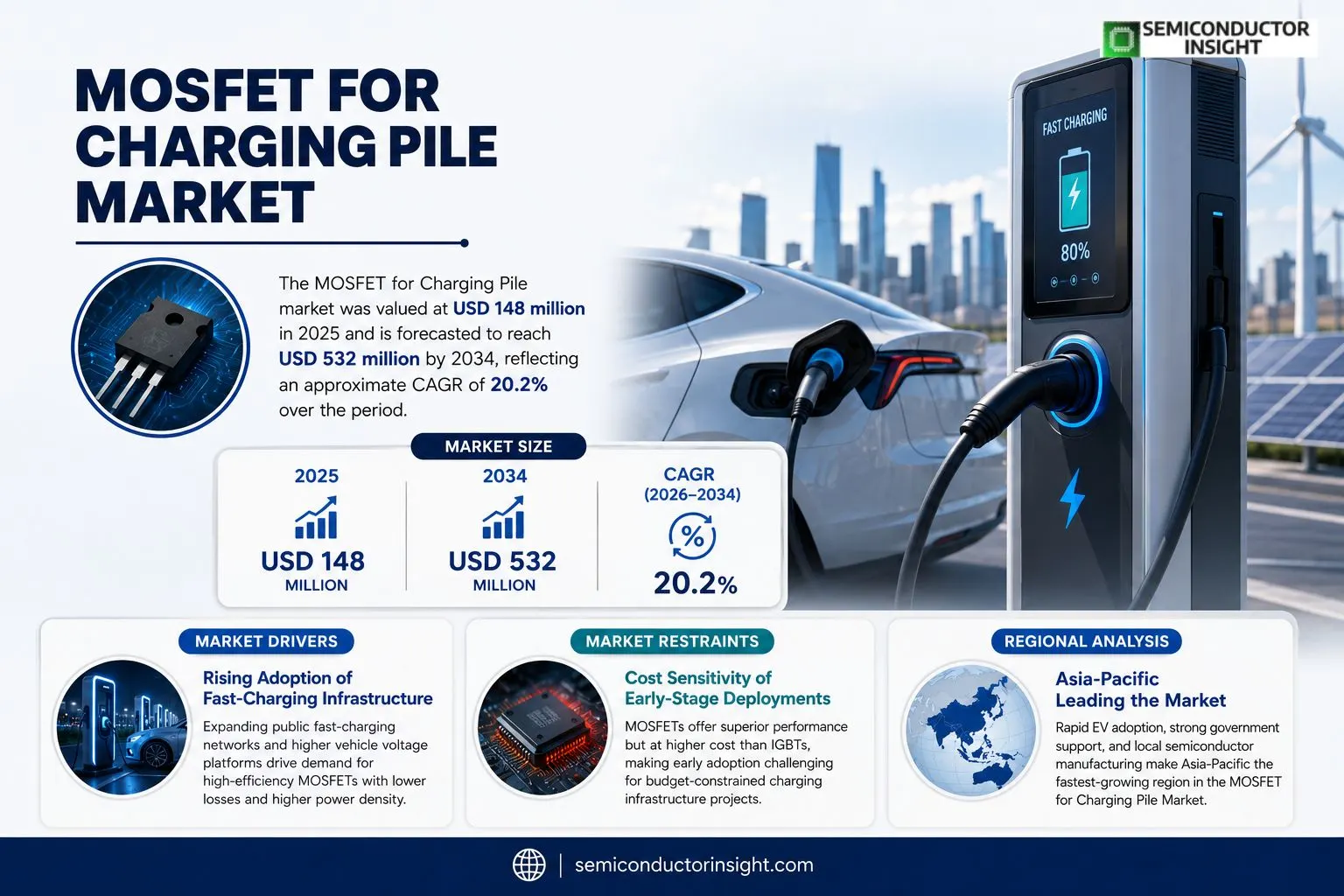
MOSFET for Charging Pile market size was valued at USD 148 million in 2025 and is forecasted to reach USD 532 million by 2034, reflecting an approximate compound annual growth rate of 20.2 % over the period.
MOSFETs used in charging piles are power metal‑oxide‑semiconductor field‑effect transistors that act as high‑frequency switching elements inside AC chargers and DC fast chargers. By applying a gate voltage, these devices control drain‑to‑source conduction, enabling efficient conversion of electrical energy from the grid to the vehicle battery.The upward trajectory stems from expanding public fast‑charging networks, higher vehicle voltage platforms, and tighter energy‑loss targets within charger bill‑of‑materials. Recent industry activity underscores this trend; for example, in March 2024 Infineon Technologies entered a supply agreement with ABB to provide silicon‑carbide MOSFETs for next‑generation DC fast chargers operating above 800 V. Simultaneously, domestic suppliers such as ROHM and STMicroelectronics have accelerated their SiC production lines to meet rising demand while maintaining price pressure on traditional silicon devices.
MARKET DRIVERS
Rising Adoption of Fast‑Charging Infrastructure
The acceleration of electric‑vehicle adoption has forced operators to install fast‑charging stations that demand higher efficiency and tighter thermal tolerances. MOSFETs designed for charging piles meet these requirements by offering lower on‑resistance and faster switching, which translates into reduced energy loss and higher power density. This technical advantage is prompting system integrators to replace legacy silicon‑based switches with advanced MOSFET solutions.
Stringent Emission Regulations
Governments across Europe and Asia have tightened CO₂ limits for transport, effectively mandating a shift toward electric mobility. To comply, utility companies are investing in charging‑pile networks that rely on components capable of handling 400 kW or more per unit. MOSFETs provide the necessary voltage blocking capability while maintaining compact footprints, enabling rapid deployment of dense charging corridors in urban areas.
➤ “The ability of MOSFETs to operate at higher temperatures reduces the need for auxiliary cooling, cutting both cap‑ex and opex for charging‑pile owners.”
Manufacturers are also benefiting from economies of scale as wafer‑level integration improves yields. The resulting cost decline makes MOSFET‑based modules financially attractive, encouraging OEMs to standardize on this technology for next‑generation charging stations.
MARKET CHALLENGES
Thermal Management Complexities
Although MOSFETs offer superior switching performance, their operation at high current densities generates significant heat. Designing effective thermal pathways without inflating enclosure size remains a hurdle, especially for retrofit projects where space is constrained. Failure to address heat dissipation can lead to premature degradation, eroding the expected reliability benefits.
Other Challenges
Supply‑Chain Volatility
The semiconductor industry continues to grapple with raw‑material shortages and geopolitical tensions. Fluctuations in silicon wafer availability can cause lead‑time extensions for MOSFET inventories, pressuring project schedules for charging‑pile deployments.
MARKET RESTRAINTS
Cost Sensitivity of Early‑Stage Deployments
While MOSFETs deliver performance gains, their unit price remains higher than older IGBT alternatives. Early adopters, often municipal utilities with tight budgets, may hesitate to allocate additional capital for MOSFET‑based converters, opting instead for cost‑effective, albeit less efficient, solutions until economies of scale bring prices down further.
MARKET OPPORTUNITIES
Integration with Smart‑Grid Technologies
The convergence of charging‑pile infrastructure with smart‑grid management opens a niche for MOSFETs that can be tightly coordinated with real‑time load‑balancing algorithms. By embedding MOSFETs capable of rapid response into bidirectional chargers, operators can support vehicle‑to‑grid services, unlocking new revenue streams and enhancing grid stability. This functional synergy positions MOSFET for Charging Pile Market at the forefront of next‑generation energy ecosystems.
MOSFET for Charging Pile Market Trends
Rising Adoption of SiC MOSFETs in Fast‑Charging Applications
The transition to higher‑voltage electric‑vehicle platforms has pressed charger designers to seek devices that can switch faster while shedding thermal losses. Silicon‑carbide (SiC) MOSFETs answer that need by delivering lower on‑resistance at comparable voltage ratings, which translates into tighter power‑density packs and lighter cooling infrastructure. In 2025, manufacturers reported an average unit price of about US$ 5.2, yet margins for SiC‑based offerings have already crept above 40% because the premium is offset by system‑level savings on magnetics and heat‑sink mass. This cost‑performance balance has motivated fast‑charging network operators to qualify SiC modules for stations exceeding 350 kW, where traditional silicon devices would incur prohibitive switching loss. Consequently, MOSFET for Charging Pile Market is witnessing a clear tilt toward premium substrates, reshaping supplier negotiations and prompting OEMs to lock‑in long‑term contracts for silicon‑carbide supply.
Other Trends
Supply‑Chain Consolidation and Packaging Innovation
Fragmented wafer producers have begun merging to secure silicon‑carbide capacity, while packaging firms are investing in direct‑bond‑copper (DBC) and aluminum‑metal‑base (AMB) substrates that tolerate higher junction temperatures. The result is a tighter loop between silicon substrate fab and module assembler, reducing lead times from weeks to days for high‑volume charger makers. Local distributors are leveraging this proximity to offer just‑in‑time delivery, a factor that pressures legacy players to either upscale their logistics or concede market share. Reliability qualification programs have also become a differentiator; firms that can certify devices to the latest IEC safety standards are able to command premium pricing, even as overall unit cost pressures intensify.
Shift Toward High‑Frequency Synchronous PFC Architectures
Traditional diode‑bridge front ends are giving way to active power‑factor‑correction (PFC) stages that operate above 200 kHz. By moving the rectification function into a synchronous MOSFET topology, designers achieve measurable reductions in conductive loss and improve overall station efficiency—critical when operators evaluate total‑cost‑of‑ownership across sprawling networks. This architectural shift elevates the role of MOSFET for Charging Pile Market from a passive switch to a central efficiency lever, prompting OEMs to co‑develop driver ICs that fine‑tune gate timing and mitigate electromagnetic interference. The downstream effect is a cascade of design optimizations: smaller inductors, slimmer heat sinks, and, ultimately, chargers that can be installed in tighter urban footprints. Companies that align their product roadmaps with this high‑frequency trend are positioning themselves to capture a larger share of upcoming charger contracts, while those clinging to legacy designs risk obsolescence as network planners prioritize compact, high‑efficiency solutions.
COMPETITIVE LANDSCAPE
Key Industry Players
MOSFET for Charging Pile Market – Competitive Overview
Infineon Technologies dominates the high‑power segment, leveraging its vertically integrated SiC substrate line and advanced DBC/AMB packaging capabilities. The company’s ability to qualify SiC MOSFETs for automotive safety standards underpins its position as a preferred supplier for fast‑charging module manufacturers in Europe and North America. Alongside Infineon, STMicroelectronics and Texas Instruments command sizable market shares in the silicon‑based MOSFET arena, where cost sensitivity still drives volume. The overall market structure resembles an oligopoly at the upper tier—four to five fabs control most of the wafer supply—while a dense fringe of regional fabricators and specialty packagers competes on lead time and customized thermal solutions.Beyond the headline names, a cohort of niche players injects competitive pressure through focused product portfolios or aggressive pricing. ROHM Semiconductor and Vishay have carved out mid‑range markets by offering super‑junction devices that balance efficiency with price. GeneSiC Semiconductor and Alpha & Omega Semiconductor specialize in SiC MOSFETs for ultra‑compact DC‑DC converters, gaining traction with OEMs targeting 800 V+ platforms. Fuji Electric, Mitsubishi Electric, and Renesas Electronics provide integrated power modules that embed MOSFETs, allowing them to capture system‑level contracts in the Asian fast‑charging rollout. The proliferation of these specialists forces the incumbents to accelerate technology refresh cycles and to tighten supply‑chain coordination, a dynamic that reshapes pricing curves and influences long‑term investment decisions for charger manufacturers.
List of Key MOSFET for Charging Pile Companies Profiled
- Infineon Technologies
- STMicroelectronics
- Texas Instruments
- ON Semiconductor
- Toshiba
- Samsung Electronics
- ROHM Semiconductor
- Vishay
- GeneSiC Semiconductor
- Alpha & Omega Semiconductor
- Fuji Electric
- Mitsubishi Electric
- Renesas Electronics
- NXP Semiconductors
- Wolfspeed (Cree)
Segment Analysis:
| Segment Category | Sub-Segments | Key Insights |
| By Type |
|
Silicon Carbide MOSFET is increasingly preferred for high‑power charging modules because it:
|
| By Application |
|
DC Fast Charger Modules benefit most from advanced MOSFETs as they:
|
| By End User |
|
Charging Station Operators prioritize MOSFET attributes that:
|
| By Technology |
|
Advanced Packaging drives market differentiation by:
|
| By Voltage Range |
|
High‑Voltage MOSFETs are crucial for next‑generation fast chargers because they:
|
Regional Analysis: MOSFET for Charging Pile Market
Asia‑Pacific
Governments across the region are issuing tiered incentives that directly reward fast‑charging capability, prompting vehicle makers to specify MOSFET‑based converters. The alignment of fiscal rebates with technical standards accelerates component uptake and narrows the time‑to‑market for new topologies.
Proximity to wafer foundries reduces transit latency and mitigates exposure to logistics disruptions. Localised assembly hubs further insulate the ecosystem from external shocks, reinforcing confidence among charging‑station operators.
The shift toward high‑voltage, high‑current charging stations drives preference for MOSFETs with lower on‑resistance and superior switching speed. Early pilots of silicon‑carbide devices signal a willingness to experiment with next‑gen architectures.
Regional champions are leveraging vertically integrated models to capture margin upside, while firms pursue joint ventures to tap local design expertise. The resulting competitive mosaic encourages continuous innovation.
North America
Demand for MOSFET for Charging Pile Market solutions in North America is shaped by a mature EV fleet and a regulatory agenda that emphasizes grid‑interactive charging. Utilities are piloting demand‑response schemes that require fast, reliable power conversion, pushing OEMs toward MOSFETs that can handle frequent cycling. At the same time, the market is witnessing a strategic pivot toward domestic semiconductor production to reduce reliance on overseas sources, affecting sourcing strategies for charging‑infrastructure developers.
Europe
European jurisdictions have woven stringent emissions targets with substantial funding for public charging networks, creating a fertile ground for MOSFET integration. The continent’s strong emphasis on safety certification and interoperability has forced manufacturers to align their device specifications with harmonised standards, fostering a more predictable procurement environment. Additionally, the emergence of cross‑border charging corridors encourages suppliers to develop MOSFET solutions that can operate efficiently across diverse voltage regimes.
South America
South America remains in an early‑adoption phase, but government incentives for urban electrification are accelerating the rollout of fast‑charging stations in cities such as São Paulo and Buenos Aires. Limited local semiconductor capacity means most MOSFETs are imported, which raises price sensitivity among project developers. Nevertheless, regional partnerships with Asian fabs are beginning to lower entry barriers, hinting at a gradual shift toward localized supply chains.
Middle East & Africa
In the Middle East & Africa, the advent of large‑scale solar farms paired with burgeoning EV adoption is reshaping power‑conversion requirements. Stakeholders are prioritising MOSFETs that can sustain high ambient temperatures while delivering high efficiency, a combination that aligns with the region’s climate constraints. Collaborative ventures between multinational chipmakers and local energy firms are emerging, providing a platform for technology transfer and capacity building.
Report Scope
This market research report provides a comprehensive analysis of the MOSFET for Charging Pile Market , covering the forecast period 2026–2034. It offers detailed insights into market dynamics, technological advancements, competitive landscape, and key trends shaping the industry.
Key focus areas of the report include:
- Market Overview: The report begins with an overview outlining its current market scenario, key growth indicators, and industry transformation drivers. It discusses macroeconomic factors, demand–supply balance, regulatory landscape, and the strategic role of semiconductors in powering advancements across industries such as automotive, telecommunications, consumer electronics, and industrial automation.
- Market Size & Forecast: Historical data and future projections for revenue, unit shipments, and market value across major regions and segments.
- Segmentation Analysis: Detailed breakdown by product type, technology, application, and end-user industry to identify high-growth segments and investment opportunities.
- Regional Insights: Insights into market performance across North America, Europe, Asia-Pacific, Latin America, and the Middle East & Africa, including country-level analysis where relevant.
- Competitive Landscape: Profiles of leading market participants, including their product offerings, R&D focus, manufacturing capacity, pricing strategies, and recent developments such as mergers, acquisitions, and partnerships.
- Technology Trends & Innovation: Assessment of emerging technologies, integration of AI/IoT, semiconductor design trends, fabrication techniques, and evolving industry standards.
- Market Drivers & Restraints: Evaluation of factors driving market growth along with challenges, supply chain constraints, regulatory issues, and market-entry barriers.
- Stakeholder Insights: Insights for component suppliers, OEMs, system integrators, investors, and policymakers regarding the evolving ecosystem and strategic opportunities.
Primary and secondary research methods are employed, including interviews with industry experts, data from verified sources, and real-time market intelligence to ensure the accuracy and reliability of the insights presented.
FREQUENTLY ASKED QUESTIONS:
What is the current market size of MOSFET for Charging Pile Market?
-> MOSFET for Charging Pile Market was valued at USD 148 million in 2025 and is expected to reach USD 532 million by 2034, growing at a CAGR of 20.2% during the forecast period.
Which key companies operate in MOSFET for Charging Pile Market?
-> Key players include leading semiconductor manufacturers and specialized MOSFET suppliers that dominate Si and SiC MOSFET production for charging applications.
What are the key growth drivers?
-> Key growth drivers include higher charging power density requirements, expansion of public fast‑charging networks, migration to higher‑voltage vehicle platforms, and the need for low‑loss, high‑efficiency MOSFET solutions.
Which region dominates the market?
-> Asia‑Pacific shows the fastest growth due to rapid EV adoption and extensive deployment of fast‑charging infrastructure, while Europe remains a significant market contributor.
What are the emerging trends?
-> Emerging trends include the shift from diode‑based rectifiers to active PFC topologies, increased use of high‑frequency isolated DC‑DC converters, and accelerated adoption of SiC MOSFETs for high‑power, high‑temperature charger designs.

Get Sample Report PDF for Exclusive Insights
Report Sample Includes
- Table of Contents
- List of Tables & Figures
- Charts, Research Methodology, and more...
 Download Sample Report PDF