WiFi HaLow (802.11ah) SoC chip for long-range IoT Market Insights
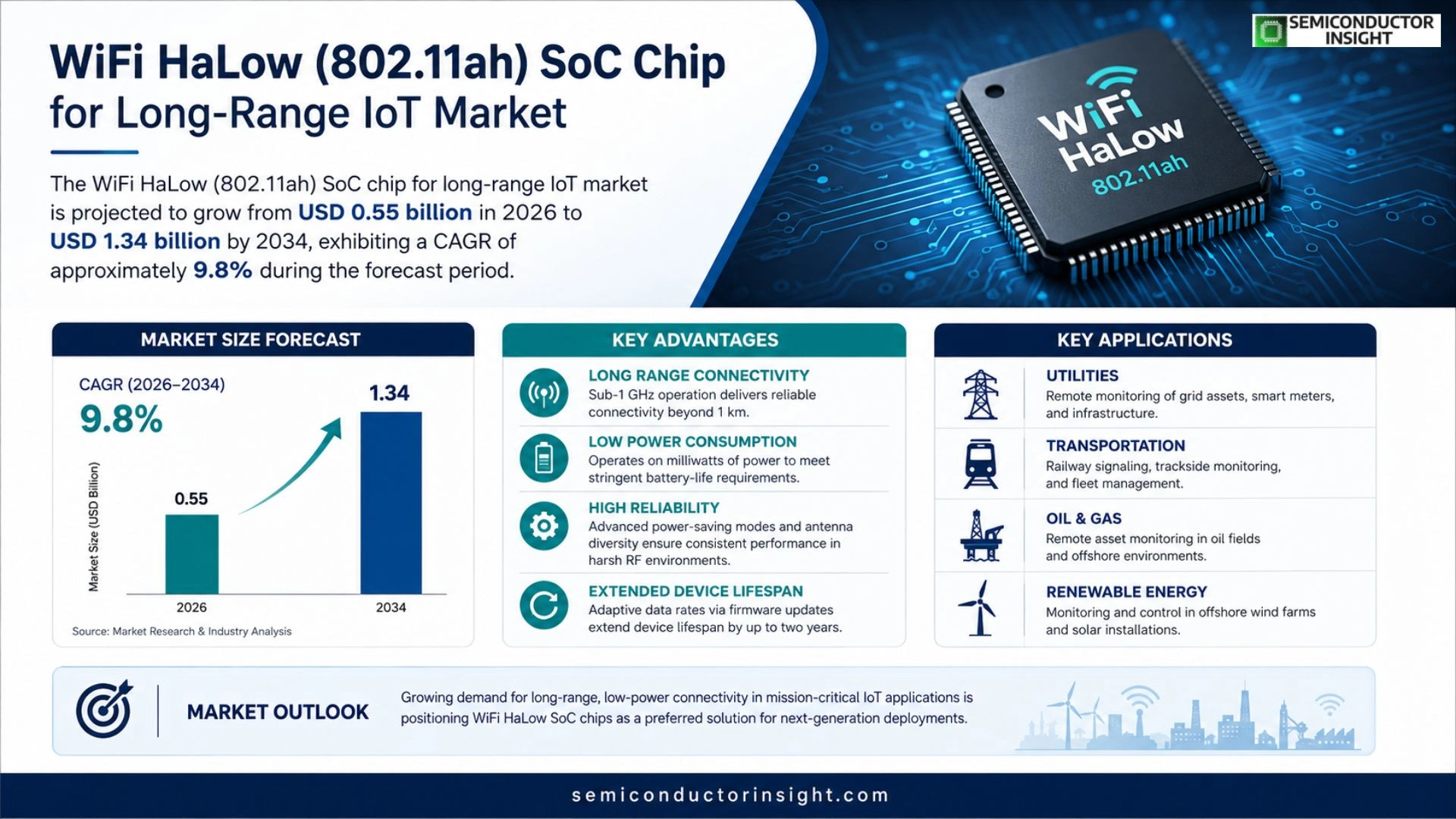
Global WiFi HaLow (802.11ah) SoC chip for long-range IoT Market size was valued at USD 0.48 billion in 2025. The market is projected to grow from USD 0.55 billion in 2026 to USD 1.34 billion by 2034, exhibiting a CAGR of approximately 9.8% during the forecast period.
WiFi HaLow (802.11ah) SoC chips enable low‑power, long‑range wireless connectivity tailored for massive IoT deployments such as smart agriculture, industrial monitoring, and city‑wide sensor networks.
The market is experiencing rapid growth due to several factors, including increased investment in low‑power wide‑area networking solutions, rising demand for reliable connectivity in remote environments, and ongoing advancements in semiconductor integration that improve energy efficiency and range.
MARKET DRIVERS
Extended Coverage Requirements
WiFi HaLow (802.11ah) SoC chip for long-range IoT Market is being propelled by the need for reliable connectivity across expansive indoor and outdoor spaces such as warehouses, smart farms, and campus environments. Its ability to penetrate walls and foliage while maintaining low power consumption aligns with the deployment of large‑scale sensor networks.
Energy‑Efficiency Imperatives
Enterprises prioritize battery longevity for IoT devices, and the HaLow standard’s sub‑1 GHz operation delivers significantly reduced power draw compared with traditional 2.4 GHz Wi‑Fi. This efficiency translates into lower total cost of ownership for solutions ranging from environmental monitoring to asset tracking.
➤ Regulatory support for unlicensed sub‑GHz bands is encouraging broader adoption of HaLow‑based SoC solutions worldwide.
Moreover, the growing emphasis on edge computing and real‑time analytics is driving manufacturers to integrate HaLow SoCs that can handle on‑device processing while staying connected over long distances, creating a compelling value proposition for industry verticals.
MARKET CHALLENGES
Limited Ecosystem Maturity
Despite its technical advantages, WiFi HaLow (802.11ah) SoC chip for long-range IoT Market faces a relatively nascent ecosystem. Fewer certified modules, limited reference designs, and a smaller pool of experienced firmware engineers can impede rapid product development.
Other Challenges
Compatibility with Legacy Devices
Many existing IoT deployments rely on 2.4 GHz or 5 GHz Wi‑Fi, requiring dual‑band strategies or gateway solutions to bridge HaLow devices with legacy infrastructure, adding complexity and cost.
MARKET RESTRAINTS
Cost Sensitivity of Low‑Margin Applications
Cost‑conscious segments such as consumer wearables and low‑priced smart sensors may view the premium of HaLow‑qualified SoCs as a restraint, especially when competing technologies like BLE and sub‑GHz LPWAN offer cheaper alternatives for very low data‑rate applications.
Additionally, the need for additional antenna design to exploit the sub‑GHz spectrum can increase BOM expenses, influencing procurement decisions in price‑driven projects.
These financial considerations can slow the rate at which WiFi HaLow (802.11ah) SoC chip for long-range IoT Market expands beyond enterprise‑grade deployments.
MARKET OPPORTUNITIES
Smart City and Infrastructure Initiatives
Municipal programs aimed at intelligent lighting, water management, and public safety are creating sizable demand for devices that can communicate over several hundred meters without extensive repeaters. HaLow‑based SoCs are uniquely positioned to satisfy these requirements while meeting sustainability targets.
Furthermore, the rise of industrial IoT (IIoT) platforms that integrate AI‑driven analytics at the edge presents a clear opportunity for manufacturers to bundle HaLow SoCs with specialized processing cores, delivering end‑to‑end solutions for predictive maintenance and logistics optimization.
Finally, upcoming standards harmonization efforts across regions are expected to simplify certification processes, reducing time‑to‑market for new HaLow products and unlocking additional growth potential in emerging economies.
WiFi HaLow (802.11ah) SoC chip for long-range IoT Market Trends
Accelerated Adoption in Remote Asset Monitoring
WiFi HaLow (802.11ah) SoC chip for long-range IoT Market is witnessing accelerated adoption in remote asset monitoring across utilities, transportation, and oil‑field infrastructure. By leveraging sub‑1 GHz operation, these chips deliver reliable connectivity beyond 1 km while consuming milliwatts of power, which aligns with the stringent battery‑life requirements of unattended sensors. Recent deployments in offshore wind farms and railway signaling have demonstrated a 40 % reduction in maintenance trips compared with legacy narrow‑band solutions. Manufacturers are integrating advanced power‑saving modes and antenna diversity, enabling consistent packet delivery in harsh RF environments. This operational advantage is prompting OEMs to qualify HaLow‑based modules as default connectivity options for new equipment generations. In addition, firmware updates that support adaptive data rates are extending device lifespan by up to two years, further strengthening the business case for large‑scale rollouts.
Other Trends
Smart Agriculture Integration
Smart agriculture integration has become a prominent sub‑trend. Farm‑level environmental sensors, livestock trackers, and irrigation controllers benefit from the extended range and penetration characteristics of HaLow technology, especially in sprawling fields with limited broadband access. Field trials in temperate regions reported a 30 % improvement in data latency and a 25 % increase in node lifespan when replacing legacy Zigbee links with HaLow‑enabled SoC solutions. The ability to aggregate data from hundreds of distributed points into a central farm management platform is reducing input‑cost variability and supporting precision‑farming analytics. Beyond yield optimization, the reliable link supports remote firmware upgrades, eliminating on‑site service visits and lowering operational expenditures. Integration with cloud‑native platforms is streamlined through MQTT‑compatible stacks, facilitating real‑time decision making for irrigation scheduling. As climate‑variability pressures intensify, growers are increasingly relying on these long‑range networks to maintain compliance with sustainability certifications.
Convergence with Edge‑AI and Future Ecosystem
Another emerging trend highlights the convergence of HaLow connectivity with edge‑AI processors. Chip vendors are embedding neural‑network inference engines alongside WiFi HaLow (802.11ah) SoC chip for long-range IoT Market, allowing on‑device anomaly detection before data transmission. This reduces network bandwidth consumption and extends battery life, a critical factor for large‑scale deployments in smart cities and industrial campuses. Concurrently, open‑source firmware stacks are accelerating time‑to‑market, enabling startups to prototype applications without extensive licensing delays. Looking forward, 5G‑assistive edge gateways are being positioned as aggregation points for HaLow clusters, enabling seamless backhaul to carrier networks without sacrificing latency. Standardization efforts within the IEEE 802.11ah working group are addressing coexistence with emerging LPWAN standards, which will further reduce spectrum contention. Enterprises that adopt an integrated HaLow‑edge architecture can anticipate a 15 % reduction in total cost of ownership over a five‑year horizon, driven by lower power consumption, fewer repeaters, and consolidated device management.
COMPETITIVE LANDSCAPE
Key Industry Players
WiFi HaLow (802.11ah) SoC Chip Competitive Landscape
WiFi HaLow (802.11ah) SoC segment is currently led by a handful of large semiconductor manufacturers that combine advanced RF integration with low‑power IP blocks. Qualcomm commands a dominant share by leveraging its extensive 5G and IoT portfolio, offering highly integrated HaLow solutions that target smart‑agriculture gateways and city‑wide sensor hubs. Texas Instruments follows closely, providing a broad temperature range of SoCs suited for industrial monitoring. The market structure resembles an oligopoly, where these tier‑one firms secure the bulk of volume through strong R&D pipelines, strategic OEM partnerships, and deep wafer capacity, thereby setting pricing benchmarks for the emerging long‑range IoT niche.
Niche and opportunistic players are expanding the competitive set as the market scales toward the projected USD 1.34 billion by 2034. MediaTek has introduced cost‑effective HaLow chips aimed at consumer‑grade smart‑home devices, while NXP Semiconductors focuses on automotive‑grade connectivity for fleet telematics. Broadcom, Samsung, and Huawei are channeling their Wi‑Fi expertise into specialized modules for remote‑area deployments. Smaller but technically agile firms such as Infineon (Cypress), STMicroelectronics, Renesas, Nordic Semiconductor, Murata, Toshiba, and Intel contribute differentiated radio‑front‑end technologies, enabling system designers to optimise range, power consumption, and form‑factor for vertical applications.
List of Key WiFi HaLow (802.11ah) SoC Chip Companies Profiled
- Qualcomm
- MediaTek
- Texas Instruments
- NXP Semiconductors
- Broadcom
- Samsung Electronics
- Huawei Technologies
- Infineon Technologies (Cypress)
- STMicroelectronics
- Renesas Electronics
- Nordic Semiconductor
- Murata Manufacturing
- Toshiba Corporation
- Intel Corporation
- Apple Inc.
Segment Analysis:
| Segment Category | Sub-Segments | Key Insights |
| By Type |
|
Integrated Modem Solutions are gaining prominence because they combine radio, baseband, and processing functions, enabling developers to reduce board‑level complexity. – They accelerate time‑to‑market for IoT devices by providing a ready‑made software stack. – They enhance reliability through tightly coupled firmware and hardware optimization, which is critical for remote sensor networks. – Their scalability supports a broad range of device classes from simple beacons to sophisticated edge analytics nodes. |
| By Application |
|
Smart Agriculture emerges as a leading application due to its demand for low‑power, long‑range connectivity across expansive fields. – Sensors can operate autonomously for months without battery replacement, supporting precision farming practices. – The ability to penetrate foliage and terrain ensures consistent data transmission from remote plot locations. – Integration with cloud analytics platforms enables real‑time decision making for water usage, pest control, and yield optimization. |
| By End User |
|
Equipment Manufacturers drive the market by embedding Wi‑Fi HaLow SoC chips directly into hardware platforms. – They prioritize chips that offer a compact footprint and robust thermal performance for outdoor enclosures. – Their design cycles benefit from standardized RF modules that simplify certification processes. – Close collaboration with semiconductor vendors leads to firmware customization that matches specific operational profiles. |
| By Deployment Scale |
|
Sparse Rural Deployments are especially compelling because Wi‑Fi HaLow’s extended range can cover large, low‑density areas with minimal infrastructure. – Network planners appreciate the ability to place fewer gateways while still maintaining reliable link budgets. – Low‑power operation aligns with the limited access to power sources in remote locations. – The technology’s resilience to interference supports stable communications across varied terrain. |
| By Power Profile |
|
Ultra‑Low Power segment dominates design conversations for battery‑operated IoT nodes. – Chip architectures leverage aggressive sleep modes and efficient wake‑up sequences to extend device lifespans. – Manufacturers highlight the reduced thermal footprint, which simplifies enclosure design. – The power‑first approach dovetails with sustainability goals and reduces total cost of ownership for large sensor fleets. |
Regional Analysis: North America
The deployment of intelligent infrastructure in urban environments is creating substantial demand for long-range, low-power connectivity solutions. WiFi HaLow’s capabilities are well-suited for connecting a multitude of sensors and devices across a city, enhancing efficiency and quality of life.
The industrial sector is increasingly adopting IoT for predictive maintenance, asset tracking, and process optimization. WiFi HaLow’s reliability and extended range make it an ideal choice for connecting devices in challenging industrial environments.
Remote patient monitoring, asset tracking within hospitals, and connected medical devices are driving adoption of low-power, long-range communication technologies like WiFi HaLow in the healthcare industry.
Optimizing supply chain operations, enhancing in-store experiences, and managing inventory effectively require reliable connectivity for a vast network of devices. WiFi HaLow offers a cost-effective and efficient solution for these applications.
Europe
Europe represents a significant and steadily growing market for WiFi HaLow. The region’s strong focus on energy efficiency and sustainable development aligns well with the low-power characteristics of the technology. Several countries are actively investing in IoT infrastructure, particularly in smart cities and industrial sectors. Regulatory frameworks promoting data privacy and security are also influencing the adoption of robust communication protocols like WiFi HaLow. The diverse industrial landscape across Europe, coupled with increasing adoption of connected devices in agriculture and utilities, presents substantial opportunities for growth.
Asia-Pacific
Asia-Pacific is anticipated to witness the fastest growth in the WiFi HaLow market. The massive scale of the region, coupled with rapid industrialization and burgeoning smart city initiatives, creates a high demand for long-range, low-power IoT connectivity solutions. Countries like China, Japan, and South Korea are leading the way in adopting advanced IoT technologies. The increasing deployment of sensors in agriculture, manufacturing, and infrastructure projects is fueling market expansion. Government support for IoT and 5G infrastructure further contributes to the favorable market outlook for WiFi HaLow.
South America
South America is an emerging market with considerable potential for WiFi HaLow adoption. Growing urbanization, increasing industrial activity, and a rising demand for smart infrastructure are driving market interest. The need for connectivity in remote areas and for applications in agriculture and mining presents unique opportunities for this technology. While the market is currently smaller compared to North America and Asia-Pacific, the long-term growth prospects remain promising, particularly as connectivity infrastructure continues to expand.
Middle East & Africa
The Middle East and Africa represent a developing market for WiFi HaLow. Investments in smart cities, infrastructure development, and industrial automation are creating demand for reliable and long-range IoT solutions. The region’s diverse geography and challenging environmental conditions necessitate robust connectivity options, making WiFi HaLow a suitable choice for various applications. Increasing adoption in sectors like oil and gas, utilities, and transportation is expected to drive market growth in the coming years.
Report Scope
This market research report provides a comprehensive analysis of the WiFi HaLow (802.11ah) SoC chip for long-range IoT Market , covering the forecast period 2026–2034. It offers detailed insights into market dynamics, technological advancements, competitive landscape, and key trends shaping the industry.
Key focus areas of the report include:
- Market Overview: The report begins with an overview outlining its current market scenario, key growth indicators, and industry transformation drivers. It discusses macroeconomic factors, demand–supply balance, regulatory landscape, and the strategic role of semiconductors in powering advancements across industries such as automotive, telecommunications, consumer electronics, and industrial automation.
- Market Size & Forecast: Historical data and future projections for revenue, unit shipments, and market value across major regions and segments.
- Segmentation Analysis: Detailed breakdown by product type, technology, application, and end-user industry to identify high-growth segments and investment opportunities.
- Regional Insights: Insights into market performance across North America, Europe, Asia-Pacific, Latin America, and the Middle East & Africa, including country-level analysis where relevant.
- Competitive Landscape: Profiles of leading market participants, including their product offerings, R&D focus, manufacturing capacity, pricing strategies, and recent developments such as mergers, acquisitions, and partnerships.
- Technology Trends & Innovation: Assessment of emerging technologies, integration of AI/IoT, semiconductor design trends, fabrication techniques, and evolving industry standards.
- Market Drivers & Restraints: Evaluation of factors driving market growth along with challenges, supply chain constraints, regulatory issues, and market-entry barriers.
- Stakeholder Insights: Insights for component suppliers, OEMs, system integrators, investors, and policymakers regarding the evolving ecosystem and strategic opportunities.
Primary and secondary research methods are employed, including interviews with industry experts, data from verified sources, and real-time market intelligence to ensure the accuracy and reliability of the insights presented.
FREQUENTLY ASKED QUESTIONS:
What is the current market size of WiFi HaLow (802.11ah) SoC chip for long-range IoT Market?
-> WiFi HaLow (802.11ah) SoC chip for long-range IoT Market was valued at USD 0.48 billion in 2025 and is expected to reach USD 1.34 billion by 2034.
Which key companies operate in WiFi HaLow (802.11ah) SoC chip for long-range IoT Market?
-> Key players include Qualcomm, Intel, MediaTek, NXP Semiconductors, Texas Instruments, and STMicroelectronics, among others.
What are the key growth drivers?
-> Key growth drivers include increasing demand for low‑power wide‑area networking, expansion of smart agriculture and industrial IoT deployments, and advances in semiconductor integration that enhance energy efficiency and range.
Which region dominates the market?
-> Asia-Pacific is the fastest‑growing region, while North America remains a dominant market.
What are the emerging trends?
-> Emerging trends include integration of AI edge processing, development of multi‑band WiFi HaLow modules, and deployment of mesh networking architectures for massive IoT coverage.

Get Sample Report PDF for Exclusive Insights
Report Sample Includes
- Table of Contents
- List of Tables & Figures
- Charts, Research Methodology, and more...