
A small chemical delivery error can affect yield, reliability and tool uptime in semiconductor manufacturing. A Liquid Delivery System (LDS) is the controlled hardware and automation layer that stores, conditions and supplies ultra-high-purity liquids, such as solvents, acids, cleaners and precursors, to wafer process tools with the precision fabs need.
LDS is not only about flow control but also about contamination control, safety and repeatability. Semiconductor fabs are scaling on the back of more than 400 tracked 300 mm fabs and lines worldwide. Global 300 mm capacity is expected to reach 11.1 million wafers per month by 2028, which means more tools, more chemistries and more demand for stable liquid handling systems.
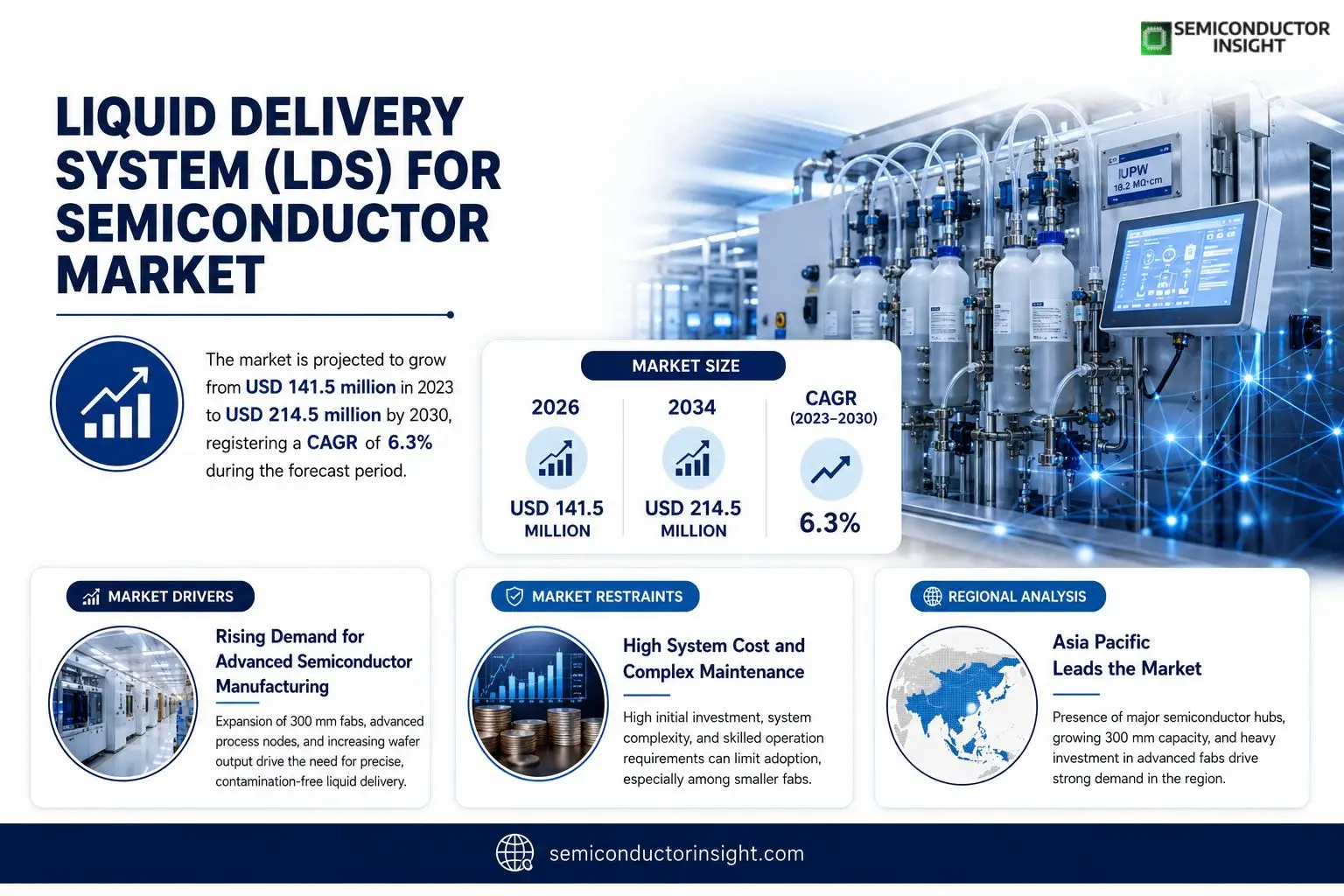
- Market revenue totaled USD 141.5 million in 2023
- Estimated to grow to USD 214.5 million by 2030
- Registering a compound annual growth rate of 6.3%
In the semiconductor world, a Liquid Delivery System can be thought of as the chemical backbone of the fab. It delivers the right liquid, at the right pressure, in the right amount, to the right place, without particles, metals, moisture or human handling compromising the process.
In practice, LDS is used in processes such as wafer cleaning, wet etching, and photoresist processing and chemical mechanical planarization, where even small levels of contamination can affect device performance. These processes often use high-purity chemicals, such as hydrochloric acid, hydrogen peroxide, ammonia, sulfuric acid and isopropyl alcohol, often prepared at controlled ratios for cleaning and surface preparation.
Key Takeaways:
- Asia Pacific leads adoption, driven by the density of semiconductor fabs, growing 300 mm capacity, and heavy use of ultra-high-purity liquid handling in advanced processing lines.
- Terminal Delivery System (TDS) leads the type mix, because fabs need stable point-of-use chemical supply for wet processing, cleaning, and precise on-tool delivery.
- PVD/CVD processes remain a key application, supported by the need for tightly controlled liquid precursors and repeatable chemistry in advanced deposition steps.
MARKET DRIVERS
Rising Adoption of Advanced Semiconductor Nodes
As the semiconductor manufacturers move to 3 nm, 2 nm and sub-2 nm process technologies, the importance of liquid chemical delivery increases to maintain process uniformity, control contamination and to deliver precise quantities of chemicals. Liquid Delivery Systems (LDS) Provides precision dispensing of the ultra-high-purity chemicals, photoresists, developers, CMP slurries, acids, solvents and cleaning agents needed in wafer fabrication. At advanced technology nodes, small variations in flow rate or contamination can significantly impact device yield.
- Due to ongoing investments in advanced logic and memory fabrication, SEMI projects that worldwide semiconductor manufacturing capacity will surpass 40 million wafers (200 mm equivalent) every quarter by 2028.
- Simultaneously, IMEC emphasises the need for increasingly complex chemical management systems that can offer ultra-pure process chemicals with extremely tight control over flow, pressure, and contamination levels for next-generation 2 nm and beyond manufacturing.
- Leading semiconductor factories are investing more in sophisticated LDS platforms as a result of these technological developments.
Expanding Global Semiconductor Fab Construction Accelerates LDS Equipment Installations
Governments around the world are supporting domestic semiconductor manufacturing with large-scale incentive programs, helping to drive continued demand for liquid chemical delivery infrastructure. For each new fab, integrated LDS solutions are needed to support the lithography, etching, deposition, cleaning, CMP and wet processing operations.
- More than 100 semiconductor fabrication facilities are expected to be brought online worldwide in this expansion cycle, according to SEMI’s World Fab Forecast, and worldwide semiconductor equipment spending remains above USD 100 billion annually.
- National programs such as the U.S. CHIPS and Science Act, European Chips Act, India Semiconductor Mission (ISM), and manufacturing investments in Taiwan, South Korea, Japan and China are driving sharp increases in installations of advanced process equipment requiring precision liquid delivery systems.
The continuous expansion of foundries, memory fabs, and advanced packaging facilities directly supports long-term LDS market growth.
Growing Demand for AI, High-Bandwidth Memory, and Advanced Packaging Drives Chemical Delivery Requirements
Artificial intelligence processors, High-Bandwidth Memory (HBM), chiplet architectures, and heterogeneous integration require significantly more process steps involving wet chemical treatment, CMP, cleaning, and advanced lithography. These applications depend on stable, contamination-free delivery of specialty chemicals throughout fabrication.
The IEEE Electronics Packaging Society has identified advanced packaging and hybrid integration as enabling technologies for next-generation AI computing platforms. At the same time, increasing production of HBM stacks and advanced logic chips is driving higher consumption of ultra-high-purity chemicals, which is driving growing demand for intelligent LDS platforms that can provide automated monitoring, precision dispensing and real-time process control.
MARKET RESTRAINTS
High Capital Investment and Integration Costs Restrict Adoption
Modern Liquid Delivery System 3D Model include chemical blending modules, high purity pumps, filtration systems, precision flow controllers, leak detection sensors, automated monitoring software and contamination control technologies. These are highly engineered systems that require significant capital investment, particularly for leading edge semiconductor fabs at advanced process nodes.
The U.S. Department of Commerce said building a state-of-the-art semiconductor fabrication facility costs tens of billions of dollars. Process infrastructure such as chemical distribution and ultra-pure utility systems make up a significant fraction of the total fab costs. This leads to smaller semiconductor manufacturers and specialty fabs often delaying LDS improvements due to the high implementation costs.
Stringent Chemical Purity Requirements Increase Operational Complexity
Liquid delivery systems have to be of very high chemical purity and must not generate particles, metallic contamination and air bubbles. Any deviation can have negative impacts on wafer yields, especially in EUV lithography and advanced etching processes.
NIST notes that nanometer scale contamination can have a dramatic effect on the performance of semiconductor manufacturing. To maintain purity, semiconductor makers must frequently replace filters, calibrate, perform preventive maintenance and monitor rigorously, all of which adds to the complexity of their operations, and the cost of ownership.
MARKET CHALLENGES
Maintaining Ultra-High Purity during High-Volume Semiconductor Production
When semiconductor geometries shrink, delivering chemicals without contamination over large-scale manufacturing becomes more problematic. Liquid delivery systems must reliably deliver aggressive chemicals without introducing particles, dissolved gases or metallic impurities, and must support continuous 24/7 production.
According to SEMI contamination control guidelines, advanced semiconductor manufacturing is becoming increasingly reliant on ultra-clean process environments with very low particle levels. Keeping thousands of wafers per day at consistent purity is one of the hardest engineering challenges in the industry.
Supply Chain Dependence for High-Purity Components and Specialty Materials
Liquid Delivery Systems demand specialized fluoropolymer tubing, precision valves, mass flow controllers, diaphragm pumps, sensors, filtration units, and semiconductor-grade fluid handling components from a small number of global manufacturers.
LDS installations, equipment maintenance and fab expansion projects can be delayed by disruptions to speciality polymers, precision instrumentation or semiconductor-grade component suppliers. Continued geopolitical uncertainties and accelerating global semiconductor equipment demand are further weighing on specialized supply chains.
MARKET OPPORTUNITIES
Expansion of Advanced Packaging and Specialty Chemical Processing Creates Strong Growth Potential
The rapid growth of advanced packaging technologies including chiplets, wafer-level packaging, fan-out packaging, and 3D integration is increasing the number of wet processing, cleaning, and chemical treatment steps during semiconductor manufacturing. This trend creates significant opportunities for next-generation LDS capable of automated chemical blending, real-time monitoring, and intelligent process optimization.
- According to SEMI, worldwide advanced packaging capacity is projected to expand significantly through the forecast period as AI processors, automotive electronics, and high-performance computing continue driving semiconductor demand.
- This sustained capacity expansion is expected to generate substantial opportunities for LDS manufacturers offering high-precision, contamination-controlled chemical delivery platforms.
Segment Analysis:
| Segment Category | Sub-Segments | Key Insights |
| By Type |
|
The dominating segment in Liquid Delivery System (LDS) for Semiconductor Market is: Terminal Delivery System (TDS)
· Widely deployed in semiconductor fabrication facilities (fabs) for the safe storage, monitoring, and continuous delivery of high-purity process chemicals. · Supports a broad range of wet processing applications, including cleaning, etching, and chemical mechanical planarization (CMP). |
| By Application |
|
PVD/CVD Processes is the leading segment in Liquid Delivery System (LDS) for Semiconductor Market.
· Chemical Vapor Deposition (CVD) and Physical Vapor Deposition (PVD) require highly precise and contamination-free delivery of liquid precursors. · Advanced semiconductor manufacturing (5 nm, 3 nm, 2 nm and beyond) relies heavily on thin-film deposition, significantly increasing the demand for high-performance liquid delivery systems. |
By Application:
Competitive Analysis
Liquid Delivery System (LDS) for Semiconductor Market is becoming increasingly competitive as semiconductor manufacturers pursue tighter process control, higher chemical utilization efficiency, and contamination-free delivery of ultra-high-purity chemicals.
Current market developments highlight:
- Entegris introduced advanced intelligent fluid management technologies integrating real-time sensing, contamination control, and automated chemical delivery designed for advanced semiconductor fabrication and EUV process environments.
- CKD Corporation expanded its precision chemical delivery solutions with high-purity valves and flow control systems supporting next-generation semiconductor fabs requiring ultra-low particle generation and enhanced process stability.
- Pall Corporation strengthened its semiconductor filtration and fluid management portfolio by introducing high-performance filtration technologies capable of removing nanoscale contaminants from critical semiconductor process chemicals.
Leading suppliers such as Entegris, CKD Corporation, Ichor Systems, and Pall Corporation continue investing in automated chemical delivery architectures that improve yield, reduce chemical waste, and enhance fab productivity.
An Overview of Key Liquid Delivery System Manufacturers
- Entegris Inc.
- Ichor Systems Inc.
- CKD Corporation
- Pall Corporation
- MKS Instruments Inc.
- Fujikin Incorporated
- Swagelok Company
- Saint-Gobain Performance Plastics
- Parker Hannifin Corporation
- KITZ SCT Corporation
- VAT Group AG
- Valex Corporation
- Asahi/America Inc.
- FITOK Group
- High Purity New England (HPNE)
REGIONAL ANALYSIS
Why does Asia Pacific dominate Liquid Delivery System (LDS) for Semiconductor Market through global wafer fabrication leadership?
Asia Pacific dominates the global Liquid Delivery System (LDS) for Semiconductor Market because it hosts the world’s largest concentration of semiconductor fabrication facilities and advanced packaging plants that require continuous delivery of ultra-high-purity chemicals. Every advanced wafer fabrication process including lithography, deposition, etching, cleaning, CMP, and wafer rinsing depends on highly reliable liquid delivery infrastructure capable of maintaining contamination-free process conditions.
- More than 75% of global semiconductor manufacturing capacity is concentrated in Asia, led by Taiwan, South Korea, China, Japan, and Singapore, creating the world’s largest installed base of semiconductor chemical delivery infrastructure.
- Taiwan accounts for over 60% of global semiconductor foundry revenue, while South Korea leads global memory manufacturing, significantly increasing demand for precision liquid delivery systems used in advanced DRAM, NAND, and HBM production.
- Rapid investments in 2 nm logic production, AI accelerators, chiplet packaging, silicon carbide (SiC), and gallium nitride (GaN) fabrication continue driving demand for automated, contamination-controlled chemical delivery platforms throughout the region.
North America
North America remains one of the world’s leading innovation centers for semiconductor process equipment, chemical engineering, and advanced manufacturing technologies. The region is supported by strong investments in next-generation semiconductor fabrication, research laboratories, and domestic manufacturing expansion.
- The United States CHIPS and Science Act provides approximately USD 52.7 billion to strengthen semiconductor manufacturing, research, and supply chain resilience, resulting in multiple new wafer fabrication facilities requiring advanced chemical delivery infrastructure.
- Growing investments in High-NA EUV lithography, advanced packaging, heterogeneous integration, silicon photonics, and quantum computing continue accelerating adoption of intelligent LDS platforms equipped with real-time monitoring and automated process control.
How is Europe advancing semiconductor fluid management through precision manufacturing and sustainability initiatives?
Europe continues strengthening its position by combining world-class semiconductor research with highly specialized precision engineering capabilities. The region emphasizes sustainable semiconductor manufacturing while supporting advanced chemical management technologies that improve process efficiency and reduce chemical consumption.
- The European Chips Act aims to mobilize approximately EUR 43 billion in public and private semiconductor investments to expand Europe’s semiconductor manufacturing ecosystem.
- Europe hosts globally recognized research organizations including imec, Fraunhofer Society, and CEA-Leti, which collectively advance semiconductor process technologies including precision fluid handling and contamination control.
Middle East & Africa
As governments grow electronics manufacturing, semiconductor research, and technological diversification activities, the Middle East and Africa present an emerging market for semiconductor liquid delivery systems.
- Countries including the United Arab Emirates and Saudi Arabia are increasing investments in advanced manufacturing, AI infrastructure, research universities, and electronics production, creating demand for high-purity fluid handling technologies in semiconductor laboratories and pilot manufacturing facilities.
- National industrial diversification strategies are encouraging collaborations with global semiconductor technology providers, strengthening regional expertise in microelectronics research and specialty manufacturing.
Latin America
Latin America is steadily expanding its semiconductor ecosystem through electronics manufacturing, automotive production, and government-supported microelectronics research initiatives.
- Brazil and Mexico remain the region’s principal semiconductor manufacturing and electronics assembly hubs, supported by growing automotive electronics, industrial automation, telecommunications, and consumer electronics industries.
- Mexico’s expanding role in the North American semiconductor supply chain is encouraging investment in semiconductor packaging, testing, and precision manufacturing facilities requiring reliable chemical distribution infrastructure.
- Increasing research activities in MEMS, sensors, power electronics, and advanced packaging are creating long-term opportunities for contamination-controlled liquid delivery systems designed to improve chemical efficiency and manufacturing reliability.
Get Sample Report PDF for Exclusive Insights
Report Sample Includes
- Table of Contents
- List of Tables & Figures
- Charts, Research Methodology, and more...




