Market Insights
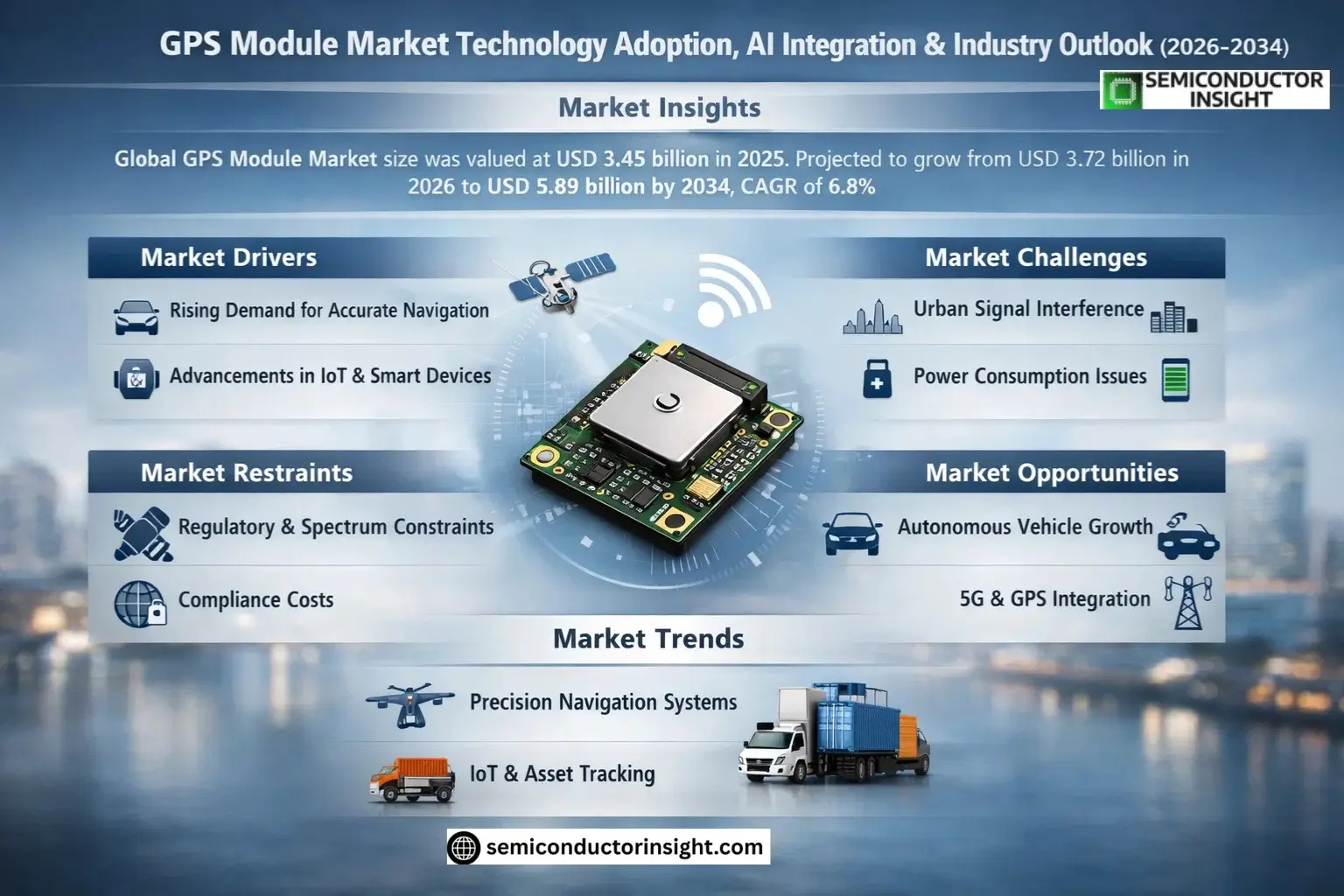
Global GPS Module Market size was valued at USD 3.45 billion in 2025. The market is projected to grow from USD 3.72 billion in 2026 to USD 5.89 billion by 2034, exhibiting a CAGR of 6.8% during the forecast period.
GPS modules are compact electronic devices that integrate a GPS receiver, antenna, and processing capabilities to provide accurate location data. These modules are widely used in applications such as navigation systems, asset tracking, wearable devices, and autonomous vehicles. Key types include modules with integrated antennas and those requiring external antennas, catering to diverse industry needs.
The market growth is driven by increasing demand for real-time location tracking across logistics and transportation sectors, alongside rising adoption of IoT-enabled devices. Technological advancements such as multi-constellation support (GPS, GLONASS, Galileo) and low-power designs further enhance module performance. Major players like Quectel and Garmin continue to innovate with high-precision modules for emerging applications in drones and smart agriculture.
MARKET DRIVERS
Increasing Demand for Accurate Navigation Systems
GPS Module Market is experiencing significant growth due to the rising demand for precise location tracking across industries. Automotive, aviation, and maritime sectors are increasingly integrating GPS modules to enhance operational efficiency and safety. Global adoption rate of GPS modules in commercial vehicles has surpassed 65%, reflecting strong market traction.
Advancements in IoT and Smart Devices
The proliferation of IoT-connected devices has created a substantial demand for compact, energy-efficient GPS modules. Asset tracking and wearable technology applications accounted for nearly 30% of total GPS module shipments last year. The market is expected to maintain a CAGR of 8.2% through 2028 as smart city initiatives expand globally.
Military and defense sectors continue to be major consumers, with governments allocating over USD 12 billion annually for GPS-enabled defense systems worldwide.
MARKET CHALLENGES
Technical Limitations in Urban Environments
GPS module performance faces challenges in dense urban areas due to signal multipath interference and building obstructions. Recent studies show that positioning errors increase by 40-60% in high-rise urban canyons compared to open areas, creating reliability concerns for critical applications.
Other Challenges
Power Consumption Constraints
Battery-powered IoT devices require GPS modules with minimal energy consumption, yet current solutions still account for 20-35% of total device power budgets in tracking applications.
MARKET RESTRAINTS
Regulatory and Spectrum Allocation Issues
GPS Module Market growth faces constraints from strict radio frequency regulations that vary by region. Compliance with differing GNSS frequency standards in North America, Europe, and Asia adds 15-20% to product development costs. Spectrum crowding in popular L-band frequencies is becoming a growing concern for signal integrity.
MARKET OPPORTUNITIES
Emergence of Autonomous Vehicle Technologies
The development of self-driving vehicles presents a USD 9.5 billion opportunity for high-precision GPS module manufacturers. Automotive-grade modules capable of centimeter-level accuracy are seeing 150% year-over-year demand growth from autonomous vehicle prototypes and ADAS systems.
Integration with 5G Networks
The rollout of 5G infrastructure enables new GPS module applications through improved time synchronization capabilities. Telecom operators are investing heavily in GPS-synchronized base stations, with projections indicating 2.8 million units will be deployed by 2026 for 5G network timing applications.
GPS Module Market Trends
Increasing Demand for Precise Navigation Across Industries
GPS Module Market is experiencing growth due to rising adoption across transportation, logistics, and drone applications. Manufacturers are developing modules with enhanced accuracy and lower power consumption to meet evolving industry requirements. The integration of dual-frequency GNSS support in modern modules improves position accuracy to centimeter-level in open environments.
Other Trends
Technological Advancements in Module Design
Leading manufacturers are introducing compact GPS modules with integrated antennas, reducing device footprint while maintaining performance. Multi-constellation support (GPS, GLONASS, Galileo, BeiDou) has become standard in premium modules, ensuring reliable positioning in diverse geographic regions. Low-power designs now enable years of operation on single batteries for IoT applications.
Regional Market Developments
Asia-Pacific dominates GPS module production, with China housing several key manufacturers. The North American market shows strong demand for high-precision modules in transportation and aerospace applications. Europe is witnessing growth in industrial IoT deployments using GPS-enabled tracking solutions. Emerging markets are adopting cost-effective modules for automotive and asset tracking applications.
Other Trends
Competitive Landscape Shifts
The market remains consolidated among established players, with the top five companies holding significant revenue share. Recent strategic partnerships between module manufacturers and chipset providers aim to accelerate development cycles. Several companies are expanding their portfolios to include integrated cellular-GPS modules for connected device applications.
Regulatory Influences
Stringent regulations regarding position reporting in commercial transportation are driving adoption of certified GPS modules. Aviation authorities are mandating high-integrity GPS solutions for unmanned aerial systems, creating new opportunities for specialized module manufacturers.
COMPETITIVE LANDSCAPE
Key Industry Players
Consolidated Market with Leaders Dominating 45% Revenue Share
GPS Module Market is moderately consolidated with the top five players accounting for approximately 45% of global revenue in 2025. Garmin leads with superior military-grade positioning solutions, while Quectel dominates the automotive telematics segment. Chinese manufacturers like Fibocom and Kyland are gaining traction through cost-effective IoT modules, particularly in Asian markets. The industry is witnessing strategic partnerships between module manufacturers and semiconductor companies to enhance GNSS integration capabilities.
Niche players are specializing in application-specific solutions, with Dynon Avionics focusing on aviation navigation and LOCOSYS excelling in marine tracking systems. The emergence of dual-frequency GNSS modules has created opportunities for specialized manufacturers like Sierra Wireless in precision agriculture. Smaller innovators such as Adafruit are catering to the maker community with open-source GPS development kits, while Lantronix provides industrial-grade modules for harsh environments.
List of Key GPS Module Companies Profiled
- Garmin
- Quectel
- Dynon Avionics
- LOCOSYS
- Adafruit
- Kyland
- Lantronix
- Fibocom
- Sierra Wireless
- u-blox
- Trimble
- Telit
- STMicroelectronics
- Skyworks Solutions
- NovAtel
Segment Analysis:
| Segment Category | Sub-Segments | Key Insights |
| By Type |
|
With Antenna modules dominate due to:
|
| By Application |
|
Transportation leads application demand due to:
|
| By End User |
|
Commercial sector shows strongest adoption:
|
| By Technology |
|
Multi-Constellation systems show accelerated growth:
|
| By Precision Level |
|
High Precision modules gaining traction:
|
Regional Analysis: GPS Module Market
California’s tech corridor leads in developing AI-enhanced GPS modules with machine learning capabilities for predictive positioning and reduced signal interference in urban canyons, setting global benchmarks for precision.
Detroit’s automotive cluster demands high-reliability GPS modules with centimeter-level accuracy, driving innovation in multi-constellation support and dead reckoning features for autonomous vehicle navigation systems.
Texas and Alberta’s energy sector utilizes ruggedized GPS modules for asset tracking in oil fields, with specialized solutions for high-vibration environments and extreme temperature operation.
Pentagon contracts drive demand for military-grade GPS modules with anti-jamming capabilities and encrypted signals, with strict compliance requirements for defense applications.
Europe
Europe maintains second position in GPS module adoption, with stringent regulations on transportation telematics fueling demand. The region excels in industrial-grade modules for precision agriculture and maritime navigation, with Germany and France leading manufacturing innovation. EU standardization initiatives promote Galileo constellation adoption, creating opportunities for dual-frequency module developers. Automotive OEM preferences for integrated navigation systems drive technical requirements, while alpine logistics firms demand modules with enhanced elevation accuracy.
Asia-Pacific
Asia-Pacific emerges as the fastest-growing GPS Module Market, propelled by China’s massive IoT device production and India’s logistics modernization. Japanese manufacturers lead in miniaturized modules for consumer electronics, while Southeast Asia sees rising demand for fleet management solutions. Smart city initiatives across metro regions require high-density positioning modules, though urban canyon effects present technical challenges that local developers are addressing through hybrid positioning algorithms.
South America
South America shows selective growth in GPS module applications, with Brazil’s agricultural sector adopting precision farming modules and mining operations requiring rugged tracking solutions. Urban transport modernization in Chile and Colombia drives demand for fleet management modules, while regulatory delays in some countries create adoption bottlenecks. Local manufacturers focus on cost-competitive solutions for regional requirements.
Middle East & Africa
The MEA region demonstrates growing GPS module adoption in oil/gas operations and mobile asset tracking, with UAE and Saudi Arabia investing in smart infrastructure. African logistics providers utilize basic tracking modules, while security applications drive demand in conflict zones. Climate challenges require design adaptations for desert environments, with regional players developing heat-resistant module variants.
Report Scope
This market research report provides a comprehensive analysis of the GPS Module Market , covering the forecast period 2025–2034. It offers detailed insights into market dynamics, technological advancements, competitive landscape, and key trends shaping the industry.
Key focus areas of the report include:
- Market Overview: The report begins with an overview outlining its current market scenario, key growth indicators, and industry transformation drivers. It discusses macroeconomic factors, demand–supply balance, regulatory landscape, and the strategic role of GPS modules in powering advancements across industries such as transportation, drone aerial photography, and others.
- Market Size & Forecast: Historical data and future projections for revenue, unit shipments, and market value across major regions and segments.
- Segmentation Analysis: Detailed breakdown by product type, technology, application, and end-user industry to identify high-growth segments and investment opportunities.
- Regional Insights: Insights into market performance across North America, Europe, Asia, Latin America, and the Middle East & Africa, including country-level analysis where relevant.
- Competitive Landscape: Profiles of leading market participants, including their product offerings, R&D focus, manufacturing capacity, pricing strategies, and recent developments such as mergers, acquisitions, and partnerships.
- Technology Trends & Innovation: Assessment of emerging technologies, integration of AI/IoT, GPS module design trends, fabrication techniques, and evolving industry standards.
- Market Drivers & Restraints: Evaluation of factors driving market growth along with challenges, supply chain constraints, regulatory issues, and market-entry barriers.
- Stakeholder Insights: Insights for component suppliers, OEMs, system integrators, investors, and policymakers regarding the evolving ecosystem and strategic opportunities.
Primary and secondary research methods are employed, including interviews with industry experts, data from verified sources, and real-time market intelligence to ensure the accuracy and reliability of the insights presented.
FREQUENTLY ASKED QUESTIONS:
What is the current market size of GPS Module Market?
-> GPS Module Market size was valued at USD 3.45 billion in 2025. The market is projected to grow from USD 3.72 billion in 2026 to USD 5.89 billion by 2034, exhibiting a CAGR of 6.8% during the forecast period..
Which key companies operate in GPS Module Market?
-> Key players include Dynon Avionics, Quectel, LOCOSYS, Adafruit, Kyland, Lantronix, Fibocom, Sierra Wireless, and Garmin, among others.
What are the key growth drivers?
-> Key growth drivers include increasing demand for GPS modules in transportation and drone aerial photography applications, technological advancements in GPS technology, and rising adoption of IoT devices.
Which region dominates the market?
-> Asia is expected to be the fastest-growing region, with China projected to reach USD million by 2034.
What are the emerging trends?
-> Emerging trends include integration of GPS modules with AI/IoT, development of more compact and energy-efficient modules, and increasing use in autonomous systems.
Get Sample Report PDF for Exclusive Insights
Report Sample Includes
- Table of Contents
- List of Tables & Figures
- Charts, Research Methodology, and more...