Key Statistics
Key Takeaways
- Type 3 memory expander controllers are the dominant product category because they address the most immediate CXL use case: adding coherent capacity beyond a server CPU’s local DIMM channels. Commercial adoption is moving from specification validation toward real deployments, as shown by Microsoft Azure’s announced CXL-attached memory preview using Astera Labs controllers and by customer-qualified CXL 2.0 memory modules from SK hynix.
- Artificial intelligence and machine learning are the fastest-growing application. Large models increase memory capacity and bandwidth requirements faster than conventional server architectures can economically scale through processor-attached DRAM alone. CXL allows memory to be expanded, tiered and eventually pooled, creating a controller opportunity wherever system designers need more capacity without proportionally increasing CPU sockets or stranding expensive memory.
- North America is the largest regional market because it concentrates hyperscale cloud operators, CPU platform vendors, CXL silicon companies and the earliest public cloud deployments. Asia Pacific is the fastest-evolving supply and product-development region, with Samsung, SK hynix and Montage Technology advancing CXL memory modules and controller silicon while regional data-center and AI investment expands the deployment base.
- The protocol roadmap is accelerating rather than stabilizing. CXL 4.0 was released in November 2025, doubling link bandwidth from 64 GT/s to 128 GT/s while retaining backward compatibility. That expands the long-term performance ceiling but also increases design complexity, validation cost and the need for controller vendors to support multiple specification generations across server qualification cycles.
- Software and platform enablement are now as important as controller silicon. Intel’s Flat Memory Mode on Xeon 6 can present local DRAM and CXL-attached memory as one hardware-managed address space, while operating systems and memory-management software are learning to tier and place data across heterogeneous memory. This reduces deployment friction and changes competition from a pure chip-performance race into an ecosystem and workload-optimization contest.
Compute Express Link (CXL) Memory Expansion Controller Market Overview
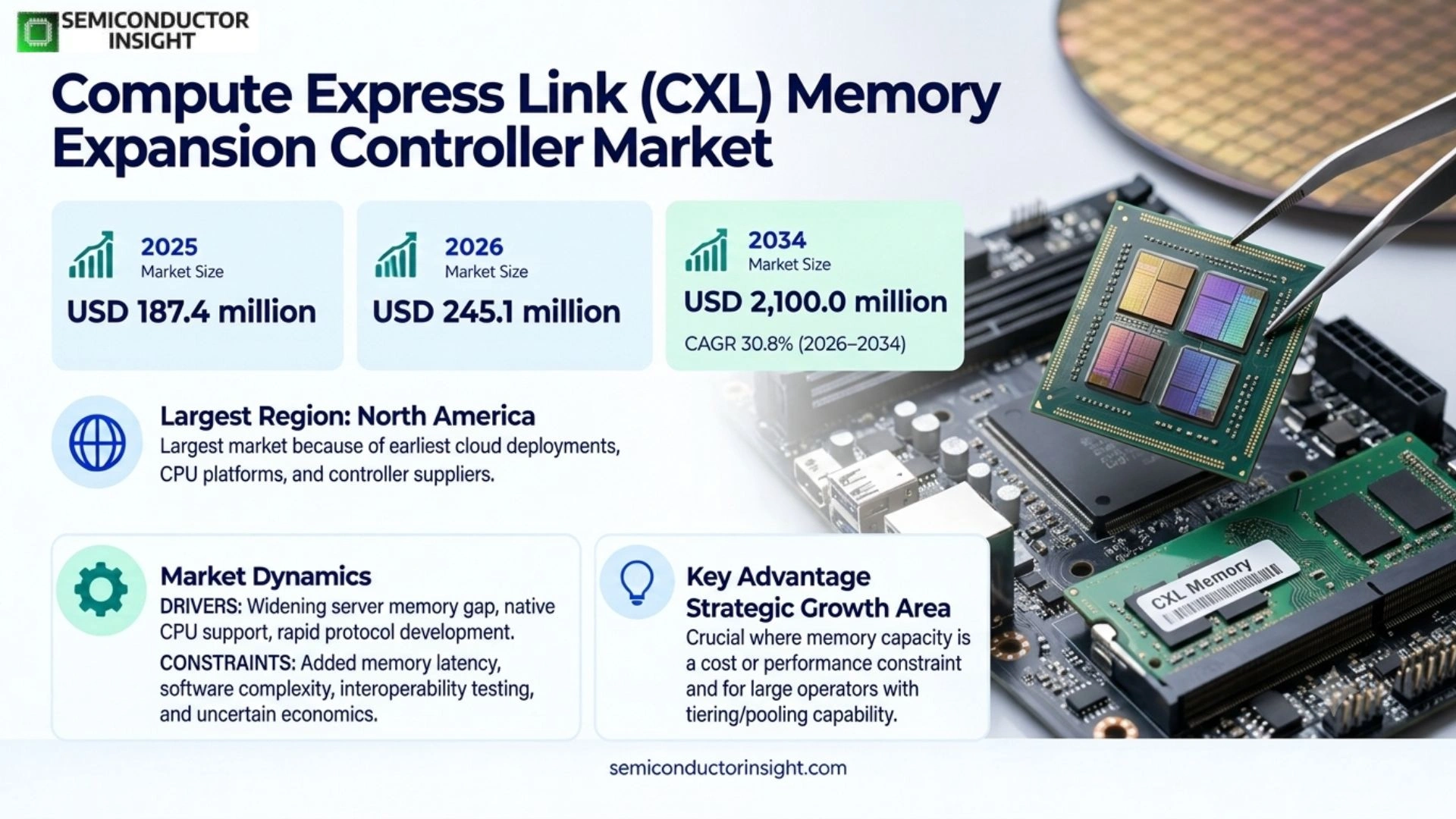
Compute Express Link (CXL) memory expansion controller market was valued at USD 187.4 million in 2025. The growth factor implied by the published 2025 and 2034 size anchors produces an estimated USD 245.1 million in 2026 and a projected USD 2,100.0 million by 2034, equivalent to a 30.8% CAGR during 2026–2034. North America is the largest market because the earliest cloud deployments, CPU platforms and controller suppliers are concentrated there.
CXL memory expansion controllers are semiconductor devices that connect host processors to external memory over the PCI Express physical layer while maintaining coherent memory semantics. In Type 3 devices, the controller presents attached memory to the host through CXL.mem and uses CXL.io for discovery and management. More advanced controller and switch architectures support pooling, multi-host sharing, memory tiering and system-level management, allowing servers to scale memory independently from processor sockets.
The economic problem CXL addresses is the growing mismatch between compute and memory. AI inference, model serving, graph analytics, in-memory databases and high-performance computing can require very large memory footprints, yet server CPUs have a finite number of local DRAM channels and DIMM slots. Adding another processor simply to obtain more memory can strand compute resources and raise licensing, power and platform cost. CXL introduces a standards-based path to add capacity or share it more flexibly across systems.
Controller value is created through latency, bandwidth, error handling, memory media support, firmware, security and interoperability rather than link connectivity alone. A commercially useful device must behave predictably across host processors, DIMMs, form factors, BIOS, operating systems and management software. As the ecosystem moves from CXL 2.0 toward 3.x and eventually 4.0, vendors also need backward compatibility and a roadmap that protects OEM qualification investment across several server generations.
The market is moving from demonstrations to early production evidence. Astera Labs disclosed an Azure M-series preview that it described as the industry’s first announced cloud deployment of CXL-attached memory; SK hynix completed customer validation of a 96 GB CXL 2.0 DDR5 module; Montage began sampling a CXL 3.1 controller with a PCIe 6.2 physical layer; and Intel documented hardware-managed tiering through Flat Memory Mode. These milestones reduce both technical and organizational barriers to deployment.
Segment Analysis: By Type
By type, the source scope includes Type 3 Memory Expander Controllers, Smart Memory Controllers with Near-Memory Processing, Multi-Host Memory Sharing Controllers and CXL Switch Controllers. Type 3 controllers are the dominant commercial category because memory expansion is the most mature CXL deployment model. Multi-host sharing and switch-based fabrics have greater architectural leverage but require a broader ecosystem of management software, topology control and workload scheduling.
| Type | Technical role | Market position and implications |
|---|---|---|
| Type 3 Memory Expander Controllers | These controllers attach DDR or other memory media to a host as a CXL memory device, typically using CXL.mem and CXL.io. They solve the immediate capacity problem without requiring the system to adopt a fully disaggregated fabric. Products can be implemented on add-in cards or EDSFF memory modules, and current commercial validation centers on DDR5-backed memory expansion for servers and cloud infrastructure. | Largest and most mature type. Type 3 devices benefit from clear platform compatibility and a direct total-cost-of-ownership proposition: add memory without adding another CPU socket. Astera Labs, Montage and memory-module vendors have all pursued this path. Competition focuses on latency, DDR5 speed, power, RAS, firmware maturity, security and the breadth of validated host-platform combinations. |
| Smart Memory Controllers with Near-Memory Processing | Smart controllers add processing, compression, memory management or acceleration closer to the memory resource. The requirement is to reduce unnecessary data movement or handle memory services without consuming host CPU cycles. The architecture can improve selected analytics, AI inference or memory-management workloads, but it raises silicon complexity, software integration and programming-model requirements relative to a straightforward capacity-expansion controller. | This is a faster-evolving premium segment rather than the volume anchor. Vendors can differentiate more strongly because value comes from workload-specific intelligence rather than standards compliance alone. Adoption depends on software support and measurable application gains; if acceleration does not offset additional silicon, firmware and integration cost, data-center buyers can prefer simpler Type 3 memory expansion. |
| Multi-Host Memory Sharing Controllers | These controllers allow memory capacity to be allocated or shared across more than one host, supporting composable infrastructure and reducing stranded memory. CXL 2.0 introduced pooling concepts and later versions expand fabric capabilities. The technical challenge is not only moving data but enforcing isolation, managing allocation, handling failures and coordinating software so multiple systems can consume a shared resource predictably. | Strategically important but earlier in deployment. The commercial upside is high because pooled memory can improve utilization at rack or cluster scale, yet adoption requires switches, fabric management and orchestration. Buyers therefore evaluate the complete ecosystem rather than an individual controller. Vendors with hardware, firmware and software partnerships are better positioned than suppliers offering a standalone device without validated management integration. |
| CXL Switch Controllers | CXL switches connect multiple hosts and devices, enabling fan-out, pooling and more complex fabric topologies. They complement memory expansion controllers rather than replacing them. The switch must preserve protocol semantics at low latency while managing routing, RAS, security and topology. With CXL 3.x and 4.0, switch capabilities become more important as the industry moves toward composable racks and higher aggregate bandwidth. | This is an enabling segment whose growth is tied to pooled and shared memory rather than simple direct-attached expansion. Companies such as Xconn and other connectivity specialists compete on port count, bandwidth, latency, fabric features and interoperability. Adoption can accelerate once hyperscalers standardize repeatable rack architectures, because one qualified switch platform can pull through large volumes of attached memory controllers and modules. |
Why do Type 3 controllers lead the first commercial wave?
Type 3 memory expansion requires the least disruptive change to existing server economics. The host already understands CXL, the controller attaches familiar DDR5 media, and the operating system can expose the added capacity as a NUMA node or use platform-specific tiering. This lets buyers solve a concrete memory-capacity problem before committing to multi-host fabrics. The commercial implication is that Type 3 qualification creates the installed base from which more advanced pooling and sharing architectures can later develop.
Segment Analysis: By Application
By application, the market is segmented into Artificial Intelligence and Machine Learning, High-Performance Computing, Cloud and Hyperscale Data Centers, In-Memory Databases and Analytics, and Others. AI/ML is the fastest-growing and most strategically significant application because model weights, key-value caches, feature stores and large datasets can exceed economical local DRAM capacity. Cloud operators are the most influential buyers because they can validate CXL at fleet scale.
| Application | Demand characteristics |
|---|---|
| Artificial Intelligence and Machine Learning | AI inference and training can be constrained by memory capacity, bandwidth and the cost of keeping large datasets close to accelerators. CXL memory expansion allows servers to add capacity independently of CPU socket count and can support tiered or pooled architectures. The purchasing trigger is strongest when expanded memory increases accelerator utilization, reduces data movement or permits larger models and caches without forcing a more expensive server configuration. |
| High-Performance Computing (HPC) | HPC workloads often combine large memory footprints with heterogeneous CPUs and accelerators. CXL creates a standardized way to attach additional memory and, in later architectures, to compose resources across nodes. Research institutions and national computing programs value bandwidth, RAS and software transparency, but they also have specialized performance requirements. Adoption therefore depends on benchmarked workload gains and integration with NUMA, job schedulers and memory-management software rather than capacity alone. |
| Cloud and Hyperscale Data Centers | Hyperscalers are commercially decisive because they can deploy large numbers of repeatable server configurations and have the software expertise to manage heterogeneous memory. Azure’s announced CXL-attached memory preview using Astera Labs controllers demonstrates the transition from laboratory validation to customer-accessible cloud evaluation. Fleet operators care about memory utilization, server consolidation, lifecycle flexibility and the ability to reduce stranded DRAM across diverse workload shapes. |
| In-Memory Databases and Analytics | Databases, real-time analytics and large caches can consume terabytes of active memory. CXL expansion offers a way to enlarge the working set without adding processor sockets solely for DIMM capacity. These workloads can be sensitive to latency, so performance depends on intelligent data placement between local DRAM and CXL-attached tiers. Intel’s Flat Memory Mode is one example of platform support intended to reduce the software burden of managing that placement. |
| Others | Additional applications include virtualization, memory-intensive enterprise software, data processing, edge or telecom infrastructure and specialized composable systems. The common requirement is an imbalance between compute resources and directly attached memory. CXL becomes commercially attractive where the value of flexible capacity, better utilization or lifecycle upgrades exceeds the added controller, module and software complexity. Adoption will vary widely because many general-purpose workloads remain adequately served by local DDR memory. |
Regional Analysis
North America is the largest CXL memory expansion controller market because the United States concentrates hyperscale cloud operators, CPU vendors, controller startups and the earliest publicly announced cloud deployments. Asia Pacific is the fastest-evolving product-development region through Samsung, SK hynix and Montage. Europe is building a large public AI/HPC infrastructure base, while South America and the Middle East & Africa are earlier-stage demand markets driven by cloud and sovereign-AI investment.
How does regional demand differ across the CXL memory expansion controller market?
Regional differences are less about local server memory consumption and more about who controls platform architecture, where controller and memory products are developed, and how quickly large data-center operators qualify new infrastructure. North America leads deployment and software integration. Asia Pacific combines memory manufacturing and controller development. Europe is building public and sovereign compute capacity. South America is expanding hyperscale cloud demand from a smaller base, while Gulf countries are using large sovereign-AI investments to compress adoption timelines for advanced server technology.
| Region | Position | Growth outlook | Demand profile | What decides supplier selection |
|---|---|---|---|---|
| North America | Largest market | Early commercial deployment | Hyperscale, AI and enterprise memory expansion | Host-platform validation, latency, firmware maturity, RAS, software enablement and cloud-scale qualification. Buyers value controllers that work across Intel and AMD platforms, support operational telemetry, and can demonstrate total-cost-of-ownership gains on real memory-intensive workloads. |
| Asia Pacific | Fastest-evolving supply region | Very strong | Memory modules, controller silicon and AI infrastructure | Interoperability with Samsung/SK hynix memory ecosystems, access to regional server OEMs, CXL 2.0/3.x roadmap execution, DDR5 speed and cost. Product sampling and customer validation matter because the region is both a component supplier and a rapidly expanding data-center market. |
| Europe | Growing institutional and cloud market | Strong from smaller base | EuroHPC, AI Factories and sovereign compute | Standards-based interoperability, energy efficiency, RAS, security and integration with heterogeneous HPC environments. Public procurement and AI infrastructure programs can accelerate qualification, but deployment may be more diverse than hyperscale fleets and therefore requires broad platform support. |
| South America | Early-stage demand market | Emerging | Brazil-led cloud, analytics and AI investment | Availability through global cloud platforms, price-performance, software transparency and support for memory-intensive services. Direct CXL deployment evidence is limited, so near-term demand follows the refresh cycle of hyperscale infrastructure installed in regional data centers. |
| Middle East & Africa | Sovereign-AI-led emerging market | High from small base | UAE/Saudi data centers and AI clusters | Vendor bankability, integration with accelerator platforms, power efficiency, support for sovereign data requirements and global OEM qualification. Large new AI clusters can adopt newer architectures faster than legacy enterprise estates because they are built from greenfield infrastructure. |
Competitive Landscape
Competition spans controller silicon, memory-module integration, interface IP, switches and software orchestration rather than a single product class. Astera Labs and Montage Technology are visible merchant controller suppliers; Samsung and SK hynix can integrate CXL control directly with DRAM products; Rambus, Synopsys and Cadence provide IP that enables custom controller designs; Xconn targets switching; and MemVerge focuses on memory software. This layered structure makes ecosystem position as important as standalone chip performance.
Merchant controller vendors win by shortening the path from CXL specification to a qualified memory-expansion card or module. Astera Labs’ Azure engagement shows the value of hyperscale validation, while Montage’s CXL 3.1 sampling demonstrates the importance of protocol-roadmap execution. Buyers compare latency, DDR bandwidth, power, RAS, security, firmware, telemetry and reference designs, but the decisive factor can be how many CPUs, DIMMs, operating systems and OEM platforms a controller has already been proven to work with.
Memory manufacturers have a different strategic advantage because they control the DRAM media, module design and qualification process. Samsung and SK hynix can optimize controller firmware together with memory devices and potentially capture a larger share of module value. This vertical model can reduce integration friction for customers but also creates channel tension with independent controller suppliers. Merchant vendors respond by supporting multiple memory suppliers and offering flexibility to OEMs that want to avoid dependence on a single vertically integrated module source.
IP vendors such as Rambus, Synopsys and Cadence expand the competitive field by allowing custom ASIC and SoC developers to implement CXL without building every protocol block internally. Rambus achieved a CXL 2.0 Type 3 controller IP compliance listing in 2025, illustrating how standards validation can turn IP into a lower-risk starting point. The market implication is that controller differentiation can migrate upward toward firmware, memory management and system architecture as basic protocol capability becomes more widely licensable.
Switch and software vendors become more important as deployments progress from direct-attached expansion toward pooled and shared memory. Xconn and other fabric companies can determine how many hosts and devices participate in a topology, while MemVerge and operating-system software help place data and manage tiers. This means a company can influence controller demand without selling a Type 3 controller itself. Competitive analysis should therefore map who owns the attach point, the memory media, the switch fabric and the orchestration layer.
| Competitive tier | Representative companies | How they compete |
|---|---|---|
| Merchant controller silicon | Astera Labs; Montage Technology; Renesas Electronics; Microchip Technology; Marvell Technology; IntelliProp; Kandou Bus; Tetramer Technologies | These vendors compete through controller or connectivity silicon, firmware, reference designs and platform validation. The strongest differentiation comes from low latency, high DDR bandwidth, RAS, security, management and the ability to follow CXL generations quickly while supporting multiple host and memory combinations. |
| Memory-integrated suppliers | Samsung Electronics; SK Hynix | Memory manufacturers can integrate CXL control with high-capacity DDR5 modules and control both media and module economics. Their advantage is vertical optimization and existing relationships with server OEMs and hyperscalers. They can accelerate qualification by validating controller, DRAM and form factor as one product. |
| IP, switch and software ecosystem | Rambus Inc.; Synopsys; Cadence Design Systems; Xconn Technologies; MemVerge | IP vendors lower the barrier to custom CXL silicon, switch companies enable pooling and sharing topologies, and software vendors manage tiering and resource allocation. Their commercial importance rises as CXL evolves from direct-attached expansion into rack-scale composable infrastructure where no single controller can deliver the complete solution. |
Companies profiled in the source scope
Production Capacity Analysis
Production capacity for CXL memory expansion controllers is constrained less by a unique manufacturing process than by access to advanced logic nodes, high-speed SerDes IP, DDR controller capability, packaging, firmware engineering and compliance resources. Many controller companies operate fabless models, so physical wafer capacity is shared with other high-speed connectivity and data-center silicon. The more critical bottleneck is qualified silicon: a controller must meet timing, signal-integrity, RAS and interoperability requirements across host processors and memory devices before it can generate production revenue.
Protocol generation directly affects silicon complexity. CXL 2.0 commonly rides on PCIe 5.0 physical layers, while newer CXL 3.1 products such as Montage’s M88MX6852 use PCIe 6.2 at up to 64 GT/s. CXL 4.0 doubles the specification bandwidth to 128 GT/s. Higher speeds increase SerDes, equalization, packaging and validation difficulty, so design teams need access to leading interface IP and high-quality substrate/package engineering. Capacity is therefore partly an engineering-throughput problem rather than only a foundry wafer-start problem.
Memory-module production is a second capacity layer. Type 3 controllers create revenue only when paired with DRAM, module PCBs, power management and a supported form factor. Samsung and SK hynix bring large DRAM manufacturing scale, while independent controller vendors rely on partnerships with module makers and memory suppliers. During tight memory cycles, the economics of CXL expansion can change quickly because the controller may represent only a fraction of the total module bill of materials, making DRAM pricing and capacity important demand-side variables.
Compliance and customer validation form the final capacity gate. SK hynix’s 96 GB module completed customer validation in 2025, Rambus placed its CXL 2.0 Type 3 controller IP on the Integrators List, and Astera Labs reached an Azure workload-evaluation milestone. These are more commercially meaningful than a tape-out announcement because they show ecosystem readiness. Vendors able to run parallel qualification programs across Intel, AMD, multiple DIMMs and several OEMs can convert the same silicon design into revenue faster than competitors with limited validation bandwidth.
Market Dynamics
The CXL controller market is driven by a widening server memory gap, native CXL support in mainstream processors and rapid protocol development, but adoption is constrained by added memory latency, software complexity, interoperability testing and uncertain economics for workloads that fit comfortably in local DRAM. The market therefore grows fastest where memory capacity is a binding cost or performance constraint and where large operators have enough software capability to manage tiering or pooling effectively.
Market Drivers
| Driver | Directional impact | Evidence and commercial mechanism |
|---|---|---|
| AI memory-capacity growth | Very high positive | AI training and inference increase model weights, key-value caches and active datasets, creating a need for more memory per accelerator and server. CXL allows capacity to expand independently from CPU sockets. When expanded memory keeps expensive GPUs utilized or reduces the number of underused CPU sockets purchased solely for DIMM capacity, a controller can deliver clear system-level economic value. |
| Native CPU platform support | High positive | Intel documents CXL support from 4th Gen Xeon Scalable onward and AMD EPYC 9005 integrates CXL 2.0 controllers. Native host support removes a foundational adoption barrier because server OEMs can qualify memory expansion without proprietary CPU interfaces. Each new CXL-capable server generation enlarges the installed base that can attach controllers when workloads require more memory. |
| Cloud and customer validation | High positive | Azure’s announced CXL-attached memory preview and SK hynix’s customer-validated CXL 2.0 DDR5 module provide evidence that ecosystem qualification is moving beyond demonstrations. Cloud exposure gives end users a way to test workload behavior, while module validation reduces procurement risk for OEMs. These milestones can accelerate design wins because buyers can reference proven platform combinations rather than evaluating from scratch. |
| Protocol bandwidth and fabric evolution | Medium-high positive | CXL 4.0 doubles link speed to 128 GT/s and preserves backward compatibility, while CXL 3.x expands fabric and sharing capabilities. A stronger roadmap increases the number of possible use cases and protects ecosystem investment. It also allows controller vendors to sell higher-value products for pooling, switching and multi-host architectures as data-center operators move beyond simple memory expansion. |
AI makes memory a first-order infrastructure constraint
Modern AI systems are often discussed in terms of accelerator count, but effective utilization also depends on keeping model state and data close enough to compute. When local DRAM capacity is insufficient, operators can add CPU sockets, distribute the workload or attach additional memory. CXL creates a standards-based fourth option. The commercial response is controller demand wherever memory expansion improves accelerator utilization or reduces stranded compute, making AI the strongest catalyst for rapid market growth.
Processor support converts CXL from optional peripheral technology into a platform feature
A memory-expansion controller cannot be adopted if the host processor lacks a compatible CXL root. Intel’s server roadmap and AMD EPYC 9005 provide this support in mainstream data-center CPUs. As these processors replace older fleets, more servers become technically capable of attaching CXL memory even if they do not do so immediately. This creates a growing addressable installed base and allows OEMs to offer memory expansion as a configurable option rather than a specialized architecture.
Hyperscale validation lowers perceived deployment risk
Data-center buyers are conservative about memory because errors can compromise system stability and data integrity. An announced Azure deployment path using Astera Labs controllers and customer validation from a top-tier memory vendor provide evidence that CXL can move through enterprise-grade qualification. The mechanism is reputational and technical: once a controller and module survive large-scale validation, other OEMs can reuse lessons about firmware, telemetry and failure handling, shortening their own adoption cycle.
The protocol roadmap expands future monetization beyond direct attachment
CXL 2.0 made memory pooling practical, 3.x expands fabric capabilities, and CXL 4.0 raises bandwidth and RASfeatures. This gives controller vendors a path from simple Type 3 devices into switches, shared memory and composable infrastructure. The commercial implication is rising silicon content per rack if operators deploy fabrics rather than one controller per server. The opportunity is larger, but it also depends on orchestration software and standardized operating practices that are still maturing.
Market Restraints
| Restraint | Directional impact | Evidence and commercial mechanism |
|---|---|---|
| Latency relative to local DRAM | High negative | CXL-attached memory introduces additional link and controller latency compared with processor-attached DRAM. Workloads that are latency sensitive may lose performance unless hot data is kept local. This forces tiering, profiling or hardware-managed placement and limits the set of applications where capacity expansion produces a positive result. |
| Interoperability and qualification burden | High negative | A controller must operate with host CPUs, BIOS, DIMMs, operating systems, form factors and management software across multiple CXL revisions. Compliance testing reduces risk but does not replace full system validation. Qualification consumes engineering time and can delay revenue, especially for smaller vendors that cannot support many customer combinations in parallel. |
| Software and memory-placement complexity | Medium-high negative | Default CXL memory may appear as separate NUMA resources, requiring the operating system or application to place data intelligently. Intel Flat Memory Mode can hide some complexity on supported systems, but not every platform or workload has equivalent support. Without good tiering, applications can place latency-sensitive data in slower memory and erase the economic benefit of added capacity. |
| DRAM economics and uncertain attachment rates | Medium negative | The controller is only one part of a CXL memory module. If DRAM prices rise, the total expansion module can become expensive; if local DIMM capacity is sufficient, customers may skip CXL entirely. Forecast risk therefore comes from attachment rate, not host compatibility alone. A large installed base of CXL-capable CPUs does not automatically translate into equivalent controller shipments. |
The latency gap restricts workload suitability
CXL is designed for coherent memory access, but the path still includes a high-speed serial link and controller rather than the CPU’s direct DDR interface. Latency-sensitive applications can therefore require careful placement of hot pages in local DRAM while colder data sits on the CXL tier. If software cannot distinguish those classes effectively, added capacity can reduce performance. This restraint makes workload benchmarking a central sales activity for controller vendors rather than a post-purchase optimization.
Interoperability multiplies as the ecosystem grows
Every new host processor, DIMM speed, firmware release and CXL generation adds another validation combination. The standard provides a common protocol, but system behavior also depends on BIOS, memory mapping, RAS and management software. Large vendors can maintain extensive compatibility labs, while smaller entrants may struggle to qualify broadly. This creates a scale advantage that is not obvious from chip specifications and can slow multi-vendor adoption in conservative enterprise environments.
Software must turn heterogeneous memory into a usable resource
CXL can expose additional memory capacity, but applications do not automatically know which data should occupy local versus attached memory. Hardware-managed approaches such as Intel Flat Memory Mode reduce this burden on specific platforms, while operating-system and third-party tools provide other tiering methods. Until these approaches are broadly automated and workload-aware, some enterprises will prefer simpler all-local memory configurations even if they are less capital efficient.
Attachment rate remains the key forecast uncertainty
CXL support is becoming a standard CPU feature, yet only a subset of servers will need dedicated memory expansion. The market outcome depends on how many workloads encounter a memory wall, how much capacity they attach and how often pooling replaces direct expansion. This creates a wider forecast range than processor shipment data alone would imply. Controller vendors must prove measurable utilization or consolidation benefits to convert theoretical host compatibility into actual unit demand.
Market Opportunities
Cloud-delivered CXL creates a low-friction evaluation channel
A cloud preview lets customers test memory expansion without purchasing specialized servers, which can accelerate application qualification and expose which workload classes benefit. If successful, cloud providers can convert those results into repeatable fleet configurations. Controller suppliers that win a hyperscale platform therefore gain both direct volume and a reference environment that enterprise customers can emulate. Azure’s announced use of Astera Labs controllers is an important early example of this adoption pathway.
Hardware-managed tiering can broaden enterprise adoption
Many enterprises lack the engineering resources to manually optimize NUMA placement across local and CXL memory. Hardware-managed tiering reduces that barrier by presenting a simpler memory model while automatically moving data between tiers. Intel’s Flat Memory Mode demonstrates this approach. The opportunity for controller vendors is larger attachment rates in mainstream database and virtualization servers if similar capabilities become common across platforms and deliver predictable performance without application rewrites.
CXL 3.x and 4.0 enable pooling and composable memory
Direct-attached expansion improves one server, while pooling can improve utilization across many servers. Later CXL versions provide the fabric and bandwidth foundation for shared or composable architectures. If hyperscalers can allocate memory dynamically to changing workloads, they can reduce stranded DRAM at rack scale. That creates demand not only for Type 3 controllers but also switches, fabric management, security and telemetry, increasing total ecosystem value per deployment.
Emerging memory media can extend controller value beyond DRAM
The source segmentation includes NAND-backed CXL memory, persistent-memory modules and emerging media such as MRAM or phase-change memory. CXL provides a standardized host interface that can help new media enter servers without requiring a proprietary processor connection. The opportunity is long term because latency, endurance and software semantics vary by technology, but controller vendors that abstract multiple media types can become a strategic layer between evolving memory technologies and stable server platforms.
Supply Chain Analysis
IP and interface technology. CXL controllers require protocol logic, PCIe/CXL physical-layer capability, DDR controllers, RAS, security and extensive verification. Companies such as Rambus, Synopsys and Cadence can supply licensable IP, reducing the time needed for custom ASIC developers to implement standards compliance. As link speeds rise, high-quality SerDes and verification become more valuable because a functional protocol design can still fail commercially if signal integrity or interoperability is weak.
Controller silicon and foundry. Merchant vendors integrate CXL, DDR, management processors and firmware into an ASIC, then rely on foundry, packaging and test partners. Their production economics depend on node selection, die size, package complexity and volume. Unlike DRAM, the controller is a relatively low-volume logic device, so gross margin depends heavily on design reuse across many customers. Foundry capacity is important, but the larger commercial bottleneck is completing qualification with enough server and memory combinations to scale shipments.
Memory modules and switches. Type 3 controllers are combined with DDR5 and module hardware to create add-in cards or EDSFF devices, while switches enable pooling and multi-host fabrics. Samsung and SK hynix can vertically integrate memory and controller functionality, whereas independent controller vendors partner with memory and module suppliers. Total system cost is strongly influenced by DRAM content, so controller demand can rise or fall with memory pricing even when the underlying need for capacity is unchanged.
Servers, cloud and software. CPU vendors provide CXL-capable roots, OEMs integrate cards and modules, and cloud or enterprise operators decide whether the performance and utilization benefits justify attachment. BIOS, operating systems and memory-management software determine how usable the capacity becomes. This downstream layer captures a large share of strategic power because one hyperscale qualification can generate high controller volume, while failure to secure server-platform validation can leave technically capable silicon without a commercial route to deployment.
Recent Developments in the Compute Express Link (CXL) Memory Expansion Controller Market
Developments tracked to September 2026. Entries prioritize official standards-body, semiconductor and platform-vendor evidence.
- 1 June 2026 PLATFORM ENABLEMENT
Intel documented Flat Memory Mode for Xeon 6 and Xeon 6+ systems with CXL-attached memory, allowing local DRAM and CXL memory to appear as one address space while hardware manages placement. This reduces software friction for selected workloads and makes memory expansion more accessible to enterprises that cannot manually optimize NUMA placement across heterogeneous memory tiers. Source - 18 November 2025 CLOUD DEPLOYMENT
Astera Labs announced that its Leo CXL Smart Memory Controllers are used to enable CXL memory-expansion evaluation on Microsoft Azure M-series virtual machines, described as the industry’s first announced cloud deployment of CXL-attached memory. The milestone gives external users a practical evaluation path and provides merchant controller silicon with a high-credibility hyperscale reference deployment. Source - 18 November 2025 STANDARD RELEASE
The CXL Consortium released CXL 4.0, doubling link bandwidth from 64 GT/s to 128 GT/s while adding bundled ports and enhanced memory RAS capabilities with backward compatibility. The specification increases the long-term performance ceiling for memory fabrics and gives controller vendors a roadmap for higher-bandwidth expansion, pooling and accelerator connectivity, while simultaneously increasing design and validation complexity. Source - 1 September 2025 PRODUCT SAMPLING
Montage Technology introduced its M88MX6852 CXL 3.1 memory-expander controller and began sampling key customers. The device supports up to 64 GT/s over an x8 PCIe 6.2 physical layer and dual-channel DDR5 up to 8000 MT/s. The launch moves merchant competition into CXL 3.1 and provides module makers with a standards-based path toward higher-bandwidth expansion and pooling designs. Source - 23 April 2025 CUSTOMER VALIDATION
SK hynix completed customer validation of a 96 GB CXL 2.0 DDR5 module and disclosed a 128 GB follow-on product in validation. The company said the validated module offered 50% more capacity and 30% more bandwidth than the comparison DDR5 module. Customer qualification is commercially significant because it indicates that CXL memory is progressing from demonstrations toward deployable server products. Source
Report Scope & Segmentation
| Attribute | Scope |
|---|---|
| Market | Compute Express Link (CXL) Memory Expansion Controller Market |
| Base / estimate / forecast | Base year 2025; estimated year 2026; forecast period 2026–2034. Values are reported in USD million. The 2025 and 2034 market-size anchors from the source page are retained, while the 2026 estimate and CAGR are calculated from the constant annual growth factor implied by those two anchors. |
| By Type | Type 3 Memory Expander Controllers; Smart Memory Controllers with Near-Memory Processing; Multi-Host Memory Sharing Controllers; CXL Switch Controllers |
| By Application | Artificial Intelligence and Machine Learning; High-Performance Computing (HPC); Cloud and Hyperscale Data Centers; In-Memory Databases and Analytics; Others |
| By End User | Hyperscale Cloud Service Providers; Enterprise Data Centers; High-Performance Computing Research Institutions; Original Equipment Manufacturers (OEMs) |
| By CXL Protocol Version | CXL 1.1 Controllers; CXL 2.0 Controllers; CXL 3.0 Controllers; CXL 3.1 and Next-Generation Controllers |
| By Memory Technology | DRAM-Based CXL Memory Modules; NAND Flash-Backed CXL Memory; Persistent Memory (PMEM) CXL Modules; Emerging Memory Technologies (MRAM, PCM) |
| Regions | North America; Europe; Asia Pacific; South America; Middle East & Africa |
| Companies profiled | Astera Labs, Samsung Electronics, SK Hynix, Renesas Electronics, Rambus Inc., Synopsys, Cadence Design Systems, Montage Technology, Microchip Technology, Marvell Technology, Xconn Technologies, IntelliProp, MemVerge, Kandou Bus, Tetramer Technologies |
| Customization Scope | Additional analysis can be developed by controller architecture, host CPU, memory capacity, module form factor, cloud platform, workload and country where reliable evidence exists. The headline market-size series should remain tied to the controlling report scope. External technical and official sources are used to establish protocol milestones, platform compatibility, customer validation and data-center demand mechanisms rather than to replace the published market anchors. |
Frequently Asked Questions
What is the current size of the CXL memory expansion controller market?
The global market was valued at USD 187.4 million in 2025. Using the constant annual growth factor implied by the source page’s 2025 and 2034 market-size anchors gives an estimated USD 245.1 million in 2026 and a projected USD 2,100.0 million by 2034, equivalent to a 30.8% CAGR during 2026–2034. The source page prints USD 243.6 million for 2026 and a 27.3% CAGR, but those values do not reconcile with the two headline size anchors.
Which region leads the CXL memory expansion controller market?
North America is the largest regional market because it concentrates hyperscale cloud operators, server processor vendors, CXL controller companies and the earliest publicly announced cloud deployments. Astera Labs has disclosed an Azure M-series CXL memory-expansion preview, Intel supports CXL across current Xeon generations and documents Flat Memory Mode, and the broader U.S. ecosystem has the software resources to qualify tiered or pooled memory at scale. Asia Pacific is the fastest-evolving supply region.
Which CXL controller type currently leads the market?
Type 3 Memory Expander Controllers are the leading product category because they address the most direct and mature CXL use case: adding coherent memory capacity to one host beyond its local DIMM channels. They can be integrated into add-in cards or EDSFF memory modules and do not require a full multi-host fabric. This lowers deployment complexity and gives operators a clear economic test based on capacity, server consolidation and processor-socket avoidance.
Why is AI a major driver of CXL memory expansion?
AI workloads can require very large memory footprints for model weights, key-value caches, feature stores and training data, while accelerator utilization is expensive to waste. Conventional servers are limited by CPU-attached DRAM channels and DIMM slots. CXL allows memory capacity to scale more independently from compute, so operators can add or tier memory without purchasing another CPU socket solely for DIMM capacity. The controller becomes valuable when that flexibility improves accelerator utilization or total infrastructure cost.
What is the role of CXL 2.0, 3.x and 4.0 in market growth?
CXL 2.0 established commercially important pooling and switching capabilities and is the most widely deployed generation in the source scope. CXL 3.x expands fabric and sharing functionality, while CXL 4.0, released in November 2025, doubles link bandwidth from 64 GT/s to 128 GT/s and enhances RAS while maintaining backward compatibility. The roadmap gives vendors a larger future opportunity, but it also increases SerDes, firmware, security and interoperability validation requirements.
Which companies are profiled in the CXL memory expansion controller market?
The source scope profiles Astera Labs, Samsung Electronics, SK Hynix, Renesas Electronics, Rambus Inc., Synopsys, Cadence Design Systems, Montage Technology, Microchip Technology, Marvell Technology, Xconn Technologies, IntelliProp, MemVerge, Kandou Bus and Tetramer Technologies. They occupy different layers of the ecosystem, including merchant controller silicon, memory-integrated products, interface IP, switches and software, so competitive position should be assessed by role rather than forcing every company into one identical market-share category.
How does CXL-attached memory differ from local DDR memory?
Local DDR memory connects directly to the processor’s memory controllers and generally offers the lowest memory latency available to the CPU. CXL-attached memory travels across a high-speed serial link and a controller, adding flexibility but also additional latency. Systems therefore often treat CXL as a separate memory tier or use hardware/software policies to place data intelligently. Intel Flat Memory Mode is one approach that can combine local DRAM and CXL memory into one hardware-managed address space on supported platforms.
What are the biggest barriers to CXL controller adoption?
The principal barriers are latency relative to local DRAM, broad interoperability testing, software memory-placement complexity, the cost of DRAM-backed expansion modules and uncertain attachment rates. A server can support CXL but never install a memory controller if local DIMM capacity is sufficient. Vendors must therefore prove workload-specific economic or performance benefits and support a large matrix of CPUs, BIOS versions, DIMMs, operating systems and management tools before customers commit to production deployment.
Why is Asia Pacific strategically important if North America is the largest market?
Asia Pacific contains much of the memory and electronics supply chain that makes CXL products possible. Samsung and SK hynix are developing and validating CXL DRAM modules, while Montage Technology is sampling CXL 3.1 controller silicon. The region also hosts major foundry, packaging and server manufacturing. As a result, Asia Pacific can capture substantial controller and module production value even when final systems are deployed in North American or European data centers, making it the fastest-evolving supply ecosystem.
What will determine CXL memory expansion controller growth through 2034?
Growth through 2034 will depend on how quickly AI and analytics workloads outgrow local DRAM economics, the attachment rate of CXL memory on new server platforms, software maturity for tiering and pooling, and the success of later protocol generations. Direct-attached Type 3 expansion should remain the near-term volume foundation, while CXL 3.x and 4.0 can open larger rack-scale opportunities through pooling, switching and composable memory if hyperscalers prove that utilization gains outweigh added system complexity.
Research Sources & Evidence Base
Get Sample Report PDF for Exclusive Insights
Report Sample Includes
- Table of Contents
- List of Tables & Figures
- Charts, Research Methodology, and more...
 Download Sample Report PDF