Federated Learning Processor Market Insights
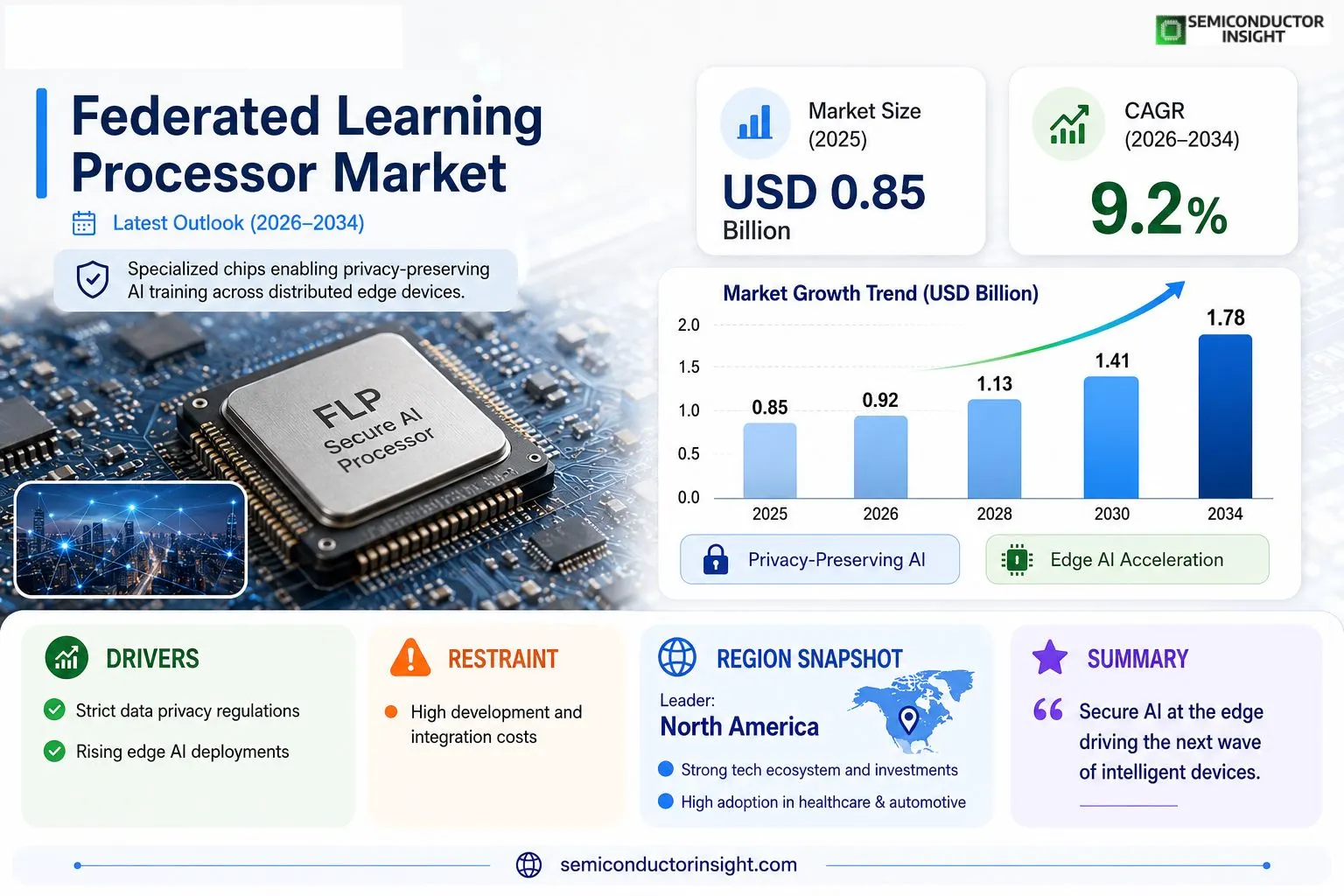
Global Federated Learning Processor market size was valued at USD 0.85 billion in 2025. The market is projected to grow from USD 0.92 billion in 2026 to USD 1.78 billion by 2034, exhibiting a CAGR of 9.2% during the forecast period.
Federated learning processors are specialized hardware accelerators designed to execute privacy‑preserving machine‑learning algorithms across distributed edge devices while keeping raw data local. These processors integrate secure enclaves, on‑chip memory hierarchies, and optimized tensor cores to reduce communication overhead and enhance model convergence speed.The market is experiencing rapid expansion because enterprises are increasingly adopting federated AI to comply with data‑privacy regulations such as GDPR and CCPA. Furthermore, the surge in edge‑AI applications,from autonomous vehicles to smart healthcare,drives demand for dedicated processors that can handle intensive collaborative training without exposing sensitive information. Major semiconductor firms are launching dedicated chips and forming alliances with cloud providers, further accelerating adoption.
MARKET DRIVERS
Rising Demand for Data Privacy
Federated Learning Processor Market is being propelled by stricter data‑privacy regulations worldwide. Enterprises are adopting federated learning to keep raw data on‑device while still benefiting from collective model improvements, thereby reducing compliance risk and strengthening consumer trust.
Growth of Edge AI Deployments
Edge devices such as smartphones, wearables, and industrial IoT gateways now require on‑board intelligence that can train locally without heavy cloud bandwidth. Specialized processors designed for federated learning enable real‑time model updates, driving adoption across sectors like healthcare, automotive, and smart manufacturing.
➤ “Federated learning processors are the enabling hardware for privacy‑preserving AI at the edge, turning regulatory pressure into a market advantage.”
Investors are also attracted by the scalability of federated architectures, which reduce centralized compute costs and open new business models based on secure data collaboration.
MARKET CHALLENGES
Regulatory Ambiguities
While data‑privacy laws encourage federated solutions, the lack of clear standards for model‑aggregation protocols creates uncertainty for vendors. Companies must navigate divergent regional guidelines, which can delay product roll‑outs and increase compliance overhead.
Other Challenges
Talent Shortage
Designing efficient federated learning processors demands expertise at the intersection of hardware security, low‑power ASIC design, and distributed AI algorithms. The scarcity of such cross‑disciplinary talent slows innovation cycles and raises staffing costs.
MARKET RESTRAINTS
High Development Costs
Creating custom silicon for federated learning involves extensive R&D, silicon‑validation, and firmware integration, which can exceed the budgets of many mid‑size firms. Consequently, many organizations opt for off‑the‑shelf solutions, limiting the market penetration of purpose‑built processors.Supply‑chain constraints for advanced process nodes also restrict volume production, especially during periods of high demand for unrelated semiconductor segments.Additionally, the need for rigorous security certifications adds another layer of expense, making entry barriers noticeably higher than for generic AI accelerators.
MARKET OPPORTUNITIES
Emerging 5G Edge Use Cases
The rollout of 5G networks enhances bandwidth and reduces latency, creating fertile ground for federated learning at the edge. Applications such as autonomous vehicle fleets, real‑time video analytics, and remote healthcare monitoring can leverage low‑latency model updates, expanding the addressable market for specialized processors.Furthermore, collaborations between cloud providers and semiconductor manufacturers are opening up “as‑a‑service” federated learning platforms, which can accelerate adoption among enterprises lacking in‑house expertise.In parallel, the growing emphasis on sustainable AI,where energy‑efficient on‑device training reduces overall carbon footprints,positions federated learning processors as a green technology, attracting ESG‑focused investors.
Federated Learning Processor Market Trends
Regulatory‑Driven Adoption of Privacy‑Preserving AI
Enterprises worldwide are accelerating the deployment of federated learning solutions to meet tightening data‑privacy regulations such as GDPR and CCPA. By keeping raw data on device and only sharing model updates, organizations reduce legal exposure while still gaining collective intelligence. This regulatory pressure is prompting technology buyers to prioritize hardware that can enforce secure enclaves and on‑chip encryption, features that are increasingly standard in modern federated learning processors. As a result, Federated Learning Processor Market is seeing a shift from generic accelerators toward purpose‑built silicon that guarantees compliance without sacrificing training speed.
Other Trends
Edge‑AI Growth Fuels Processor Demand
The proliferation of edge‑AI workloads,from autonomous vehicle navigation to remote health monitoring,creates a compelling use case for federated learning processors. These processors combine tensor cores optimized for collaborative model training with hierarchical memory that minimizes inter‑device communication latency. In sectors such as smart healthcare, the ability to train models across hospital networks without transmitting patient data directly addresses both performance and privacy concerns, reinforcing demand for specialized chips. Likewise, automotive manufacturers leverage the technology to improve sensor fusion algorithms while preserving proprietary data, further expanding the addressable market.
Strategic Chip Alliances Accelerate Ecosystem
Leading semiconductor firms are forming alliances with cloud service providers to embed federated learning capabilities into end‑to‑end solutions. Joint roadmaps emphasize secure key management, hardware‑rooted trust, and seamless integration with existing AI pipelines. These collaborations lower adoption barriers for enterprises that lack in‑house expertise, encouraging broader rollout of privacy‑preserving AI across industries. By aligning product development with cloud orchestration tools, the ecosystem gains scalability, making Federated Learning Processor Market more resilient to shifting regulatory and technological landscapes.
COMPETITIVE LANDSCAPEKey Industry Players
Federated Learning Processor Market Outlook and Competitive Dynamics
The market is currently dominated by a handful of semiconductor powerhouses that have leveraged existing AI accelerator portfolios to create dedicated federated learning processors. NVIDIA, with its DGX‑A100 series and newly announced Privacy‑Guarded Tensor Cores, leads in raw performance and ecosystem support, positioning itself as the go‑to supplier for large‑scale edge clusters. Intel follows closely, bundling its Habana Gaudi and Xeon‑based security enclaves into a unified federated AI solution that emphasizes low‑latency model aggregation across data‑center and edge nodes. Google’s Edge TPU, while originally targeted at inference, is being extended with secure execution environments that make it attractive for distributed training scenarios. Samsung and Qualcomm contribute highly integrated System‑on‑Chip (SoC) designs that embed secure memory and on‑chip tensor engines, enabling OEMs to embed federated learning capabilities directly into smartphones, automotive controllers, and IoT gateways. Together these leaders shape a market structure that balances high‑performance silicon with robust software stacks, driving the bulk of revenue and setting de‑facto standards for interoperability.Beyond the tier‑one manufacturers, a vibrant cohort of niche innovators is expanding the competitive horizon. Graphcore’s IPU architecture offers fine‑grained parallelism optimized for the asynchronous weight updates typical of federated training. AMD’s Instinct accelerators have begun supporting confidential compute extensions, providing an alternative for GPU‑centric deployments. Emerging pure‑play firms such as Mythic, Syntiant, and BrainChip specialize in ultra‑low‑power neuromorphic and analog inference, now adapting their chips to handle collaborative learning while preserving battery life in wearables and remote sensors. European players like Xilinx (now part of AMD) and Cadence provide programmable logic and verification platforms that allow customers to prototype custom federated processors rapidly. Chinese manufacturers Huawei and MediaTek are also releasing AI‑centric SoCs with built‑in secure enclaves, targeting the expansive domestic edge market. This diversified ecosystem ensures that specialized use‑cases,from autonomous vehicles to smart healthcare,can find a processor that matches their performance, power, and privacy requirements.
List of Key Federated Learning Processor Companies Profiled
- NVIDIA
- Intel
- Google (Edge TPU)
- Samsung Electronics
- Qualcomm
- Graphcore
- AMD
- Mythic
- Syntiant
- BrainChip
- Xilinx
- Cadence Design Systems
- Huawei Technologies
- MediaTek
Segment Analysis:
| Segment Category | Sub-Segments | Key Insights |
| By Type |
|
Hardware Accelerators
|
| By Application |
|
Edge AI for Autonomous Systems
|
| By End User |
|
Healthcare Providers
|
| By Architecture |
|
Secure Enclave‑Based Processors
|
| By Deployment Model |
|
Hybrid Cloud‑Edge
|
Regional Analysis: North America
North America
The healthcare sector in North America is rapidly embracing federated learning to enable collaborative research and development while maintaining patient data privacy. This trend is creating a substantial demand for specialized processors optimized for secure data processing.
Financial institutions are leveraging federated learning for fraud detection, risk management, and algorithmic trading, where data security is paramount. This application area drives the need for high-performance, secure processors tailored to financial workloads.
The automotive industry is exploring federated learning for autonomous driving applications, enabling vehicles to share data and improve safety without compromising user privacy. This emerging application presents a considerable growth opportunity for Federated Learning Processor Market.
North American research institutions are at the forefront of federated learning innovation, driving the demand for advanced processors that can support complex machine learning models and large datasets.
North America
The North American Federated Learning Processor Market is characterized by a strong emphasis on innovation and a supportive regulatory environment for data privacy. Businesses are increasingly recognizing the potential of federated learning to unlock the value of distributed data while adhering to stringent regulations like HIPAA and GDPR-like state laws. The market’s growth is being propelled by the increasing adoption of cloud-based federated learning platforms and the availability of specialized hardware solutions.
Europe
Europe presents a significant and evolving market for Federated Learning Processors. The region’s stringent data privacy regulations, particularly GDPR, are driving demand for privacy-preserving technologies. Key applications in Europe include healthcare, finance, and industrial IoT, where data security and compliance are critical. The focus is shifting towards edge computing and decentralized AI solutions to meet these requirements.
Asia-Pacific
The Asia-Pacific region is poised for substantial growth in Federated Learning Processor Market. Rapid digitalization, increasing data generation, and a growing emphasis on AI adoption are driving demand. Key markets within the region include China, Japan, and South Korea, where significant investments are being made in AI infrastructure and research. The market is expected to benefit from government initiatives promoting data sharing and collaborative AI development.
South America
South America represents an emerging market for Federated Learning Processors. While adoption rates are currently lower than in North America or Europe, the region’s growing digital economy and increasing investments in technology are creating opportunities. Key application areas include finance, retail, and agriculture, where federated learning can enable more personalized and secure services. The market is expected to expand as data infrastructure matures and awareness of federated learning benefits increases.
Middle East & Africa
The Middle East and Africa region is an early-stage market for Federated Learning Processors, with significant potential for future growth. The region’s increasing investments in technology, particularly in sectors like healthcare and finance, are driving demand. Key challenges include limited data infrastructure and regulatory uncertainty. However, the region’s rapid economic development and growing adoption of digital services are creating a favorable environment for the adoption of federated learning.
Report Scope
This market research report provides a comprehensive analysis of the Federated Learning Processor Market , covering the forecast period 2026–2034. It offers detailed insights into market dynamics, technological advancements, competitive landscape, and key trends shaping the industry.
Key focus areas of the report include:
- Market Overview: The report begins with an overview outlining its current market scenario, key growth indicators, and industry transformation drivers. It discusses macroeconomic factors, demand–supply balance, regulatory landscape, and the strategic role of semiconductors in powering advancements across industries such as automotive, telecommunications, consumer electronics, and industrial automation.
- Market Size & Forecast: Historical data and future projections for revenue, unit shipments, and market value across major regions and segments.
- Segmentation Analysis: Detailed breakdown by product type, technology, application, and end-user industry to identify high-growth segments and investment opportunities.
- Regional Insights: Insights into market performance across North America, Europe, Asia-Pacific, Latin America, and the Middle East & Africa, including country-level analysis where relevant.
- Competitive Landscape: Profiles of leading market participants, including their product offerings, R&D focus, manufacturing capacity, pricing strategies, and recent developments such as mergers, acquisitions, and partnerships.
- Technology Trends & Innovation: Assessment of emerging technologies, integration of AI/IoT, semiconductor design trends, fabrication techniques, and evolving industry standards.
- Market Drivers & Restraints: Evaluation of factors driving market growth along with challenges, supply chain constraints, regulatory issues, and market-entry barriers.
- Stakeholder Insights: Insights for component suppliers, OEMs, system integrators, investors, and policymakers regarding the evolving ecosystem and strategic opportunities.
Primary and secondary research methods are employed, including interviews with industry experts, data from verified sources, and real-time market intelligence to ensure the accuracy and reliability of the insights presented.
FREQUENTLY ASKED QUESTIONS:
What is the current market size of Federated Learning Processor Market?
-> Federated Learning Processor Market was valued at USD 0.85 billion in 2025 and is expected to reach USD 1.78 billion by 2034, reflecting a CAGR of 9.2% over the forecast period.
Which key companies operate in Federated Learning Processor Market?
-> Key players include leading semiconductor manufacturers and cloud service providers that are developing dedicated federated learning processors and forming strategic alliances.
What are the key growth drivers?
-> Growth is driven by stricter data‑privacy regulations such as GDPR and CCPA, rising demand for edge‑AI applications (e.g., autonomous vehicles, smart healthcare), and increasing enterprise adoption of federated AI to keep data localized.
Which region dominates the market?
-> Adoption is strong across major technology hubs, with North America, Europe, and Asia‑Pacific showing the highest activity in deploying federated learning processors.
What are the emerging trends?
-> Emerging trends include integration of secure enclaves within processors, tighter coupling with cloud AI platforms, and the formation of ecosystem partnerships to accelerate federated learning deployments.

Get Sample Report PDF for Exclusive Insights
Report Sample Includes
- Table of Contents
- List of Tables & Figures
- Charts, Research Methodology, and more...
 Download Sample Report PDF