Compute Express Link (CXL) Semiconductor Market Insights
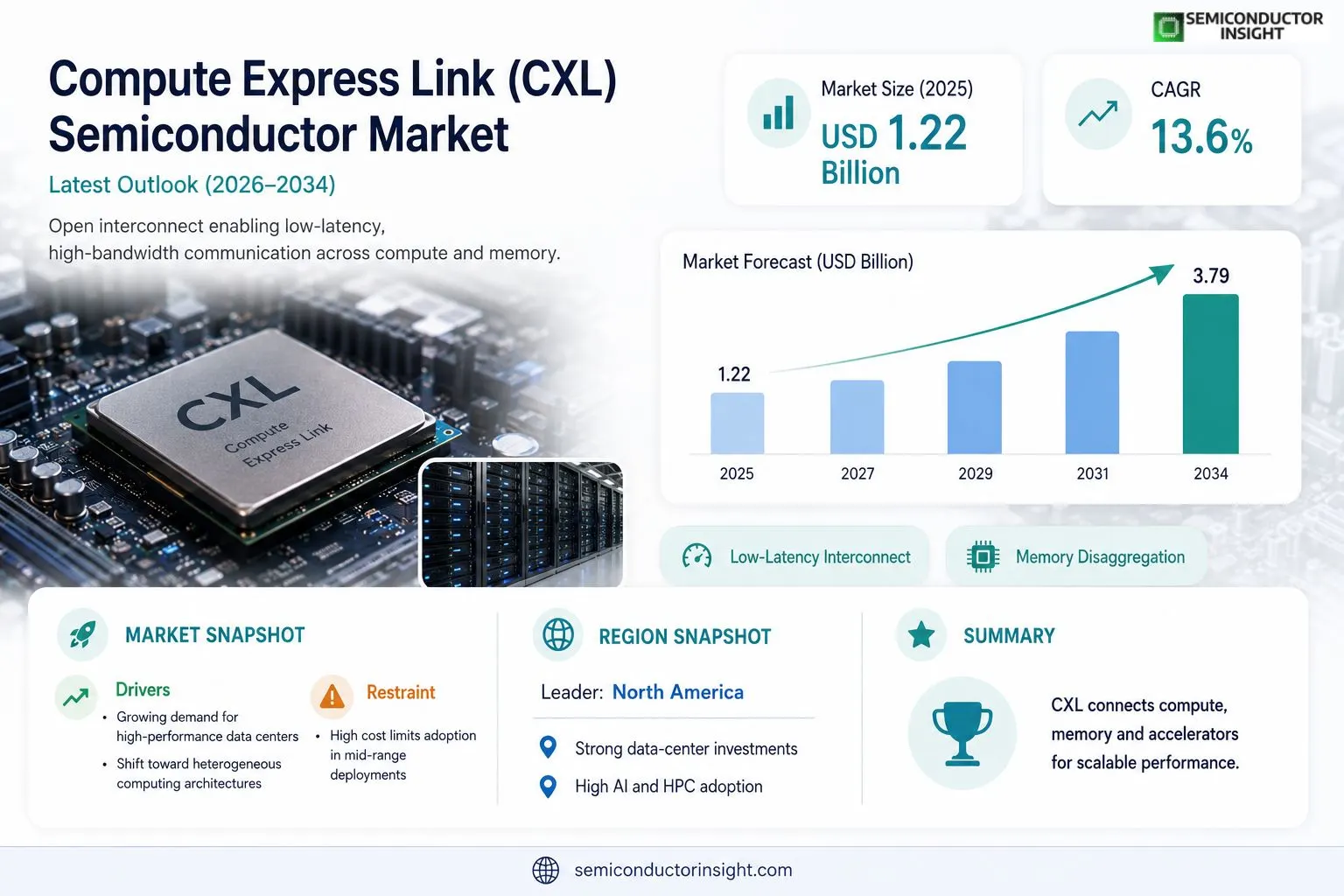
Global Compute Express Link (CXL) semiconductor market size was valued at USD 1.22 billion in 2025. The market is projected to grow from USD 1.34 billion in 2026 to USD 3.79 billion by 2034, exhibiting a CAGR of 13.6% during the forecast period.
Compute Express Link (CXL) is an open‑industry interconnect protocol that facilitates low‑latency, high‑bandwidth communication between CPUs, GPUs, accelerators and memory devices across heterogeneous computing platforms.The market is accelerating because data‑center expansion, AI workload proliferation and demand for memory disaggregation are driving adoption of CXL solutions. Furthermore, strong ecosystem support from leading silicon vendors such as Intel, AMD and Samsung is boosting confidence among system integrators.
MARKET DRIVERS
Growing Demand for High‑Performance Data Centers
The rapid expansion of cloud services and AI workloads is compelling data‑center operators to adopt faster, more scalable interconnect solutions. Compute Express Link (CXL) Semiconductor Market benefits from this trend because CXL enables low‑latency memory sharing and composable infrastructure, which directly supports the performance requirements of modern workloads.
Shift Toward Heterogeneous Computing Architectures
Enterprises are increasingly integrating CPUs, GPUs, FPGAs, and specialized accelerators into unified systems. CXL’s standardized protocol simplifies bandwidth allocation and coherency across these diverse components, making it a preferred choice for designers seeking flexible system scaling without extensive custom engineering.
➤ Adoption of CXL is accelerating as OEMs recognize its role in reducing total cost of ownership while delivering performance parity with legacy PCIe solutions.
Regulatory encouragement for energy‑efficient data‑center designs further amplifies the market’s momentum, as CXL’s efficient data pathways contribute to lower power consumption per compute unit.
MARKET CHALLENGES
Integration Complexity with Legacy Systems
Despite its advantages, CXL requires substantial firmware and software updates to coexist with entrenched PCIe ecosystems. Organizations must invest in validation and compatibility testing, which can delay deployment timelines and inflate project budgets.
Other Challenges
Supply Chain Constraints
The specialized silicon needed for CXL controllers is sourced from a limited number of fabs, creating potential bottlenecks. Fluctuations in manufacturing capacity can affect rollout schedules for new platforms.Furthermore, talent shortages in high‑speed interface design add to the difficulty of implementing CXL solutions at scale, forcing many firms to rely on external consultants or partnerships.
MARKET RESTRAINTS
Cost Sensitivity Across Mid‑Range Deployments
For midsize enterprises, the initial capital outlay for CXL‑enabled hardware can appear prohibitive compared with traditional PCIe options, especially when budget cycles prioritize incremental upgrades over wholesale architectural changes.Additionally, uncertainty around long‑term standard evolution creates hesitation among conservative buyers who prefer proven, stable interconnect technologies.
MARKET OPPORTUNITIES
Emerging Edge‑Computing Deployments
Edge‑focused workloads,such as real‑time analytics, autonomous systems, and 5G infrastructure,require compact, high‑bandwidth solutions. CXL’s ability to pool memory resources across heterogeneous nodes presents a compelling proposition for edge data‑centers, where space and power budgets are limited.Beyond the data‑center, the automotive and industrial IoT sectors are beginning to explore CXL for advanced driver assistance and predictive maintenance platforms, opening new revenue streams for semiconductor vendors specializing in this protocol.
Compute Express Link (CXL) Semiconductor Market Trends
Data‑Center Expansion Drives CXL Adoption
Compute Express Link (CXL) Semiconductor Market is being reshaped by rapid data‑center expansion worldwide. Operators are modernizing infrastructure to support increasingly heterogeneous workloads, and CXL’s low‑latency, high‑bandwidth interconnect protocol offers a practical path to disaggregate memory and accelerate compute resources without redesigning existing server architectures. By enabling direct communication between CPUs, GPUs, accelerators and memory devices, CXL reduces bottlenecks that traditionally limited scaling. This functional flexibility aligns with the industry’s move toward composable infrastructure, where resources can be provisioned on demand, improving overall utilization and total cost of ownership. As a result, system integrators are prioritizing CXL‑compatible silicon in new builds, positioning the market for sustained momentum.
Other Trends
AI Workload Proliferation
Artificial‑intelligence workloads are a catalyst for deeper CXL penetration. Training large language models and inference at edge requires massive data movement between compute engines and high‑speed memory pools. CXL’s coherent memory sharing eliminates the need for redundant data copies, cutting latency and power consumption,critical factors for AI‑intensive services. Vendors are integrating CXL bridges directly into AI accelerators, allowing seamless scaling across multiple nodes while preserving model accuracy. This architectural advantage is prompting cloud providers and enterprise AI teams to adopt CXL as a standard interface for next‑generation AI pipelines, reinforcing the market’s growth trajectory.
Ecosystem Support from Silicon Leaders
Broad endorsement from leading silicon manufacturers such as Intel, AMD and Samsung is solidifying confidence in Compute Express Link (CXL) Semiconductor Market. These companies have incorporated CXL controllers and memory modules into their product roadmaps, fostering a robust ecosystem of compatible devices and development tools. Collaborative standard‑setting bodies are accelerating the release of successive CXL specifications, ensuring backward compatibility and smoother technology transitions. This strong vendor commitment reduces perceived risk for adopters, encouraging early‑stage deployments in both hyperscale and mid‑size data centers. Looking ahead, the convergence of hardware innovation and open‑industry collaboration suggests that CXL will become the de‑facto interconnect for heterogeneous computing platforms.
COMPETITIVE LANDSCAPEKey Industry Players
Compute Express Link (CXL) Semiconductor Market: Navigating a Rapidly Evolving Competitive Ecosystem Driven by AI, Data Center Expansion, and Memory Disaggregation Demands
Global Compute Express Link (CXL) semiconductor market is characterized by intense competition among a diverse mix of established semiconductor giants and specialized emerging players. Intel Corporation holds a foundational position in this landscape, having been a primary architect and promoter of the CXL open-industry interconnect standard, which enables low-latency, high-bandwidth communication between CPUs, GPUs, accelerators, and memory devices across heterogeneous computing platforms. AMD and Samsung Electronics are similarly prominent, lending significant ecosystem credibility and technical momentum to CXL adoption across hyperscale data centers and enterprise infrastructure deployments. The market, valued at USD 1.22 billion in 2025 and projected to reach USD 3.79 billion by 2034 at a CAGR of 13.6%, reflects strong competitive investment in CXL-compatible silicon, memory controllers, retimers, and switching fabrics as system integrators increasingly prioritize memory disaggregation and workload acceleration strategies.Beyond the dominant silicon vendors, a growing cohort of specialized and niche players is actively shaping the CXL semiconductor competitive landscape. Companies such as Micron Technology and SK Hynix are advancing CXL-attached memory solutions targeting AI inference and high-performance computing workloads, while Montage Technology and Rambus are focused on memory interface chipsets and CXL controller intellectual property licensing. Firms including Microchip Technology, Marvell Technology, and Synopsys are contributing retimer silicon, PCIe/CXL switch solutions, and silicon IP cores respectively, enabling broader ecosystem integration. Meanwhile, emerging pure-play CXL specialists such as MemVerge, Astera Labs, and Enfabrica are gaining traction by addressing system-level memory pooling, CXL connectivity silicon, and accelerated networking fabrics tailored for next-generation AI data center architectures.
List of Key Compute Express Link (CXL) Semiconductor Companies Profiled
- Intel Corporation
- Advanced Micro Devices (AMD)
- Samsung Electronics
- Micron Technology
- SK Hynix
- Marvell Technology
- Microchip Technology
- Rambus Inc.
- Montage Technology
- Synopsys, Inc.
- Astera Labs
- MemVerge
- Enfabrica
- Cadence Design Systems
- Xilinx (AMD)
Segment Analysis:
| Segment Category | Sub-Segments | Key Insights |
| By Type |
|
Cache‑Coherent Interconnect is emerging as the dominant type because it:
|
| By Application |
|
Artificial‑Intelligence Accelerators benefit most from CXL because it:
|
| By End User |
|
Cloud Service Providers view CXL as a strategic enabler because it:
|
Regional Analysis: North America
North America
The data center segment represents a primary driver for CXL adoption, as it addresses the increasing demands for efficient data transfer between CPUs, GPUs, and memory. The need for faster and more reliable interconnects is crucial for supporting advanced data analytics and artificial intelligence workloads.
CXL offers a compelling alternative to traditional PCIe, providing enhanced bandwidth and reduced latency, ultimately leading to improved data center performance and energy efficiency.
The rapid growth of artificial intelligence and machine learning is creating an urgent need for high-performance accelerators. CXL’s ability to facilitate seamless data sharing between processors and accelerators makes it an ideal technology for boosting AI/ML performance. The demand for specialized CXL-enabled chips is expected to surge as AI deployments become more pervasive.
This market segment focuses on optimizing compute capabilities for deep learning, natural language processing, and other AI-driven applications.
HPC environments require extremely low latency and high bandwidth for complex simulations and data analysis. CXL is well-suited to meet these demanding requirements, enabling faster communication between processors, memory, and accelerators in HPC systems.
The adoption of CXL in HPC is expected to accelerate as researchers and scientists seek to tackle increasingly complex computational challenges.
CXL introduces new possibilities for memory expansion and pooling, allowing systems to dynamically allocate memory resources as needed. This enhances system performance and efficiency, particularly in scenarios with high memory demands.
The ability to pool memory from multiple devices improves resource utilization and reduces the overall cost of computing infrastructure.
United States
The United States is the leading market within North America for CXL Semiconductor. Driven by a strong emphasis on innovation and a large concentration of technology companies, the country is investing heavily in CXL research and development. Major players like Intel, AMD, and NVIDIA are actively developing CXL-enabled products and solutions. Government initiatives and funding programs are also playing a significant role in accelerating CXL adoption within the US. The robust ecosystem of startups and established technology providers further strengthens the market position of the United States.
The focus in the US market is heavily on integrating CXL into high-end servers and data center infrastructure. The demand for CXL in AI and HPC is substantial and is expected to grow significantly over the next few years.
Canada
Canada represents a smaller but growing market for CXL Semiconductor. With a strong academic research base and a supportive government environment, Canada is attracting investment in CXL technologies. Key players are collaborating with research institutions to develop innovative CXL-based solutions. The focus is on leveraging CXL to enhance the performance of data centers and support emerging AI applications. The Canadian market is expected to witness steady growth in the coming years as CXL adoption expands.
Mexico
Mexico’s CXL Semiconductor market is in its early stages of development. However, with increasing investments in data centers and a growing focus on technological advancements, the market is expected to gain traction. The country’s strategic location and proximity to the US market present opportunities for growth. Key drivers include the expansion of cloud computing services and the increasing demand for high-performance computing solutions.
Report Scope
This market research report provides a comprehensive analysis of the Compute Express Link (CXL) Semiconductor Market , covering the forecast period 2026–2034. It offers detailed insights into market dynamics, technological advancements, competitive landscape, and key trends shaping the industry.
Key focus areas of the report include:
- Market Overview: The report begins with an overview outlining its current market scenario, key growth indicators, and industry transformation drivers. It discusses macroeconomic factors, demand–supply balance, regulatory landscape, and the strategic role of semiconductors in powering advancements across industries such as automotive, telecommunications, consumer electronics, and industrial automation.
- Market Size & Forecast: Historical data and future projections for revenue, unit shipments, and market value across major regions and segments.
- Segmentation Analysis: Detailed breakdown by product type, technology, application, and end-user industry to identify high-growth segments and investment opportunities.
- Regional Insights: Insights into market performance across North America, Europe, Asia-Pacific, Latin America, and the Middle East & Africa, including country-level analysis where relevant.
- Competitive Landscape: Profiles of leading market participants, including their product offerings, R&D focus, manufacturing capacity, pricing strategies, and recent developments such as mergers, acquisitions, and partnerships.
- Technology Trends & Innovation: Assessment of emerging technologies, integration of AI/IoT, semiconductor design trends, fabrication techniques, and evolving industry standards.
- Market Drivers & Restraints: Evaluation of factors driving market growth along with challenges, supply chain constraints, regulatory issues, and market-entry barriers.
- Stakeholder Insights: Insights for component suppliers, OEMs, system integrators, investors, and policymakers regarding the evolving ecosystem and strategic opportunities.
Primary and secondary research methods are employed, including interviews with industry experts, data from verified sources, and real-time market intelligence to ensure the accuracy and reliability of the insights presented.
FREQUENTLY ASKED QUESTIONS:
What is the current market size of Compute Express Link (CXL) Semiconductor Market?
-> Compute Express Link (CXL) Semiconductor Market was valued at USD 1.22 billion in 2025 and is expected to reach USD 3.79 billion by 2034, exhibiting a CAGR of 13.6% during the forecast period.
Which key companies operate in Compute Express Link (CXL) Semiconductor Market?
-> Key players include Intel, AMD, Samsung, NVIDIA, and Marvell, among others.
What are the key growth drivers?
-> Key growth drivers include data‑center expansion, AI workload proliferation, and demand for memory disaggregation.
Which region dominates the market?
-> North America remains the dominant region, while Asia‑Pacific is the fastest‑growing market.
What are the emerging trends?
-> Emerging trends include adoption of CXL 2.0, memory‑centric architectures, and increasing ecosystem collaboration among silicon vendors.
Get Sample Report PDF for Exclusive Insights
Report Sample Includes
- Table of Contents
- List of Tables & Figures
- Charts, Research Methodology, and more...
 Download Sample Report PDF