Key Statistics
Key Takeaways
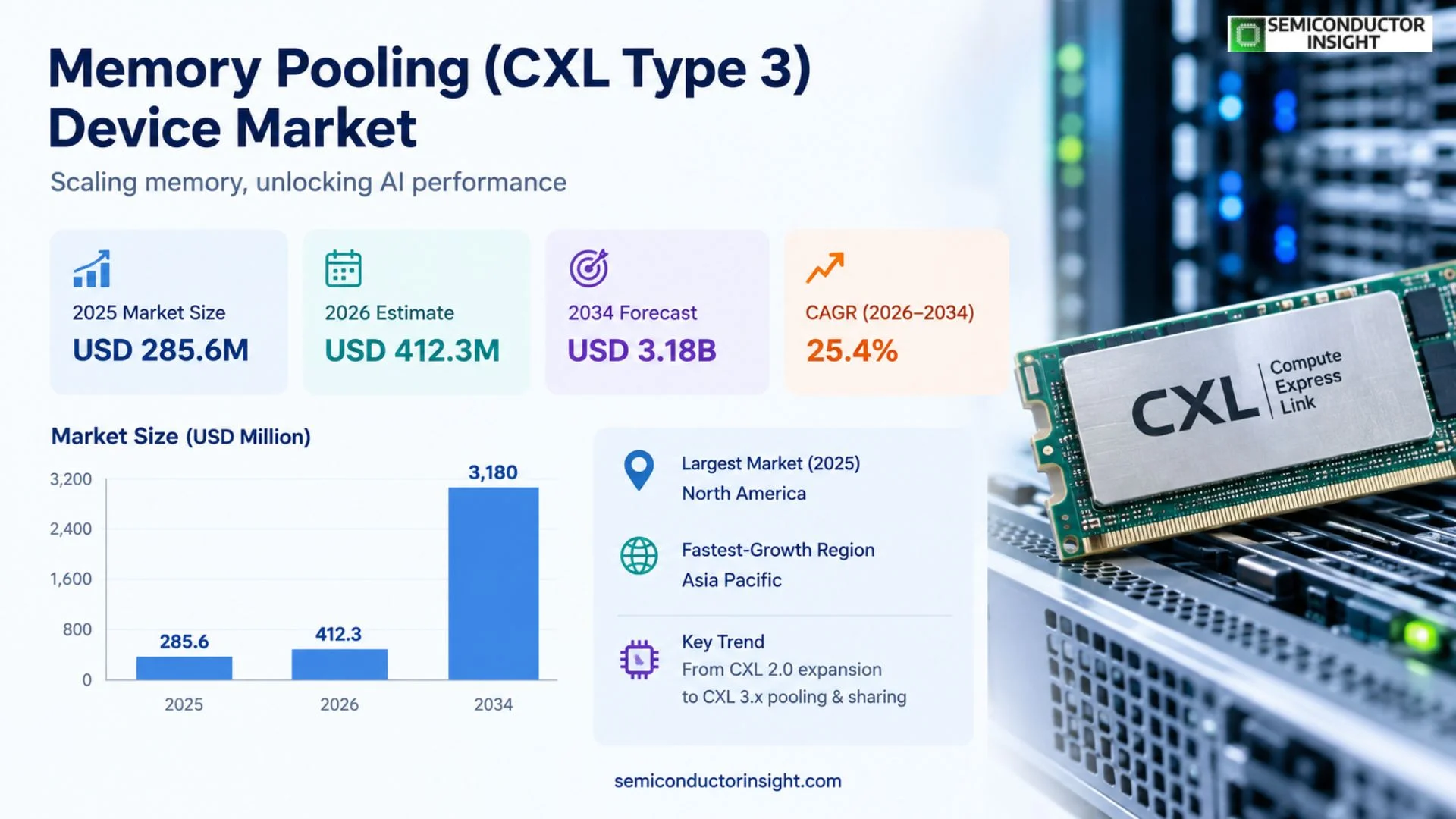
- Market size: The market is valued at USD 285.6 million in 2025 and is projected to reach USD 3.18 billion by 2034, representing a 25.4% CAGR during 2026–2034.
- CXL memory expanders are the dominant near-term product, while semantic switches and fabric-attached architectures expand the market from capacity extension toward true pooled memory.
- North America leads current deployment because hyperscalers, cloud platforms and AI infrastructure vendors are early adopters of composable memory architectures.
- Asia Pacific is the fastest-growth region, supported by Samsung, SK hynix, Taiwanese server manufacturing and the broader memory supply chain.
- CXL 3.2 and PCIe 6 are moving the market toward rack-scale pooling, with new controllers supporting higher bandwidth, dynamic capacity management and memory reuse.
Memory Pooling (CXL Type 3) Device Market Overview
Memory Pooling CXL Type 3 Device Market is valued at USD 285.6 million in 2025 and is projected to reach USD 3.18 billion by 2034, expanding at a 25.4% CAGR during 2026–2034. The 2026 market level is USD 412.3 million. North America leads current commercial deployment, while Asia Pacific is the fastest-growth manufacturing and supply region. AI inference, in-memory databases and memory-constrained enterprise workloads are pushing system designers to decouple memory capacity from individual CPU sockets and use CXL-attached capacity more dynamically.
CXL Type 3 devices provide host-managed memory over the Compute Express Link fabric. The market includes memory expander modules, smart memory controllers, semantic switches and pooled-memory appliances that attach DRAM or other memory media to CXL-capable processors. The value proposition is not simply more capacity: pooling can reduce stranded memory, improve utilization across heterogeneous workloads and allow data-center operators to scale memory independently from compute.
Commercialization is moving from CXL 2.0 memory expansion toward CXL 3.x pooling and sharing. Micron’s CZ120 demonstrated a production-volume CXL 2.0 Type 3 module with up to 256GB capacity, while Astera Labs’ 2026 Leo 2 P-Series targets CXL 3.2 pooling with PCIe 6 connectivity and dynamic capacity management. This progression turns CXL from a single-server expansion technology into a rack-level resource-management layer.
Software remains a critical part of market adoption. Operating systems, hypervisors, memory-tiering frameworks and orchestration software must identify which memory regions can tolerate CXL latency and move data intelligently. The strongest use cases are capacity-bound AI inference, databases, analytics and cloud workloads where additional memory enables larger models or datasets without requiring another CPU socket.
Segment Analysis: By Type
By type, the market is segmented into CXL memory expanders, memory semantic switches, pooled DRAM modules and persistent-memory devices. Memory expanders lead current revenue because they solve an immediate server-capacity problem with relatively simple topology. Switches and pooled modules become more important as operators move toward multi-host fabrics and disaggregated rack architectures.
| Type | Commercial role |
|---|---|
| CXL Memory Expanders | Directly attached Type 3 memory capacity for individual servers; the most production-ready category. |
| Memory Semantic Switches | Fabric devices that route memory-semantic traffic and enable multi-host topologies. |
| Pooled DRAM Modules | Shared DRAM capacity allocated dynamically among multiple hosts or accelerators. |
| Persistent Memory Devices | CXL-attached nonvolatile memory tiers for capacity, checkpointing and specialized data-centric workloads. |
Additional Segmentation: By CXL Specification Version
CXL version determines supported topology, bandwidth and fabric capability. CXL 2.0 established memory expansion and switching foundations, CXL 3.0 added stronger fabric and peer-to-peer capabilities, and CXL 3.1/3.2 extends the architecture for higher-speed platforms and richer memory sharing. Product roadmaps increasingly align with PCIe 6 and rack-scale AI infrastructure.
| CXL Specification Version | Demand characteristics |
|---|---|
| CXL 2.0 | Foundation for production memory expansion modules and early switching deployments. |
| CXL 3.0 | Enables richer fabric topologies and more capable pooling and sharing. |
| CXL 3.1/3.2 & Next Generation | Higher-bandwidth, rack-scale memory architectures paired with PCIe 6 and evolving AI platforms. |
Segment Analysis: By Application
By application, AI and machine learning are the strongest growth segment because KV cache, inference context and model serving can consume very large memory footprints. HPC and in-memory databases also benefit from greater capacity, while general enterprise and cloud infrastructure use CXL to improve server utilization and avoid over-provisioning local DRAM.
| Application | Demand characteristics |
|---|---|
| AI & Machine Learning | KV cache, inference, model serving and memory-tiering for accelerator-rich systems. |
| High-Performance Computing | Large scientific datasets and memory-intensive workloads that exceed local DRAM capacity. |
| In-Memory Databases | Capacity expansion for large databases and analytics without adding another CPU socket. |
| Enterprise & Cloud Infrastructure | Composable servers, memory reuse and improved fleet-level resource utilization. |
Additional Segmentation: By Deployment Architecture
Deployment architecture separates server-attached expansion from fabric-attached pooling and full rack-scale disaggregation. Server-attached expansion is the easiest to deploy because it behaves as an additional memory tier for one host. Fabric-attached and rack-scale architectures deliver greater utilization benefits but require switches, orchestration and stronger interoperability across CPUs, controllers and software.
| Deployment Architecture | Commercial relevance |
|---|---|
| Server-Attached Memory Expansion | Single-host capacity extension using CXL Type 3 memory modules or add-in cards. |
| Fabric-Attached Pooled Memory | Shared memory pools connected through CXL fabrics and semantic switching. |
| Rack-Scale Disaggregated Memory | Composable infrastructure where compute and memory are provisioned independently across racks or pods. |
Regional Analysis
North America leads commercial deployment because hyperscalers, cloud providers and AI infrastructure vendors are early users of memory disaggregation. Asia Pacific is the fastest-growth region because South Korea and Taiwan provide memory, server and semiconductor manufacturing, while China and Japan are investing in advanced computing. Europe remains a smaller but important HPC and enterprise market.
Why does regional demand differ across the Memory Pooling (CXL Type 3) Device market?
CXL value is created where servers are architected and operated, but the physical supply chain is heavily Asian. This produces a two-center market: North America drives hyperscale demand and architecture decisions, while Asia Pacific supplies DRAM, controllers, systems and manufacturing. Regional growth therefore depends on both end-user adoption and the ability of local suppliers to validate interoperability across a rapidly evolving ecosystem.
| Region | Position | Demand profile | Supplier-selection factor |
|---|---|---|---|
| North America | Largest | Hyperscale AI, cloud, databases | Early deployment and ecosystem leadership |
| Asia Pacific | Fastest growth | Memory manufacturing, servers, AI | Supply-chain scale and product integration |
| Europe | Strategic | HPC, enterprise cloud | Standards adoption and system integration |
| South America | Emerging | Cloud and enterprise | Server refresh cycles |
| Middle East & Africa | Emerging | AI data centers, sovereign cloud | Greenfield infrastructure |
Competitive Landscape
Samsung Electronics, SK hynix and Micron bring vertically integrated DRAM supply, while Astera Labs, Xconn, Montage, IntelliProp, Rambus and other controller vendors provide memory connectivity and switching silicon. Competitive advantage depends on interoperability, latency, RAS, security and the ability to qualify products across major CPU, memory and server platforms. For commercial decisions in the Memory Pooling (CXL Type 3) Device market, buyers also weigh qualification evidence, integration effort, operating reliability, lifecycle support, supply continuity and measurable system-level value rather than a single specification.
Astera Labs is moving beyond simple expansion into CXL 3.2 pooling and fabric-attached memory. Its Leo 2 P-Series supports dual-port PCIe 6 connectivity and dynamic capacity management, while the X-Series targets near-GPU memory tiers for agentic AI. This illustrates how value is shifting from a standalone controller toward a broader memory-connectivity platform.
Memory vendors retain an important advantage because they can optimize controller behavior, DRAM media and module qualification together. Micron’s CZ120 is already available in production volume through OEM channels, while Samsung and SK hynix continue CXL memory development. Multi-vendor interoperability remains essential because cloud operators resist architectures that lock memory pools to a single supplier.
| Competitive tier | Representative companies | Primary differentiation |
|---|---|---|
| Integrated memory suppliers | Samsung, SK hynix, Micron | DRAM, modules and hyperscale customer qualification. |
| CXL controller / switch specialists | Astera Labs, Xconn, Montage, IntelliProp | Controllers, semantic switching, pooling and fabric management. |
| Software / ecosystem specialists | MemVerge, Panmnesia, H3 Platform | Memory tiering, pooling software and system integration. |
Key companies profiled
Samsung Electronics, SK hynix, Micron Technology, Astera Labs, Xconn Technologies, MemVerge, Montage Technology, IntelliProp, Panmnesia, Rambus, H3 Platform, SMART Modular Technologies, Marvell and Synopsys are included in the competitive scope. Their roles span memory media, Type 3 controllers, switching, modules, IP and orchestration software. For commercial decisions in the Memory Pooling (CXL Type 3) Device market, buyers also weigh qualification evidence, integration effort, operating reliability, lifecycle support, supply continuity and measurable system-level value rather than a single specification.
Production Capacity Analysis
Capacity depends on controller silicon, DRAM supply, module assembly, server qualification and firmware rather than one manufacturing bottleneck. Type 3 modules use high-value DRAM and advanced PCIe/CXL controllers, so memory pricing and availability materially affect deployment economics. Qualification with CPU and server OEM platforms can also delay revenue even when components are physically available.
Volume scaling improves when products move into standardized server form factors and OEM channels. Micron’s CZ120 reached production-volume availability, while Astera Labs’ newer Leo platforms are sampling with hyperscalers. Broader adoption requires multi-source controllers, validated firmware and enough DRAM supply to support pooled capacity without simply shifting the memory shortage elsewhere.
Market Dynamics
The market is driven by AI memory footprints, cloud utilization and CXL standard maturity. Growth is restrained by latency, interoperability complexity and limited multi-vendor production history. The commercial opportunity is strongest where memory is the constraining resource and utilization varies across servers, because pooling can reduce stranded DRAM and improve accelerator productivity.
Market Drivers
| Driver | Impact | Commercial mechanism |
|---|---|---|
| AI memory demand | High | KV cache and inference workloads require large, flexible capacity. |
| CXL 3.x maturity | High | Newer standards enable true pooling, sharing and fabrics. |
| Cloud utilization | Medium-High | Pooling reduces stranded DRAM across heterogeneous fleets. |
| Server refresh cycle | Medium | PCIe 5/6 and CXL-capable CPUs expand the addressable installed base. |
AI memory demand
Agentic and long-context AI workloads can consume substantial memory outside the accelerator. CXL allows operators to attach additional capacity without adding CPU sockets and can support tiering strategies that keep expensive GPU memory focused on the hottest data. For commercial decisions in the Memory Pooling (CXL Type 3) Device market, buyers also weigh qualification evidence, integration effort, operating reliability, lifecycle support, supply continuity and measurable system-level value rather than a single specification.
CXL 3.x maturity
CXL 2.0 enabled early Type 3 expansion, while CXL 3.x adds richer fabric capabilities. Astera Labs’ 2026 CXL 3.2 products demonstrate the industry’s move toward dual-port pooled memory and rack-scale dynamic capacity management. For commercial decisions in the Memory Pooling (CXL Type 3) Device market, buyers also weigh qualification evidence, integration effort, operating reliability, lifecycle support, supply continuity and measurable system-level value rather than a single specification.
Cloud utilization
Cloud fleets are often provisioned for peak memory per server, leaving unused capacity on many nodes. Shared pools can improve fleet economics if software can allocate memory dynamically and workloads tolerate the added access latency. For commercial decisions in the Memory Pooling (CXL Type 3) Device market, buyers also weigh qualification evidence, integration effort, operating reliability, lifecycle support, supply continuity and measurable system-level value rather than a single specification.
Server refresh cycle
CXL adoption requires compatible processors, firmware and operating-system support. As enterprise and hyperscale fleets move to newer CPU generations, the number of systems capable of using Type 3 devices rises without needing proprietary interconnects. For commercial decisions in the Memory Pooling (CXL Type 3) Device market, buyers also weigh qualification evidence, integration effort, operating reliability, lifecycle support, supply continuity and measurable system-level value rather than a single specification.
Market Restraints
| Restraint | Impact | Commercial consequence |
|---|---|---|
| Latency overhead | High | CXL-attached memory is slower than local DRAM. |
| Interoperability | Medium-High | Controllers, CPUs, switches and software must work together. |
| Limited field history | Medium-High | Large-scale pooling has less operational history than conventional DRAM. |
| Memory cost | Medium | CXL does not remove the need to buy DRAM capacity. |
Latency overhead
Capacity-bound workloads can tolerate a slower tier, but latency-sensitive databases or real-time applications may not. The economic case therefore depends on software placing data intelligently rather than treating pooled memory as identical to local DRAM. For commercial decisions in the Memory Pooling (CXL Type 3) Device market, buyers also weigh qualification evidence, integration effort, operating reliability, lifecycle support, supply continuity and measurable system-level value rather than a single specification.
Interoperability
The CXL ecosystem is broad and still evolving. Multi-vendor deployments require compatibility testing across firmware, operating systems and management tools, increasing qualification time and making hyperscalers the most capable early adopters. For commercial decisions in the Memory Pooling (CXL Type 3) Device market, buyers also weigh qualification evidence, integration effort, operating reliability, lifecycle support, supply continuity and measurable system-level value rather than a single specification.
Limited field history
Enterprise buyers need confidence in RAS, failover, hot-plug behavior and performance under mixed workloads. Production deployments and public cloud previews are reducing uncertainty, but many organizations still treat pooled memory as an emerging architecture. For commercial decisions in the Memory Pooling (CXL Type 3) Device market, buyers also weigh qualification evidence, integration effort, operating reliability, lifecycle support, supply continuity and measurable system-level value rather than a single specification.
Memory cost
Pooling improves utilization but cannot eliminate the cost of the underlying memory. High DRAM prices can strengthen the utilization case while simultaneously raising module cost, complicating deployment decisions. For commercial decisions in the Memory Pooling (CXL Type 3) Device market, buyers also weigh qualification evidence, integration effort, operating reliability, lifecycle support, supply continuity and measurable system-level value rather than a single specification.
Market Opportunities
Rack-scale AI memory
CXL pooling can create a shared memory tier for KV cache and inference, improving accelerator utilization when local memory is limited. For commercial decisions in the Memory Pooling (CXL Type 3) Device market, buyers also weigh qualification evidence, integration effort, operating reliability, lifecycle support, supply continuity and measurable system-level value rather than a single specification.
Memory reuse
New controllers that support both DDR4 and DDR5 can redeploy previously purchased DIMMs into modern cloud servers, lowering infrastructure cost and extending asset life. For commercial decisions in the Memory Pooling (CXL Type 3) Device market, buyers also weigh qualification evidence, integration effort, operating reliability, lifecycle support, supply continuity and measurable system-level value rather than a single specification.
Composable databases
In-memory databases and analytics can consume large shared pools without requiring each server to be provisioned for peak capacity. For commercial decisions in the Memory Pooling (CXL Type 3) Device market, buyers also weigh qualification evidence, integration effort, operating reliability, lifecycle support, supply continuity and measurable system-level value rather than a single specification.
CXL 3.2 switching
Higher-speed fabrics and semantic switches create opportunities for rack-level appliances, management software and pooled memory services beyond individual expansion cards. For commercial decisions in the Memory Pooling (CXL Type 3) Device market, buyers also weigh qualification evidence, integration effort, operating reliability, lifecycle support, supply continuity and measurable system-level value rather than a single specification.
Supply Chain Analysis
Silicon. DRAM suppliers and CXL controller vendors provide the two critical semiconductor inputs. Controllers handle protocol translation, RAS, security and memory management, while the DRAM media determines capacity and bandwidth. Both must be qualified together under server-grade reliability requirements. For commercial decisions in the Memory Pooling (CXL Type 3) Device market, buyers also weigh qualification evidence, integration effort, operating reliability, lifecycle support, supply continuity and measurable system-level value rather than a single specification.
Modules and switches. Controllers are integrated into E3.S modules, add-in cards or pooled-memory appliances with DDR4/DDR5 channels, power delivery and thermal management. Switch silicon becomes necessary as architectures evolve beyond a single host. For commercial decisions in the Memory Pooling (CXL Type 3) Device market, buyers also weigh qualification evidence, integration effort, operating reliability, lifecycle support, supply continuity and measurable system-level value rather than a single specification.
Platform validation. Server OEMs test Type 3 devices with CPUs, BIOS, operating systems and hypervisors. Qualification is extensive because memory errors or instability can affect the entire workload. Interoperability labs and ecosystem programs reduce this friction. For commercial decisions in the Memory Pooling (CXL Type 3) Device market, buyers also weigh qualification evidence, integration effort, operating reliability, lifecycle support, supply continuity and measurable system-level value rather than a single specification.
Deployment. Cloud operators and enterprises use software to classify hot and cold memory, monitor latency and allocate capacity. The highest value comes from orchestrating memory at fleet or rack level rather than simply installing more DIMMs in one server. For commercial decisions in the Memory Pooling (CXL Type 3) Device market, buyers also weigh qualification evidence, integration effort, operating reliability, lifecycle support, supply continuity and measurable system-level value rather than a single specification.
Recent Developments in the Memory Pooling (CXL Type 3) Device Market
Developments tracked through September 2026 and limited to events that materially affect technology, capacity, adoption or competition.
- 15 September 2026
Astera Labs expanded its Leo family with CXL 3.2 Leo 2 E-Series and P-Series controllers. The P-Series targets pooling and sharing across hosts using dual-port PCIe 6 connectivity and dynamic capacity management for disaggregated memory architectures. Source - 18 November 2025
Astera Labs announced that Leo CXL Smart Memory Controllers enable evaluation of CXL-attached memory in Microsoft Azure M-series virtual machine preview, described as the industry’s first announced cloud deployment of CXL-attached memory. Source - 2024–2026 Production Availability
Micron’s CZ120 CXL 2.0 Type 3 memory expansion module reached production-volume availability through OEM channels, providing 128GB and 256GB configurations for AI, databases, HPC and general-purpose compute. Source
Report Scope & Segmentation
| Attribute | Scope |
|---|---|
| Base year | 2025 |
| Estimated year | 2026 |
| Forecast period | 2026–2034 |
| 2025 market size | USD 285.6 million |
| 2026 estimated size | USD 412.3 million |
| 2034 projected size | USD 3.18 billion |
| CAGR (2026–2034) | 25.4% |
| Largest market in 2025 | North America |
| By Type | CXL Memory Expanders; Memory Semantic Switches; Pooled DRAM Modules; Persistent Memory Devices |
| By Application | AI & Machine Learning; High-Performance Computing; In-Memory Databases; Enterprise & Cloud Infrastructure |
| By CXL Specification Version | CXL 2.0; CXL 3.0; CXL 3.1/3.2 & Next Generation |
| By Deployment Architecture | Server-Attached Memory Expansion; Fabric-Attached Pooled Memory; Rack-Scale Disaggregated Memory |
| Companies profiled | Samsung; SK hynix; Micron; Astera Labs; Xconn; MemVerge; Montage; IntelliProp; Panmnesia; Rambus; H3 Platform; SMART Modular; Marvell; Synopsys |
Frequently Asked Questions
What is the Memory Pooling CXL Type 3 Device market size in 2025?
The market is valued at USD 285.6 million in 2025 and is moving from early CXL memory expansion toward pooled and fabric-attached architectures.
What is the market forecast for 2034?
The market is projected to reach USD 3.18 billion by 2034, representing a 25.4% CAGR during 2026–2034. The 2026 market level is USD 412.3 million.
Which region leads the market?
North America leads current deployment because hyperscale cloud and AI infrastructure vendors are early CXL adopters, while Asia Pacific is the fastest-growth supply region.
What is a CXL Type 3 device?
A CXL Type 3 device exposes host-managed memory over CXL, enabling server memory expansion and, with newer fabrics, memory pooling and sharing.
Which product type is largest?
CXL memory expanders are the largest current category because they solve immediate server-capacity limits with relatively simple deployment.
Why is AI important for this market?
AI inference and long-context workloads use large memory footprints for model state and KV cache, making flexible memory tiers economically valuable.
What does CXL 3.2 add?
CXL 3.2 products are appearing with PCIe 6 connectivity, higher bandwidth and more capable pooling or sharing architectures for rack-scale systems.
Who are the main suppliers?
Samsung, SK hynix, Micron, Astera Labs, Xconn, Montage, Rambus and other memory, controller and software vendors shape the ecosystem.
What limits adoption?
Latency, interoperability, limited field history and the cost of underlying DRAM remain the primary constraints.
What will drive growth through 2034?
AI memory demand, cloud composability, server refresh cycles and CXL 3.x pooling architectures will drive rapid expansion.
Research Sources & Evidence Base
View research sources used in this market overview
- Astera Labs – Leo CXL Smart Memory Controllers. CXL 3.2 expansion, pooling, sharing and product roadmap evidence.
- Micron – CZ120 CXL Memory Expansion Module. CXL 2.0 Type 3 product capacities and interface evidence.

Get Sample Report PDF for Exclusive Insights
Report Sample Includes
- Table of Contents
- List of Tables & Figures
- Charts, Research Methodology, and more...
 Download Sample Report PDF