DRAM (DDR4, DDR5, LPDDR5X) Market Insights
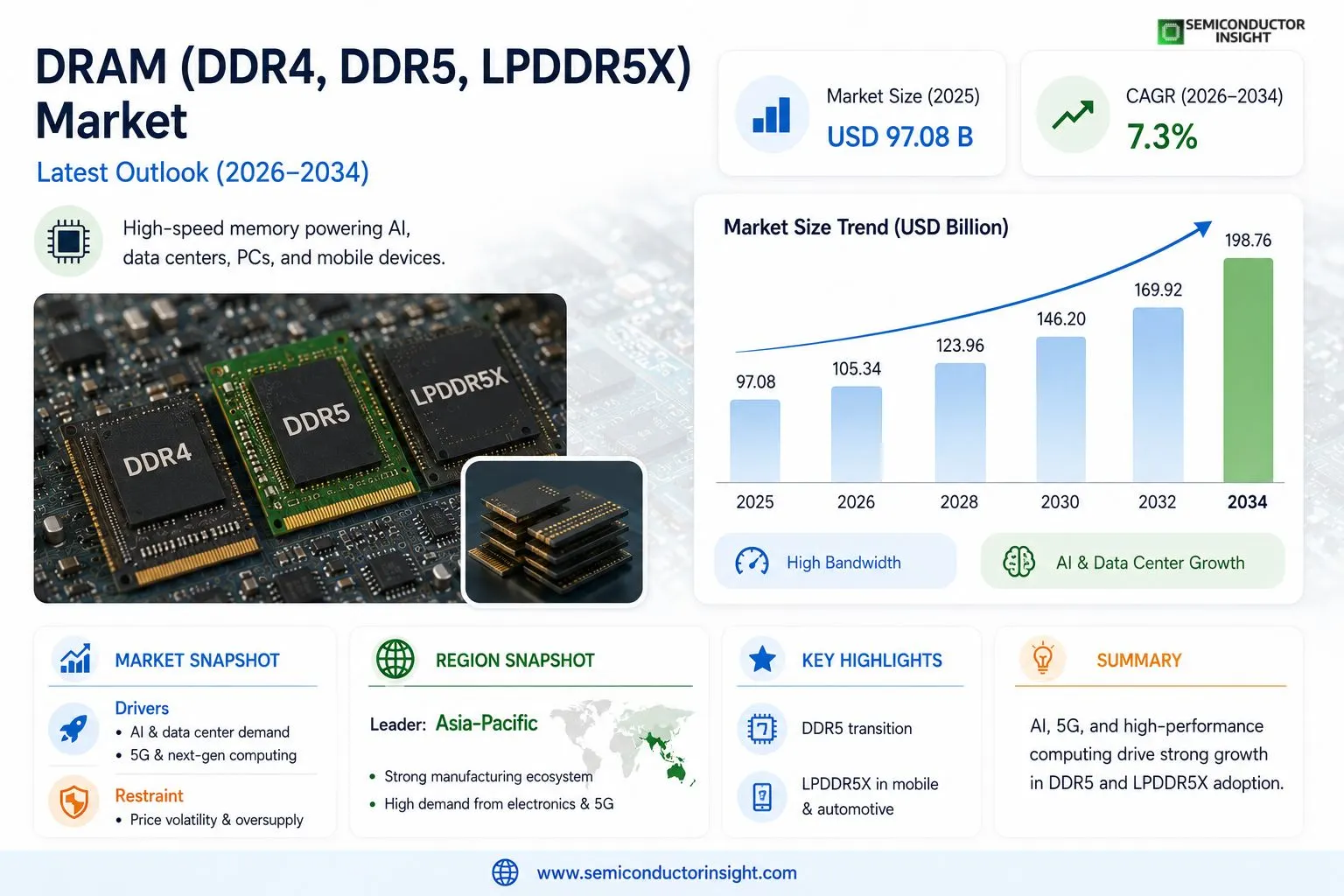
Global DRAM (DDR4, DDR5, LPDDR5X) market size was valued at USD 97.08 billion in 2025. The market is projected to grow from USD 105.34 billion in 2026 to USD 198.76 billion by 2034, exhibiting a CAGR of 7.3% during the forecast period.
DRAM, or Dynamic Random-Access Memory, is a type of semiconductor memory widely used in computing and electronic devices to store data and program code that a processor needs in real time. The market encompasses several key memory generations, including DDR4 (Double Data Rate 4), which remains the dominant standard across mainstream computing applications; DDR5, the next-generation successor offering significantly higher bandwidth and improved power efficiency; and LPDDR5X (Low Power Double Data Rate 5X), optimized for mobile devices, automotive systems, and edge computing applications requiring both high performance and low energy consumption.
The market is experiencing robust growth driven by surging demand for high-performance memory in artificial intelligence infrastructure, data centers, and next-generation consumer electronics. The rapid proliferation of AI-enabled servers and accelerators has substantially elevated memory bandwidth requirements, accelerating the industry-wide transition from DDR4 to DDR5. Furthermore, the expanding adoption of LPDDR5X in flagship smartphones and automotive ADAS platforms is broadening the addressable market. Samsung Electronics, SK Hynix, and Micron Technology are among the key players operating in the market, collectively accounting for the substantial majority of global DRAM supply.
MARKET DRIVERS
Surging Demand from Data Centers and Cloud Infrastructure
The DRAM market, encompassing DDR4, DDR5, and LPDDR5X variants, is experiencing sustained growth driven primarily by the exponential expansion of hyperscale data centers and cloud computing infrastructure worldwide. As enterprises accelerate digital transformation initiatives, the demand for high-bandwidth, low-latency memory solutions has intensified considerably. Hyperscalers such as major cloud service providers are continuously upgrading server architectures to support increasingly memory-intensive workloads, including real-time analytics, in-memory databases, and virtualization platforms. DDR5 modules, with their higher data transfer rates and improved power efficiency compared to DDR4, are becoming the preferred choice for next-generation server deployments, reinforcing adoption momentum across enterprise and cloud segments.
AI and Machine Learning Workloads Accelerating DDR5 and LPDDR5X Adoption
Artificial intelligence and machine learning applications are emerging as among the most significant catalysts for DRAM market growth. Training large language models and running inference workloads require massive memory bandwidth and capacity, creating compelling demand for advanced DDR5 and LPDDR5X solutions. GPU-based AI accelerators increasingly depend on high-speed DRAM modules to prevent memory bottlenecks, and system designers are specifying DDR5 as the baseline standard for AI-optimized servers. In the mobile and edge computing segment, LPDDR5X has gained traction in flagship smartphones and on-device AI processing chips, where its combination of high performance and low power consumption addresses the strict thermal and battery constraints of portable devices. This dual demand from both cloud-scale AI infrastructure and consumer AI-enabled devices is providing a broad and durable foundation for DRAM market expansion.
➤ The accelerating transition from DDR4 to DDR5 architectures across server, client PC, and automotive platforms represents one of the most consequential technology upgrade cycles in the DRAM industry’s recent history, creating sustained volume and pricing tailwinds for leading memory manufacturers.
Beyond AI, the proliferation of 5G-connected devices, autonomous vehicle platforms, and advanced driver-assistance systems (ADAS) is further broadening the addressable market for high-performance DRAM. Automotive-grade LPDDR5X memory is increasingly specified in next-generation vehicles requiring real-time sensor fusion and processing, adding a structurally new and growing demand vertical that reinforces the long-term growth trajectory of the overall DRAM market, including DDR4, DDR5, and LPDDR5X segments.
MARKET CHALLENGES
Cyclical Oversupply and Price Volatility Pressuring DRAM Market Participants
The DRAM market has historically been characterized by pronounced cyclicality, and this structural dynamic continues to pose significant challenges for manufacturers, distributors, and end-users. Periods of aggressive capacity expansion by leading producers can rapidly outpace demand growth, triggering sharp average selling price (ASP) declines that compress margins across the supply chain. The DDR4 segment, in particular, has faced persistent pricing pressure as DDR5 ramp-up draws investment and attention away from mature DDR4 capacity, while DDR4 demand from legacy platforms remains substantial. Balancing production allocation between established DDR4 volumes and the growing DDR5 and LPDDR5X ramps requires disciplined inventory management and accurate demand forecasting, capabilities that have historically proven difficult to sustain across full market cycles.
Other Challenges
Geopolitical and Supply Chain Risks
The DRAM industry is highly concentrated among a small number of global manufacturers, and ongoing geopolitical tensions,particularly those affecting semiconductor trade flows between the United States, China, South Korea, and Taiwan,introduce meaningful supply chain risk. Export control regulations and technology licensing restrictions have the potential to disrupt both raw material sourcing and finished product distribution, adding uncertainty to capacity planning and customer supply commitments across DDR4, DDR5, and LPDDR5X product lines.
High Capital Expenditure Requirements for Advanced Node Migration
Transitioning DRAM production to advanced process nodes required for DDR5 and LPDDR5X manufacturing demands extraordinarily high capital expenditure. Cutting-edge lithography equipment, advanced packaging technologies, and process development investments create substantial financial barriers, particularly for smaller industry participants. The complexity of achieving acceptable yields at advanced nodes also extends development timelines and increases unit production costs during ramp phases, challenging near-term profitability even as long-term demand fundamentals remain constructive for the broader DRAM market.
MARKET RESTRAINTS
Slow Enterprise Transition from DDR4 Creating Near-Term Demand Fragmentation
Despite the clear technical advantages of DDR5 in bandwidth, capacity, and power efficiency, the pace of enterprise adoption has been moderated by platform compatibility constraints and total system upgrade costs. A significant proportion of installed server infrastructure continues to rely on DDR4-compatible platforms, and the cost of simultaneous CPU, motherboard, and memory upgrades creates a meaningful economic barrier for enterprises operating under constrained IT budgets. This installed base inertia is sustaining DDR4 volumes while simultaneously slowing the overall revenue mix shift toward higher-value DDR5 products, creating a period of demand fragmentation that complicates revenue optimization strategies for DRAM manufacturers and constrains the pace of average selling price recovery across the product portfolio.
Competitive Pressure from Emerging Memory Technologies
The DRAM market faces a longer-term structural restraint in the form of emerging alternative memory technologies that are progressively addressing performance and efficiency gaps in specific application segments. High Bandwidth Memory (HBM) has captured a substantial share of AI accelerator memory demand that might otherwise have been addressed by conventional DDR5 configurations, particularly in GPU and custom AI chip platforms. While HBM and DRAM serve largely complementary roles today, continued advancement in processing-in-memory and near-memory computing architectures could gradually displace conventional DDR4 and DDR5 in select high-performance compute applications over the medium term. Additionally, NAND flash-based storage class memory and persistent memory technologies continue to evolve, blurring traditional memory hierarchy boundaries and creating substitution risk at the margin for certain DRAM use cases in enterprise storage and caching applications.
MARKET OPPORTUNITIES
Generative AI Infrastructure Build-Out Driving Unprecedented DDR5 Server Memory Demand
Global build-out of generative AI infrastructure represents a transformational demand opportunity for the DDR5 segment of the DRAM market. As hyperscalers and sovereign AI initiatives deploy large-scale GPU clusters and AI-optimized server farms, per-server DRAM content is increasing substantially relative to traditional compute workloads. DDR5’s higher per-module capacity points and improved channel architecture allow system designers to populate AI servers with significantly more memory, directly expanding the addressable memory content per rack and per data center. This content growth effect, compounded by the accelerating number of AI server deployments globally, positions DDR5 as a primary beneficiary of one of the most significant infrastructure investment cycles in the technology industry’s history.
LPDDR5X Expansion in Mobile AI, Automotive, and Edge Computing Segments
LPDDR5X is well-positioned to capture growing demand across multiple high-growth end markets beyond flagship smartphones. In the automotive sector, the transition toward software-defined vehicles with advanced ADAS and in-cabin AI features is driving specification of automotive-qualified LPDDR5X in centralized compute platforms, creating a durable and margin-accretive demand stream for memory suppliers with automotive-grade qualification capabilities. In edge AI applications,including industrial automation, smart surveillance, and robotics,LPDDR5X’s combination of high bandwidth and low power consumption is enabling deployment of sophisticated inference workloads at the network edge without the thermal and energy constraints of data center DRAM. These diversified growth vectors reduce dependence on traditional smartphone and PC demand cycles, enhancing the structural resilience of the overall DRAM market encompassing DDR4, DDR5, and LPDDR5X product families.
PC Client Refresh Cycle Supported by Windows Platform Transitions
The anticipated PC client refresh cycle, accelerated by end-of-support timelines for legacy operating system versions and the introduction of AI PC platforms requiring DDR5 and LPDDR5X memory, presents a meaningful volume opportunity for DRAM suppliers across both the consumer and commercial segments. AI PCs incorporating dedicated neural processing units (NPUs) are being designed with higher base memory configurations to support on-device AI workloads, increasing average DRAM content per system relative to prior PC generations. As commercial enterprises and individual consumers refresh aging PC fleets, the volume of DDR5 units shipped into the client segment is expected to grow progressively, complementing the server-driven demand narrative and supporting more balanced utilization of global DRAM manufacturing capacity across product generations.
DRAM (DDR4, DDR5, LPDDR5X) Market Trends
Accelerating Transition from DDR4 to DDR5 Driven by AI Infrastructure Demand
DRAM (DDR4, DDR5, LPDDR5X) Market is undergoing a significant generational shift as artificial intelligence infrastructure becomes a primary demand driver. AI-enabled servers and accelerators require substantially higher memory bandwidth than conventional computing workloads, making DDR5’s architectural advantages increasingly critical. While DDR4 continues to hold a dominant share across mainstream computing environments due to its established ecosystem and cost-competitive positioning, enterprise and hyperscale data center operators are progressively adopting DDR5 to meet the elevated throughput requirements of large-scale AI model training and inference. This transition is reshaping procurement cycles across cloud service providers and enterprise IT segments, with DDR5 adoption rates accelerating notably compared to the pace seen during previous memory generation transitions.
Other Trends
LPDDR5X Expansion into Automotive and Mobile Platforms
LPDDR5X is gaining considerable traction beyond its traditional mobile device stronghold. Flagship smartphone manufacturers have broadly integrated LPDDR5X to support on-device AI processing, advanced camera systems, and high-refresh-rate displays. Simultaneously, automotive original equipment manufacturers are incorporating LPDDR5X into advanced driver assistance systems and in-vehicle infotainment platforms, where the combination of high data throughput and low power consumption is essential. This dual-market expansion is meaningfully broadening the addressable application base for LPDDR5X and contributing to a more diversified demand structure within the overall DRAM market.
Supply Consolidation Among Leading Manufacturers
DRAM (DDR4, DDR5, LPDDR5X) Market remains highly concentrated, with Samsung Electronics, SK Hynix, and Micron Technology collectively accounting for the substantial majority of global supply. This oligopolistic structure has significant implications for pricing dynamics, technology roadmap alignment, and capital expenditure cycles. Leading manufacturers are directing substantial investment toward advancing DDR5 and LPDDR5X production capabilities while managing DDR4 output to balance supply with moderating legacy demand. Strategic capacity decisions by these three players continue to exert a decisive influence on global memory pricing and availability.
Data Center and Edge Computing as Emerging Growth Vectors
Beyond traditional consumer electronics, the DRAM market is increasingly shaped by demand from data centers and edge computing deployments. The proliferation of generative AI applications and real-time data processing workloads is driving hyperscale operators to deploy memory-intensive server configurations at an accelerated pace. Concurrently, edge computing infrastructure , spanning industrial automation, telecommunications, and smart city applications , is creating incremental demand for both DDR5 and LPDDR5X solutions optimized for performance under constrained power and thermal budgets. These converging demand vectors are expected to sustain strong growth momentum across DRAM (DDR4, DDR5, LPDDR5X) Market in the coming years.
COMPETITIVE LANDSCAPE
Key Industry Players
DRAM Market Dominated by Oligopolistic Structure Amid Accelerating DDR5 and LPDDR5X Adoption
Global DRAM (DDR4, DDR5, LPDDR5X) market is characterized by a highly concentrated oligopolistic structure, with Samsung Electronics, SK Hynix, and Micron Technology collectively commanding the substantial majority of worldwide DRAM supply. Samsung Electronics maintains its position as the undisputed market leader, leveraging its advanced process node capabilities and vertically integrated manufacturing operations to sustain competitive advantages across DDR4, DDR5, and LPDDR5X product lines. SK Hynix has emerged as a formidable second-place competitor, having secured significant design wins for HBM and DDR5 modules destined for AI accelerator platforms, while Micron Technology rounds out the top tier with a diversified portfolio spanning data center, client, mobile, and automotive memory segments. The accelerating industry-wide migration from DDR4 to DDR5, driven by surging AI infrastructure demand and next-generation server deployments, is intensifying capital investment cycles among all three leading suppliers, raising substantial barriers to entry for potential new market participants.
Beyond the dominant trio, a number of specialized and regional players contribute to the broader DRAM ecosystem across design, packaging, testing, and distribution segments. Nanya Technology and Winbond Electronics, both headquartered in Taiwan, occupy meaningful niches in commodity DDR4 and specialty DRAM segments, particularly for industrial and embedded applications. Powerchip Semiconductor and CXMT (ChangXin Memory Technologies) represent the ongoing push by Chinese manufacturers to develop indigenous DRAM capabilities, with CXMT making notable progress in DDR4 production. On the module and system memory side, companies such as Kingston Technology, Crucial (a Micron brand), ADATA Technology, G.Skill, and Corsair play critical roles in packaging and distributing DRAM solutions to consumer, gaming, and enterprise end markets. The competitive intensity across the DRAM value chain continues to escalate as AI-driven memory bandwidth requirements broaden the addressable market for DDR5 and LPDDR5X through 2034.
List of Key DRAM (DDR4, DDR5, LPDDR5X) Companies Profiled
- Samsung Electronics Co., Ltd.
- SK Hynix Inc.
- Micron Technology, Inc.
- Nanya Technology Corporation
- Winbond Electronics Corporation
- Powerchip Semiconductor Manufacturing Corp.
- ChangXin Memory Technologies, Inc. (CXMT)
- Kingston Technology Company, Inc.
- Crucial (Micron Consumer Products Group)
- ADATA Technology Co., Ltd.
- G.Skill International Enterprise Co., Ltd.
- Corsair Gaming, Inc.
- TeamGroup Inc.
- Transcend Information, Inc.
Segment Analysis:
| Segment Category | Sub-Segments | Key Insights |
| By Type |
|
DDR4 continues to hold a dominant position as the established mainstream memory standard across a broad range of computing platforms, though its leadership is increasingly being challenged by next-generation alternatives.
|
| By Application |
|
Servers and Data Centers represent the most strategically critical and fastest-evolving application segment in the DRAM market, driven by an unprecedented surge in AI infrastructure investment.
|
| By End User |
|
Cloud Service Providers and Hyperscalers have emerged as the dominant end-user group shaping overall DRAM market dynamics, particularly in the transition toward DDR5 adoption.
|
| By Technology Generation |
|
Next Generation (DDR5, LPDDR5X) is the most consequential technology generation segment, attracting the largest share of R&D investment and capacity expansion commitments from leading memory manufacturers.
|
| By Form Factor |
|
RDIMM (Registered DIMM) stands as the leading form factor in the high-value server and enterprise memory segment, owing to its ability to support large memory capacities with enhanced signal integrity and reliability.
|
Regional Analysis: DRAM (DDR4, DDR5, LPDDR5X) Market
Asia-Pacific
Asia-Pacific hosts a deeply integrated DRAM manufacturing ecosystem encompassing raw material suppliers, equipment manufacturers, and advanced packaging specialists. South Korea and Taiwan anchor the high-end DDR5 and LPDDR5X supply chain, while Japan contributes critical materials and precision tooling. This vertical integration provides the region with unmatched cost efficiencies and technological agility, reinforcing its central role in global DRAM production and supply reliability across diverse end-use verticals.
The rapid proliferation of AI infrastructure and hyperscale data centers across China, India, Japan, and Southeast Asia is significantly elevating demand for high-performance DDR5 modules. Cloud service providers and technology conglomerates are upgrading server memory architectures at scale, creating sustained procurement pressure for next-generation DRAM. This trend is expected to remain a primary demand driver for the region throughout the forecast horizon, supporting premium-tier DRAM consumption.
Asia-Pacific dominates global smartphone and consumer electronics manufacturing, making it the largest single consumer of LPDDR5X memory solutions. OEMs in China, South Korea, and India are rapidly incorporating LPDDR5X into flagship and mid-range devices to support AI-on-device capabilities and higher refresh rate displays. The sheer volume of mobile devices shipped annually across the region ensures that LPDDR5X demand remains structurally elevated and continues to grow well beyond 2026.
National semiconductor policies across Asia-Pacific are reshaping DRAM investment flows, with China, India, Japan, and South Korea each implementing targeted incentive frameworks. China’s push for DRAM self-sufficiency is fostering domestic capacity growth, while South Korea and Taiwan continue attracting foreign collaboration for advanced DDR5 nodes. These policy-driven forces are accelerating regional capacity expansion and intensifying competitive dynamics within Global DRAM supply landscape.
North America
North America represents a strategically critical region in Global DRAM (DDR4, DDR5, LPDDR5X) market, primarily driven by its position as a leading consumer of high-performance memory solutions across data centers, defense systems, automotive applications, and enterprise computing. The United States is the epicenter of AI research and hyperscale cloud infrastructure, with major technology firms consistently deploying next-generation DDR5-enabled server platforms at scale. Policy initiatives such as the CHIPS and Science Act have spurred renewed interest in domestic semiconductor manufacturing, potentially reshaping North America’s role from a consumption-led market to one with meaningful production capabilities over the forecast period. The automotive sector, undergoing a profound electrification and autonomous driving transformation, is emerging as a meaningful growth vector for specialized DRAM solutions, particularly ruggedized and thermally resilient memory modules. Academic, research, and high-performance computing institutions further reinforce premium DRAM demand, positioning North America as a high-value, technology-forward regional market through 2034.
Europe
Europe’s DRAM (DDR4, DDR5, LPDDR5X) market is characterized by steady, quality-driven demand across industrial automation, automotive electronics, telecommunications infrastructure, and healthcare technology sectors. Germany, the Netherlands, and France are at the forefront of industrial digitalization, creating consistent procurement needs for robust DDR4 and increasingly DDR5 memory solutions embedded in factory automation systems, edge computing devices, and connected vehicle platforms. The European Chips Act reflects the region’s ambitions to reduce dependency on Asian DRAM supply chains and develop greater semiconductor resilience. Automotive manufacturers across Europe are accelerating adoption of advanced DRAM architectures in ADAS and infotainment systems, aligning with stringent safety and performance requirements. While Europe does not manufacture DRAM at scale, its role as a sophisticated end-market with high regulatory standards and premium application requirements positions it as an important influencer of product specification roadmaps for global DRAM suppliers targeting the 2026–2034 period.
North America (United States Focus)
The United States specifically commands outsized influence in shaping DRAM technology roadmaps through its dominant hyperscale cloud operators, advanced semiconductor design houses, and AI chip developers. Demand for DDR5 and high-bandwidth memory configurations is being driven by GPU-accelerated AI training clusters and inference platforms that require memory subsystems capable of sustaining massive throughput at low latency. Federal investments in domestic semiconductor fabrication are expected to gradually diversify the DRAM supply chain, reducing geopolitical concentration risks. The defense and aerospace sectors maintain specialized DRAM procurement pipelines requiring radiation-hardened and extended-lifecycle memory modules. As AI adoption deepens across enterprise, healthcare, and financial services industries, the United States’ appetite for high-performance DRAM solutions will continue to expand significantly through the forecast horizon.
South America
South America occupies an emerging position in Global DRAM (DDR4, DDR5, LPDDR5X) market, with demand primarily concentrated in Brazil, Argentina, and Chile. The region’s DRAM consumption is largely import-dependent and driven by the expansion of telecommunications networks, growing smartphone penetration, and increasing cloud adoption among enterprises and public institutions. Brazil’s digital transformation agenda and expanding IT infrastructure investments are creating incremental demand for DDR4 and entry-level DDR5 memory modules in server and consumer device applications. While South America currently lacks significant DRAM manufacturing capacity, improving economic conditions and foreign direct investment in technology sectors could stimulate market growth over the forecast period. The region’s younger demographic profile and rising digital literacy are expected to sustain consumer electronics demand, indirectly supporting LPDDR5X procurement through regional smartphone distribution channels aligned with global OEM supply chains.
Middle East & Africa
The Middle East and Africa region presents a nascent yet increasingly relevant landscape for DRAM (DDR4, DDR5, LPDDR5X) Market, underpinned by ambitious digital infrastructure programs, sovereign cloud initiatives, and rapid mobile connectivity expansion. Gulf Cooperation Council nations, particularly Saudi Arabia and the UAE, are heavily investing in data center construction as part of broader Vision 2030-type economic diversification agendas, driving demand for enterprise-grade DDR5 server memory. Africa’s rapidly growing mobile subscriber base is fueling LPDDR5X demand through smartphone adoption, particularly in Nigeria, Kenya, South Africa, and Egypt. While the region remains predominantly a consumer rather than a producer of DRAM, improving financial ecosystems and government-led technology investment programs are gradually elevating the strategic importance of the Middle East and Africa within Global DRAM supply and demand framework through 2034.
Report Scope
This market research report provides a comprehensive analysis of the DRAM (DDR4, DDR5, LPDDR5X) Market , covering the forecast period 2026–2034. It offers detailed insights into market dynamics, technological advancements, competitive landscape, and key trends shaping the industry.
Key focus areas of the report include:
- Market Overview: The report begins with an overview outlining its current market scenario, key growth indicators, and industry transformation drivers. It discusses macroeconomic factors, demand–supply balance, regulatory landscape, and the strategic role of semiconductors in powering advancements across industries such as automotive, telecommunications, consumer electronics, and industrial automation.
- Market Size & Forecast: Historical data and future projections for revenue, unit shipments, and market value across major regions and segments.
- Segmentation Analysis: Detailed breakdown by product type, technology, application, and end-user industry to identify high-growth segments and investment opportunities.
- Regional Insights: Insights into market performance across North America, Europe, Asia-Pacific, Latin America, and the Middle East & Africa, including country-level analysis where relevant.
- Competitive Landscape: Profiles of leading market participants, including their product offerings, R&D focus, manufacturing capacity, pricing strategies, and recent developments such as mergers, acquisitions, and partnerships.
- Technology Trends & Innovation: Assessment of emerging technologies, integration of AI/IoT, semiconductor design trends, fabrication techniques, and evolving industry standards.
- Market Drivers & Restraints: Evaluation of factors driving market growth along with challenges, supply chain constraints, regulatory issues, and market-entry barriers.
- Stakeholder Insights: Insights for component suppliers, OEMs, system integrators, investors, and policymakers regarding the evolving ecosystem and strategic opportunities.
Primary and secondary research methods are employed, including interviews with industry experts, data from verified sources, and real-time market intelligence to ensure the accuracy and reliability of the insights presented.
FREQUENTLY ASKED QUESTIONS:
What is the current market size of DRAM (DDR4, DDR5, LPDDR5X) Market?
-> DRAM (DDR4, DDR5, LPDDR5X) Market was valued at USD 97.08 billion in 2025 and is projected to grow from USD 105.34 billion in 2026 to USD 198.76 billion by 2034, exhibiting a CAGR of 7.3% during the forecast period.
Which key companies operate in DRAM (DDR4, DDR5, LPDDR5X) Market?
-> Key players include Samsung Electronics, SK Hynix, and Micron Technology, among others, collectively accounting for the substantial majority of global DRAM supply.
What are the key growth drivers?
-> Key growth drivers include surging demand for high-performance memory in artificial intelligence infrastructure, data centers, and next-generation consumer electronics. The rapid proliferation of AI-enabled servers and accelerators has substantially elevated memory bandwidth requirements, accelerating the industry-wide transition from DDR4 to DDR5. The expanding adoption of LPDDR5X in flagship smartphones and automotive ADAS platforms is also broadening the addressable market.
Which region dominates the market?
-> Asia-Pacific is a key region in Global DRAM market, driven by the concentration of major semiconductor manufacturers and robust demand from consumer electronics, automotive, and data center sectors across the region.
What are the emerging trends?
-> Emerging trends include the industry-wide transition from DDR4 to DDR5, growing adoption of LPDDR5X in mobile and automotive ADAS platforms, and the integration of high-bandwidth memory solutions in AI-enabled servers and edge computing applications.

Get Sample Report PDF for Exclusive Insights
Report Sample Includes
- Table of Contents
- List of Tables & Figures
- Charts, Research Methodology, and more...
 Download Sample Report PDF