HPC AI Server Market Insights
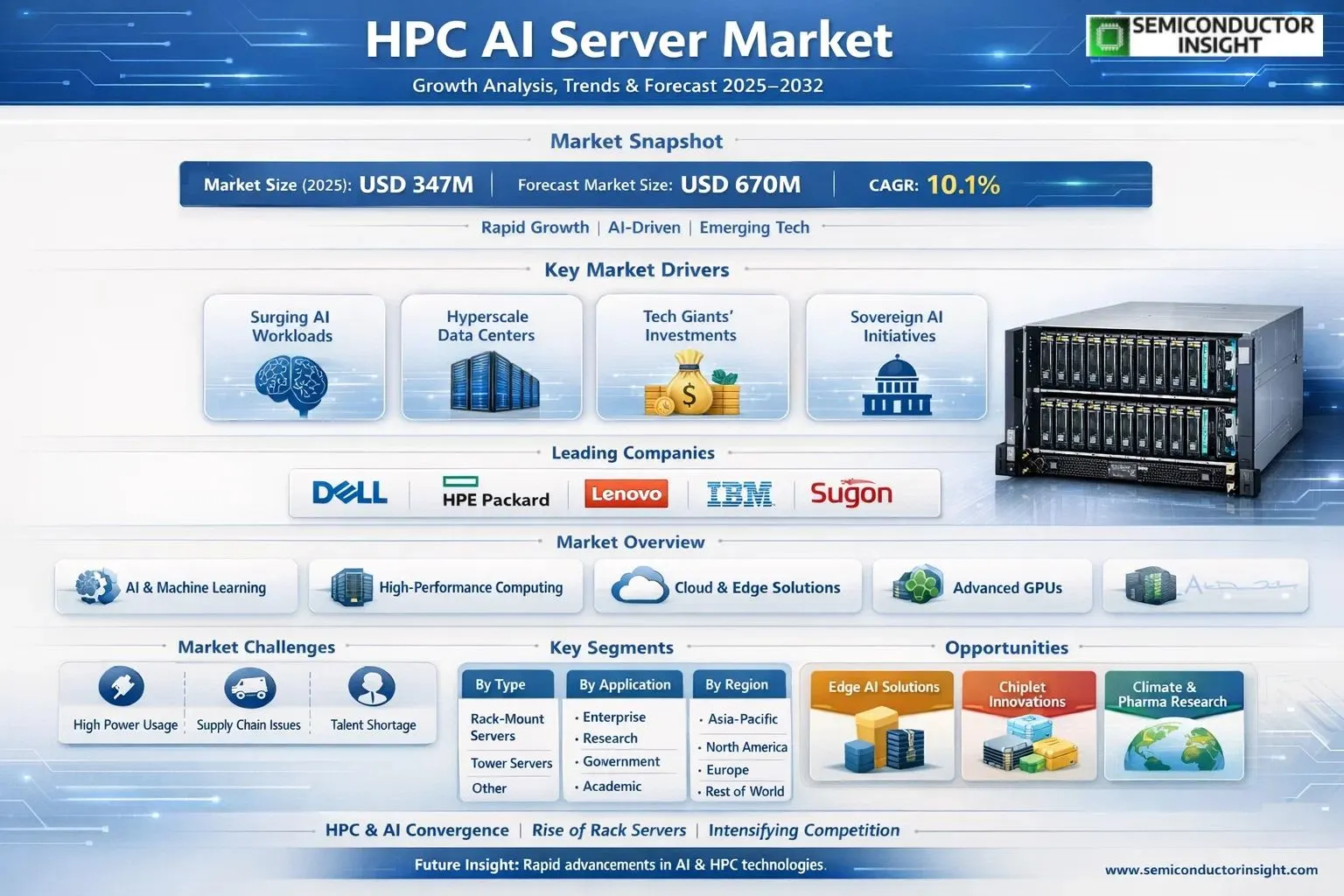
Global HPC AI Server market size was valued at USD 347 million in 2025. The market is projected to grow from USD 347 million in 2025 to USD 670 million by 2032, exhibiting a CAGR of 10.1% during the forecast period.
HPC AI Server, or High Performance Computing (HPC) AI Server, is a high-performance computing server designed specifically for artificial intelligence (AI) applications. It combines the advantages of high-performance computing and artificial intelligence technologies, providing powerful computing and data processing capabilities to meet the needs of AI applications for high-performance computing resources. These servers typically integrate advanced GPUs, high-speed interconnects, and optimized cooling systems to handle massive parallel processing workloads.
The market is experiencing rapid growth due to several factors, including surging demand for training large language models, expanding hyperscale data centers, and rising investments in AI infrastructure by tech giants. Furthermore, advancements in accelerator technologies and the push for sovereign AI capabilities are fueling expansion. Initiatives by key players are accelerating innovation; for example, major vendors continue to launch GPU-dense systems compatible with frameworks like NVIDIA’s CUDA. DELL, HPE, Lenovo, IBM, Sugon, Inspur, Atos, Huawei, Fujitsu, and Penguin Computing are prominent leaders, holding significant market shares with diverse portfolios tailored for enterprise and research needs.
MARKET DRIVERS
Explosive Growth in AI Workloads
HPC AI Server Market is propelled by the escalating demand for processing complex AI and machine learning workloads. Enterprises across sectors like healthcare, finance, and autonomous vehicles require high-performance computing infrastructure capable of handling petabyte-scale datasets. With AI model training times reduced by up to 40% using latest GPU clusters, adoption rates have surged, driving market expansion.
Hyperscaler Investments and Data Center Boom
Major cloud providers are investing over $100 billion annually in data center expansions tailored for AI, boosting HPC AI Server Market. Innovations in liquid-cooled servers and high-bandwidth memory enable efficient scaling for exascale computing, supporting generative AI applications that demand unprecedented parallelism.
➤ Government initiatives in supercomputing, such as Europe’s EuroHPC and U.S. DOE programs, allocate billions to deploy AI-optimized HPC servers, fostering technological sovereignty.
These drivers collectively position HPC AI Server Market for sustained double-digit growth through 2030, underpinned by edge-to-cloud AI deployments.
MARKET CHALLENGES
Power Consumption and Cooling Demands
HPC AI Server Market faces significant hurdles from skyrocketing energy needs, with top-tier AI servers consuming up to 700W per GPU, straining global power grids. Data centers worldwide are projected to account for 8% of electricity use by 2030, necessitating advanced cooling solutions like immersion tech to mitigate overheating risks.
Other Challenges
Supply Chain Disruptions
Semiconductor shortages, exacerbated by geopolitical tensions, delay HPC AI Server deployments by 6-12 months, inflating costs by 20-30% for components like HBM memory and NVLink interconnects.
Talent Shortage
A dearth of experts in parallel computing and AI optimization hampers market maturity, with only 10% of data center staff versed in configuring multi-node HPC clusters for AI workloads.
MARKET RESTRAINTS
High Capital Expenditure Barriers
Prohibitive upfront costs restrict HPC AI Server Market, as a single rack-scale system can exceed $5 million, deterring SMEs despite ROI potential within 2-3 years. Financing models and leasing options are emerging but remain underdeveloped in emerging regions.Evolving standards for interconnect fabrics like InfiniBand and Ethernet create interoperability issues, slowing adoption in hybrid environments and fragmenting HPC AI Server Market ecosystem.Regulatory scrutiny on data privacy and energy usage further constrains expansion, particularly in Europe under GDPR and green mandates targeting data center PUE below 1.2.
MARKET OPPORTUNITIES
Edge AI and Hybrid Deployments
HPC AI Server Market stands to gain from edge computing integration, where compact servers process real-time AI inferences, reducing latency by 50% for applications in smart cities and manufacturing. Hybrid cloud models blending on-prem HPC with public AI services open new revenue streams estimated at $50 billion by 2028.Advancements in chiplet-based architectures and photonic interconnects promise 2x efficiency gains, unlocking opportunities in sustainable HPC AI Server designs that align with net-zero goals.Growing demand from climate modeling and drug discovery accelerates bespoke HPC AI Server innovations, with Asia-Pacific regions poised for 25% CAGR through specialized sovereign cloud builds.
HPC AI Server Market Trends
Convergence of HPC and AI Technologies
HPC AI Server Market is witnessing a profound shift driven by the convergence of high-performance computing and artificial intelligence technologies. These servers, designed specifically for AI workloads, integrate advanced processors and accelerators to handle complex data processing and model training tasks. This trend is fueled by escalating demands from AI applications requiring immense computational power, enabling faster insights and simulations in fields like scientific research and machine learning. Leading manufacturers are prioritizing hardware optimizations to support distributed computing architectures, enhancing scalability for large-scale deployments. As enterprises seek efficient solutions for AI-driven analytics, HPC AI Server Market continues to evolve, bridging traditional HPC capabilities with modern AI paradigms seamlessly.
Other Trends
Shift Toward Rack-Mount Servers
Rack-Mount Servers are emerging as the dominant product type in HPC AI Server Market, favored for their space efficiency and superior cooling in data centers. This segment caters effectively to high-density computing environments essential for AI training and inference. Tower Servers and other types maintain niche roles in smaller-scale or edge deployments, but rack-mount configurations lead due to their adaptability to cloud-hybrid infrastructures. Manufacturers are innovating with modular designs to boost energy efficiency and throughput, aligning with sustainability goals amid rising power consumption concerns in AI operations.
Intensifying Competition and Regional Dynamics
Competition in HPC AI Server Market is heating up with global key players including DELL, HPE, Lenovo, IBM, Sugon, Inspur, Atos, Huawei, Fujitsu, and Penguin shaping the landscape. Top manufacturers are expanding portfolios through strategic developments and partnerships, focusing on customized solutions for diverse applications. In applications, commercial sectors are outpacing academic and government uses, driven by business intelligence and predictive modeling needs. Regionally, Asia, particularly China with firms like Inspur and Huawei, is gaining momentum alongside North America and Europe. This dynamic fosters innovation in server architectures tailored for next-generation AI workloads, positioning HPC AI Server Market for sustained strategic advancements across verticals.
COMPETITIVE LANDSCAPE
Key Industry Players
HPC AI Server Market Leaders and Emerging Challengers
HPC AI Server Market is dominated by established technology giants such as Dell Technologies, Hewlett Packard Enterprise (HPE), and Lenovo, which collectively hold a significant portion of global revenue. These leaders leverage their extensive R&D capabilities, robust supply chains, and integrated ecosystems to deliver high-performance servers optimized for AI workloads, including GPU-accelerated computing and scalable architectures. The market structure remains oligopolistic, with the top five players accounting for a substantial share of the $347 million market in 2025, projected to grow to $670 million by 2032 at a 10.1% CAGR. Their dominance is driven by innovations in rack-mount and tower servers tailored for academic, government, and commercial applications, particularly in North America and Asia-Pacific regions.
Beyond the frontrunners, niche and regional players like Sugon, Inspur, and Huawei are gaining traction, especially in China, where they benefit from local policies and massive data center investments. Companies such as Atos, Fujitsu, Penguin Computing, and NEC contribute specialized HPC solutions, focusing on energy-efficient designs and hybrid cloud integrations for AI training and inference. These players address specific segments like government research and commercial enterprises, fostering competition through recent mergers, product launches, and partnerships. The competitive landscape is intensified by challenges like supply chain disruptions and geopolitical tensions, yet it encourages innovation in high-density computing for AI-driven industries.
List of Key HPC AI Server Companies Profiled
- Dell Technologies
- Hewlett Packard Enterprise (HPE)
- Lenovo
- IBM
- Sugon
- Inspur
- Atos
- Huawei
- Fujitsu
- Penguin Computing
- NEC
- Super Micro Computer
- Cisco Systems
- Asus
- Gigabyte Technology
Segment Analysis:
| Segment Category | Sub-Segments | Key Insights |
| By Type |
|
Rack-Mount Server
|
| By Application |
|
Commercial
|
| By End User |
|
Enterprises
|
| By Deployment Mode |
|
On-Premise
|
| By Processor Type |
|
GPU-Accelerated
|
Regional Analysis: HPC AI Server Market
North America
Innovations in multi-node architectures and NVLink interconnects propel North America’s HPC AI Server Market leadership. Focus on tensor core enhancements accelerates deep learning training, with hybrid CPU-GPU systems dominating deployments.
Dominant firms like NVIDIA and AMD drive the market with specialized AI server platforms. Partnerships with Dell and HPE customize rack-scale solutions, strengthening ecosystem integration for enterprise HPC AI needs.
Hyperscalers pour resources into AI-optimized data centers, prioritizing modular HPC servers. Venture funding targets startups advancing photonic interconnects, fueling long-term growth in HPC AI Server Market.
High energy demands and supply chain dependencies pose hurdles, prompting strategies for sustainable cooling and domestic fabrication. Regulatory pushes for data sovereignty add complexity to cross-border deployments.
Europe
Europe exhibits steady growth in HPC AI Server Market, emphasizing sustainable and regulated deployments. Research institutions leverage EuroHPC initiatives for federated supercomputing, integrating AI servers into green data centers. Stringent energy efficiency standards drive adoption of advanced cooling and low-power processors. Key industries like automotive and pharmaceuticals utilize HPC AI for simulations and drug discovery. Collaborative frameworks across member states enhance interoperability, while business strategies focus on sovereign cloud solutions to comply with GDPR. Expansion of edge HPC infrastructure supports smart manufacturing, positioning Europe as a hub for ethical AI development through 2034.
Asia-Pacific
Asia-Pacific emerges as a dynamic force in HPC AI Server Market, propelled by manufacturing prowess and surging demand from tech giants. Rapid urbanization fuels data center builds in China and India, optimizing for massive AI training clusters. Local firms adapt global technologies for cost-effective HPC solutions, bolstered by government subsidies for digital transformation. Diverse applications span e-commerce, telecom, and smart cities, with business strategies centering on scalable supply chains. Investments in indigenous chip development challenge import reliance, fostering regional self-sufficiency and explosive market expansion into the next decade.
South America
South America shows nascent potential in HPC AI Server Market, hindered by infrastructure gaps but gaining traction through public-private partnerships. Brazil leads with data center investments targeting agrotech and energy sectors, deploying compact HPC AI servers for resource optimization. Economic diversification drives adoption in finance and research, with strategies emphasizing affordable, modular systems. Regional collaborations address connectivity issues, while renewable energy sources align with sustainable server operations. Gradual maturation promises accelerated growth as digital economies evolve by 2034.
Middle East & Africa
The Middle East & Africa region advances in HPC AI Server Market, powered by oil-funded diversification into tech hubs. UAE and Saudi Arabia pioneer sovereign data centers with high-density AI servers for oil exploration and urban planning. Africa benefits from mobile-driven AI, deploying edge HPC solutions for healthcare and agriculture. Business strategies prioritize heat-resistant designs for harsh climates, alongside skill-building programs. Strategic alliances with global vendors accelerate infrastructure, unlocking vast potential for AI-driven innovation through 2034.
Report Scope
This market research report provides a comprehensive analysis of HPC AI Server Market, covering the forecast period 2025–2032. It offers detailed insights into market dynamics, technological advancements, competitive landscape, and key trends shaping the industry.
Key focus areas of the report include:
- Market Overview: The report begins with an overview outlining its current market scenario, key growth indicators, and industry transformation drivers. It discusses macroeconomic factors, demand–supply balance, regulatory landscape, and the strategic role of HPC AI servers in powering advancements across industries such as academic, government, and commercial.
- Market Size & Forecast: Historical data and future projections for revenue, unit shipments, and market value across major regions and segments.
- Segmentation Analysis: Detailed breakdown by product type, technology, application, and end-user industry to identify high-growth segments and investment opportunities.
- Regional Insights: Insights into market performance across North America, Europe, Asia-Pacific, Latin America, and the Middle East & Africa, including country-level analysis where relevant.
- Competitive Landscape: Profiles of leading market participants, including their product offerings, R&D focus, manufacturing capacity, pricing strategies, and recent developments such as mergers, acquisitions, and partnerships.
- Technology Trends & Innovation: Assessment of emerging technologies, integration of AI/IoT, semiconductor design trends, fabrication techniques, and evolving industry standards.
- Market Drivers & Restraints: Evaluation of factors driving market growth along with challenges, supply chain constraints, regulatory issues, and market-entry barriers.
- Stakeholder Insights: Insights for component suppliers, OEMs, system integrators, investors, and policymakers regarding the evolving ecosystem and strategic opportunities.
Primary and secondary research methods are employed, including interviews with industry experts, data from verified sources, and real-time market intelligence to ensure the accuracy and reliability of the insights presented.
FREQUENTLY ASKED QUESTIONS:
What is the current market size of HPC AI Server Market?
-> HPC AI Server Market was valued at USD 347 million in 2025 and is expected to reach USD 670 million by 2032, at a CAGR of 10.1% during the forecast period.
Which key companies operate in HPC AI Server Market?
-> Key players include DELL, HPE, Lenovo, IBM, Sugon, Inspur, Atos, Huawei, Fujitsu, and Penguin, among others.
What are the key growth drivers?
-> Key growth drivers include demand for powerful computing and data processing capabilities for AI applications, advancements in high-performance computing technologies, and expansion in AI adoption across sectors.
Which region dominates the market?
-> Asia is the fastest-growing region, while North America (U.S.) remains a dominant market.
What are the emerging trends?
-> Emerging trends include growth in rack-mount servers, integration of HPC with AI technologies, and innovations in server architectures for AI workloads.

Get Sample Report PDF for Exclusive Insights
Report Sample Includes
- Table of Contents
- List of Tables & Figures
- Charts, Research Methodology, and more...