
CPU Socket Type Connector Market Insights
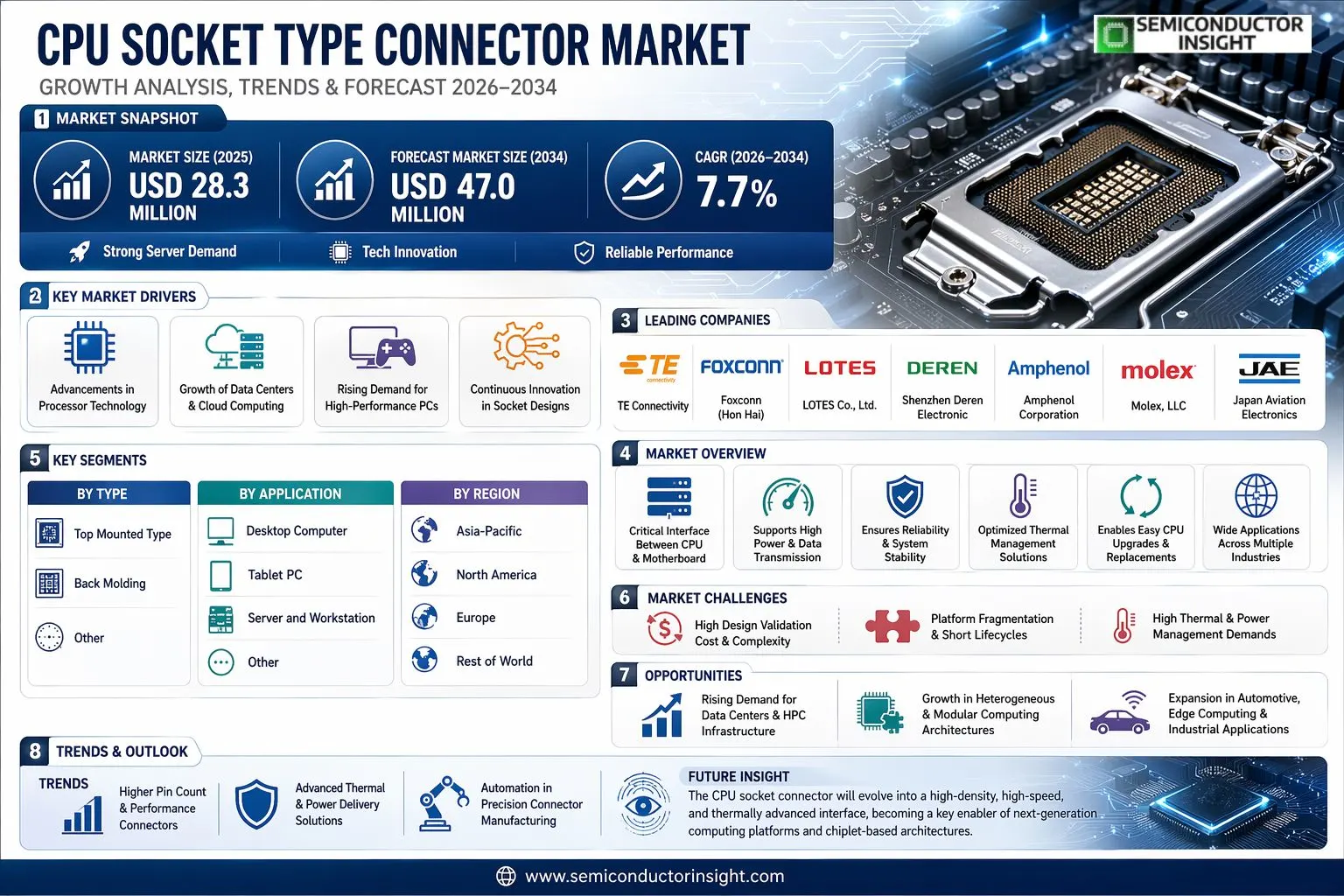
Global CPU socket type connector market size was valued at USD 28.3 million in 2025. The market is projected to grow from USD 30.5 million in 2026 to USD 47 million by 2034, exhibiting a CAGR of 7.7% during the forecast period.
A CPU socket type connector is a critical hardware interface used to connect the processor (CPU) to the motherboard. This component allows users to install, remove, or replace the CPU without soldering it directly onto the motherboard, enabling flexible upgrades and replacements which are essential for both consumer and enterprise computing.
The market growth is primarily driven by continuous advancements in processor technology from leading manufacturers like Intel and AMD, which necessitate new socket designs for each generation. Furthermore, rising demand for high-performance computing in data centers, workstations, and gaming PCs fuels the need for reliable and advanced socket connectors. The server and workstation segment represents a significant growth area due to ongoing global digitalization and cloud infrastructure expansion. Key players such as TE Connectivity, FOXCONN (Hon Hai Precision Industry), LOTES, and Shenzhen Deren Electronic dominate the competitive landscape with extensive portfolios catering to various form factors including Top Mounted Type and Back Molding designs.
MARKET DRIVERS
Continuous Advancement in Microprocessor Technology
The primary engine for CPU Socket Type Connector Market is the relentless pace of innovation in CPU architectures. Each new generation from leading semiconductor designers, such as AMD’s Ryzen and EPYC or Intel’s Core and Xeon families, often necessitates a new physical interface to support increased pin counts for enhanced power delivery, memory channels, and PCIe lanes. This planned obsolescence at the silicon level creates a recurring demand for new motherboard platforms and their corresponding socket connectors, directly driving socket market refresh cycles every two to three years in the consumer and enterprise segments.
Proliferation of Data-Centric Computing and Servers
The exponential growth in data generation, cloud computing, and artificial intelligence has fueled massive investment in data center infrastructure. High-performance servers, which are the backbone of this expansion, rely heavily on robust CPU Socket Type Connector designs to ensure reliable, high-speed signaling between the processor and the motherboard under constant, heavy loads. The shift towards multi-socket platforms for higher core density in servers directly increases the volume of sockets required per system unit, significantly expanding the market’s total available unit volume.
➤ The adoption of Land Grid Array (LGA) sockets, which place pins on the motherboard socket rather than the CPU, has become a dominant standard due to superior durability and higher pin density, catering to the needs of both high-end desktops and mission-critical servers.
Furthermore, the diversification of computing, from traditional PCs to edge computing nodes, gaming consoles, and high-performance workstations, creates multiple specialized tiers within the CPU socket market. Each application demands specific reliability, thermal, and electrical characteristics from the connector, prompting continuous R&D investment and specialized product lines from connector manufacturers.
MARKET CHALLENGES
High Complexity and Cost of Design Validation
Developing a compliant CPU Socket Type Connector is a highly complex engineering challenge. The connector must maintain precise mechanical alignment and electrical continuity for over a thousand pins, with tolerances measured in microns, while withstanding repeated thermal cycling and mechanical stress from CPU installation. Validating performance across parameters like insertion loss, crosstalk, and power integrity requires sophisticated simulation tools and physical testing, leading to extended development cycles and significant non-recurring engineering costs that act as a barrier to entry for new market players.
Other Challenges
Platform Fragmentation and Short Lifecycles
The frequent introduction of incompatible CPU socket designs by leading vendors, such as the transitions from LGA 1700 to LGA 1851, creates supply chain complexity. Manufacturers must manage production for multiple, often short-lived, socket types simultaneously, increasing inventory risks and complicating long-term component forecasting for OEMs.
Thermal Management and Power Delivery Pressures
As CPU TDP ratings push beyond 300 watts in high-performance segments, the socket connector becomes a critical thermal and electrical bottleneck. Designing contacts and substrates that can handle extreme current loads without excessive resistance or heat generation, while also ensuring compatibility with advanced cooling solutions, presents a persistent engineering challenge that increases unit cost.
MARKET RESTRAINTS
Market Consolidation and Vendor Lock-in
CPU Socket Type Connector Market is tightly coupled with the roadmaps of a duopoly in the x86 CPU market. Socket specifications are proprietary and controlled by AMD and Intel, which limits connector manufacturers to a follower role. This dependence constrains innovation at the connector level to parameters set by the CPU designers and creates significant business risk. A strategic shift by a major CPU vendor towards a new packaging technology, such as System-on-Chip (SoC) designs with soldered CPUs or advanced interposers, could potentially reduce or eliminate the need for traditional socket connectors in certain market segments, posing a long-term existential threat.
MARKET OPPORTUNITIES
Growth in Heterogeneous and Modular Computing Architectures
The industry trend towards chiplet-based designs and heterogeneous integration opens new frontiers for advanced interconnect solutions. While challenging the traditional socket, it also creates opportunities for next-generation CPU Socket Type Connectors that can accommodate multi-chip modules or serve as high-density bridges between chiplets and the substrate. Developing sockets capable of handling ultra-high bandwidth die-to-die interconnects like Universal Chiplet Interconnect Express (UCIe) could define the next phase of market growth for connector specialists.
Expansion Beyond Traditional Data Centers
The demand for high-performance computing is expanding into new verticals such as automotive (for autonomous driving systems), aerospace, and specialized industrial automation. These applications require ruggedized, reliable connectors that mirror the performance of data center sockets but are engineered for harsh environmental conditions. This diversification presents a high-margin niche for manufacturers to develop specialized, application-specific variants of CPU socket technology, thereby reducing reliance on the cyclical PC and standard server markets.
CPU Socket Type Connector Market Trends
Demand Shifts Towards Server and High-Performance Computing Applications
Global CPU Socket Type Connector market is experiencing a significant pivot in demand dynamics driven by the expansion of data centers and enterprise computing. As the fundamental hardware interface that enables CPU installation and replacement, the connector market is closely tied to processor deployment trends. The server and workstation application segment is a primary growth catalyst, as hyperscale data centers and high-performance computing clusters require robust, reliable, and upgradeable CPU socket solutions. This contrasts with more mature segments like desktop PCs, where market volumes are stabilizing or declining. The technical specifications for these connectors are evolving towards designs that support next-generation processors with higher pin counts, improved thermal characteristics, and greater signal integrity.
Other Trends
Consolidation Among Top Manufacturers
The competitive landscape of CPU Socket Type Connector Market is characterized by a high concentration among leading manufacturers such as TE, FOXCONN, and LOTES. This consolidation intensifies the focus on innovation, supply chain efficiency, and strategic partnerships with CPU developers. Market analysis indicates these top players leverage vertical integration and substantial R&D to maintain technical dominance, particularly for advanced connector types like top-mounted designs which see strong uptake in specialized applications.
Geographic Market Realignment and Regional Production
A clear trend in CPU Socket Type Connector Market is the realignment of manufacturing and demand centers. While North America remains a key market for high-end server applications, the Asia-Pacific region, led by China, has become a dominant production hub and a rapidly growing consumption market. This shift is influencing global supply chains, pricing strategies, and inventory management practices. The market trend reflects a move towards regionalized procurement models, especially as server OEMs seek to mitigate supply chain risks and reduce lead times for critical motherboard components, including the CPU socket connector.
COMPETITIVE LANDSCAPE
Key Industry Players
Market Consolidation and Technological Specialization Define the Arena
Global CPU Socket Type Connector market is characterized by a high degree of consolidation among a few dominant manufacturers who maintain significant control over core technologies and large-scale production. TE Connectivity (TE) and Foxconn (Hon Hai Precision Industry) are consistently identified as Global leaders, commanding a substantial combined revenue share. Their dominance is built on extensive R&D capabilities, vertical integration, and long-standing partnerships with major CPU and motherboard manufacturers. These players set the de facto standards for socket technologies, such as Intel’s LGA (Land Grid Array) and AMD’s PGA (Pin Grid Array) families, driving innovation in pin counts, power delivery, and thermal management to support next-generation processors for servers, workstations, and high-end desktops.
Beyond the top-tier players, the market features several significant specialized and regional competitors that capture important niches. Companies like LOTES and Shenzhen Deren Electronic compete strongly, particularly in the Asia-Pacific region and within specific segments like mid-range desktop and emerging markets. Other players focus on specialized manufacturing processes, such as advanced back molding techniques for improved durability, or cater to legacy socket support and industrial computing applications. The competitive dynamics are further influenced by the cyclical nature of CPU platform upgrades, which creates periodic demand surges for new socket designs and pressures manufacturers to rapidly scale production while maintaining micron-level precision and reliability.
List of Key CPU Socket Type Connector Companies Profiled
- TE Connectivity
- Foxconn (Hon Hai Precision Industry Co., Ltd.)
- LOTES Co., Ltd.
- Shenzhen Deren Electronic Co., Ltd.
- Amphenol Corporation
- Molex, LLC
- Japan Aviation Electronics Industry, Ltd.
- Shenzhen Kinwong Electronic Co., Ltd.
- APTIV PLC
- J.S.T. Mfg. Co., Ltd.
- Hirose Electric Co., Ltd.
- Yamaichi Electronics
- KEL Corporation
- ERNI Electronics (a TE Connectivity company)
Segment Analysis:
| Segment Category | Sub-Segments | Key Insights |
| By Type |
|
Top Mounted Type is the leading design format, favored for its superior performance attributes in high-power, high-frequency computing environments.
|
| By Application |
|
Server and Workstation applications represent the most demanding and high-value segment, driving innovation and premium socket connector specifications.
|
| By End User |
|
OEMs/ODMs are the primary volume drivers, integrating CPU socket connectors directly into finished motherboards and systems.
|
| By Pin Technology |
|
Land Grid Array (LGA) has become the dominant socket technology, particularly for performance-oriented computing segments.
|
| By Integration Level |
|
Integrated Socket Assemblies are seeing rising demand as they offer a complete, performance-optimized solution for motherboard manufacturers.
|
Regional Analysis: CPU Socket Type Connector Market
Asia-Pacific
The region’s unparalleled concentration of contract electronics manufacturers and component suppliers creates a vertically integrated ecosystem. This proximity drastically shortens time-to-market for new CPU socket type connector designs, as prototyping, testing, and mass production are streamlined within localized networks, responding swiftly to demands from CPU vendors.
Explosive growth in smartphone penetration, gaming PCs, and hyper-scale data center construction across Asia-Pacific generates immense, sustained demand. This drives consistent and large-volume orders for CPU socket connectors, incentivizing local manufacturers to invest in advanced production capabilities and materials science for higher pin counts and improved thermal management.
National policies and subsidies aimed at achieving technological self-sufficiency and leadership in semiconductors and high-tech infrastructure are key catalysts. These initiatives fund domestic research into advanced packaging and interconnect technologies, fostering an environment where innovation in CPU Socket Type Connector Market is prioritized and commercially supported.
Close collaboration between connector manufacturers and major CPU designers and foundries located in the region facilitates co-development. This synergy ensures that new connector specifications for emerging processor architectures, such as server-grade LGA sockets, are developed in tandem, optimizing performance, reliability, and manufacturability from the outset.
North America
North America remains a critical innovation and high-value segment driver for CPU Socket Type Connector Market, anchored by the presence of leading microprocessor designers like Intel and AMD. The market is characterized by advanced R&D activities focused on next-generation connector technologies for enterprise servers, high-performance computing (HPC), and workstation platforms. Demand is highly sophisticated, driven by the need for extreme reliability, signal integrity, and thermal performance in data-intensive applications. The region’s emphasis on early adoption of new CPU architectures creates a premium market for cutting-edge socket designs, such as those supporting increased pin density and advanced power delivery. Strategic partnerships between connector suppliers and OEMs in the aerospace, defense, and automotive sectors further diversify application areas, pushing specifications for ruggedness and longevity.
Europe
The European market for CPU socket connectors exhibits steady demand rooted in its strong industrial and automotive manufacturing base, alongside a growing focus on sovereign cloud and edge computing infrastructure. The region’s stringent regulations on product quality, energy efficiency, and sustainability influence connector design, promoting the use of durable materials and recyclable components. Key demand originates from the automotive industry’s shift towards advanced driver-assistance systems (ADAS) and in-vehicle infotainment, which require specialized, robust connector solutions. Furthermore, significant investments in supercomputing projects under EU initiatives fuel demand for high-end server platforms and their associated interconnect components. European OEMs typically prioritize long-term supply stability and technical precision, fostering strong, collaborative relationships with a select group of specialized connector manufacturers.
South America
The South American market for CPU socket type connectors is in a growth phase, primarily propelled by the expansion of data center infrastructure and increasing PC gaming adoption in urban centers. While not a major manufacturing hub, the region presents a significant consumption market, with imports meeting most local demand. Economic fluctuations can impact the pace of technology refresh cycles in the commercial and consumer segments. Nonetheless, government and private sector investments in digital transformation and telecommunications infrastructure are creating new opportunities. Market dynamics are largely influenced by price sensitivity and the availability of compatible motherboard platforms, with demand skewed towards established, cost-effective connector standards for mainstream computing rather than the latest high-end server sockets.
Middle East & Africa
This region is emerging as a strategic growth area, largely driven by massive investments in smart city projects, telecommunications, and large-scale data center construction, particularly in the Gulf Cooperation Council (GCC) nations. The CPU socket connector market here is defined by project-based demand tied to major infrastructure rollouts, with a focus on reliability and performance in harsh environmental conditions. There is a growing emphasis on building local technology hubs, which may gradually influence supply chain strategies. In other parts of Africa, market growth is more nascent, linked to increasing mobile and internet penetration driving demand for basic computing infrastructure. Overall, the market is characterized by a blend of high-specification demand for flagship projects and volume-driven demand for foundational IT expansion.
Report Scope
This market research report provides a comprehensive analysis of the CPU Socket Type Connector Market , covering the forecast period 2026–2034. It offers detailed insights into market dynamics, technological advancements, competitive landscape, and key trends shaping the industry.
Key focus areas of the report include:
- Market Overview: The report begins with an overview outlining its current market scenario, key growth indicators, and industry transformation drivers. It discusses macroeconomic factors, demand–supply balance, regulatory landscape, and the strategic role of semiconductors in powering advancements across industries such as automotive, telecommunications, consumer electronics, and industrial automation.
- Market Size & Forecast: Historical data and future projections for revenue, unit shipments, and market value across major regions and segments.
- Segmentation Analysis: Detailed breakdown by product type, technology, application, and end-user industry to identify high-growth segments and investment opportunities.
- Regional Insights: Insights into market performance across North America, Europe, Asia-Pacific, Latin America, and the Middle East & Africa, including country-level analysis where relevant.
- Competitive Landscape: Profiles of leading market participants, including their product offerings, R&D focus, manufacturing capacity, pricing strategies, and recent developments such as mergers, acquisitions, and partnerships.
- Technology Trends & Innovation: Assessment of emerging technologies, integration of AI/IoT, semiconductor design trends, fabrication techniques, and evolving industry standards.
- Market Drivers & Restraints: Evaluation of factors driving market growth along with challenges, supply chain constraints, regulatory issues, and market-entry barriers.
- Stakeholder Insights: Insights for component suppliers, OEMs, system integrators, investors, and policymakers regarding the evolving ecosystem and strategic opportunities.
Primary and secondary research methods are employed, including interviews with industry experts, data from verified sources, and real-time market intelligence to ensure the accuracy and reliability of the insights presented.
FREQUENTLY ASKED QUESTIONS:
What is the current market size of CPU Socket Type Connector Market?
-> Global CPU Socket Type Connector Market was valued at USD 28.3 million in 2025 and is projected to reach USD 47 million by 2034, exhibiting a CAGR of 7.7% during the forecast period.
Which key companies operate in CPU Socket Type Connector Market?
-> Key players in Global CPU Socket Type Connector Market include TE, FOXCONN, LOTES, and Shenzhen Deren Electronic, among others. In 2025, Global top five players held a significant revenue share.
What are the key growth drivers?
-> The market growth is driven by the demand for CPU upgradability and replacement in various computing devices, technological advancements in processor and motherboard design, and the expansion of data centers and high-performance computing.
Which region dominates the market?
-> The markets in the U.S. and China are key regions, with specific country-level analyses provided. The report offers detailed regional insights covering North America, Europe, Asia, South America, and the Middle East & Africa.
What are the emerging trends?
-> Segmentation by type (Top Mounted Type, Back Molding, Other) and application (Desktop Computer, Tablet PC, Server and Workstation, Other) highlights emerging high-growth segments and application areas in the market.

Get Sample Report PDF for Exclusive Insights
Report Sample Includes
- Table of Contents
- List of Tables & Figures
- Charts, Research Methodology, and more...
 Download Sample Report PDF


