Key Statistics
Key Takeaways
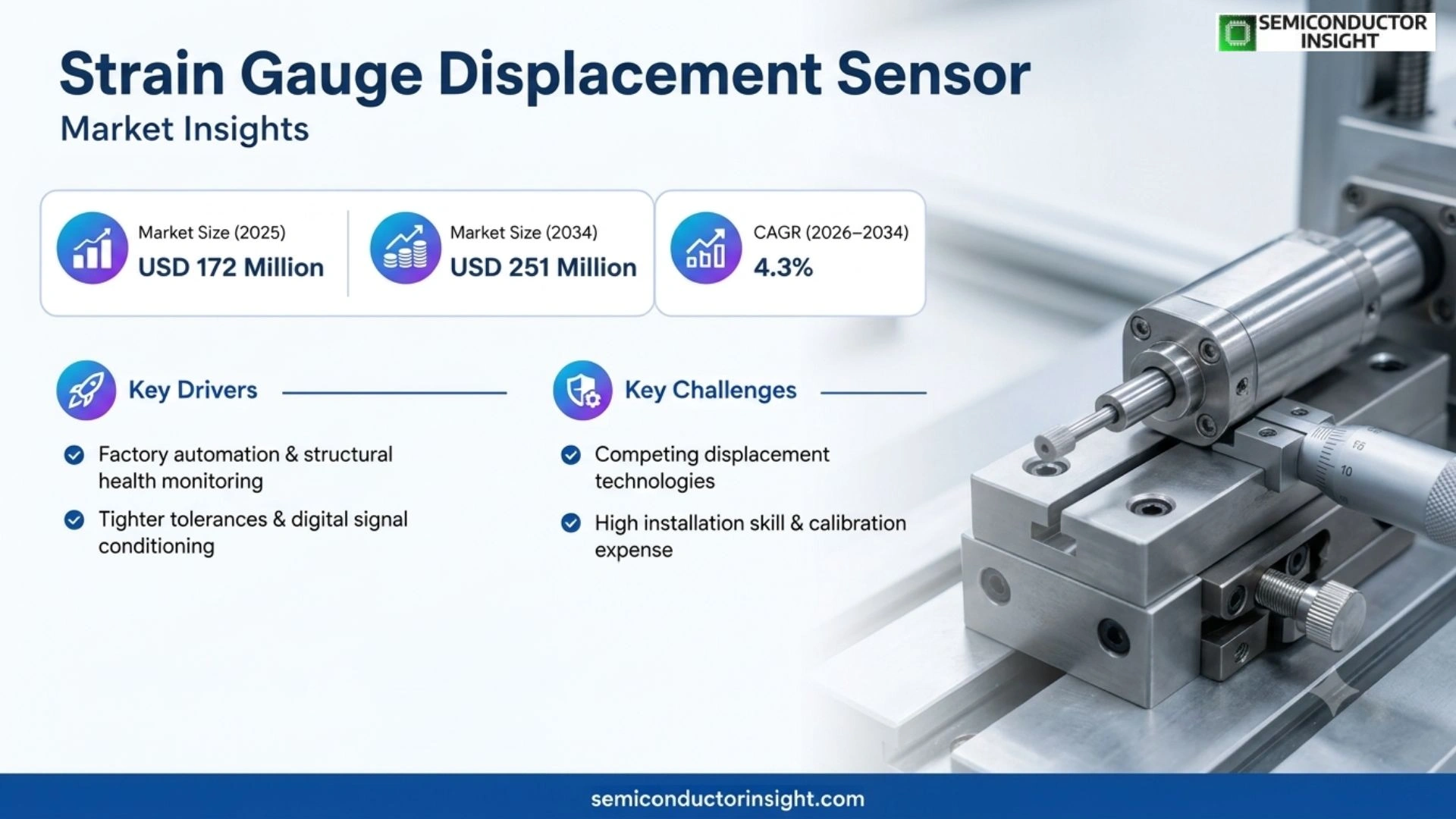
- The market was valued at USD 172 million in 2025 across sensors, signal conditioning and directly integrated measurement assemblies.
- Revenue is forecast to reach USD 251 million by 2034, representing a 4.3% CAGR during 2026–2034.
- Asia Pacific leads demand through machine tools, electronics manufacturing, robotics, infrastructure monitoring and expanding domestic sensor capability.
- Cantilever and spring-loaded designs form the installed base, while digital conditioning, embedded installation and remote structural monitoring provide higher-value growth.
Strain Gauge Displacement Sensor Market Overview
Strain Gauge Displacement Sensor Market covers devices that translate linear or angular movement into resistance change through a bonded or integrated strain-gauge bridge. Valued at USD 172 million in 2025, the market is projected to reach USD 251 million by 2034 at a 4.3% CAGR during 2026–2034. HBK’s displacement portfolio illustrates the established commercial architecture: a mechanically compliant element converts movement into strain, while a Wheatstone bridge and amplifier produce a calibrated electrical signal for test, automation or monitoring systems.
Purchasing decisions are governed by range, linearity, hysteresis, repeatability, temperature effect, fatigue life, environmental sealing and the quality of installation. A nominally accurate transducer can produce poor results when strain transfer, mounting stiffness, cable routing or bridge excitation is uncontrolled. HBK’s strain-measurement guidance therefore treats sensor selection, bonding, wiring and signal conditioning as one measurement chain, which explains why calibration competence and application engineering remain competitive advantages.
Segment Analysis: By Type
Product segmentation reflects the mechanism used to turn movement into strain. Cantilever designs provide high resolution over short ranges, spring-loaded probes simplify contact measurement, draw-wire systems extend range, and lever mechanisms adapt motion in confined setups. Digital and integrated conditioning raises value where customers need local conversion, diagnostics or network connectivity rather than a raw bridge signal.
| Type | Role in the market | Commercial outlook |
|---|---|---|
| Cantilever-type Sensors | A flexure bends in proportion to target motion, creating a stable strain signal over a defined short range. | Largest precision category for laboratory, machine and structural applications where linearity and repeatability justify careful mounting. |
| Spring-loaded Sensors | A plunger maintains contact while internal mechanics transfer movement to a strain-gauged element. | Broad industrial use in inspection, fixtures and automation; commercial strength depends on cycle life, side-load tolerance and replaceable tips. |
| Draw-wire Sensors | A cable and return mechanism convert longer linear travel into measurable strain or force within the transducer. | Useful for construction, lifting and large machinery, although potentiometric, optical and magnetic alternatives create competition. |
| Lever and Embedded Sensors | Mechanical leverage or structural integration adapts small displacement and difficult geometry to the strain element. | Higher engineering content supports custom pricing in aerospace, civil structures, robotics and compact equipment. |
Segment Analysis: By Application
Application value depends on whether displacement is used for closed-loop control, dimensional verification, load-related deformation or long-term structural health. Industrial machinery and weighing systems prioritize rugged repeatability; aerospace and automotive testing require traceable high-frequency evidence; construction needs stable multi-year monitoring; petrochemical and energy installations demand sealing, temperature tolerance and serviceability.
| Application | Purchase logic | Forecast implications |
|---|---|---|
| Industrial Automation and Machine Tools | Sensors verify actuator travel, tool position, press deflection and fixture movement. | The largest repeat-volume application, benefiting from factory upgrades and predictive maintenance but exposed to competing displacement technologies. |
| Construction and Structural Monitoring | Installed sensors track bridge joints, settlement, crack movement and load-induced deformation. | Growth follows infrastructure renewal and continuous monitoring, with installation durability and data continuity more important than unit price. |
| Aerospace and Automotive Testing | Transducers measure component movement during fatigue, crash, propulsion and materials tests. | High-value demand with long qualifications, traceable calibration and harsh-environment requirements. |
| Weighing, Petrochemical and Energy Equipment | Displacement provides secondary evidence for load, pressure, valve, pipeline or rotating-asset behavior. | Steady specialized opportunity where rugged packaging and integration into existing instrumentation determine selection. |
Regional Analysis
Asia Pacific leads through manufacturing scale and expanding automation, while Europe and North America remain important centers for precision metrology, aerospace testing and advanced structural monitoring. South America and Middle East & Africa are project-led markets tied to mining, energy and infrastructure. Across regions, local calibration and application support frequently matter more than the location of final sensor assembly.
North America
North American demand is anchored by aerospace, automotive development, industrial automation, civil engineering and test laboratories. The United States has a large installed base of data-acquisition platforms and calibration services, supporting premium transducers. NIST force and mass metrology reinforces traceability expectations that extend through strain-based measurement chains, especially where test evidence supports safety or certification.
| Country / market | Commercial role | Evidence-led outlook |
|---|---|---|
| United States | Largest regional buyer | Aerospace, machinery, laboratories and infrastructure monitoring sustain demand. |
| Canada | Energy and civil-monitoring niche | Mining, bridges and research create rugged-measurement opportunities. |
| Mexico | Manufacturing integration market | Automotive and appliance plants favor serviceable sensor packages. |
Dated market instances
Europe
Europe combines established sensor manufacturers with automotive, aerospace, wind-energy and structural-engineering customers. Germany, the United Kingdom and France host strong test-and-measurement ecosystems. EURAMET coordinates European metrology cooperation, supporting the traceability culture behind premium displacement and strain measurement. Energy transition and infrastructure renewal create demand, but machinery investment cycles can make orders uneven.
| Country / market | Commercial role | Evidence-led outlook |
|---|---|---|
| Germany | Leading engineering market | Machine tools, vehicles and metrology support advanced transducers. |
| United Kingdom | Aerospace and test expertise | Specialized suppliers and laboratories sustain custom solutions. |
| France | Transport and energy demand | Aerospace, rail and civil projects favor traceable measurement. |
Dated market instances
Asia Pacific
Asia Pacific leads demand because China, Japan, South Korea and Taiwan combine machine-tool, robotics, electronics and automotive production. Japan also has established suppliers such as Kyowa, while China is expanding cost-competitive transducers. India adds infrastructure and industrial automation projects. Buyers range from global OEMs requiring audited calibration to local machinery builders prioritizing price and rapid customization.
| Country / market | Commercial role | Evidence-led outlook |
|---|---|---|
| China | Largest regional volume | Automation, construction and equipment manufacturing support broad demand. |
| Japan | Precision supplier and user base | Robotics, automotive testing and quality culture favor high-performance sensors. |
| India | Emerging infrastructure opportunity | Rail, bridges and manufacturing modernization broaden adoption. |
Dated market instances
South America
Brazil, Chile and Argentina generate targeted demand in mining, hydropower, heavy equipment and civil structures. Harsh sites need corrosion resistance, long cable runs and maintainable instrumentation. Import dependence and currency volatility can delay purchases, so distributors with calibration capability and replacement stock have an advantage. Project-based orders are meaningful but less predictable than recurring factory automation demand.
| Country / market | Commercial role | Evidence-led outlook |
|---|---|---|
| Brazil | Largest regional opportunity | Mining, energy and manufacturing support rugged sensors. |
| Chile | Mining-focused market | Large equipment and structural monitoring create specialized demand. |
| Argentina | Selective industrial demand | Energy and laboratories support project purchases. |
Dated market instances
Middle East & Africa
Gulf construction, oil and gas, desalination and transport projects support demand for rugged displacement sensing. South Africa adds mining and engineering capability, while other African markets depend on infrastructure programs and specialist integrators. High heat, dust, corrosion and limited access raise the importance of sealed packages, remote diagnostics and installation training. Local service coverage is a decisive tender criterion.
| Country / market | Commercial role | Evidence-led outlook |
|---|---|---|
| Saudi Arabia | Large project pipeline | Energy and megaprojects create engineered sensing demand. |
| United Arab Emirates | Infrastructure and laboratory hub | Premium projects favor integrated monitoring systems. |
| South Africa | Mining and engineering base | Asset integrity supports rugged strain-based measurement. |
Dated market instances
Key Strain Gauge Displacement Sensor Manufacturers and Competitive Landscape
Competition includes dedicated displacement-transducer specialists, broad strain-gauge and load-cell manufacturers, data-acquisition vendors and application integrators. The source-page company set is retained in full. Market position depends less on catalog breadth alone than on calibration evidence, mechanical design, signal conditioning, environmental qualification, custom engineering and the ability to support installation over the measurement lifecycle.
| Competitive tier | Companies | Basis of position |
|---|---|---|
| Global metrology leaders | HBK; Kyowa Electronic Instruments; Vishay Precision Group | Deep strain-gauge expertise, calibration infrastructure and global channels. |
| Specialist displacement suppliers | Applied Measurements; Burster; Yangzhou Kedong Electronics; TST; Sensel | Application-specific probes, flexures and custom mechanical packages. |
| Instrumentation and connectivity participants | TE Connectivity; Parker MicroStrain; NI; PCB Piezotronics; Amphenol | Broader sensor, DAQ and industrial integration capabilities. |
Companies covered in the report
- Applied Measurements
- Kyowa Electronic Instruments
- HBK
- Burster
- Yangzhou Kedong Electronics
- TST
- Sensel
- Hottinger Brüel & Kjær
- TE Connectivity
- Parker MicroStrain
- National Instruments
- PCB Piezotronics
- Amphenol
- Vishay Precision Group
HBK and Kyowa are strongly positioned where customers need a complete measurement chain spanning transducer, amplifier, data acquisition and software. Vishay Precision Group brings strain-gauge and precision-sensor depth. Applied Measurements and Burster compete through application engineering and custom transducers. Asian specialists can win price-sensitive equipment programs but must demonstrate repeatability, fatigue life and calibration consistency.
Instrumentation companies influence specifications even when they do not manufacture every mechanical sensor. Compatibility with NI, HBK or industrial control platforms reduces integration cost, while connector and cable suppliers affect noise and environmental reliability. The most defensible vendors provide traceable calibration, mounting guidance, repair or replacement programs and configuration continuity for long-lived machinery and structures.
Measurement Architecture, Calibration and Installation Analysis
A conventional production-capacity review is not the most relevant decision lens for this market. Measurement performance depends on the complete mechanical and electrical installation, not simply on the number of sensors a factory can assemble. This replacement examines range selection, strain transfer, bridge excitation, conditioning, calibration and environmental qualification as the practical constraints on adoption and supplier value.
| Design factor | Qualification requirement | Commercial consequence |
|---|---|---|
| Mechanical architecture | Range, stiffness, contact force, side load and fatigue life | Determines application fit and replacement frequency. |
| Bridge and conditioning | Excitation stability, noise, zero balance and bandwidth | Controls usable resolution and integration cost. |
| Calibration | Traceability, linearity, hysteresis and temperature characterization | Enables audited test and safety-critical use. |
| Installation | Mounting, alignment, bonding, cables and environmental sealing | Often determines field accuracy more than the sensor specification. |
Range and stiffness must match the structure
A sensor selected only by maximum travel can influence the mechanism being measured or become overloaded by side force. Engineers need to evaluate stiffness, contact geometry, dynamic frequency and expected cycles. Proper mechanical modeling and overload protection reduce calibration drift and premature failure, especially in presses, robotics and long-term structural installations.
Calibration must represent operating conditions
Room-temperature static calibration may not describe a sensor exposed to thermal gradients, vibration or long cable runs. Buyers should specify calibration points, direction, dwell time, temperature and electronics. Traceability documents need to cover the assembled channel when amplifiers and digital conversion materially affect results, rather than certifying the mechanical transducer in isolation.
Digital outputs shift maintenance economics
Local conversion, IO-Link and edge amplification can reduce analog noise and expose diagnostic information such as overload, cable faults and temperature. The benefit is strongest across large machine fleets, but digital dependence adds firmware, protocol and cybersecurity requirements. Suppliers that preserve raw measurement access and long configuration support can make the lifecycle case more credible.
Strain Gauge Displacement Sensor Market Dynamics: Drivers, Restraints and Opportunities
Growth is driven by factory automation, structural health monitoring, tighter tolerances and integrated digital conditioning. Restraints include competing displacement technologies, installation skill, calibration expense and price sensitivity. The directional ranges below are scenario estimates intended for planning and are not independent third-party forecasts. The analysis therefore connects technical constraints to procurement, qualification, deployment and long-term service economics instead of treating unit shipments as the only indicator of market strength.
MARKET DRIVERS
Estimated impact of primary growth drivers
| Factor | Directional CAGR impact | Most exposed market | Time horizon |
|---|---|---|---|
| Industrial automation upgrades | +0.8 to +1.3 points | Asia Pacific manufacturing | Medium term |
| Infrastructure monitoring | +0.6 to +1.1 points | Global civil engineering | Medium to long |
| Digital conditioning and diagnostics | +0.4 to +0.8 points | Machine builders | Immediate to medium |
| Aerospace and energy testing | +0.3 to +0.7 points | North America and Europe | Medium term |
Precision automation requires repeatable feedback
Machine tools, presses, robots and fixtures need displacement evidence to maintain quality as tolerances narrow. Strain-gauge devices are attractive where ruggedness, static stability and mechanical customization matter. Demand grows when suppliers package the sensor with conditioning and calibration so equipment builders can qualify one subsystem instead of designing the entire bridge measurement chain.
Infrastructure owners are moving toward continuous monitoring
Bridges, tunnels, dams, rail and wind structures experience small movements that can indicate settlement, fatigue or joint degradation. Embedded or protected displacement sensors support trend analysis between manual inspections. The commercial opportunity depends on long-term stability, replaceable electronics and data continuity because a monitoring system must remain interpretable for years.
Edge diagnostics reduce commissioning and service effort
Smart amplifiers can detect wiring problems, overload and temperature effects while converting analog bridge signals near the sensor. HBK’s IO-Link and digiBOX initiatives show how traditional strain technology is moving into connected industrial architectures. Reduced troubleshooting can justify a higher system price when machines are dispersed or downtime is expensive.
MARKET RESTRAINTS
Estimated impact of primary restraints
| Factor | Directional CAGR impact | Most exposed market | Time horizon |
|---|---|---|---|
| Alternative sensing technologies | -0.7 to -1.1 points | General automation | Immediate |
| Installation and calibration complexity | -0.6 to -1.0 points | New adopters | Medium term |
| Price-sensitive machinery demand | -0.4 to -0.8 points | Emerging markets | Immediate |
| Long qualification cycles | -0.3 to -0.6 points | Aerospace and civil | Long term |
Non-contact sensors compete in clean applications
Optical, laser, inductive, capacitive and magnetic displacement sensors can measure without mechanical contact or strain transfer. They may offer longer life or easier installation in suitable environments. Strain-gauge designs remain competitive where rugged static measurement, force-related deformation or compact custom mechanics matter, but suppliers must prove the total application advantage rather than rely on historical familiarity.
Installation skill limits repeatability
Alignment, surface preparation, mounting torque, cable shielding and temperature compensation can materially change the result. Customers without experienced technicians may prefer plug-and-play alternatives even if the underlying strain method is more accurate. Clear installation kits, training, self-diagnostics and field-calibration services are therefore necessary to convert technical capability into scalable sales.
Traceable accuracy adds lifecycle cost
High-value applications require scheduled calibration, documentation and sometimes removal from service. Spare sensors and interchangeability can reduce downtime, but customized mechanical interfaces complicate replacement. Buyers may defer upgrades when the economic value of better displacement data is unclear. Vendors need to link accuracy to avoided scrap, safer operation or reduced inspection labor.
MARKET OPPORTUNITIES
Embedded sensing in smart structures
Integrating strain-based displacement elements during fabrication can improve protection and measurement geometry. Composite parts, bridge components, wind blades and specialized machinery are candidates. The opportunity requires co-design with OEMs, long validation and a credible replacement or redundancy strategy because embedded sensors may be difficult to service after installation. For commercial planning, this evidence should be read together with qualification requirements, installed-base economics, regional service coverage and the operating consequences of a failed deployment. Decision makers can then distinguish a durable purchasing signal from a short-lived technology announcement while keeping specification, integration and lifecycle risk visible in investment case 19.
Measurement-as-a-service
Suppliers and integrators can combine sensors, data acquisition, calibration and remote analysis under a lifecycle contract. Customers gain predictable performance and fewer internal skills requirements, while vendors create recurring revenue. Service-level agreements should define uptime, uncertainty, recalibration, data ownership and responsibility for diagnosing mechanical versus electronic faults. For commercial planning, this evidence should be read together with qualification requirements, installed-base economics, regional service coverage and the operating consequences of a failed deployment. Decision makers can then distinguish a durable purchasing signal from a short-lived technology announcement while keeping specification, integration and lifecycle risk visible in investment case 20.
Miniaturized digitally conditioned modules
Compact sensors with local amplification and standardized outputs can enter robotic joints, semiconductor equipment and constrained test fixtures. The strongest products will manage temperature, overload and noise without sacrificing traceability. Interoperable interfaces and configuration memory shorten assembly time for OEMs and support automated replacement during field service. For commercial planning, this evidence should be read together with qualification requirements, installed-base economics, regional service coverage and the operating consequences of a failed deployment. Decision makers can then distinguish a durable purchasing signal from a short-lived technology announcement while keeping specification, integration and lifecycle risk visible in investment case 21.
Sensor-to-Decision Metrology Ecosystem Analysis
A generic supply-chain section would understate the relationships that create value. Strain-gauge displacement measurement moves from sensing materials and mechanics through calibration, data acquisition, analytics and maintenance decisions. This replacement ecosystem analysis preserves the required depth while focusing on the interfaces where measurement uncertainty, integration cost and supplier differentiation actually arise.
Sensor manufacturers depend on precision metalworking, gauge materials, adhesives, electronics and connectors, but value is concentrated in design knowledge and calibration rather than commodity inputs. Custom geometry and qualification can create switching costs. Buyers should retain drawings, calibration history and interface definitions so an obsolete product does not force expensive redesign or interrupt a multi-year monitoring record.
The feedback loop from field results to engineering is commercially important. Drift, overload and installation movement can resemble real structural change. Platforms that preserve raw data, diagnostics and calibration metadata allow users to distinguish sensor faults from asset behavior. Vendors with one support path across transducer, amplifier and software can shorten troubleshooting and capture higher service revenue.
Recent Developments in the Strain Gauge Displacement Sensor Market
Developments tracked to September 2026. Entries are dated to their official announcement or publication period.
- November 2025
Source – HBK launched digiBOX, a modular edge amplifier supporting strain gauges and load cells in industrial and wind applications. - August 2025
Source – HBK documented strain measurement on high-load eVTOL rotor development, demonstrating aerospace testing demand. - 2025
Source – HBK highlighted the U93A launch and broader movement toward durable, high-accuracy strain-gauge transducers. - September 2024
Source – HBK acquired Piezocryst, expanding high-precision sensor capability and application reach. - 2024
Source – HBK promoted IO-Link diagnostics for strain-gauge sensors, reinforcing connected measurement architectures.
REPORT SCOPE & SEGMENTATION
| Attribute | Details |
|---|---|
| Category | Sensors > Position and Displacement Measurement > Strain Gauge Displacement Sensors |
| Base Year | 2025 |
| Forecast Period | 2026–2034 |
| Market Size | USD 172 million in 2025; USD 251 million by 2034; 4.3% CAGR during 2026–2034 |
| By Type | Cantilever-type; Spring-loaded; Draw-wire; Lever-type and Embedded |
| By Application | Construction; Industrial Automation; Weighing; Aerospace and Automotive Testing; Petrochemical and Energy |
| By Output | Raw mV/V; Analog Voltage; Analog Current; Digital / IO-Link |
| By Installation | Surface-mounted; Bolt-on; Embedded; Clamp-on; Contact Probe |
| By End User | Equipment Builders; System Integrators; Structural Monitoring Firms; Test Laboratories; Asset Owners |
| Regions | North America; Europe; Asia Pacific; South America; Middle East & Africa |
| Companies | Applied Measurements; Kyowa Electronic Instruments; HBK; Burster; Yangzhou Kedong Electronics; TST; Sensel; Hottinger Brüel & Kjær; TE Connectivity; Parker MicroStrain; National Instruments; PCB Piezotronics; Amphenol; Vishay Precision Group |
Frequently Asked Questions
What is the current size of the strain gauge displacement sensor market?
The global strain gauge displacement sensor market was valued at USD 172 million in 2025. Scope includes cantilever, spring-loaded, draw-wire, lever and embedded displacement transducers that use a strain-gauge bridge, together with conditioning that is directly integrated into the sensor assembly. It excludes general strain gauges sold without a displacement mechanism.
What will the market be worth by 2034?
The market is forecast to reach USD 251 million by 2034, equivalent to a 4.3% CAGR during 2026–2034. Expansion comes from precision automation, structural monitoring, aerospace testing and digital signal conditioning. Growth remains moderate because optical, magnetic, inductive and potentiometric displacement technologies compete strongly in applications that do not require strain-based mechanics.
Which region leads the market?
Asia Pacific is the largest market because it combines high volumes of machine tools, robotics, electronics manufacturing and infrastructure investment with established Japanese suppliers and expanding Chinese production. North America and Europe retain strong value positions in aerospace, calibration, automotive testing and advanced civil monitoring, where traceability and engineering support command premium pricing.
Which product type is most important?
Cantilever-type and spring-loaded sensors form the core installed market. Cantilever designs provide precise short-range response, while spring-loaded probes simplify repetitive contact measurement. Draw-wire products cover longer travel, and embedded or lever mechanisms address custom geometry. Integrated digital conditioning is the most important value shift because it reduces noise and exposes diagnostics.
What are the principal applications?
Applications include machine-tool and robotic position verification, press and fixture deflection, bridge-joint and structural movement, materials and fatigue testing, vehicle and aerospace development, industrial weighing, energy equipment and petrochemical integrity monitoring. The correct sensor depends on range, stiffness, cycle life, environment, bandwidth, traceability and how displacement data will support a control or maintenance decision.
What drives adoption?
Industrial automation, narrower manufacturing tolerances, infrastructure renewal, predictive maintenance and the need for traceable test evidence drive demand. Smart amplifiers and IO-Link make traditional strain-gauge systems easier to integrate and diagnose. Adoption is strongest when improved measurement can be connected to lower scrap, safer operation, avoided manual inspection or faster equipment commissioning.
What restrains the market?
Alternative non-contact technologies, installation skill, calibration cost, temperature effects and long application qualifications restrain growth. A high-specification transducer may still provide poor results if mounted incorrectly or paired with unstable electronics. Customers also hesitate when the financial value of higher accuracy is unclear or when customized mechanical interfaces create future replacement risk.
Which companies are covered?
The report covers Applied Measurements, Kyowa Electronic Instruments, HBK, Burster, Yangzhou Kedong Electronics, TST, Sensel, Hottinger Brüel & Kjær, TE Connectivity, Parker MicroStrain, National Instruments, PCB Piezotronics, Amphenol and Vishay Precision Group. Profiles compare architecture, range, calibration, conditioning, environmental capability, channels and application support. For commercial planning, this evidence should be read together with qualification requirements, installed-base economics, regional service coverage and the operating consequences of a failed deployment. Decision makers can then distinguish a durable purchasing signal from a short-lived technology announcement while keeping specification, integration and lifecycle risk visible in investment case 31.
Why was production-capacity analysis replaced?
Manufacturing volume is not the principal commercial constraint. Accuracy depends on mechanical architecture, bridge electronics, calibration and installation. The report therefore replaces production capacity with Measurement Architecture, Calibration and Installation Analysis. This is more useful for buyers and investors because it explains why similar-looking transducers can deliver materially different field performance and lifecycle cost.
Where are the strongest opportunities?
The strongest opportunities are embedded sensing in smart structures, digitally conditioned miniature modules, managed calibration and measurement services, and structural-monitoring systems that preserve data continuity. Suppliers can differentiate through overload protection, diagnostics, traceability and integration support. Asia Pacific offers volume, while aerospace, energy and infrastructure applications support premium engineered solutions globally.
Get Sample Report PDF for Exclusive Insights
Report Sample Includes
- Table of Contents
- List of Tables & Figures
- Charts, Research Methodology, and more...
 Download Sample Report PDF